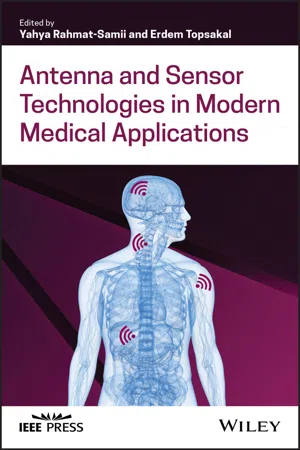
A guide to the theory and recent development in the medical use of antenna technology
Antenna and Sensor Technologies in Modern Medical Applications offers a comprehensive review of the theoretical background, design, and the latest developments in the application of antenna technology. Written by two experts in the field, the book presents the most recent research in the burgeoning field of wireless medical telemetry and sensing that covers both wearable and implantable antenna and sensor technologies.
The authors review the integrated devices that include various types of sensors wired within a wearable garment that can be paired with external devices. The text covers important developments in sensor-integrated clothing that are synonymous with athletic apparel with built-in electronics. Information on implantable devices is also covered. The book explores technologies that utilize both inductive coupling and far field propagation. These include minimally invasive microwave ablation antennas, wireless targeted drug delivery, and much more. This important book:
Covers recent developments in wireless medical telemetry
Reviews the theory and design of in vitro/in vivo testing
Explores emerging technologies in 2D and 3D printing of antenna/sensor fabrication
Includes a chapter with an annotated list of the most comprehensive and important references in the field
Written for students of engineering and antenna and sensor engineers, Antenna and Sensor Technologies in Modern Medical Applications is an essential guide to understanding human body interaction with antennas and sensors.
We strongly believe that when history is looked back a century from now, the twenty-first century will be considered the dawn of convergence of engineering technology and its infusion into modern medical practice. Among various important engineering disciplines, customized antennas and sensors are going to be evaluated as paramount components. This book is the first of its kind in paving the way for helping engineering researchers, medical practitioners, educators, and students to appreciate the importance of the fundamentals and the state-of-the-art developments in antennas and sensors in medical applications. Every chapter of this book is written by well-known researchers in the field, and we, as the editors, thank them for their timely contributions and high-quality production.
This book consists of 14 chapters and an Appendix. We would like to encourage the readers who are not familiar with the topics of this book to first review the appendix, providing a representative literature review of antennas and sensors for medical applications, and then learn about the details of diversified subjects in various chapters of the book. Figure 1.1 shows a pictorial demonstration of chapters and their body-related significance. As can be seen from this figure, the book covers many applications that are relevant to multiple regions of the body varying from implantable to wearable devices.
In Chapter 2, the authors initially introduce some key features of magnetic resonance imaging (MRI). MRI has evolved into one of the most powerful imaging methods since its inception in the 1970s. Clinically, it is regarded as the ultimate imaging method for a wide variety of diseases. MRI has the most distinct feature of effectively differentiating between soft tissues both qualitatively and quantitatively, compared with other imaging methods. The powerful capability of MRI fundamentally depends on the image quality which is characterized by image signal-to-noise ratio (SNR). The ultraflexible 3 Tesla (3T) MRI radio-frequency (RF) coil array presented in Chapter 2 manages to increase the MRI image SNR by a noticeable amount in targeted regions. It utilizes high conductivity and flexible electrotextile designs to closely wrap around the regions of interest. The ultraflexible RF coil array for the neck region is designed to significantly enhance the image quality of carotid artery, which is a key area for stroke being a leading cause of death in the United States. The chapter focuses on the challenges, requirements, and strategies for the design of ultraflexible electrotextile MRI RF coils. This is done by the characterization of several flexible materials and the development of roadmap to guide the design procedure. As a representative example, the neck RF coil array system is designed, prototyped, measured, and integrated into the MRI platform to perform phantom scanning and system-level characterizations. In order to confirm the effectiveness of the ultraflexible RF coil array, cadaver measurements are also conducted to demonstrate the enhanced MRI image quality. The flexible RF coil can be applied to other body areas such as wrist and knee and could potentially be extended to applications such as MRI-guided surgeries.
Figure 1.1 A pictorial demonstration of various chapters and their body-related significance.
Chapter 3 will focus on human motion capture. Capturing motion as an intricate part of human existence can lead to tremendous improvements in our quality of life. Example applications range from health care to sports, gaming, training, and beyond. But what technologies are currently available for motion capture, and what are the associated benefits and limitations? What are the current research trends in the area? And what lies in the future? This chapter is dedicated to answering all these questions. Focus is primarily on wearable sensors for motion capture as attributed to their seamless nature and future potential. Examples include inertial measurement units, bending/deformation sensors, time-of-flight sensors, and received signal strength-based sensors. Nevertheless, several technologies that are relevant to motion capture are also discussed in this chapter (motion capture labs, electromagnetic-based sensors, magnetic motion capture, imaging methods, and more), indicating where wearable sensors find their place. Knowledge of the various available technologies, along with their advantages and limitations, provides guidelines to choose one or combination thereof per application requirements. Although the discussion in this chapter is geared toward human motion, nothing stops the reported technologies from capturing motion of any other moving beings (i.e. animals) and beyond (such as structures).
In Chapter 4, the authors outline the approaches to the electromagnetic optimization of antennas and wireless links for battery-free brain implantable devices where the wireless powering and data transmission are based on inductive coupling, far-field radiation, and platforms integrating both approaches. Progress in brain research has brought compelling approaches to managing neurological illnesses. In neurorehabilitation, bidirectional neural interfaces enabling mind control of prosthetics and assistive devices as well as versatile research platform. Deep brain stimulators have become available for the management of movement disorders, such as tremors in Parkinson’s disease. In the experimental neuroscience, optogenetic methods are providing a powerful new research tool, and advances have been made toward optoelectronics methods for potential local cerebral tissue oxygenation monitoring. Apart from neurophysiological applications, new methods for the long-term monitoring of intracranial pressure (ICP) hold the potential for home monitoring for improving the safety of people predisposed to the elevation of ICP and becoming a research tool for cerebrospinal fluid research. In terms of medical technology, the enabling parts for all systems involving long-term brain implantable devices are antennas that must be small and flexible enough to be fully cranially concealed and function based on energy transmitted from an external source rather than relying on batteries. This technology will empower novel means to research in in vivo animal models and long-term implantable medical devices for humans alike. To demonstrate the research, the authors present three different wireless systems developed in our research group that rely on each of the three electromagnetic modalities.
Chapter 5 discusses tools and techniques for in vitro and in vivo testing of implantable antennas as well as the common materials used for fabricating them. Various factors go into the design of an implantable antenna, including the materials for the substrate and radiating element. Historically used materials for antennas (e.g. copper) can pose health effects with prolonged exposure, requiring either biocompatible encapsulation or biocompatible conductors. After the antenna is designed to operate within the body, bench testing is required to validate performance. One method is to test the antenna using ex vivo tissues; however, this method requires immediate testing of the antenna due to the decay of the tissues after extraction. As a result, this chapter presents the mixture and characterization of in vitro tissue-mimicking gels (for the dielectric properties of human skin, adipose, and muscle) to validate antenna performance. Tissue-mimicking gels have shelf, if refrigerated, life greater than three weeks. While in vitro testing provides a necessary step in the development of implantable antennas, it still remains lacking in some aspects. For example, tissue-mimicking gels only replicate the dielectric properties of human tissues, not the thermal or biological properties. In vivo, Latin for “in the living,” testing is the next step after in vitro. A major difference between the two testing methodologies is the presence of an immune system, which seeks to encapsulate and expel foreign objects. Due to this, in vivo measurements are necessary for long-term studies for antenna performance and biological effects. Additionally, in vivo models are dynamic systems where dielectric properties can change with temperature and time. This chapter explores how the dielectric properties of three animal models change with temperature and age, and how implanted antennas are tested in vivo.
In Chapter 6, the focus is ingestible devices. The localization of ingestible (swallowable) biomedical devices is crucial for accurate diagnosis. Over the past decades, a variety of approaches have been proposed to increase the localization accuracy. However, localizing ingestible devices is very challenging by considering the complexity of the in-body environment. Focusing on wireless capsule endoscopy, various solutions for localizing ingestible devices are analyzed in this chapter. Firstly, the chapter starts from introducing various localization approaches, and performance comparisons are made in terms of positioning accuracy, system complexity, power consumption, and device size. Secondly, considering the unique requirements of wireless capsule endoscopy, the magnetic localization method is focused and analyzed. The research progress of the magnetic localization for wireless capsule endoscopy is introduced and analyzed. Two types of magnetic localization, static magnetic localization and inductive magnetic localization, are introduced in detail from the basic theory to the possible solutions for realization challenges. Thirdly, the performance comparison of each solution with different system configurations and position retrieval algorithms are discussed. An innovative method of combining the wireless charging and wireless positioning within the same hardware system is also introduced. The chapter concludes at the end that the selection of different solutions depends on different application scenarios.
Chapter 7 addresses the UWB channel characteristics for an application of transplanted liver monitoring after an operation using liver-implanted wireless devices in an example case scenario. The chapter presents quantitative information such as path loss models under various circumstances for two typical in-body communication scenarios, i.e. in-body to on-body and in-body to off-body, as well as assesses the system performance. Initially, simplified human equivalent multilayer semisolid phantoms were used in measurement and simulation studies. To gain the first approximation on liver-implanted channel characteristics and to confirm the feasibility of the wireless communications from the liver to the skin surface, channel characteristics in the frequency domain are discussed and analyzed. Thereafter, numerical studies on the characteristics of liver-implanted channel were done by means of simulations using digital human models. Accordingly, path loss data and path loss models are presented and discussed. Consequently, the evaluations of system performance are carried out by the approach of link budget analysis. The chapter also deals with the possibility of UWB communications for the liver-implanted channel considering the safety standard based on the FCC regulations of UWB transmission power and ICNIRP guidelines. These results demonstrated that it is feasible to achieve a reliable wireless communication link using UWB technology for the liver-implanted scenarios. The results can be used as guidelines for the analysis of in-body applications using wireless implant devices such as medical telemetry for not only the liver area but also other implant locations.
In Chapter 8, the authors describe an in-depth operation of inductive power transfer for the biomedical applications. The inductive wireless power transfer technique has been successfully applied to transmit power to commercial prosthetic systems, such as the artificial retina. The chapter describes the existing conventional techniques and focuses mainly on the multicoil approach to the system design. The chapter covers the design procedure of the traditional two- and three-coil systems and the advantages offered by the proposed circuit techniques. The reflected impedance concepts explain the operation and simplify the system design parameters such as efficiency, power delivery, and power factor of a wireless power and data transmission system. The proposed coil design technique enhances efficiency and operational tolerance and simplifies the coil design and data transmission capabilities.
Chapter 9 is devoted to precision wireless drug delivery. Precision medicine technology is an emerging facet of therapeutic regimen that is conducive for treating chronic ailments due to its ability to concentrate high drug potency at the targeted tumors as compared to traditional systemic administration. The recent developments in microchip and micromachined technology have leveraged the fabrication of miniaturized transdermal and implantable devices for delivering drugs in the human body. Profuse research is still in progress to devise an optimum drug delivery device that can be wirelessly triggered for releasing encapsulated drug compounds according to prescribed dosing schedule. Apart from drug release actuation, wireless systems of a drug delivery device are useful for wireless power transfer and data telemetry with an external interrogator. In addition, an embedded wireless system of a device provides patients and physicians the control on release mechanism for personalized drug delivery. This chapter recapitulates the state-of-the-art multifaceted drug delivery devices and discusses about imperative requirements for manifesting wireless power transfer, data telemetry, and user control on the release mechanism. The main emphasis is on wirelessly controlled devices that exhibit release mechanisms that can triggered wirelessly, enabling drug spouting from the device toward the targeted organ location in the human body. We have also delineated a wide ensemble of integrated components for drug delivery applications, such as microchips, microvalves, micropumps, and microrobots. Apart from integrated components, a wide assortment of nanomaterials-mediated drug delivery and the fabrication of RF-sensitive microcontainers have also been discussed in this chapter.
In Chapter 10, the authors discuss the recent advances in minimally invasive microwave ablation antenna designs. The emphasis is placed on a growing trend in miniaturization of interstitial antennas to reduce the invasiveness and increase the flexibility of the treatment. The effort toward length reduction for interstitial antennas is highlighted by a number of studies investigating the use of higher frequency microwaves for tissue ablation. Additionally, various novel microwave ablation antenna designs with reduced-diameter topologies, compared to conventional coax-fed, balun-equipped antennas, are presented. These innovative designs are classified into two general groups: one group represents solutions that target less-invasive implementations of coaxial baluns, and the other involves novel balun-free antenna designs that provide localized heating patterns. Moreover, this chapter also presents the authors’ own effort in developing flexible antennas as well as directional-heating antennas, which are aime...
Table of contents
Cover
Table of Contents
Title Page
Copyright
Dedication
List of Contributors
1 Introduction
2 Ultraflexible Electrotextile Magnetic Resonance Imaging (MRI) Radio‐Frequency Coils
3 Wearable Sensors for Motion Capture
4 Antennas and Wireless Power Transfer for Brain‐Implantable Sensors
5 In Vitro and In Vivo Testing of Implantable Antennas
6 Wireless Localization for a Capsule Endoscopy: Techniques and Solutions
7 Study on Channel Characteristics and Performance of Liver‐Implanted Wireless Communications
8 High‐Efficiency Multicoil Wireless Power and Data Transfer for Biomedical Implants and Neuroprosthetics
9 Wireless Drug Delivery Devices
10 Minimally Invasive Microwave Ablation Antennas
11 Inkjet‐/3D‐/4D‐Printed Nanotechnology‐Enabled Radar, Sensing, and RFID Modules for Internet of Things, “Smart Skin,” and “Zero Power” Medical Applications
12 High‐Density Electronic Integration for Wearable Sensing
13 Coupling‐Independent Sensing Systems with Fully Passive Sensors
14 Wireless and Wearable Biomarker Analysis
1 1Antennas and Sensors for Medical Applications: A Representative Literature Review
Index
End User License Agreement
Trusted by 375,005 students
Access to over 1.5 million titles for a fair monthly price.
Study more efficiently using our study tools.
Frequently asked questions
Yes, you can cancel anytime from the Subscription tab in your account settings on the Perlego website. Your subscription will stay active until the end of your current billing period. Learn how to cancel your subscription
No, books cannot be downloaded as external files, such as PDFs, for use outside of Perlego. However, you can download books within the Perlego app for offline reading on mobile or tablet. Learn how to download books offline
Perlego offers two plans: Essential and Complete
Essential is ideal for learners and professionals who enjoy exploring a wide range of subjects. Access the Essential Library with 800,000+ trusted titles and best-sellers across business, personal growth, and the humanities. Includes unlimited reading time and Standard Read Aloud voice.
Complete: Perfect for advanced learners and researchers needing full, unrestricted access. Unlock 1.5M+ books across hundreds of subjects, including academic and specialized titles. The Complete Plan also includes advanced features like Premium Read Aloud and Research Assistant.
Both plans are available with monthly, semester, or annual billing cycles.
We are an online textbook subscription service, where you can get access to an entire online library for less than the price of a single book per month. With over 1.5 million books across 990+ topics, we’ve got you covered! Learn about our mission
Look out for the read-aloud symbol on your next book to see if you can listen to it. The read-aloud tool reads text aloud for you, highlighting the text as it is being read. You can pause it, speed it up and slow it down. Learn more about Read Aloud
Yes! You can use the Perlego app on both iOS and Android devices to read anytime, anywhere — even offline. Perfect for commutes or when you’re on the go. Please note we cannot support devices running on iOS 13 and Android 7 or earlier. Learn more about using the app
Yes, you can access Antenna and Sensor Technologies in Modern Medical Applications by Yahya Rahmat-Samii, Erdem Topsakal, Yahya Rahmat-Samii,Erdem Topsakal in PDF and/or ePUB format, as well as other popular books in Technology & Engineering & Electrical Engineering & Telecommunications. We have over 1.5 million books available in our catalogue for you to explore.