This thought-provoking text offers many insights not generally perceived by ornithologist or botanist and is illustrated in masterly fashion by John Busby's lively drawings.
The book's subtitle - A study of an ecological interaction - properly reflects the author's theme but may tend to hide the fact that the relationships between birds and berries can be much more than the simple, mutually advantageous systems ('eat my fruits, spread my seeds' ) they may seem at first to be.
Therein lies the core of the book - the less obvious intricacies and implications of plant/bird associations, the co-evolution of species in some cases and the adaptation of a species (bird or plant) to further its own advantage. To complicate the scene, too, there are the 'exploiters', the pulp-predators and seed-predators that feed at the plant's expense.
In Part I of the book the authors provide accounts by species of the trees and shrubs they observed over many years in their study area of southern England; similarly, Part 2 records the bird species they watched feeding, or attempting to feed, or preventing other birds from feeding, on the fruits. Part 3 ranges widely and is not confined to Britain and Europe. It investigates the strategies and adaptations evolved and employed by plants to ensure their success, and their attempts at defence against the bird 'predators'.
It looks at the birds themselves, their foraging techniques and fruit preferences, the limitations of a fruit diet and adaptations to it, the time and energy budgets of fruit-eaters and, finally, the intriguing question of co-evolution of plants and birds.
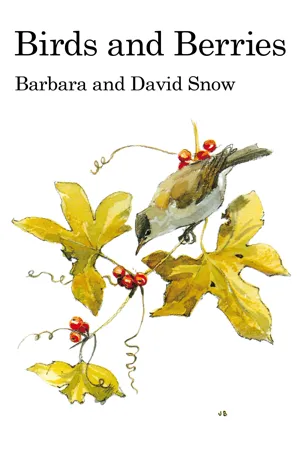
- 268 pages
- English
- ePUB (mobile friendly)
- Available on iOS & Android
eBook - ePub
Birds and Berries
About this book
Information
1: THE FRUITS
At least 39 different species of plants with fleshy fruits are native in our study area. There are in addition a further three species, found mainly in gardens, that may not occur naturally in the area but are native elsewhere in southern England, and one (bird cherry) that occurs in an apparently wild state in our area but has a more northerly range in Britain and has probably been introduced. We treat all of these as wild fruits; their main characteristics are summarised in Appendices 2 and 4.
These 43 species comprise about two-thirds of all the species of plants with fleshy fruits that are native to England and Wales, if a few species that are very rare or local are left out of consideration. The 43 species are listed in Appendix 1, and Table 1 shows a break-down into different growth-forms. It will be seen that our area contains nearly all the trees and climbers on the list for England and Wales, but only 16 of the 28 species of shrubs. The main species in the latter group that are missing are the small shrubs of heathland and moorland, such as bilberry and cranberry.
There is also, in gardens in the study area, a considerable number of exotic plants and cultivars with fleshy bird-dispersed fruits. We have made observations on the more important of them, but have made no attempt to find and watch all of them. The fruit characters of 16 of them, including all those for which we had significant numbers of feeding records, are summarised in Appendix 3.
In the following sections we discuss, species by species, the wild fruits, dealing with their seasons, the birds that feed on them, and other points of interest. After dealing with our own observations we discuss, more briefly, published observations on the fruits from other parts of Britain and from continental Europe, concentrating on points that amplify or contrast with our observations, or are of interest in other ways. Our observations on introduced and cultivated fruits are dealt with in less detail in a final section.
TABLE 1 Number of species, and growth-forms, of plants with fleshy fruits native to England and Wales, and occurring in the study area | ||
Number of species occurring in | ||
England and Wales | study area | |
Trees | 9 | 9 |
Small trees/shrubs | 9 | 6 |
Shrubs | 28 | 16 |
Climbers | 6 | 5 |
Herbs | 11 | 6 |
Epiphytes | 1 | 1 |
Totals | 64 | 43 |
Notes. Data for England and Wales based on Clapham, Tutin & Warburg (1973). Aggregates of very closely related forms (eg in Rosa) are treated as single species. A few very rare or local species are omitted (Cotoneaster integerrimus, Polygonatum odoratum, Asparagus officinalis). | ||
The seasonal pattern of fruiting
When we began systematic observation in our study area we had had some experience of the humid tropics, where fruit is available the year round. We did not expect the same situation in southern England, but in fact we found that here too wild fruits of some kind are available to birds for the whole year. There are, of course, marked seasonal fluctuations in the variety and quantity of fruits available. We may begin by looking at seasonal changes in the variety of fruits, without taking into account their abundance. It is reasonable to do so, because the wild fruits that are present in our study area today are much the same as would have been present when the vegetation was in its natural state; but their relative abundance must have been drastically altered by forest-clearing, cultivation and urbanization. Thus the relative abundance of different fruits now is largely artificial, and liable to rapid alteration; but there is no reason to think that their seasons have been altered.
The ‘fruit year’ begins, not in January, but with the ripening of the first summer fruits. The earliest of these, the wild cherry, currant and strawberry, ripen in June. Of these three, only the wild cherry is an important source of food for birds, the other two being local as wild plants in our area. July sees the ripening of several more, especially rowan, wayfaring tree, woody nightshade and lords and ladies. The earliest yews ripen at the end of July. More fruits ripen in August, much the most important being the elder, the bulk of the yews, and the earliest haws and blackberries. In September come whitebeam, dogwood, and the bulk of the haws and blackberries. The earliest hollies ripen at the end of September, but most in October, when a locally common small tree, the buckthorn, and mistletoe are added to the list. Privet and spindle are the main fruits starting to ripen in November, also the earliest hips of the dog rose (Rosa canina, the less common sweet-briar and field rose being much earlier). Most dog rose hips ripen later, in December or January, and it is in late December that the earliest ivy fruits ripen. Different strains of ivy ripen over a prolonged period, from late December to April. Some of the autumn- and winter-ripening fruits remain on the plants – for various reasons, which we deal with later in the accounts of the fruits concerned – until the spring, so that, in some years at least, in addition to ivy a certain amount of haw, holly and mistletoe fruit remains until February or March, and some hollies and mistletoes retain fruit until much later, in extreme cases until June or July, so that they overlap the beginning of the next fruit year.
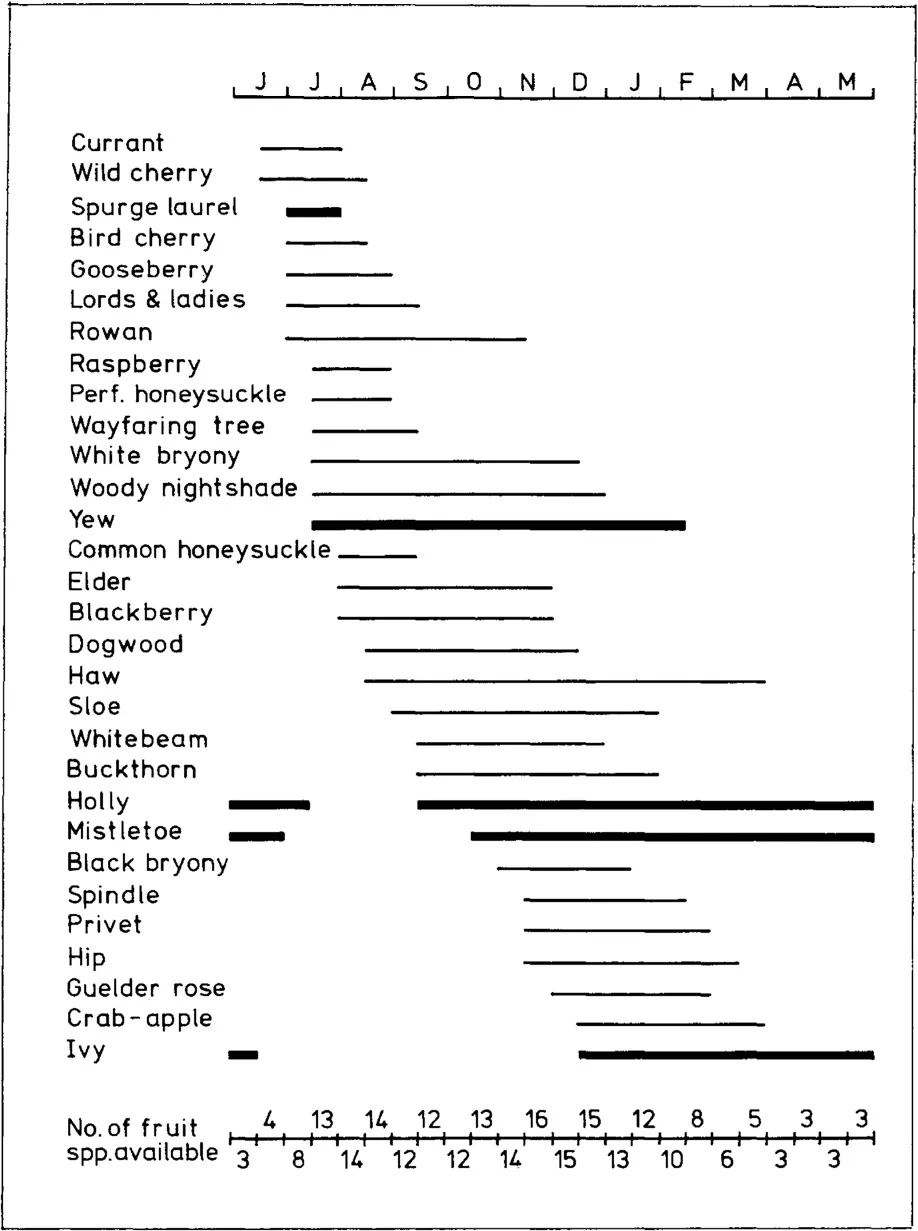
Figure 1 Seasonal availability of wild fruits for dispersers, Vale of Aylesbury area, 1980–85.
The figure is based on observations of fruit being eaten, except for gooseberry for which observations of ripening and depletion of fruits have been used. The season for hip refers to Rosa canina only. Evergreen plants are distinguished by a heavy line.
The fruiting seasons are shown graphically in Fig. 1. This figure illustrates m...
Table of contents
- Cover
- Copyright page
- Contents
- List of Figures
- List of Tables
- Dedication
- Introduction
- Acknowledgements
- Chapter 1 - THE FRUITS
- Chapter 2 - THE FRUIT-EATERS
- Chapter 3 - INTERPRETATION
- Appendix 1 - Plants with fleshy fruits native to England and Wales
- Appendix 2 - Design components of native hird-dispersed fruits, southern England
- Appendix 3 - Design components of some introduced and cultivar bird-dispersed fruits, southern England
- Appendix 4 - Nutritive values of some bird-dispersed fruits, southern: England
- Appendix 5 - Monthly totals of timed watches at wild fruits, southern England 1980–85
- References
Trusted by 375,005 students
Access to over 1.5 million titles for a fair monthly price.
Study more efficiently using our study tools.
Frequently asked questions
Yes, you can cancel anytime from the Subscription tab in your account settings on the Perlego website. Your subscription will stay active until the end of your current billing period. Learn how to cancel your subscription
No, books cannot be downloaded as external files, such as PDFs, for use outside of Perlego. However, you can download books within the Perlego app for offline reading on mobile or tablet. Learn how to download books offline
Perlego offers two plans: Essential and Complete
- Essential is ideal for learners and professionals who enjoy exploring a wide range of subjects. Access the Essential Library with 800,000+ trusted titles and best-sellers across business, personal growth, and the humanities. Includes unlimited reading time and Standard Read Aloud voice.
- Complete: Perfect for advanced learners and researchers needing full, unrestricted access. Unlock 1.5M+ books across hundreds of subjects, including academic and specialized titles. The Complete Plan also includes advanced features like Premium Read Aloud and Research Assistant.
We are an online textbook subscription service, where you can get access to an entire online library for less than the price of a single book per month. With over 1.5 million books across 990+ topics, we’ve got you covered! Learn about our mission
Look out for the read-aloud symbol on your next book to see if you can listen to it. The read-aloud tool reads text aloud for you, highlighting the text as it is being read. You can pause it, speed it up and slow it down. Learn more about Read Aloud
Yes! You can use the Perlego app on both iOS and Android devices to read anytime, anywhere — even offline. Perfect for commutes or when you’re on the go.
Please note we cannot support devices running on iOS 13 and Android 7 or earlier. Learn more about using the app
Please note we cannot support devices running on iOS 13 and Android 7 or earlier. Learn more about using the app
Yes, you can access Birds and Berries by Barbara Snow,David Snow,John Busby in PDF and/or ePUB format, as well as other popular books in Biological Sciences & Zoology. We have over 1.5 million books available in our catalogue for you to explore.