This book argues that insufficient recognition of new families is a legal problem that needs fixing in light of recent evolutions in family patterns and normative conceptions of 'family'. People increasingly invest in relationships falling outside the model of the marital family, such as non-conjugal unions of friends or relatives, polyamorous relationships and various religious-based families. Despite this, Western jurisdictions retain the marital family as the relevant basis for allocating family law benefits, rights and obligations.
Part I of the book illustrates recent evolutions in family patterns and norms, and explores how law can accommodate multiple family grids without legal recognition involving normalisation. Part II focuses on courtroom litigation on the basis that courts nowadays are central avenues of social change. It takes non-conjugal families as a case study and provides an analysis of the most compelling argumentative strategies that non-conjugal families can mobilise to pursue legal recognition in Canada and the United States, and within the systems of the European Convention of Human Rights and the European Union.
Through its comparative, interdisciplinary and critical legal method, the book provides scholars, activists and policymakers with conceptual tools to tackle the current invisibility of new families. Further, by advancing legal arguments to enhance the protection of non-conjugal families in courtrooms, the book illuminates the different approaches jurisdictions are likely to take and the hindrances thereof to overcome and debunk stereotypes associated with proper familyhood.
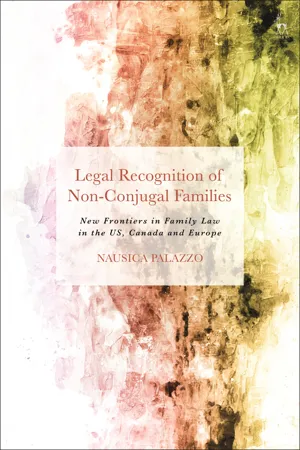
eBook - ePub
Legal Recognition of Non-Conjugal Families
New Frontiers in Family Law in the US, Canada and Europe
- 248 pages
- English
- ePUB (mobile friendly)
- Available on iOS & Android
eBook - ePub
Legal Recognition of Non-Conjugal Families
New Frontiers in Family Law in the US, Canada and Europe
About this book
Information
PART I
New Families and Law-Makers
1
New Families
1.What is the ‘New’ Family?
The level of care and commitment amongst individuals has not diminished, despite marriage rates falling in the West: people are investing in relationships outside of marriage and of the traditional model of family it embeds. Think of non-conjugal relationships of friends or relatives that lack a sexual component. Examples also include polyamorous relationships involving more than two persons, and various religion-based families such as polygamous unions. I should term these unions to be ‘new families’. Such families are new not in an ontological sense. Some are truly a novel phenomenon, while others are more well known. Extended families, for instance, have always existed; indeed, they were legally paid reverence at some points in history. This occurred in the pre-industrialisation era in the US,1 and in Eastern European societies constitutionalising the protection of extended families.2 Non-traditional families are new in the sense that, epistemologically, we now have a growingly rich set of analytical tools to see them and especially to see them under a different light.
These formations challenge state-sponsored conceptions of family, that is what I term to be the ‘traditional’ or ‘archetypical’ (marital) family. Standard signifiers of the archetypical family include conjugality – ie, a sexual component – the dyadic, exclusive nature of the relationship, and a for-life commitment. However, consider two siblings who decide to emotionally and financially support each other on a long-term basis. They are not conjugal, in the sense that they are not in a sexual relationship.3 Hence, they fall short of displaying arguably the most salient feature of the traditional marital couple: its sexual component. Nonetheless, they do care for each other deeply over the course of their lives. Should financial or other personal problems arise, they pledge to support each other.
According to this view, it is useful to think of family as a relationship marked by ‘mutual care and concern, the expectation of some form of an enduring bond, sometimes a deep commitment, and a range of interdependencies – emotional and economic – that arise from these features’,4 as a Canadian reform agency suggested doing in 2001. However, a caveat is required here. This definition is a good proxy for family. Yet, the variety of practices within constellations of family can be hardly captured by a monolithic definition. The most accurate definition is a ‘queer’ one, with ‘queer’ designating an inclusive project that encompasses more practices that can be identified and ‘more spaces that can be mapped beyond a few reference points’.5
This conceptual impossibility to engaging in a comprehensive mapping exercise results in the ultimate rejection of status and a priori attributes. Queer theorists oppose the very idea that the family can be seen as an essentialised entity of its own with features that can be fruitfully mapped. ‘Family’ is built through discursive practices and does not exist outside of or prior to them. As with gender, family is also the result of performativity, which is understood as ‘a set of repeated acts within a highly rigid regulatory frame that congeal over time to produce the appearance of substance, of a natural sort of being’.6
What is family then? Poststructuralist accounts might be scary. By persistently deconstructing and denaturalising seemingly natural objects, they might generate a horror vacui, that is, a fear of the empty spaces left by their deconstructionist fury. The resulting image is one of a non-essentialised notion of family which is free-floating from any normative anchor. Nonetheless, (one of) the logical outgrowth(s) of the theory is to see family as being linked not to an essence, but to a set of family functions, such as parenting or the formation of an economic unit between adults. Family is not something which ‘is’, but rather is something we ‘do’ in daily practices, with this ‘doing’ displaying characteristics which warrant the label ‘family’.7 These functions are familiar if we perceive them as such – that is, significant enough to deserve the label – and if a range of interdependencies arises therefrom. The second limb of the definition is necessary if one wants to preserve the specificity of family units from non-family units. This specificity would get lost should we be able to assign the tag ‘family’ regardless of whether some form of interdependency or commitment exists – ie, under a pure at-will model.8
In light of this introduction, one might expect states to have loosened their grip on the traditional family. This is not the case. The dominant understanding of family still adheres to a marital norm from a juridical and cultural perspective in the West, by which term I pre-eminently refer to the Euro-American context.9 In these societies, law has not yet abandoned its focus on a family that is nuclear, preferably heterosexual and exclusive. As a consequence, all who deliberately do not conform to the prevailing norm remain ‘legal strangers’ to one another, as well as social outcasts. A question arises as to why the commitment of new families is overlooked by the state. The reasons are complex and I will attempt to flag them up throughout this volume.
However, one tentative reason should be anticipated and lies in their subversive nature. All family unions outside of the dominant model expose the cracks of a seemingly coherent system of ordering. They are subversive to a pre-arranged and state-approved way of being family. Put in simpler terms, they are too queer to be accepted, let alone promoted. Queer knowledge is disruptive knowledge as it exposes the fissures and biases of a given system – be it political, social, economic or moral – through individual experience that deviates from ‘traditional’ steps. The state’s insistence on ‘proper’ familyhood is in the end a means of ordering society and a form of subjugation of deviant experiences that need fixing.
Family law is central to this governmental project, which Foucault popularly labelled ‘biopolitics’.10 The term stands for the authoritative appropriation of lives and bodies by modern states and a concomitant covering them through technologies of regulation.11 I will advance an argument that modern states’ biopolitical aims are at the core of the so-called non-verbalised functions of family law. Such functions cannot be verbalized to the extent that they are reminiscent of an ancient attribute of sovereignty, ius vitae ac necis, whereby the state took control over life and death. While the juridical power associated with ancient sovereignty was tantamount to taking life or letting live,12 contemporary biopower consists of ‘foster[ing] life or disallow[ing] it to the point of death’ by ostracising deviant experiences.13
A second perspective that I will adopt is a critical legal pluralist one. Integrating critical legal pluralism within queer theory offers the conceptual framework for the ambitious project of rethinking the approach to new families’ recognition in the West. Legal pluralism reflects the view that in any given space, there is more than one legal system. Critical legal pluralists have especially contributed to debunking various false ideas attendant to law, amongst which is the law’s centralism, monism and prescriptivism.14 These terms respectively refer to a belief that law can only be state law, that normative processes are unitary, and that law has nothing to do with human agency and with the aspirations of the addressees of legal norms. The chief merit of this approach is to promote the view that law is the byproduct of the desires, aspirations and motives of law users themselves. Law users, by means of such motives, desires and aspirations, are able to determine the direction law is to take.
Hence, on the one hand, the utility of queer theory is to reveal the cracks of this false success story of family and to expose the biases of a narrative that only seeks to promote a singular conception of family. On the other hand, the utility of a critical legal pluralist approach is its cogent deconstruction of the various mythologies associated with law, amongst which is the apparent expulsion of legal actors from normative processes. This integrated framework should enable us to reconceive current approaches to family regulation by radically rethinking both terms: family, which should no longer be seen as an essence but as a sum of familiar functions; and regulation, which should be synonymous with facilitating legal actors’ own jurisgenerative processes through state-made law.15
While some approaches to legal recognition tend to fiercely run up against the key tenets of the proposed framework and promote a prescriptivist, monolithic, top-down understanding of law (from which a prescriptivist, monolithic, top-down understanding of family derives), other approaches do not. The task of this chapter is to outline the contours of the proposed theoretical framework, while that of the next chapter is to analyse how this theory is to put to work to reduce the lag between law and the sociological reality of families.
However, before doing that, we should address a preliminary question: why should a state recognise new families or families at all? Is there something special about families that sets them apart from mere individuals? A sociological functionalist would answer this question by looking at ‘the empirical evidence of the effects of stable, longer-term relationships on the health, happiness and productivity of peoples’ lives’.16 Yet, this account is insufficient, as family networks might have different degrees of interdependence. Hence, utilising a fixed notion of interdependence – as the key marker of deserving families – would cut out other expressions and experiences.
I suggest placing emphasis on both the normative and empirical accounts outlined below as the most compelling reasons to reform family law. Empirically, if families have reached an astoundingly high degree of diversity and complexity, then law’s continued focus on the traditional family creates a gap that is increasingly intolerable. The more families that deviate from the model, the larger the injustice that a traditional family-centred approach to family regulation works for all outside of the model. However, empirical data must be taken at face value. It is strategically effective to argue that in light of the rich landscape of modern families, law should follow suit and reduce the conceptual lag between the legal framework and such families. This is why I often resort to this argument. Yet, the relevant account should be supplemented with the normative conceptions outlined above. In particular, the account is deficient if it fails to consider the significance of self-authorship to the crafting of intimacy; that is, that to the extent one wishes to live family in a certain way, it is irrelevant whether that relationship is empirically relevant. Thus, Western states should recognise new families especially because self-authorship is the highest-ranked, most cherished value informing present-day conceptions of family.
The next two sections thus address the preliminary question of why a state should recognise new families. To this end, I first examine the ...
Table of contents
- Cover
- Title Page
- Preface
- Acknowledgements
- Contents
- Table of Cases
- Table of Legislation
- PART I: NEW FAMILIES AND LAW-MAKERS
- PART II: NON-CONJUGAL FAMILIES BEFORE THE COURTS
- Conclusion
- References
- Index
- Copyright Page
Trusted by 375,005 students
Access to over 1.5 million titles for a fair monthly price.
Study more efficiently using our study tools.
Frequently asked questions
Yes, you can cancel anytime from the Subscription tab in your account settings on the Perlego website. Your subscription will stay active until the end of your current billing period. Learn how to cancel your subscription
No, books cannot be downloaded as external files, such as PDFs, for use outside of Perlego. However, you can download books within the Perlego app for offline reading on mobile or tablet. Learn how to download books offline
Perlego offers two plans: Essential and Complete
- Essential is ideal for learners and professionals who enjoy exploring a wide range of subjects. Access the Essential Library with 800,000+ trusted titles and best-sellers across business, personal growth, and the humanities. Includes unlimited reading time and Standard Read Aloud voice.
- Complete: Perfect for advanced learners and researchers needing full, unrestricted access. Unlock 1.5M+ books across hundreds of subjects, including academic and specialized titles. The Complete Plan also includes advanced features like Premium Read Aloud and Research Assistant.
We are an online textbook subscription service, where you can get access to an entire online library for less than the price of a single book per month. With over 1.5 million books across 990+ topics, we’ve got you covered! Learn about our mission
Look out for the read-aloud symbol on your next book to see if you can listen to it. The read-aloud tool reads text aloud for you, highlighting the text as it is being read. You can pause it, speed it up and slow it down. Learn more about Read Aloud
Yes! You can use the Perlego app on both iOS and Android devices to read anytime, anywhere — even offline. Perfect for commutes or when you’re on the go.
Please note we cannot support devices running on iOS 13 and Android 7 or earlier. Learn more about using the app
Please note we cannot support devices running on iOS 13 and Android 7 or earlier. Learn more about using the app
Yes, you can access Legal Recognition of Non-Conjugal Families by Nausica Palazzo in PDF and/or ePUB format, as well as other popular books in Law & Comparative Law. We have over 1.5 million books available in our catalogue for you to explore.