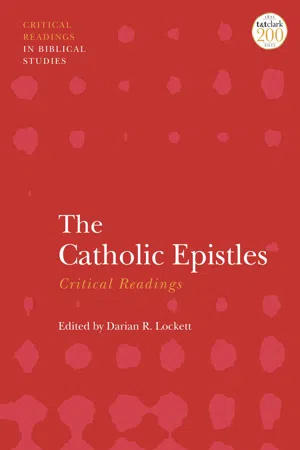
This reference volume aims to be a kind of comprehensive status quaestionis for the Catholic Epistles. Here Darian Lockett has collected some of the highest quality scholarship concentred upon the Letters of James, Peter, ohn, and Jude, creating an introduction and orientation to the wide ranging avenues of scholarly investigation into these New Testament texts all in a single-volume.
Divided into four distinct sections, the volume begins with an analysis of the Catholic Epistles as a collection, before moving to discuss historical-critical and theological studies, methodological approaches, and, finally, reception history. Taking care to situate foundational essays in the history of scholarship that may be hard to find or contextualize, Lockett offers a brief introduction to each section and draws each section to a close by providing a list of annotated readings which prompt further study and engagement with some of the last literature to be settled upon in the New Testament canon.
- 688 pages
- English
- ePUB (mobile friendly)
- Available on iOS & Android
eBook - ePub
The Catholic Epistles: Critical Readings
About this book
Information
Part 1
The Catholic Epistles as a Collection
Introduction
Darian R. Lockett
This volume focuses on the Catholic Epistles: James, 1–2 Peter, 1–3 John, and Jude. Though originating from different authors addressing widely varying audiences, these letters were traditionally grouped together in early manuscript collections of New Testament texts. While 1 Peter, 1 John, and Jude were known and used independently from an early period, all seven of these letters entered the New Testament canon as a group. Eusebius of Caesarea was the first to refer explicitly to these seven letters as “the Epistles called Catholic” (Hist. eccl. 2.23.25). Using this designation, Eusebius was dependent upon earlier tradition, yet it is unclear when exactly these seven letters were first viewed as a collection and when they received the title “Catholic Epistles.” Roughly contemporaneous with Eusebius, the great fourth- and fifth-century codices, Sinaiticus, Vaticanus, and Alexandrines, list these seven letters in the same order as they are found in most New Testaments today. This collection of seven disparate works from multiple authors eventually became a standard part of the New Testament canon, traditionally grouping two of Jesus’s apostles (Peter and John) with two of Jesus’s brothers (James and Jude)—the typical order bracketing Peter and John between the bookends of James and Jude.
Though patristic citation and manuscript evidence demonstrate the early circulation of 1 Peter, 1 John, and Jude, the history of reception in the commentary literature suggests that these letters were considered a collection from early time. Eusebius notes that in his Hypotyposeis, Clement of Alexandria “has given concise explanations of all the canonical Scriptures not passing over even the disputed writings, I mean the Epistle of Jude and the remaining Catholic Epistles” (Hist. Eccl. 6.14.1). In the ninth century, Photius seems to have had first-hand knowledge of Clement’s work saying that it contained notes on, among other biblical texts, “the divine Paul’s epistles, and the Catholic epistles.”1 The fragments that remain from Clement’s Hypotyposeis (preserved in Cassiodorus’s Adumbrationes in Epistolas Canonicas) contain comments on 1 Peter, 1–2 John, and Jude. It is possible that Clement’s commentary originally included James, but this is highly contested.2 Whether or not James was originally included, it is suggestive that letters from Peter, John, and Jude were commented on together and perhaps called Catholic Epistles. We find fragments of commentary on all the Catholic Epistles (except 2 Peter) in Pseudo-Didymus (Didymus the Blind, 313–398) in the form of catena and fragments on the Catholic Epistles from John Chrysostom and Cyril of Alexandria.3
The tradition of commenting on the Catholic Epistles together continued in the Middle Ages with Bede’s Commentary on the Seven Catholic Epistles (679), Walafrid Strabo’s Glossa Ordinaria (ca. 842, partially dependent on Bede), the commentaries of Isho’Dad of Merv (ca. 850, Syriac), and Pseudo-Oecumenius (tenth century, Greek).4 Though one begins to see commentary on individual texts from the Catholic Epistles, the tradition of commenting on them as a collection called “Catholic Epistles” largely continued through the Reformation period with commentaries by Luther, Calvin, and Grotius (Adnotationes in Actus Apostolorum et in Epistolas Catholicas) among others.5
With the rise of historical criticism in the eighteenth and nineteenth centuries, critical scholarship slowly dissolved the traditional boundaries standing between collection units of the New Testament for the purpose of examining each individual text in its unique, historical context of composition. The turn to interpreting New Testament texts in isolation from one another, focusing on their unique point of composition, affected the Catholic Epistles in a more fundamental way than other collection units of the New Testament. Whereas the critical engagement of Paul does lead to a reevaluation of the traditional Pauline Corpus—differentiating between authentic and pseudepigraphal Pauline texts—the historical-critical approach generally continued to accept that there was an authentic collection of Pauline Epistles. The Gospels, likewise, continued to be interpreted with reference to each other—this, in part, was due to the literary relationship between Matthew, Mark, and Luke and the shared focus on Jesus’s life and death characteristic of all four Gospels. Yet, when applied to the Catholic Epistles, the critical approach raised fundamental questions regarding the very notion of their status as a collection. When focusing on the particular historical and social circumstances of composition for each of the individual Catholic Epistles, the common connections between these letters were viewed as superficial and perhaps anachronistic. Lacking a common author or related subject matter, the Catholic Epistles were generally no longer viewed as a significant collection like the Gospels or the Pauline Corpus.
The critical approach to the Catholic Epistles has had two general results. First, the primary point of connection between the letters shifted from a canonical association to a shared genre.6 The common feature shared by the Catholic Epistles is that they are all letters addressed to general or nonspecific audiences. This somewhat modern consensus position is that “Catholic Epistles” and “General Letters” are interchangeable labels because “catholic” and “general” both refer to a specific type of letter—a letter written to a general audience. However, this is somewhat misleading. Jude, for example, seems to address a very specific situation, such that Richard Bauckham argues it is not a general letter at all.7 Likewise, though written to a group of affiliated churches, 1 John also addresses a very specific set of circumstances affecting a specific community. Furthermore, 2 and 3 John clearly are not general letters as they are addressed to “the chosen Lady” (2 John 1) and “Gaius” (3 John 1). So, if “catholic” is merely a genre distinction, then Jude and the Letters of John would not be included in the Catholic Epistles, and perhaps one might argue that Hebrews (or perhaps even Ephesians) should be included. This has led to uncertainty regarding where and in what grouping these letters belong in the New Testament generally. It is not uncommon for these seven letters to be described as the “non-Pauline” epistles or to be lumped together as “Concluding Letters,”8 “Other New Testament Writings,”9 or merely “The End of the New Testament.”10 These letters are variously counted as nine (Hebrews through Revelation),11 six (Hebrews through Revelation without the Letters of John),12 or, perhaps most often, they are numbered as the eight texts of Hebrews through Jude.
Second, with the shift to genre as the primary point of connection between the Catholic Epistles, and the accompanying uncertainty it brings, the traditional seven-letter collection is broken into smaller units. The critical approach is quick to observe the distinct authorial voice of 1–3 John and its degree of similarity with the language of the Gospel of John. From a critical perspective the Letters of John are studied within the context of Johannine literature (the Gospel of John, the Letters of John, and, sometimes, Revelation) or perhaps on their own.13 Originally, a consequence of the critical distinction of 1–3 John from the Catholic Epistles was the appearance of commentaries focusing only on James, Peter, and Jude. The precedent for this is set sometime in the late Reformation and continues into the modern period. In fact, a long-running section at the Society of Biblical Literature is entitled “Letters of James, Peter, and Jude,” which testifies to the ongoing influence of this critical distinction.
Similarly, under critical assessment, the traditional association of 1 and 2 Peter is doubted based on significant differences in vocabulary, style, and, most importantly, use of the Old Testament. The most likely historical reconstruction leads critical scholars to hold the literary connections between 2 Peter and Jude in higher regard than those—some would say artificial—connections between 1 and 2 Peter. Again, a consequence of this critical judgment is that virtually all modern critical commentaries include 2 Peter and Jude in the same volume offering detailed analysis of the literary and historical connections between the two texts, while at the same time it has become quite rare to find critical commentaries that both include 1 and 2 Peter together and provide argument for their authorial connection.14
The critical approach to the Catholic Epistles has focused scholarly attention on examining each text in its individual, historical-cultural context of composition. Therefore, critical scholarship tends to focus on either James, 1 Peter, the Letters of John, or 2 Peter and Jude—each its own somewhat independent field of study. As a result, critical scholarship has not focused much attention on the letters as a collection. Often the canonical grouping of the seven Catholic Epistles is understood as a later, reception-historical issue that is anachronistic with regard to the historical interpretation of these texts.
Within the past thirty years critical scholarship has taken up an ever-widening range of methodologies in the study of New Testament texts (see Part 3 of this book). In addition to the traditional historical-critical concerns focused on author, audience, and context of composition, these approaches take up social-scientific, rhetorical, narrative analysis, postcolonial, and feminist methods to gain new insights from the texts of the...
Table of contents
- Cover
- Half-title Page
- Series Page
- Title Page
- Contents
- Permission Acknowledgments
- Acknowledgments
- List of Abbreviations
- Part 1 The Catholic Epistles as a Collection
- Part 2 Historical-Critical and Theological Studies in the Catholic Epistles
- Part 3 Methodological Approaches
- Part 4 Reception History of the Catholic Epistles
- Index of Authors
- Index of References
- Copyright Page
Trusted by 375,005 students
Access to over 1.5 million titles for a fair monthly price.
Study more efficiently using our study tools.
Frequently asked questions
Yes, you can cancel anytime from the Subscription tab in your account settings on the Perlego website. Your subscription will stay active until the end of your current billing period. Learn how to cancel your subscription
No, books cannot be downloaded as external files, such as PDFs, for use outside of Perlego. However, you can download books within the Perlego app for offline reading on mobile or tablet. Learn how to download books offline
Perlego offers two plans: Essential and Complete
- Essential is ideal for learners and professionals who enjoy exploring a wide range of subjects. Access the Essential Library with 800,000+ trusted titles and best-sellers across business, personal growth, and the humanities. Includes unlimited reading time and Standard Read Aloud voice.
- Complete: Perfect for advanced learners and researchers needing full, unrestricted access. Unlock 1.5M+ books across hundreds of subjects, including academic and specialized titles. The Complete Plan also includes advanced features like Premium Read Aloud and Research Assistant.
We are an online textbook subscription service, where you can get access to an entire online library for less than the price of a single book per month. With over 1.5 million books across 990+ topics, we’ve got you covered! Learn about our mission
Look out for the read-aloud symbol on your next book to see if you can listen to it. The read-aloud tool reads text aloud for you, highlighting the text as it is being read. You can pause it, speed it up and slow it down. Learn more about Read Aloud
Yes! You can use the Perlego app on both iOS and Android devices to read anytime, anywhere — even offline. Perfect for commutes or when you’re on the go.
Please note we cannot support devices running on iOS 13 and Android 7 or earlier. Learn more about using the app
Please note we cannot support devices running on iOS 13 and Android 7 or earlier. Learn more about using the app
Yes, you can access The Catholic Epistles: Critical Readings by Darian Lockett in PDF and/or ePUB format, as well as other popular books in Theology & Religion & Biblical Studies. We have over 1.5 million books available in our catalogue for you to explore.