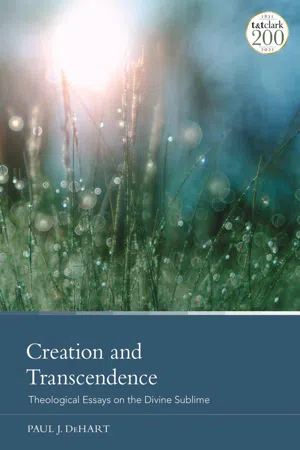
This is a creative scholarly argument revisiting the substance, understanding, and implications of the doctrine of creation ex nihilo for contemporary theology and philosophy.
Paul J. DeHart examines the special mode of divine transcendence (God's infinity) and investigates areas where accepting an infinite God presents challenging questions to Christian theology. He discusses what "saving knowledge" or "faith" would have to look like when confronted by such an unlimited conception of deity, and ponders how the doctrine of God's trinity can be brought into harmony with radical notions of transcendence, as well as ways the doctrine of creation itself is threatened when the radical otherness of the creator's mind is not maintained.
DeHart engages with a diverse range of figures: Jean-Luc Marion, Schleiermacher, Kierkegaard, Kathryn Tanner, John Milbank and Rowan Williams, to illustrate his conviction. This volume deals with deep conceptual issues, indicating that creation ex nihilo remains a lively topic in contemporary theology.
- 304 pages
- English
- ePUB (mobile friendly)
- Available on iOS & Android
eBook - ePub
About this book
Information
Part One
Cultus Mentis: Accommodating the Endless Object
1
Can Pascal Forgive Descartes? God’s Ambiguous Infinity
I cannot forgive Descartes. In all his philosophy, he would have been quite willing to dispense with God. But he had to make Him give a fillip to set the world in motion; beyond this, he has no further need for God.
Pascal
Pensées
Pensées
I have never written about the infinite except to submit myself to it, and not to determine what it is or is not.
Descartes
Letter to Mersenne
Letter to Mersenne
“God is not a name but a concept.” Thus writes Kierkegaard, speaking through the persona of Johannes Climacus.1 Presumably he means, at least in part, that God is not a thing, an ostensible referent toward which one can gesture and to which a name can consequently be applied. Instead, the use of the word “God” involves not direct reference but an effort of thought, a conceptual synthesis of ideas and experiences. There are many such concepts inhabiting our speech (one usually does not say, “That’s Truth, right over there next to the window”); they require a certain amount of learning and practice of those who would use them properly. The striking, in fact the crucial, thing about the concept “God” is that the list of situations or contexts that guide its use is potentially without limit. There is no idea or experience to which God is not in some way relevant, at least if we grasp what we mean by the concept. As Charles Wood has pointed out, “An understanding of ‘God’ relates to and affects one’s understanding of everything else, one’s own self in particular.”2
The concept “God” is (potentially) infinitely relevant because God is (actually) infinitely relevant. Ironically, this unlimited divine relatedness is why Kierkegaard, speaking through yet another persona (Anti-Climacus), can also say that God “has no concept.”3 That is, God knows or relates to all particulars directly without needing the mediation of a cognitive abstract, a universal. As infinitely relevant God needs no concept. But we do, if we are to speak of or think about God at all. Are not the special problems associated with our use of the concept “God” a direct reflection of the fact that God relates with such unfathomable immediacy (and hence “has no concept”)? In fact, it could be argued that these problems are such that we cannot even limit ourselves to a concept of God. To think God is not to arrive at an adequate single concept, the quintessence of divinity; it is to master a shifting ensemble of concepts that implicate and check each other in various ways. This pattern of concepts must be constantly renegotiated, drawing on and responding to particular historical contexts of thought, speech, and action.
The dynamics of this process, and the criteria by which it can be judged, are dependent on the goal toward which a particular “thinking” of God aims, and the communities or traditions to which it is responsible. Thus, even where the definition of a concept is agreed upon, its “freight,” its meaning and implications for reflection on God, can be judged in sharply divergent ways. A most instructive example of this is provided by the differing readings offered by two contemporary thinkers of one concept (infinity) as used in reference to God by one great philosopher (Descartes). Of course, much has been written of late about the “Cartesian subject” and the salutary results for theology and philosophy that occur when it is abandoned.4 But what of the Cartesian idea of God? I turn to the “infinite” Cartesian deity as read through the eyes of the German Lutheran theologian Eberhard Jüngel and the French Roman Catholic philosopher Jean-Luc Marion.
I. God in the Epistemological Revolution: Two Readings
The juxtaposition of two quotations with intriguing similarities will provide a point of entry into this discussion. The first, from Jüngel, comes from his great work, Gott als Geheimnis der Welt, written in 1977:
Thereby, however, the being of God necessarily falls asunder. For on the one hand God, in accordance with his essence—that is, as that which is absolutely superior to me—cannot be thought of as limited to the presence of the ego. Even for Descartes, it belongs to the essence of God to be more than merely present with me. On the other hand, God’s existence can only be asserted when he is present within the horizon of my existence. Because for “Descartes being-ness means: being represented through and for the subject,” which “I” am. Thus the following aporia emerges:
a) The existence of God is secured through me when the essence of God is represented by me.
b) In terms of his essence God is of course the almighty creator who exists necessarily through himself and through whom I exist (and also through whom I am what I am).
c) In terms of his existence, however, God is through me, inasmuch as even his existence can be understood only as a being-represented through and for the subject, which “I” am.5
The second quotation comes from Marion’s book, published in 1981, Sur la théologie blanche de Descartes:
Descartes makes no final settlement in favor either of ontic precedence or of the primacy of thought; the result is that the one and the other are put into practice alternatively, indeed conjointly, via two competing cases. As always, this paradox is nowhere more obvious than in the [case of God as] causa sui: God appears as an infinite essence, so much so that it is completely summed up in an exuperans potestas [overwhelming power]. Thus God appears as the absolute creator of beings—the ontic foundation of the res cogitans [human being as thinking substance] as well as of other beings. But at this very same point in the theory, God, in order to exist, or rather in order that his existence might become intelligible to the cogitatio [human thought], must satisfy a rational demand of the finite ego (causa sive ratio cur existat [a cause or reason why he exists]). The ego becomes the epistemological foundation of the cogitatio of God as well as of other beings. Thus the foundation is divided in two, between cogitatio and creation, a finite and created rationality and an incomprehensible and infinite power.6
Both Jüngel and Marion see a curious tension in the way Descartes tries to conceive of God, the human mind, and the interrelation of the two. Their accounts are not identical but they evidently overlap in an intriguing way. To see more clearly the similarities and differences, I will deal with each in a bit more detail. This will unavoidably involve considerable haste and oversimplification in summarizing two very complex readings of Descartes, but it is necessary to lay the groundwork for what follows.
To begin with Jüngel, the “aporia” he describes (not, strictly speaking, a contradiction but a baffling difficulty blocking a consistent course of thought) must be understood against the background of a traditional presupposition about conceiving God. God is metaphysically unique as one whose essence is logically inseparable from existence (somewhat crudely stated, what God is, God’s identity, and that God is, God’s mode of actuality or “esse,” to use Thomist language, mutually imply and define each other). In this unique case, to exist as God is God’s identity; existence is not a contingent fact separable in principle from essence, as it is with creatures. This insistence had been a commonplace of philosophical and theological thinking about God long before Descartes, and he accepted it without question. If God is to be conceived, it must be as one in whom essence and existence are thought together.7
But Descartes’s discussion of God, itself traditional in so many ways, is part of a larger argument, one of revolutionary import for the self-conception of human reason. It is well known that Descartes located the foundation for cognition and rationality in the human “ego” or self, which “clearly and distinctly” apprehends its own presence as well as its own defining activity, thinking.8 Heidegger, whom Jüngel closely follows in this discussion, argued that one result of this new foundation of thought is that the existence of things outside the self is strictly a function of their perception by the self, their “being present” to thought. This is neither a logical inference nor a stipulative definition, along the lines of Berkeley’s “To be is to be perceived.” Rather, Heidegger claims that the meaning of any assertion of existence is now implicitly determined as a mode of being present (“re-presented”) with the cognizing self making the assertion; to say “X exists” henceforth means or implies that X is within the horizon of the self’s presence to itself.9
In the passage cited, Jüngel is pointing out the difficulty of maintaining the traditional assertion of the identity of God’s essence and existence, once the import of this new understanding of existence is absorbed. Divine essence and divine existence can no longer be brought into a single movement of thought, so to speak; the mind assigns them to separate locations. God’s essence is defined as absolutely superior and transcendent to human reason, indeed as the creator of that reason. But if there is to be knowledge of God’s existence, if that existence is to be meaningfully asserted, then the divine essence must be somehow re-presented, it must be given in some idea to that human reason and thus constructed by the human subject as an object, similar to any other existent. This is because in this new Cartesian epistemological scheme, “to exist” becomes virtually identical with “to be present in the form of some attribute which affects the knowing human subject.”10
Now Descartes is certainly aware that God cannot be present in the manner of ordinary objects. To be sure, God and created things (minds and material objects) have this in common: both are characterized by a degree of ontic independence, that is, they are substances. But God’s independence is absolute, that of created substances only relative, since they depend on God holding them in being.11 Another way of putting this is to say that God is infinite substance. Thus, the word “substance” is not used in the same sense of God and created things; we can know substances, and hence God, but the qualification “infinite” signals that the concept “substance” is not used univocally of the divine. Descartes in this way tries to salvage God for his own epistemology, bringing the divine into the representational scheme while at the same time allowing enough ambiguity in this unique case to conceal the fault line that Jüngel claims to uncover.
The fault line is still present despite this concealment; I will indicate later what happens, according to Jüngel, when this fault line began to widen. But initially the nature of the “aporia” described in the quote with which we began must be grasped as carefully as possible. God’s essence is defined by Descartes (following venerable traditions) in such a way as to problematize its relation to the new role of the human subject in constituting knowledge. Existence now means objectifiable presence within the human cognitive horizon.12 But how can the absolutely transcendent creator appear within this horizon? Descartes’s denial of the univocity of substance suggests that God’s appearance in this horizon is possible but problematic, a quasi-availability qualified by infinite unavailability. To kn...
Table of contents
- Cover
- Halftitle Page
- Title Page
- Endorsement
- Contents
- Note on Aquinas Citations and on Pronouns for God
- Acknowledgments
- Introduction
- Part One Cultus Mentis: Accommodating the Endless Object
- Part Two Dogma and the Infinite God: Trinity, Christology, Grace
- Part Three Aquinas and God’s Ideas: The Impossible Mind of the Creator
- Works Cited
- Index
- Copyright Page
Trusted by 375,005 students
Access to over 1.5 million titles for a fair monthly price.
Study more efficiently using our study tools.
Frequently asked questions
Yes, you can cancel anytime from the Subscription tab in your account settings on the Perlego website. Your subscription will stay active until the end of your current billing period. Learn how to cancel your subscription
No, books cannot be downloaded as external files, such as PDFs, for use outside of Perlego. However, you can download books within the Perlego app for offline reading on mobile or tablet. Learn how to download books offline
Perlego offers two plans: Essential and Complete
- Essential is ideal for learners and professionals who enjoy exploring a wide range of subjects. Access the Essential Library with 800,000+ trusted titles and best-sellers across business, personal growth, and the humanities. Includes unlimited reading time and Standard Read Aloud voice.
- Complete: Perfect for advanced learners and researchers needing full, unrestricted access. Unlock 1.5M+ books across hundreds of subjects, including academic and specialized titles. The Complete Plan also includes advanced features like Premium Read Aloud and Research Assistant.
We are an online textbook subscription service, where you can get access to an entire online library for less than the price of a single book per month. With over 1.5 million books across 990+ topics, we’ve got you covered! Learn about our mission
Look out for the read-aloud symbol on your next book to see if you can listen to it. The read-aloud tool reads text aloud for you, highlighting the text as it is being read. You can pause it, speed it up and slow it down. Learn more about Read Aloud
Yes! You can use the Perlego app on both iOS and Android devices to read anytime, anywhere — even offline. Perfect for commutes or when you’re on the go.
Please note we cannot support devices running on iOS 13 and Android 7 or earlier. Learn more about using the app
Please note we cannot support devices running on iOS 13 and Android 7 or earlier. Learn more about using the app
Yes, you can access Creation and Transcendence by Paul J. DeHart in PDF and/or ePUB format, as well as other popular books in Theology & Religion & Theology. We have over 1.5 million books available in our catalogue for you to explore.