Drawing on a rich variety of premodern Indian texts across multiple traditions, genres, and languages, this collection explores how emotional experience is framed, evoked, and theorized in order to offer compelling insights into human subjectivity.
Rather than approaching emotion through the prism of Western theory, a team of leading scholars of Indian traditions showcases the literary texture, philosophical reflections, and theoretical paradigms that classical Indian sources provide in their own right. The focus is on how the texts themselves approach those dimensions of the human condition we may intuitively think of as being about emotion, without pre-judging what that might be. The result is a collection that reveals the range and diversity of phenomena that benefit from being gathered under the formal term "emotion", but which in fact open up what such theorisation, representation, and expression might contribute to a cross-cultural understanding of this term. In doing so, these chapters contribute to a cosmopolitan, comparative, and pluralistic conception of human experience.
Adopting a broad phenomenological methodology, this handbook reframes debates on emotion within classical Indian thought and is an invaluable resource for researchers and students seeking to understand the field beyond the Western tradition.
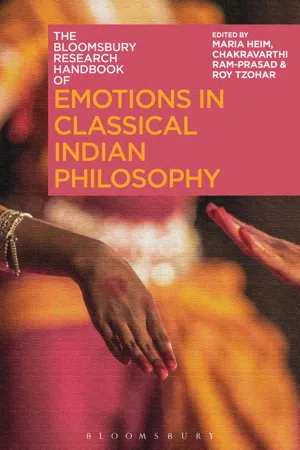
eBook - ePub
The Bloomsbury Research Handbook of Emotions in Classical Indian Philosophy
- 346 pages
- English
- ePUB (mobile friendly)
- Available on iOS & Android
eBook - ePub
The Bloomsbury Research Handbook of Emotions in Classical Indian Philosophy
About this book
Information
CHAPTER ONE
Grief, Tranquility, and Śānta Rasa in Raviṣeṇa’s Padmapurāṇa
GREGORY M. CLINES
1. INTRODUCTION
To the extent that a person knows anything about Jains, it is probable that words like “austere,” “ascetic,” and “sober” immediately come to mind. Kendall Folkert (1993: 24) notes that scholars working on Jain material will come across such a portrayal “with almost monotonous regularity.” As M. Whitney Kelting (2007: 110) further points out, Jain philosophy has historically thought of the ultimate goal of enlightenment as arising from a passionless state, free from the fetters of emotion that “are seen as part of the world of suffering and rebirth.” There is perhaps no better rendering of this concept than the serene figures of the Jinas themselves which, as John E. Cort (2010: 21) explains, depict those beings who have “overcome all bodily attachments and passions.” Again, as Kelting (2007: 110) points out: “It is not surprising…that scholarship has accepted—if not reified—Jainism’s anti-emotion stance by focusing on its veneration of passionlessness.” This chapter aims to demonstrate that at least in one work of Jain literature—the seventh-century Sanskrit Padmapurāṇa (“The Story of Padma”), a Jain version of the Rāma1 epic authored by the Digambara monk Raviṣeṇa2 —this celebrated emotionlessness and dispassion is inextricably linked to the experience of intense grief (śoka), and that this is true for both characters in the narrative and for the reader. Drawing on, and contributing to, the concepts of rasa (literally, “taste”) and, relatedly, emotion (bhāva) in Sanskrit literature, I argue that Raviṣeṇa uses śoka as an impetus for both Rāma’s and the reader’s experience of nirveda (“disgust,” “despair,” or “world weariness”). Nirveda encourages worldly renunciation which leads to śama, dispassionate tranquility. Through this, the Padmapurāṇa thus highlights the inherently and inescapably painful nature of the physical world and presents the adoption of Jain ascetic life as the way of overcoming it.3
In making these arguments, the chapter proceeds in four sections. I first provide a brief introductory account of Raviṣeṇa and the Padmapurāṇa, including a description of the narrative’s plot and the major ways in which Jain versions of the Rāma story differ from their better known “Hindu” counterparts. Second, I introduce the broad concepts of bhāva and rasa. I also discuss here the specifics of śānta rasa and its related stable emotion (sthāyibhāva), śama, in both Jain and larger Sanskrit literary history. As I point out, though, systematic theories of what rasa is, how it is experienced, and by whom, postdate Raviṣeṇa by centuries. My goal in this chapter is thus not to suggest that Raviṣeṇa proposes, or even acknowledges, a coherent theory of rasa in the Padmapurāṇa. Rather, I focus on the specific emotional work of the text itself, both in terms of Rāma as a character and the reader as a reader. Thus, in sections three and four I delve into the text, demonstrating how Raviṣeṇa skillfully uses śoka, first for Rāma as the motivating factor for worldly renunciation and the experience of śama.4 This occurs when his brother Lakṣmaṇa dies. For the reader, however, grief emerges earlier in the narrative, with the death of Rāvaṇa. The reader’s grief, I argue, is intentionally never mollified. Instead, the reader recognizes in Rāma’s experience the efficacy of worldly renunciation and is thus encouraged to do the same.
2. RAVIṢEṆA AND THE PADMAPURĀṆA
Raviṣeṇa’s Padmapurāṇa is a Jain version of the story of Rāma, the epic prince of Ayodhyā. The text consists of nearly 18,000 verses divided into 123 chapters (parva); the majority of the text is written in śloka meter, with the exception of the last stanza or few stanzas in each chapter. Raviṣeṇa’s is not the earliest Jain version of the Rāma narrative, that being Vimalasūri’s fifth-century CE Paümacariya, composed in Maharastri Prakrit, and on which Raviṣeṇa’s work is probably based.5 Raviṣeṇa’s Padmapurāṇa is, though, the earliest extant Sanskrit Jain version of the Rāma story. In terms of style, Kulkarni (1990: 102) describes Raviṣeṇa’s Sanskrit as “simple and lucid” and “easy and fluid.” Raviṣeṇa has a penchant for descriptive flair; whereas Vimalasūri’s Prakrit version of the story is sparse in description, Raviṣeṇa relishes describing localities and environments and different characters’ artistic proficiencies.6
As with many pre-modern South Asian authors, scholars know little about Raviṣeṇa’s life beyond the meagre information he provides in the Padmapurāṇa itself. He explains that he wrote the work 1,203 years and six months after Lord Mahāvīra, the most recent Jina, attained nirvāṇa, which would date him to around 676 CE.7 He does not provide information as to where he composed the text, nor does he mention a particular saṅgha to which he belonged.8 The Padmapurāṇa is also Raviṣeṇa’s only surviving work, though tradition credits him with composing additional texts, including a Harivaṃśapurāṇa.
As a whole, the plot of the Padmapurāṇa resembles that of more widely known Rāma narratives, such as Vālmīki’s Sanskrit Rāmāyaṇa.9 There are, though, identifiable components of Jain versions of the story that mark them as distinctive.10 Most fundamental is that starting with Vimalasūri, Jain authors depict both Rāma and Rāvaṇa as human,11 in contrast to, say, Vālmīki, for whom Rāma is divine and Rāvaṇa is a ten-headed rākṣasa.12 In general, Jain authors depict Rāvaṇa in a more tragic light than do many “Hindu” accounts of the story. Raviṣeṇa’s Rāvaṇa is a pious Jain, a committed vegetarian, and is renowned for both his exemplary kingship and his admirable austerity. His one vice, though, is uncontrollable lust, which leads him to eventually abduct Sītā.
Queen Kaikeyī, Rāma’s stepmother who is responsible for his exile to the forest, also becomes a more sympathetic character in Jain versions of the story. Instead of being portrayed as greedy and power-hungry, concerned only for her own fortune, Jain authors cast Kaikeyī as a loving mother concerned about losing her son Bharata to mendicancy. To stop Bharata from following in his father’s footsteps and becoming a monk, Kaikeyī concocts the plan of making him king instead of Rāma, thus investing in Bharata the responsibilities of running a kingdom. Rāma’s exile to the forest, then, does not stem from Kaikeyī’s avarice, but rather from her knowing that Bharata would never accept the throne while Rāma remained in the kingdom.
The end of many of the main characters of the narrative also differs from what is presented in “Hindu” versions. Rāma, his brother Bharata, and Hanumān all at some point over the course of the story take Jain vows of mendicancy and eventually attain mokṣa, liberation from saṃsāra, the transitory world of rebirth and re-death. Sītā, after proving her purity in the fire ritual, also accepts Jain ascetic vows and, after practicing austerities, is reborn as a god. As will be discussed in more detail below, Rāvaṇa and Lakṣmaṇa both die over the course of the narrative and, because they have committed grave acts of violence, are immediately reborn in hell, though the reader is assured that both will achieve mokṣa in a future birth.
3. EMOTION, AESTHETICS, AND ŚĀNTA RASA
Let me first introduce the theoretical scaffolding that will aid in explicating the emotional work of the Padmapurāṇa. This is the literary concept of rasa (literally “taste”), and specifically śānta rasa, the peaceful sentiment, and its relationship to bhāva, “emotion.” Discussing rasa is a complicated task, in one way because, as Wallace Dace (1963: 249) points o...
Table of contents
- Cover
- Half-Title Page
- Series Page
- Title Page
- Contents
- List of Contributors
- Acknowledgments
- Introduction
- 1 Grief, Tranquility, and Śānta Rasa in Raviṣeṇa’s Padmapurāṇa
- 2 Emotions in Viśiṣṭādvaita Vedānta
- 3 Joy as Medicine? Yogavāsiṣṭha and Descartes on the Affective Sources of Disease
- 4 Some Analyses of Feeling
- 5 Lament and the Work of Tears: Andromache, Sītā, and Yaśodharā
- 6 The Mind in Pain: The View from Buddhist Systematic and Narrative Thought
- 7 Transparent Smoke in the Pure Sky of Consciousness: Emotions and Liberation-While-Living in the Jīvanmuktiviveka
- 8 Gesture and Emotion in Tamil Śaiva Devotional Poetry
- 9 The Emotion that is Correlated with the Comic: Notes on Human Nature Through Rasa Theory
- 10 Is there a Caṅkam Way of Feeling? Body, Landscape, Voice, and Affect in Old Tamil Poetry
- 11 Wretched and Blessed: Emotional Praise in a Sanskrit Hymn from Kashmir
- 12 Savoring Rasa: Emotion, Judgment, and Phenomenal Content
- 13 How Does it Feel to be on Your Own: Solitude (viveka) in Aśvaghoṣa’s Saundarananda
- Bibliography
- Index
- Copyright
Trusted by 375,005 students
Access to over 1.5 million titles for a fair monthly price.
Study more efficiently using our study tools.
Frequently asked questions
Yes, you can cancel anytime from the Subscription tab in your account settings on the Perlego website. Your subscription will stay active until the end of your current billing period. Learn how to cancel your subscription
No, books cannot be downloaded as external files, such as PDFs, for use outside of Perlego. However, you can download books within the Perlego app for offline reading on mobile or tablet. Learn how to download books offline
Perlego offers two plans: Essential and Complete
- Essential is ideal for learners and professionals who enjoy exploring a wide range of subjects. Access the Essential Library with 800,000+ trusted titles and best-sellers across business, personal growth, and the humanities. Includes unlimited reading time and Standard Read Aloud voice.
- Complete: Perfect for advanced learners and researchers needing full, unrestricted access. Unlock 1.5M+ books across hundreds of subjects, including academic and specialized titles. The Complete Plan also includes advanced features like Premium Read Aloud and Research Assistant.
We are an online textbook subscription service, where you can get access to an entire online library for less than the price of a single book per month. With over 1.5 million books across 990+ topics, we’ve got you covered! Learn about our mission
Look out for the read-aloud symbol on your next book to see if you can listen to it. The read-aloud tool reads text aloud for you, highlighting the text as it is being read. You can pause it, speed it up and slow it down. Learn more about Read Aloud
Yes! You can use the Perlego app on both iOS and Android devices to read anytime, anywhere — even offline. Perfect for commutes or when you’re on the go.
Please note we cannot support devices running on iOS 13 and Android 7 or earlier. Learn more about using the app
Please note we cannot support devices running on iOS 13 and Android 7 or earlier. Learn more about using the app
Yes, you can access The Bloomsbury Research Handbook of Emotions in Classical Indian Philosophy by Maria Heim,Chakravarthi Ram-Prasad,Roy Tzohar in PDF and/or ePUB format, as well as other popular books in Philosophy & Eastern Philosophy. We have over 1.5 million books available in our catalogue for you to explore.