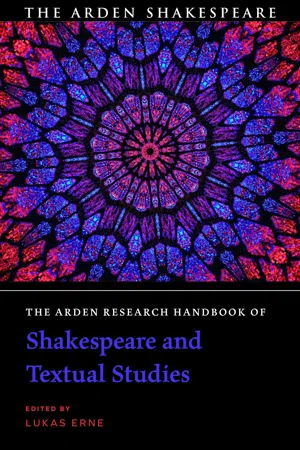
The Arden Research Handbook of Shakespeare and Textual Studies is a wide-ranging, authoritative guide to research on Shakespeare and textual studies by an international team of leading scholars. It contains chapters on all the major areas of current research, notably the Shakespeare manuscripts; the printed text and paratext in Shakespeare's early playbooks and poetry books; Shakespeare's place in the early modern book trade; Shakespeare's early readers, users, and collectors; the constitution and evolution of the Shakespeare canon from the sixteenth to the twenty-first century; Shakespeare's editors from the eighteenth to the twenty-first century; and the modern editorial reproduction of Shakespeare.
The Handbook also devotes separate chapters to new directions and developments in research in the field, specifically in the areas of digital editing and of authorship attribution methodologies. In addition, the Companion contains various sections that provide non-specialists with practical help: an A-Z of key terms and concepts, a guide to research methods and problems, a chronology of major publications and events, an introduction to resources for study of the field, and a substantial annotated bibliography.
The Arden Research Handbook of Shakespeare and Textual Studies is a reference work aimed at advanced undergraduate and graduate students as well as scholars and libraries, a guide to beginning or developing research in the field, an essential companion for all those interested in Shakespeare and textual studies.
- 409 pages
- English
- PDF
- Available on iOS & Android
eBook - PDF
The Arden Research Handbook of Shakespeare and Textual Studies
About this book
Information
Table of contents
- Cover
- Contents
- List of Illustrations
- List of Tables
- Notes on Contributors
- Series Preface
- List of Abbreviations
- Introduction Lukas Erne
- PART ONE: RESEARCH METHODS AND PROBLEMS
- 1.1 Shakespeare and ‘textual studies’: Evidence, scale, periodization and access Claire M. L. Bourne
- PART TWO: CURRENT RESEARCH AND ISSUES
- 2.1 The Shakespeare manuscripts Cathy L. Shrank and Paul Werstine
- 2.2 The early printed texts of Shakespeare John Jowett
- 2.3 Shakespeare’s early modern books: Printing, paratext and text Emma Smith
- 2.4 Shakespeare in the early modern book trade Marta Straznicky
- 2.5 Shakespeare’s early readers and users: Annotating, commonplacing, collecting Laura Estill
- 2.6 The Shakespeare canon from the sixteenth to the twenty-first century Peter Kirwan
- 2.7 Shakespeare’s editors from the eighteenth to the twenty-first century Andrew Murphy
- 2.8 The modern editing of Shakespeare: The text Margaret Jane Kidnie
- 2.9 The modern editing of Shakespeare: The apparatus Suzanne Gossett
- PART THREE: NEW DIRECTIONS
- 3.1 Shakespeare and authorship attribution methodologies Hugh Craig
- 3.2 Shakespeare and digital editions Sonia Massai
- PART FOUR: MATERIAL FOR FURTHER RESEARCH
- 4.1 Chronology Alan B. Farmer
- 4.2 A–Z of key terms and concepts Eric Rasmussen and Ian H. De Jong
- 4.3 Annotated bibliography Jean-Christophe Mayer
- 4.4 Resources Emma Depledge
- Index
Trusted by 375,005 students
Access to over 1.5 million titles for a fair monthly price.
Study more efficiently using our study tools.
Frequently asked questions
Yes, you can cancel anytime from the Subscription tab in your account settings on the Perlego website. Your subscription will stay active until the end of your current billing period. Learn how to cancel your subscription
No, books cannot be downloaded as external files, such as PDFs, for use outside of Perlego. However, you can download books within the Perlego app for offline reading on mobile or tablet. Learn how to download books offline
Perlego offers two plans: Essential and Complete
- Essential is ideal for learners and professionals who enjoy exploring a wide range of subjects. Access the Essential Library with 800,000+ trusted titles and best-sellers across business, personal growth, and the humanities. Includes unlimited reading time and Standard Read Aloud voice.
- Complete: Perfect for advanced learners and researchers needing full, unrestricted access. Unlock 1.5M+ books across hundreds of subjects, including academic and specialized titles. The Complete Plan also includes advanced features like Premium Read Aloud and Research Assistant.
We are an online textbook subscription service, where you can get access to an entire online library for less than the price of a single book per month. With over 1.5 million books across 990+ topics, we’ve got you covered! Learn about our mission
Look out for the read-aloud symbol on your next book to see if you can listen to it. The read-aloud tool reads text aloud for you, highlighting the text as it is being read. You can pause it, speed it up and slow it down. Learn more about Read Aloud
Yes! You can use the Perlego app on both iOS and Android devices to read anytime, anywhere — even offline. Perfect for commutes or when you’re on the go.
Please note we cannot support devices running on iOS 13 and Android 7 or earlier. Learn more about using the app
Please note we cannot support devices running on iOS 13 and Android 7 or earlier. Learn more about using the app
Yes, you can access The Arden Research Handbook of Shakespeare and Textual Studies by Lukas Erne in PDF and/or ePUB format, as well as other popular books in Literature & Literary Criticism History & Theory. We have over 1.5 million books available in our catalogue for you to explore.