Staging Britain's Past is the first study of the early modern performance of Britain's pre-Roman history. The mythic history of the founding of Britain by the Trojan exile Brute and the subsequent reign of his descendants was performed through texts such as Norton and Sackville's Gorboduc, Shakespeare's King Lear and Cymbeline, as well as civic pageants, court masques and royal entries such as Elizabeth I's 1578 entry to Norwich. Gilchrist argues for the power of performed history to shape early modern conceptions of the past, ancestry, and national destiny, and demonstrates how the erosion of the Brutan histories marks a transformation in English self-understanding and identity.
When published in 1608, Shakespeare's King Lear claimed to be a "True Chronicle History". Lear was said to have ruled Britain centuries before the Romans, a descendant of the mighty Trojan Brute who had conquered Britain and slaughtered its barbaric giants. But this was fake history. Shakespeare's contemporaries were discovering that Brute and his descendants, once widely believed as proof of glorious ancient origins, were a mischievous medieval invention.
Offering a comprehensive account of the extraordinary theatrical tradition that emerged from these Brutan histories and the reasons for that tradition's disappearance, this study gathers all known evidence of the plays, pageants and masques portraying Britain's ancient rulers. Staging Britain's Past reveals how the loss of England's Trojan origins is reflected in plays and performances from Gorboduc's powerful invocation of history to Cymbeline's elegiac erosion of all notions of historical truth.
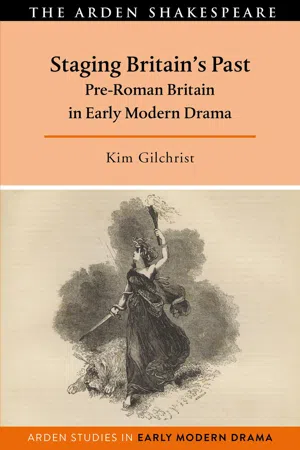
eBook - ePub
Staging Britain's Past
Pre-Roman Britain in Early Modern Drama
- 296 pages
- English
- ePUB (mobile friendly)
- Available on iOS & Android
eBook - ePub
Staging Britain's Past
Pre-Roman Britain in Early Modern Drama
About this book
Information
1
Geoffrey of Monmouth and Etiological Erosion
Brutan performance was received within the context of a polyvocal and intertextual narrative tradition that dated back to the twelfth century. From their inception the Brutan histories had been disseminated not only through expensive manuscripts and specialist historiographic books but also through popular forms such as ballads, narrative poetry and almanacs. This complex transmission resulted in multiple, sometimes conflicting, accounts of Britain’s origins. The production and reception of these, as shown in the Introduction, were determined in part by issues such as literacy, religion and social grouping. In the early modern era, the Brutan histories were being more frequently questioned by writers from Polydore Vergil in the 1530s to William Camden in Britannia (1586); however, support for the traditional account of pre-Roman Britain was continually shored up via a steady flow of defensive chronicles and treatises, as well as texts and events that endorsed Brutan historicity simply by failing to acknowledge its doubtfulness. This shoring up is also visible in the continued early modern popularity of medieval prose histories in print and in manuscript. Beyond the readers who encountered this textual tug of war, however, it is unlikely that many people were even aware that there was anything to doubt. Understanding this, I suggest, is essential for understanding the dramatic performance of Britain’s ancient past, particularly in terms of its reception.
This chapter outlines the transmission of the Brutan histories from the twelfth to the seventeenth centuries and their gradual, uneven disappearance from historical consciousness. This process has been mapped by previous scholars and my account is in large part conventional and indebted to these.1 However, accounts of this erosion are often presented as overly linear – the early modern doubt being sown by Vergil and eventually consolidated by Camden and John Speed. While this is also, broadly, the narrative that needs to be outlined, Daniel Woolf has noted that ‘[t]he study of popular culture and the influence of postcolonial theory have also made us deeply aware that perceptions of the past are not necessarily uniformly shared at all levels of society, nor uncontested’ (2005: 36). And, in relation to the Brutan histories, Andrew Griffin has recently challenged this overly tidy account of historiographic progression as a ‘narrative of methodological supersession’ that ‘occludes a more complicated and stranger story’ (2019: 93). I will therefore pause along the way to challenge and complicate this picture by offering brief case studies that place better-known Brutan and anti-Brutan texts alongside contemporaneous, but critically overlooked, texts such as William Warner’s Albions England (1586) and Thomas Deloney’s Garland of Goodwill (c. 1593). Even as the Brutan histories were being challenged, many of these works endorsed and further disseminated Brutan material in other milieux, often beyond the secure textual record into the realm of wider, non-literate, popular culture. If the ‘stranger story’ argued for by Griffin is to be told, then forms such as the ballad must be considered alongside works that have left a more secure footprint within critical tradition, such as the pragmatic historiography of Camden, or Spenser’s poesie-historical appropriations. Drawing attention to both the intertextuality and contradictions between these Brutan works invites reflection on the historical dissonance that exposure to such a variety of material might have provoked. My attentiveness to lesser-known texts is particularly revealing of attitudes to Brutan historicity in the later Jacobean and early Caroline periods when, contrary to the traditional account, in which Camden’s Britannia is viewed as representing something of a ‘case closed’ moment for Brutan historiography, we see, if anything, a new burst of Brutan engagement into the 1630s, including Charles I’s performance as ‘Albanactus’ in the masque Albions Triumph (1632). This chapter’s final section returns to performance, using the preceding material to establish the first known Brutan drama as the outcome of centuries of Brutan confluence, that of the ancient British king known variously as Gorbodian, Gorbodug or Gorboduc.
Before beginning this survey of the Brutan histories’ transmission, I would like to offer, as I did with the performance of Leir at the Rose playhouse in 1594, an initial case study of the ways in which the Brutan histories were deployed, debated and encountered across an intersecting range of textual communities. The central figure in this instance, rather than the unfortunate though fictional Lear, is the unfortunate and very real Richard Harvey, brother of the better-known Gabriel. Reading Harvey’s 1593 defence of the Brutan histories, Philadelphus, in the moment of its publication, allows us to glimpse a culture of teeming Brutan perspectives.
Philadelphus catalogues the vices and virtues of the Brutan rulers while asserting their historical truth. Following a dedication to the Earl of Essex and a letter to his brother Gabriel, this short book launches into Harvey’s impassioned, yet carefully argued, refutation of George Buchanan’s Rerum Scoticarum Historia (Edinburgh, 1582). Like Vergil’s Anglia Historia (Basel, 1534) – at which Harvey also takes occasional swipes – Buchanan questioned Brutan historicity: ‘Yet neyther seuen Polydores more, nor ten Buchanans shall perswade me, that this Genealogy is a fabulous Tale’ (1593: sig. C3r). Evidence from another text suggests that Harvey’s Brutanism was intense and long-standing. Certainly, he was mocked for it. In an episode reported by the Harveys’ frequent adversary-in-print Thomas Nashe, in Have with You to Saffron Waldon (1596), Christopher Marlowe characterizes Harvey’s advocacy of Brute as a kind of derangement:
[T]hat Dick, of whom Kit Marloe was wont to say, that he was an asse, good for nothing but to preach of the Iron Age . . . Dick the true Brute or noble Troian, or Dick that hath vowd to liue and die in defence of Brute, and this our iles first offspring from the Troian, Dick against baldnes, Dick, against Buchanan. (1596: sig. N3v)
Nashe’s use of his friend’s insults demonstrates several things.2 First, the likelihood that these comments predate the publication of Philadelphus, Marlowe having died in May 1593. Second, the overheated voice Marlowe attributes to Harvey offers clues to the tonality in which Philadelphus might be read. Have with You is a highly partisan and satirical text – principally, it’s an attack on Gabriel Harvey – and it backdates this complex network of rivalries to the participants’ time as students at Cambridge. Richard Harvey, we are told, was awarded the extraordinary distinction of having a play staged about him by his fellow students, ‘Duns furens’ or ‘Dick Haruey in a frensie’ (1596: sig. N1r). In response to the play, Nashe recalls, Harvey ‘broke the Colledge glasse windowes; and Doctor Perne (being then either for himselfe or Deputie Vice-chancellour), caused him to be fetcht in, and set in the Stockes till the Shew was ended’ (1596: sig. N1r). Nashe’s portrait of Harvey, partisan as it is, associates the defence of Brute with a particular kind of personality: ridiculous, violent, unpopular even with the deputy vice-chancellor, who appears to have wanted to finish watching ‘Duns Furens’ in peace. Yet, via Have with You, Harvey is also obliquely connected to one of the Brutan histories’ most wide-ranging and popular manifestations.
Readers of Have with You, on turning the page to read of ‘Dick the true Brute’, would have just encountered a reference to Thomas Deloney, the ‘Balleting Silke-weauer’, and his Garland of Good Will which, like Philadelphus, seems to have been published in 1593, when it was registered with the Stationers’ Company. However, the earliest extant copy dates from 1626, suggesting both that its popularity was enduring and that the book was read to pieces on a large scale. Among its twenty-seven ballads, Garland includes one on Estrild, the unfortunate mistress of Locrine, the first king of Britain and son of Brute. The companion of Humber, who invades Britain only to be defeated by Locrine, Estrild is ensconced by the British king in a subterranean boudoir before being made his queen. Enraged, Locrine’s current queen, Guendolen, raises an army of Cornishmen, defeats Locrine in battle and has Estrild and her daughter Sabren bound and thrown into a nearby river. Deloney was ‘the leading ballad maker’ of the era (Marsh 2019: 128). Many of Garland’s ballads had been previously printed as broadsides (Carpenter 2006: 139). This means that their circulation and popularity were even more comprehensive than already attested by its impressive republication rate. Here, Nashe’s textual community of rival pamphleteering graduates opens up to include a London artisan famous for ballad-making. As Tessa Watt has noted, ‘there was theoretically no man, woman or child who could not have access to a broadside ballad, at least in its oral form, when it was sung aloud’ (1991: 13). Deloney’s Brutan ballad of the ‘Dukes Daughter of Corwal’ can thus be situated as a source of self-performance and communal song within the broadest possible textual community. It allowed Estrild’s tragic story to be taken up alongside Garland’s many other songs of mistreated and tragic royal mistresses, asserting her place within popular, self-performed history.
Ballads were hugely popular even as writers and elite consumers of the era fretted over the form’s perceived ‘low’ cultural and literary status (Carpenter 2006: 140–1). One of these writers was Thomas Lodge, who in 1579 had attacked ballads and those who wrote and sang them as ‘odde rymes which runnes in euery rascales mouth’ (1979: f. 20). In 1593, Lodge had, like Deloney, published his own version of the story of Estrild, ‘The Complaint of Elstred’, included in his collection of sonnets and poems, Phillis. Have with You thus offers a snapshot of intersecting Brutan dialogues and cultural uses in mid-1590s print, in which the artisan-class writer of a Brutan ballad appears on the same page as mockery of the author of an impassioned Brutan defence and, according to Marlowe, self-proclaimed ‘true Trojan’. Both texts were published in 1593, the same year in which a university-educated critic of ballads, Thomas Lodge, saw his own ‘Complaint of Elstred’ into print. The defence, the ballad and the poem of 1593 all speak to the circulation of the Brutan histories through multiple literary factions and textual communities. Yet, as indicated by Nashe’s mockery, there was also dissonance and doubt. These undercurrents can perhaps be detected in even the most ardent of Brutan defenders: Richard Harvey himself.
One point of apparent weakness in the received account of Brutan history was a sequence of approximately twenty-four kings, about whom the source text of these histories, Geoffrey’s Historia, offered no information and regarding whom Holinshed’s Chronicles (1577; expanded edition pub. 1587) admitted to ‘great diuersitie in writers touching the reignes of these kings, and not onlie for the number of yéeres which they should continue in their reignes but also in their names’ (1587: I, Hist. 22).3 That is, the silence regarding the events and duration of these reigns raised uncomfortable questions regarding the historicity of the larger narrative in which the y were embedded. In Philadelphus, Harvey offers an extraordinary range of justifications for this unsettling lacuna. For its sustained energy and the resourceful invention of his reasoning, the passage is worth quoting at length:
They were now I may well say kinges Abstracts: that they did it no where, either incomprehensibly like Gods, or metaphisically like strange men . . . . A king cannot possibly be without his excellencies, and memorials. Now I diuine modestly, heere were actors without recorders of their actions, patrons of learning, but no learned men: or, they were of both sortes, but their studies came to no effect, by some force: or, they were very old when they came to the Crown, and could do nothing: or, the furies and helhoundes raged so extreamely, that the Muses and Graces coulde not bee quiet for them: or, their actes were wrought in needleworke onely, and so worne out: or, the senses, and senslesse desires so ruled them, that theyr liues were not so short as their actes: or, the Histories were written in some strange kind of polygraphy and steganography, and coulde neuer yet be read, but remaine in some obscure place: or, they made little account of writers, and these set as light by them: or, they that take most pains at their booke, were not most regarded: and thereupon studied to themselues: or, some infortunate and maleuolent configuration of mouable skies and starres, and spirites remoued all Histories out of the way: or, the Kinges and People agreed among themselues, to bee remembred by being not remembred, wishing to haue their time called The vnknowe Regiment, adiudging secrecie greatest wisedome: or, our Countrimen listened so much after other Noble Actors in the earth, that they had no leisure, to doe any thing themselues: or, they disdained to haue them theyr iudges after their death, whom they would scorne to haue their iudges in their life: or, some outlandish enuy destroyed the rowles and registers of our Histories, to make vs seem barbarous: or, the Vniuersitie men of Stamford had by some Priuiledge got them wiues, and so forth: and had no leisure to do any thing but liue: or, before the kings were crowned, they were worthy men, and after theyr coronations they fell to make books of nothing . . . it was not thus, or so: perhaps, neither this, nor that, but some other way, I cannot tell howe, nor I care not greatly, for feare I may bee thought neither idle, nor well occupied. (1593: sig. H2v–sig. H3v)
Harvey appears both moved and disturbed by Buchanan’s attacks as he accumulates contortions and paradoxes. Each proposed scenario tumbles into negation. There were actors but no action; patrons of learn...
Table of contents
- Cover
- Half-Title
- Series
- Title
- Contents
- List of Illustrations
- Acknowledgements
- Note on Texts
- Introduction
- 1 Geoffrey of Monmouth and Etiological Erosion
- 2 Staging Brutan Origins (1486–1600)
- 3 Reading Brutan Erosion (1604–8)
- 4 The Diminution of Brutan Time (1610–37)
- Conclusions
- Notes
- Works Cited
- Index
- Copyright
Trusted by 375,005 students
Access to over 1.5 million titles for a fair monthly price.
Study more efficiently using our study tools.
Frequently asked questions
Yes, you can cancel anytime from the Subscription tab in your account settings on the Perlego website. Your subscription will stay active until the end of your current billing period. Learn how to cancel your subscription
No, books cannot be downloaded as external files, such as PDFs, for use outside of Perlego. However, you can download books within the Perlego app for offline reading on mobile or tablet. Learn how to download books offline
Perlego offers two plans: Essential and Complete
- Essential is ideal for learners and professionals who enjoy exploring a wide range of subjects. Access the Essential Library with 800,000+ trusted titles and best-sellers across business, personal growth, and the humanities. Includes unlimited reading time and Standard Read Aloud voice.
- Complete: Perfect for advanced learners and researchers needing full, unrestricted access. Unlock 1.5M+ books across hundreds of subjects, including academic and specialized titles. The Complete Plan also includes advanced features like Premium Read Aloud and Research Assistant.
We are an online textbook subscription service, where you can get access to an entire online library for less than the price of a single book per month. With over 1.5 million books across 990+ topics, we’ve got you covered! Learn about our mission
Look out for the read-aloud symbol on your next book to see if you can listen to it. The read-aloud tool reads text aloud for you, highlighting the text as it is being read. You can pause it, speed it up and slow it down. Learn more about Read Aloud
Yes! You can use the Perlego app on both iOS and Android devices to read anytime, anywhere — even offline. Perfect for commutes or when you’re on the go.
Please note we cannot support devices running on iOS 13 and Android 7 or earlier. Learn more about using the app
Please note we cannot support devices running on iOS 13 and Android 7 or earlier. Learn more about using the app
Yes, you can access Staging Britain's Past by Kim Gilchrist, Lisa Hopkins, Douglas Bruster, Lisa Hopkins,Douglas Bruster in PDF and/or ePUB format, as well as other popular books in Literatur & Literaturkritik im Drama. We have over 1.5 million books available in our catalogue for you to explore.