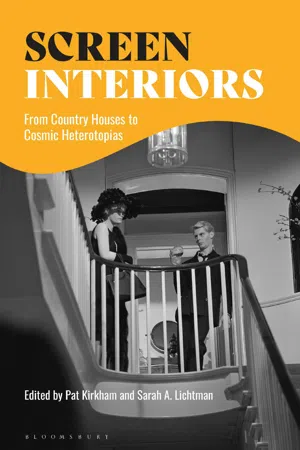
Covering everything from Hollywood films to Soviet cinema, London's queer spaces to spaceships, horror architecture and action scenes, Screen Interiors presents an array of innovative perspectives on film design.
Essays address questions related to interiors and objects in film and television from the early 1900s up until the present day. Authors explore how interior film design can facilitate action and amplify tensions, how rooms are employed as structural devices and how designed spaces can contribute to the construction of identities. Case studies look at disjunctions between interior and exterior design and the inter-relationship of production design and narrative.
With a lens on class, sexuality and identity across a range of films including Twilight of a Woman's Soul (1913), The Servant (1963), Caravaggio (1986), and Passengers (2016), and illustrated with film stills throughout, Screen Interiors showcases an array of methodological approaches for the study of film and design history.
eBook - ePub
Screen Interiors
From Country Houses to Cosmic Heterotopias
- 368 pages
- English
- ePUB (mobile friendly)
- Available on iOS & Android
eBook - ePub
Screen Interiors
From Country Houses to Cosmic Heterotopias
About this book
Information
PART 1
HOUSE AND HOME: COMFORT, CLASS,
GENDER, AND GENERATION
CHAPTER 1
COMFORT AND THE DOMESTIC INTERIOR IN SOVIET FICTION CINEMA OF THE 1920s
Eleanor Rees
This chapter examines how discourses about home comfort were represented in Soviet fiction films of the 1920s.1 During this period, a severe shortage in urban housing forced many city dwellers to live in cramped, single-room apartments or in subleased corners of rooms alongside strangers. This chapter explores how films showed that, despite a lack of private living space, individuals endeavored to create a sense of comfort at home through the practices of reordering, refurbishing, and decorating. Many social and artistic discourses of the period seemed to denounce the ornamental in favor of stripped-down interiors furnished according to the principles of maximum functionality and simplicity. This chapter also considers what form of comfort was deemed appropriate amid this context. The emphasis on comfort in this chapter sheds light on a less researched aspect of Soviet design practices and discourses, which are typically discussed in relation to Constructivist models of rationalization.
In the June 1926 issue of the monthly lifestyle magazine Women’s Journal (Zhenskii zhurnal), the title of the opening article posed the question, “How is domestic comfort created?”2 “We live, as everyone knows well, in close quarters,” wrote the article’s author V. Ostrovskii. “Housing is let out at what we call the ‘stingy rate,’ with only the most necessary furniture; there is no room to turn in our flats, but we still clutter them up with all kinds of unneeded things, naively believing that we are creating comfort and beauty.” Although Ostrovskii stressed the need for a rational approach to furnishing domestic space, he also recognized that comfort is essential, arguing that its creation at home is both a natural human impulse and a social imperative, as “a lack of comfort will drive the tenant’s feet to other cozy settings such as the tavern or the beer hall.” Ostrovskii’s article formed part of a heated debate about the configuration of interiors and the improvement of living standards that emerged in Soviet Russia during the New Economic Policy (NEP) era, from 1921 to 1927, and reached a climax during the Cultural Revolution, from 1928 to 1932. This debate was a direct response to the urban housing crisis of the period, in which a shortage of available living space forced many city dwellers to lodge in cramped, single-room apartments or in subleased corners of rooms alongside strangers.3 It was also linked to a widespread aesthetic campaign against the entrenchment of bourgeois values, which, for many leftist critics, the permission of limited market capitalism under the NEP had exacerbated.
Scholarship on Soviet artistic discourses of the 1920s has tended to focus on how avant-garde artists, in particular those associated with Constructivism, engaged with the debate about living conditions through both their dismissal of the decorative and their advocacy of interiors furnished according to the principles of maximum functionality and simplicity. However, as Karen Kettering and Emma Widdis show, a desire to create cozy interiors was prevalent during the period, and the divide as well as the overlap between the decorative and the functional was complex.4 Moreover, Victor Buchli demonstrates the ambiguities surrounding the notion of comfort at the time and argues that, over the course of the 1920s, ideas about comfort underwent substantial change.5
This chapter explores how Soviet fiction cinema engaged with evolving discourses about domestic comfort during the transition from the NEP era to the Cultural Revolution. It discusses three fiction films in which domestic interiors feature prominently: Abram Room’s Bed and Sofa (Tret´ia Meshchanskaia, 1927), Boris Barnet’s The Girl with a Hatbox (Devushka s korobkoi, 1927), and Fridrikh Ermler’s Fragment of an Empire (Oblomok imperii, 1929). The films all explicitly address the problems of living conditions and the persistence of bourgeois conventions in contemporary Soviet Russia. Each film, however, approaches these issues in a distinct way, reflecting different understandings of comfort as an approach to decorating living space, a mode of inhabitation, a form of sociability, and a psychological attachment to familiar ways of life. Moreover, each film considered in this chapter was made by a different filmmaking team and demonstrates a distinct approach to representing the domestic environment. The chapter therefore also explores how filmmakers grappled with the task of representing interior space and how they used elements of interior architecture and design to exploit cinema’s expressive capacity.
Material excess: Bed and Sofa
In a statement outlining his intentions for his proposed film Bed and Sofa, Abram Room wrote that, among other issues, he attempted to address the pressing contemporary concerns of the bourgeoisie’s obsession with material things and their social apathy.6 He claimed that while these issues had been discussed in the press, in public debates, and even on the theatrical stage, they had not yet been touched upon in Soviet cinema. Indeed, Bed and Sofa was one of the first of a number of films made in the mid- to late 1920s to tackle the Soviet housing problem and the entrenchment of bourgeois values under the NEP.7 The film’s scenario, which Room co-wrote with the formalist theorist Viktor Shklovskii, was based on an anecdote that Shklovskii had read in the Young Communist League newspaper Komsomol´skaia pravda.8 It tells the story of a young print worker, Volodia, who travels to Moscow in search of employment. With nowhere to live, he accepts an offer to stay on the sofa in the one-room apartment of an old army friend, Kolia, and his wife, Liuda. While Kolia is on a business trip, Liuda and Volodia begin an affair. On Kolia’s return, the three characters settle into a ménage à trois, with Volodia moving into the bed and Kolia onto the sofa. The living situation proves increasingly problematic. Liuda falls pregnant and both men decide on an abortion. Waiting in the abortion clinic, Liuda, however, resolves to keep the child and to leave both men and her bourgeois lifestyle.
In addition to basing the scenario on contemporary reality, Bed and Sofa was the first Soviet fiction film to incorporate extensively unstaged footage of contemporary Moscow.9 Although studio scenery is used for the interior scenes, the film is set in a real location—Tret´ia Meshchanskaia, a Moscow street synonymous with petit-...
Table of contents
- Cover
- Dedication
- Title Page
- Contents
- List of Figures
- Acknowledgments
- Introducing Screen Interiors: From Country Houses to Cosmic Heterotopias
- Part 1 House and Home: Comfort, Class, Gender, and Generation
- 1 Comfort and the Domestic Interior in Soviet Fiction Cinema of the 1920s
- 2 Furnishing I Love Lucy (19517)
- 3 From the Country House Film to the House in the Country Film: Space, Class, and Generation
- 4 Space, Interiors, and 1980s Hollywood Teen Films
- Part 2 The Curated Home
- 5 Mobilizing Material Culture: Collecting and Interiority in Luchino Viscontis Conversation Piece (1974)
- 6 From Sex to Narcissism: Understanding Minimalist Interiors in New York Films of the 1970s
- 7 Home furnishing takes a cue from Paris, too: The Fashion Professional at Work and Home in Postwar Hollywood Films, c. 195761
- Part 3 Framing Interiors and Interiorities
- 8 Framing Interiorities: Interiors, Objects, and Hidden Desires in Billy Wilders The Apartment (1960)
- 9 Frames, Veils, and Windows: Modern Cinematic Set Design in Early Russian Films by Evgenii Bauer
- Part 4 Screening Queerness: Class, Ambiguity, and Power
- 10 Interiors, Class, Perversity, and Ambiguity in The Servant (1963)
- 11 In Plain View: London Commercial Interiors as Queer Spaces in Three 1960s British Films: Victim (1961), The Leather Boys (1964), and The Killing of Sister George (1968)
- 12 Queer Interiors: Derek Jarmans Caravaggio (1986) and Edward II (1992)
- Part 5 Horror and Homicide
- 13 The Horror of the Homicidal Floor: Destabilized Elements of Interior Architecture
- 14 Designed to Destroy: Action Film Interiors and the Construction of Killscapes
- Part 6 Living in Outer Space: Sci-Fi Interiors
- 15 Visions of Home: Nostalgia and Mobility, Past, Present, and Future, in Serenitys Domestic Spaceship Interior
- 16 Cosmic Heterotopia: Banality and Disjunction in the Interiors of Passengers (2016)
- Notes on Contributors
- Index
- 1
- Copyright
Trusted by 375,005 students
Access to over 1.5 million titles for a fair monthly price.
Study more efficiently using our study tools.
Frequently asked questions
Yes, you can cancel anytime from the Subscription tab in your account settings on the Perlego website. Your subscription will stay active until the end of your current billing period. Learn how to cancel your subscription
No, books cannot be downloaded as external files, such as PDFs, for use outside of Perlego. However, you can download books within the Perlego app for offline reading on mobile or tablet. Learn how to download books offline
Perlego offers two plans: Essential and Complete
- Essential is ideal for learners and professionals who enjoy exploring a wide range of subjects. Access the Essential Library with 800,000+ trusted titles and best-sellers across business, personal growth, and the humanities. Includes unlimited reading time and Standard Read Aloud voice.
- Complete: Perfect for advanced learners and researchers needing full, unrestricted access. Unlock 1.5M+ books across hundreds of subjects, including academic and specialized titles. The Complete Plan also includes advanced features like Premium Read Aloud and Research Assistant.
We are an online textbook subscription service, where you can get access to an entire online library for less than the price of a single book per month. With over 1.5 million books across 990+ topics, we’ve got you covered! Learn about our mission
Look out for the read-aloud symbol on your next book to see if you can listen to it. The read-aloud tool reads text aloud for you, highlighting the text as it is being read. You can pause it, speed it up and slow it down. Learn more about Read Aloud
Yes! You can use the Perlego app on both iOS and Android devices to read anytime, anywhere — even offline. Perfect for commutes or when you’re on the go.
Please note we cannot support devices running on iOS 13 and Android 7 or earlier. Learn more about using the app
Please note we cannot support devices running on iOS 13 and Android 7 or earlier. Learn more about using the app
Yes, you can access Screen Interiors by Pat Kirkham, Sarah A. Lichtman, Pat Kirkham,Sarah A. Lichtman in PDF and/or ePUB format, as well as other popular books in Design & Interior Design. We have over 1.5 million books available in our catalogue for you to explore.