Patriotism and Profit
eBook - ePub

Patriotism and Profit

Washington, Hamilton, Schuyler & the Rivalry for America's Capital City

  1. 352 pages
  2. English
  3. ePUB (mobile friendly)
  4. Available on iOS & Android
eBook - ePub

Patriotism and Profit

Washington, Hamilton, Schuyler & the Rivalry for America's Capital City

About this book

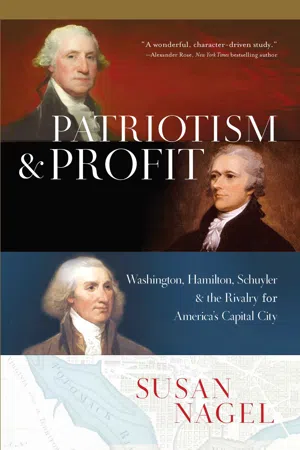
The untold story of how America's beloved first president, George Washington, borrowed, leveraged, and coerced his way into masterminding the key land purchase of the American era: the creation of the nation's capital city. Contrary to the popular historical record, Thomas Jefferson was not even a minor player at The Dinner Table Bargain, now known as The Compromise of 1790. The real protagonists of the Dinner Table Bargain were President George Washington and New York Senator Philip Schuyler, who engaged in the battle that would separate our financial capital from our political seat of power.Washington and Schuyler's dueling ambitions provoked an intense decades-long rivalry and a protracted crusade for the location of thenew empire city. Alexander Hamilton, son-in-law to Schuyler and surrogate son to George Washington, was helplessly caught inthe middle. This invigorating narrative vividly depicts New York City when it was the nation's seat of government. Susan Nagel captures the spirit, speech, and sensibility of the era in full and entertaining form—and readers will get to know the city's eighteenth-century movers, shakers, and power brokers, who are as colorful and fascinating as their counterparts today. Delicious political intrigue and scandalous gossip between the three competing alpha personalities—George Washington, Philip Schuyler, and Alexander Hamilton—make this a powerful and resonant history, reminding us that our Founding Fathers were brilliant but oftenflawed human beings. They were avaricious, passionate, and visionary. They loved, hated, sacrificed, and aspired. Even their most vicious qualities are partof the reason why, for better or worse, the United States became the premier modern empire, born from figures carving theirlegaciesinto history. Not only thedramatic story of how America's beloved first president George Washington created the nation's capital city, Patriotism & Profit serves astimely exposĂ© on issues facing Americatoday, revealing the origins behind some of our nation's most pressingproblems.
Frequently asked questions

Yes, you can cancel anytime from the Subscription tab in your account settings on the Perlego website. Your subscription will stay active until the end of your current billing period. Learn how to cancel your subscription.
No, books cannot be downloaded as external files, such as PDFs, for use outside of Perlego. However, you can download books within the Perlego app for offline reading on mobile or tablet. Learn more here.
Perlego offers two plans: Essential and Complete
  • Essential is ideal for learners and professionals who enjoy exploring a wide range of subjects. Access the Essential Library with 800,000+ trusted titles and best-sellers across business, personal growth, and the humanities. Includes unlimited reading time and Standard Read Aloud voice.
  • Complete: Perfect for advanced learners and researchers needing full, unrestricted access. Unlock 1.4M+ books across hundreds of subjects, including academic and specialized titles. The Complete Plan also includes advanced features like Premium Read Aloud and Research Assistant.
Both plans are available with monthly, semester, or annual billing cycles.
We are an online textbook subscription service, where you can get access to an entire online library for less than the price of a single book per month. With over 1 million books across 1000+ topics, we’ve got you covered! Learn more here.
Look out for the read-aloud symbol on your next book to see if you can listen to it. The read-aloud tool reads text aloud for you, highlighting the text as it is being read. You can pause it, speed it up and slow it down. Learn more here.
Yes! You can use the Perlego app on both iOS or Android devices to read anytime, anywhere — even offline. Perfect for commutes or when you’re on the go.
Please note we cannot support devices running on iOS 13 and Android 7 or earlier. Learn more about using the app.
Yes, you can access Patriotism and Profit by Susan Nagel in PDF and/or ePUB format, as well as other popular books in History & Early American History. We have over one million books available in our catalogue for you to explore.

Information

PART I
COLONIAL RIVALS

CHAPTER 1 The Race for a New World Capital of Empire

THE “OFFICIAL” NARRATIVE OF THE thousand-year-old panoramic struggle for the capital city of the New World empire appears in a painstakingly curated assemblage of art in the Rotunda of United States Capitol Building. Visitors to the Capitol can perch on a balcony some 152 feet in the air from the floor of the Rotunda and peer above into an oculus. Girdling the circumference of the vault is a continuous series of paintings and trompe l’oeil friezes that illustrate a varnished version of the epic story. Soaring even sixty-seven feet higher at the apex of the dome, a 4,664-square-foot allegorical fresco called the Apotheosis of Washington crowns the cupola. The ceiling mural, painted sixty-six years after George Washington’s death, depicts the nation’s first president, flanked by two female figures representing Liberty and Victory, ascending toward heaven. Washington and the rest of his exalted cluster are encircled by groupings of Roman gods and goddesses meant to symbolize war, science, the sea, commerce, agriculture, and mechanics; Washington is deified, and United States exceptionalism is divinely ordained.
Positioned near George Washington in the tableau is Vulcan, the god of fire, who is standing at his anvil, foot atop a cannon, boldly affirming that success and progress were predestined for the United States. Vulcan’s important placement is undoubtedly owing to his contribution to the location of the capital city itself: the providential invention in 1770 of the rubber eraser, which would lay the foundation for the 1839 innovation of vulcanized rubber, would play a significant role in the fate of where the federal government of the American empire would reside.
The story of the rise of every great empire begins with the founding of its capital city. This origin mythology explains the rise to greatness and reveals the values of its civilization. In the Judeo-Christian Bible’s book of Genesis, Cain, who has murdered his brother, flees to Nod, east of Eden, gets married somewhere along the way, and then builds “a city
 the name of the city after the name of his son—Enoch.” Noah’s sons allegedly traveled the earth establishing post-flood seats of empire. Biblical patriarch Isaiah claims to have created Jerusalem. In Revelation, the perfect seat of the eternal empire is revealed to be laid out in a square.
Classical mythology includes figures like the Sumerian Gilgamesh, Alexander the Great, and Theseus, who all created seats of empire. The Aeneid, which begins, “dum conderet urbem”—“until he should found a city”—echoes in the fourth Eclogue, that this new empire city will create a new world order: “Magnus ab integro saeclorum nascitur ordo.” Romulus and Remus fought each other in about 753 B.C.E., according to lore, for the privilege of choosing the location of Rome: Romulus preferred Palatine Hill, Remus selected Aventine. Romulus kills his brother, and the matter is settled. To perpetuate imperial propaganda, the Roman calendar actually points to the beginning of its empire as “Ab urbe condita”—“from the founding of the city.”
Through the collaboration of professionals from varying fields and diverse scientific methods like DNA testing, carbon dating, and chemical deconstruction, ancient physical and organic matter can be accurately identified. There is now concrete proof of the physical presence of western Europeans in the New World as long ago as the early Middle Ages. There have been mysterious tales that spoke of transatlantic journeys but all had been dismissed as folklore. One such Irish “immram,” known as the “Voyage of Saint Brendan the Abbot,” details the perilous voyage of a group of monks who went to sea in a primitive leather-hulled boat called a “currah.” Their leader, Brendan, who really did live c. 484–577 C.E., and his fellow friars arrived at a faraway “Isle of the Blessed.” For nearly 1,500 years, there was conjecture that this distant Promised Land of Saints was North America but it was thought impossible for such a crude vessel to sail across the Atlantic Ocean. In the 1970s, however, British explorer Timothy Severin crafted a replica of St. Brendan’s boat and successfully completed the trip, proving that the voyage was indeed feasible. More recently, a group of scientists and linguistic experts have uncovered petroglyphs on rocks in West Virginia that they authenticated as sixth-century C.E. Ogam (Old Irish) carvings.
European yearnings for a New World empire can again be traced to the year 1000 C.E. when, led by the sun, the stars, and a shard of light-polarizing crystal for cloudy days, a group of brutal hyperborean Vikings made their own foray to North America. The king of Norway had dispatched “Lucky” Leif Erikson into uncharted waters to find and convert heathens. Erikson’s Norwegian-born father, Erik the Red, and his grandfather were on the run from murder charges, and, while he was a reluctant convert, he was an eager and daring voyager. His exploits were chronicled by many, among them his contemporary Adam of Bremen, and in the “Greenlanders Saga.” According to both, Erikson journeyed to a place called “Vinland,” where he established a Christian settlement. The ambiguous location and the mysterious evaporation of the European society at “Vinland” continue to tantalize. Some have asserted that “Vinland” was, in reality, the island of Newfoundland. A Viking settlement, named “L’Anse aux Meadows” by the French, has been excavated there, but there is no irrefutable proof that it was the site of Erikson’s New World society. More recently, archaeologist Erik Wahlgren and Icelandic climate expert Pall Bergthorsson have separately concluded that based upon the descriptions of fish, flora, fauna, and the climate described in the saga, “Vinland” was most probably located around New York Harbor and the Hudson River.
When Erikson’s New World Viking colony was established at the dawn of the eleventh century, London was still an insignificant, small commercial town. Sixty-six years later, in 1066 C.E., King William of Normandy, whose great-great-great-grandfather was a Viking raider named Rollo, conquered England. The island of Britain would remain in turmoil for another hundred years. According to a medieval romance, Prince Madog ab Owain Gwynedd, one of nineteen children of the king of Wales, could not tolerate the violence. Madog took one hundred traveling companions and went in search of a new world where he could live the rest of his life in serenity. It is alleged that the group arrived in North America in 1170 C.E. and established a new city. Although there is no extant authentic contemporaneous chronicle, two poems, one by a Welshman and one by a Flemish poet, that were written within fifty years of Madog’s escape do survive. Both make reference to the “splendid” prince of peace.
No archaeological evidence has been found of Madog’s “paradise” of “love and music,” which is said to have been located everywhere from present-day Louisville to Mexico, but a story was passed on for generations that the Welsh Ă©migrĂ©s met and married the Native Americans. In the eighteenth century, there were a handful of reports from European immigrants to North America that Welsh-speaking tribes were living in Tennessee and along the Missouri River. Called the Mandans, this tribe fished from boats known as coracles, which were similar to those still found in Wales today; the Mandans had also constructed villages with streets and squares, a pattern unknown to other pre-Columbian Natives.
Some 250 years after Madog and companions allegedly found their utopian oasis in the New World, thousands of miles to the east the Ottomans forcibly gained control of Constantinople—the capital city that bridged two Old World continents. The fierce Turkish military cut off the Silk Road from European contact, coercing the Europeans to find another route to China. The Portuguese began sailing south, west, and north to reach the East. They sailed the coast of Africa, establishing trading posts, and around the continent to India and Asia. Lisbon soon became the premier metropolis in Europe. The Portuguese success prompted the Spanish to enter the exploration fray. Territorial discovery was a lawless pursuit, and the booty remained in the hands of the strongest.
Italian-born Christopher Columbus petitioned the king of Portugal to support a voyage but was declined. Columbus next approached the king of Spain. While waiting for an answer, Columbus dispatched his brother, Bartholomew, to King Henry VII of England with the same proposal. By the time Bartholomew returned to Spain with an agreement from Henry, Christopher Columbus had already received patronage from the Castilians. In 1492, nearly one thousand years after Saint Brendan was alleged to have found his city of goodness, Columbus stumbled upon the Caribbean islands. The game immediately changed, and the race for a New World empire city accelerated.
The Portuguese not only regretted their rebuff but they also now felt their supremacy over the seas threatened. When Columbus established two settlements on the island of Hispaniola in Central America, the Portuguese protested. The menace of war now loomed between the two Catholic countries so Pope Alexander VI stepped in to mediate. His solution was nothing short of the wisdom of King Solomon. The pope drew a vertical line some two thousand miles west of the Cape Verde islands: all new discoveries west of that line would belong to Spain, and, those east of that demarcation would belong to Portugal. He signed two papal bulls, and it was so—for the moment. The treaties were subsequently amended, and the Portuguese began seeding Brazil with Jews escaping the Spanish Inquisition.
King Henry VII of England, completely ignoring the pope, launched a navigation of his own. Henry granted Italian-born Giovanni Caboto (John Cabot) a petition to sail to North America in 1496. Cabot’s first voyage was unsuccessful but on a subsequent voyage in 1497, he arrived in Newfoundland, which he—and King Henry VII—claimed for England. Newfoundland had been populated by Beothuk Natives for over a thousand years. Every spring, the Beothuk would paint their bodies and their houses a bright red color, which custom gave rise to the “red man” designation for American Indigenous peoples among the British. While the island was the first foothold for the English in North America, no effort to settle the island would be attempted for another hundred years. Christopher Columbus learned of Cabot’s discovery from an anonymous “John Day” letter written by a Bristol merchant acquainted with both Cabot and himself. Cabot would be among many to challenge Columbus.
Columbus’s brother, Bartholomew, established his own settlement on Hispaniola and proclaimed it the official capital city. Christopher Columbus’s son, Diego Colón (the Hispanized version of Columbus), arrived at his uncle’s capital and, asserting hereditary rights over the islands that his father discovered, Diego began prolonged legal battles for autonomous rule. First, he battled with King Ferdinand and next, his successor, Holy Roman Emperor Charles V. Diego’s crusade for New World autonomy was in fact the first American Revolution. His palace, called Alcázar de Colón, still stands today in Santo Domingo, which remains the oldest continuously inhabited European-settled capital in the New World.
Diego ColĂłn’s capital city was the first major commercial city in New Spain and served as a magnet for rascals. The Founding Fathers of Central America gathered their forces in Santo Domingo among a rogue’s gallery of men who had exiled themselves from the Old World. Explorers like Vasco NĂșñez de Balboa, HernĂĄn CortĂ©s, Diego VelĂĄzquez de CuĂ©llar, and Juan Ponce de LeĂłn became collectively known as “conquistadores.” They were more feared than pirates. Armor-suited warrior messengers, these men delivered a stream of bloody coups d’états. Their sadism, confirmed by eyewitness accounts, became collectively known as the terrifying “Black Legend.” Some “conquistadores” would tie up entire Native villages, murder selected members of the Indigenous community, and then force them to eat one another. Other “conquistadores” favored roasting men alive like pigs over a fire. Still others preferred disemboweling their own countrymen and even their own family members, all for four fifths of whatever could be extracted from the New World. The king of Spain, whose swelling coffers were reaping his royal one-fifth, the “quinto real,” turned a blind eye to the barbarity; hence, the “Golden Age” of Spain began under a cloud of darkness.
In the Capitol Building Rotunda, all traces of the murder and mayhem perpetrated by the conquistadores have been whitewashed—erased from cultural memory—in the trompe l’oeil tableaux that memorialize these men and their voyages. Instead, the audacity of champions is celebrated. There is no illustration of how VelĂĄzquez de CuĂ©llar tamed the TaĂ­no Natives on Cuba by burning their chieftain alive when he refused to accept Christ. Neither is there a depiction of Francisco HernĂĄndez de CĂłrdoba’s massacre of the Natives on the Yucatan Peninsula. CĂłrdoba, who sailed with three ships and one hundred men through a very rough storm, arrived safely there, saw Mayan stone buildings, believed that the structures were the work of Muslims, and named the place El Oran Cairo (Cabo Catoche), which means “Little Cairo.” As a good Catholic Spaniard, he promptly supervised the genocide of the local “Muslims.”
The Rotunda frieze does narrate a cartoonish and cringeworthy version of the exploits of HernĂĄn CortĂ©s, who is seen entering a sacred Aztec temple, hailed as a god by Moctezuma II. That moment of harmony captured by an artist is pure fantasy. HernĂĄn CortĂ©s founded a city on the coast of Mexico, which was situated at the mouth of a river. He named it “Villahermosa”—“Beautiful Town.” To his surprise, two Spaniards appeared. These two men had been among fifteen survivors of a shipwreck a few years earlier; the other thirteen had either been sacrificed or worked to death by the Mayans. One of the men who stood before CortĂ©s had gone native: he now called himself “Cacique.” “Cacique” had learned Mayan, had married a Mayan princess with whom he had three children, and had become a chieftain. Mayor of his own city called Chetumal, “Cacique” told CortĂ©s to leave. The men fought, and ultimately CortĂ©s abandoned the town, dragging the other Spaniard with him to serve as interpreter. CortĂ©s also helped himself to a Native mistress named “La Malinche.”
“La Malinche” gave CortĂ©s valuable information. She informed him that the Aztec emperor, Moctezuma II, possessed vast quantities of gold at an inland city, known as Tenochtitlan. Tenochtitlan had served as the capital of the Aztec empire since 1325. CortĂ©s immediately hatched a plan to gain control over the fortune and the capital city. First, he scuttled his own vessels to prevent his crewmembers from escaping. Next, he declared himself ruler, denounced any other authority, and marshaled his own army to capture Tenochtitlan.
En route to Tenochtitlan, CortĂ©s found that a rival Spanish army had developed a parallel plan, and he found himself in combat with his own countrymen. CortĂ©s would often affirm that his worst opponent was not the Indigenous Aztec but his fellow Spaniards. CortĂ©s was merciless in battle, even beheading former friends. After slaughtering his own brethren, CortĂ©s went on to crush the Aztecs. The Aztecs, who fought with primitive spike-covered clubs, were no match for CortĂ©s, whose army was equipped with weapons of metal. CortĂ©s’s appearance before Moctezuma II was not as a friend as depicted in the Capitol Building Rotunda mural but as a vanquishing warrior. CortĂ©s, enjoying his triumph, even renamed the two-hundred-year-old seat of Aztec power Mexico City. He then went on to inflict a wider path of destruction, adding Honduras to his plunder.
A figure that looms large among the Eurocentric origin stories of New World Latin America is Vasco NĂșñez de Balboa. Balboa is rightfully hailed in official history as the founder of the Colombian city Santa MarĂ­a la Antigua del DariĂ©n, which boasts the double distinction of being the first capital city on the mainland of South America and having the first democratically elected government in the New World. Carefully censored from the story, however, was the fact that the Hispanic pioneers were so afraid of Balboa’s brutality that when they voted, they elected him “co-mayor,” limiting his power. Balboa’s incandescent ambition burned much brighter than serving as co-mayor of one town. On September 29, 1513, he became the first European to reach the Pacific Ocean through the Isthmus of Panama, for which he is also famous. Dramatically raising his sword, and with great fervor, he saluted the Pacific Ocean, opening the channel through which Spanish galleons could transport trunks of gold from the west coast of South America across the Isthmus of Panama and back to Spain. What is less often relayed is that owing to the number of men who died along the route, it became known as the “Camino de Cruces,” the “Path of Crosses.”
Another of the men lurking about the port on Hispaniola was Juan Ponce de LeĂłn. On one of his runs, Ponce de LeĂłn spied what he thought was an island. It was Florida. He stepped on shore, perhaps the first European man to set foot on continental North America since “Lucky” Leif Erikson’s arrival some five hundred years before (if, as scientists currently believe, the Vikings had landed and established “Vinland” around New York Harbor). The exact location of Ponce de LeĂłn’s arrival on mainland North America remains unknown; it is generally believed, however, that, despite popular lore, he did not alight at what today is the city of St. Augustine, which was founded fifty-two years later, in 1565, by Pedro MenĂ©ndez on August 28, the feast day of St. Augustine.
In the 1520s, Mexico City, Santo Domingo, and Havana were all competing to be the premier New World capital. These nascent cities were the physical, palpable representations of the dreams of fearless men who were desperate to sculpt New World fiefdoms. Panama City, founded by converso Pedro Arias Dávila, also became a contender. Dávila’s daughter would marry Hernando de Soto, who led the first European cavalcade into the interior of North America and arrived at the Mississippi River, an event also commemorated in the United States Capitol Building Rotunda.
The conquistadores were given free rein to ruthlessly manage their New World cities because Holy Roman Emperor Charles V was burdened with Old World matters like the Ottomans to the east and Protestants to the north. In 1525, the Emperor’s formidable counterparts included his uncle-by-marriage King Henry VIII of England, Ottoman Emperor Suleyman I (“the Magnificent”), Medici Pope Clement VII, and Venetian Doge Andrea Gritti. Charles received both uplifting news that year when the Spanish army captured and humiliated his longtime nemesis, King Francis I of France, in the Battle of Pavia, as well as distressing information that Francis was striking at Spain’s new domains.
Charles V had dispatched a convoy led by Portuguese-born EstĂȘvĂŁo Gomes into the colder waters of the Atlantic Ocean. Gomes sailed from Nova Scotia down the coastline of Maine, into New York Harbor, up the Hudson River, which he named the “San Antonio,” and south to Florida. When the Holy Roman Emperor learned that a French fleet captained by a Florentine sailor named Giovanni da Verrazzano had narrowly preceded Gomes into New York Bay, the monarch was livid. The French remained undaunted, and persevered with their own program of exploration. On behalf of the king of France, Jacques Cartier would map the Gulf of Saint Lawrence, which joined the Atlantic Ocean to the Great Lakes. Within ten years, the French would gain a sturdy foothold in North America and establish Quebec.
Maritime warfare became bigger business. Among the maneuvers employed to deter antagonists were impressment and the dissemination of disinformation, which included elaborately drawn and widely circulated fake maps. The bona fide atlases were kept in vaults, and cartographers became very valuable people. They were sometimes held for ransom or detained by...

Table of contents

  1. Cover
  2. Map of the United States 1783
  3. Title Page
  4. A Note on Spelling
  5. Dedication
  6. Preface: It Did Not Happen in the Room
  7. Part I: Colonial Rivals
  8. Part II: A Tale of Two Cities
  9. Photographs
  10. Acknowledgments
  11. About the Author
  12. Endnotes
  13. Bibliography
  14. Index
  15. Copyright