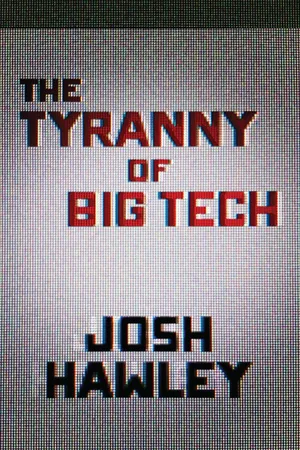
The Tyranny of Big Tech
eBook - ePub

The Tyranny of Big Tech

  1. 320 pages
  2. English
  3. ePUB (mobile friendly)
  4. Available on iOS & Android
eBook - ePub

The Tyranny of Big Tech

About this book

The reign of Big Tech is here, and Americans’ First Amendment rights hang by a keystroke.

Amassing unimaginable amounts of personal data, giants like Google, Facebook, Amazon, and Apple—once symbols of American ingenuity and freedom—have become a techno-oligarchy with overwhelming economic and political power.

Decades of unchecked data collection have given Big Tech more targeted control over Americans’ daily lives than any company or government in the world. In The Tyranny of Big Tech, Senator Josh Hawley of Missouri argues that these mega-corporations—controlled by the robber barons of the modern era—are the gravest threat to American liberty in decades.

To reverse course, Hawley argues, we must correct progressives’ mistakes of the past. That means recovering the link between liberty and democratic participation, building an economy that makes the working class strong, independent, and beholden to no one, and curbing the influence of corporate and political elites.

Big Tech and its allies do not deal gently with those who cross them, and Senator Hawley proudly bears his own battle scars. But hubris is dangerous. The time is ripe to overcome the tyranny of Big Tech by reshaping the business and legal landscape of the digital world.
Frequently asked questions

Yes, you can cancel anytime from the Subscription tab in your account settings on the Perlego website. Your subscription will stay active until the end of your current billing period. Learn how to cancel your subscription.
No, books cannot be downloaded as external files, such as PDFs, for use outside of Perlego. However, you can download books within the Perlego app for offline reading on mobile or tablet. Learn more here.
Perlego offers two plans: Essential and Complete
  • Essential is ideal for learners and professionals who enjoy exploring a wide range of subjects. Access the Essential Library with 800,000+ trusted titles and best-sellers across business, personal growth, and the humanities. Includes unlimited reading time and Standard Read Aloud voice.
  • Complete: Perfect for advanced learners and researchers needing full, unrestricted access. Unlock 1.4M+ books across hundreds of subjects, including academic and specialized titles. The Complete Plan also includes advanced features like Premium Read Aloud and Research Assistant.
Both plans are available with monthly, semester, or annual billing cycles.
We are an online textbook subscription service, where you can get access to an entire online library for less than the price of a single book per month. With over 1 million books across 1000+ topics, we’ve got you covered! Learn more here.
Look out for the read-aloud symbol on your next book to see if you can listen to it. The read-aloud tool reads text aloud for you, highlighting the text as it is being read. You can pause it, speed it up and slow it down. Learn more here.
Yes! You can use the Perlego app on both iOS or Android devices to read anytime, anywhere — even offline. Perfect for commutes or when you’re on the go.
Please note we cannot support devices running on iOS 13 and Android 7 or earlier. Learn more about using the app.
Yes, you can access The Tyranny of Big Tech by Josh Hawley in PDF and/or ePUB format, as well as other popular books in Politics & International Relations & Conservatism & Liberalism. We have over one million books available in our catalogue for you to explore.

PART I

CHAPTER 1 THE RETURN OF THE MONOPOLIES

Back in September of 2019, Mark Zuckerberg paid me a visit. He delivered himself to my door on Capitol Hill with a retinue of lobbyists and “governmental affairs” people in train, cameras whirring, reporters shouting, the whole Big Tech baronial circus right there on the second floor of the Russell Senate Office Building. Zuckerberg wanted to talk about Facebook, of course, his gift to the world, and why, on his telling, that mighty tech behemoth was utterly deserving of all the special giveaways and protections it enjoyed from the United States government.
We met in a narrow room across a long, varnished table, he on one side, I on the other, with a handful of staff flanking each of us. Light poured in from a high Norman window. We were arrayed as if negotiating the conclusion of some global conflagration, though this meeting brought no end of hostilities. On the contrary. Zuckerberg had asked to meet approximately two months earlier. By then I had been in the Senate only a matter of months—I was its youngest member—and I had devoted much of that early time to the problem of Big Tech. Within weeks of taking my oath, I proposed new protections for children online and new rights for parents to guard their family’s privacy.1 I proposed limits to tech’s addictive design features and reforms to confront tech’s political censorship.2 This followed from my efforts as Missouri attorney general to investigate Facebook (and Google) for antitrust and consumer protection violations.3 I was the first state attorney general in the nation to launch such a probe. Facebook, Inc. was not amused.
Zuckerberg originally proposed we meet in California, at his headquarters in Silicon Valley. I refused. The point of a meeting like this was to make a point, to put down a marker. My aim was to confront him on the real issue at stake, the power of his monopoly, to force that question to the fore. I was not about to travel to Facebook central command to be part of some corporate photo op. I suggested we meet in Missouri, my home. We finally compromised on my Senate office in Washington. By the time Zuckerberg arrived at my doorstep that afternoon in September, he had been in the capital for a day or more, making the rounds, hosting exclusive dinners—I was always amazed at the number of senators and congressmen who fawned over his invitations—applying a personal touch. Our meeting in my office came toward the end of his charm offensive.
He arrived prepared to reason with me, I could see. His demeanor was polite. His tone was patient, explanatory. He was even ready to make concessions. He acknowledged Facebook had wrongly de-platformed a pro-life group, Live Action—“We made a mistake,” he said—and suggested that the problem might be systemic. “We have a bias problem at Facebook,” he said. He promised action to address political bias. He also nodded to the problem of privacy, said he wanted to protect kids online, and pledged new steps to address the growing issue of online addiction. His agenda, in short, was to make Facebook a model corporate citizen. And all he needed the Senate to do was… nothing. Stay out of it. Let Facebook right its ship. Or if the Senate were inclined to do something, then impose privacy regulations of the kind Facebook was already complying with, conveniently, and be sure to apply them to smaller companies as well, start-ups and so forth, lest competition get out of hand.
Which was about the time I decided to get to the heart of the matter. You talk about competition and privacy and ending unfair censorship, I said. But it’s your monopoly that gives you the power to do all those things. So let’s get serious. Stop buying off competitors. Stop throttling competition. Prove you’re ready to change. End your monopoly: sell Instagram and WhatsApp. Break up the Facebook empire.
Zuckerberg sat silent for a moment following this challenge, blinking. His government-affairs people glowered from their chairs. I would not be getting invited to any of those glittering “private dinners with Mark,” I could see. A moment later, Zuckerberg replied, his patient tone turned to outrage. “I don’t even know what to say to this,” he said. “That’s absurd. That is not going to happen.” Which, of course, was the whole point.
Facebook was not about to give up its monopoly. It was one of the most powerful companies in America since the heyday of the Gilded Age, a century before. It was not about to surrender power, not willingly. Facebook and its fellow Big Tech platforms—Google, Twitter, Amazon, and Apple—wanted to run the American economy, they wanted to run the country, and by that September in 2019, they were increasingly in position to do so. And all I could think, as I sat across that long table from Mark Zuckerberg, modern-day robber baron, was that America had again entered the age of the monopolists. They were back, as powerful and menacing to our republic as they had been a century before, as detrimental to the rule of decent, ordinary people as they had been when Theodore Roosevelt and his trust-busting compatriots famously confronted them. Now we needed Roosevelt’s example again.

I had studied Theodore Roosevelt and written about him some years before. In my battle with the monopolists as attorney general and then in the Senate, I found myself again returning to him, our boldest of presidents, revisiting his policies, his speeches, his call to defend the republic. Yes, the republic. For Roosevelt, the American republic was not merely a form of government, but a way of liberty, a way of life premised on the dignity of the common man and dependent on the common person’s strength and independence. Roosevelt believed that liberty had more to it than the right to be let alone. It was the right to have a say in one’s nation, to help shape the future of the community one called home, to exercise the power and mastery of a citizen.
The problem was, Theodore Roosevelt had not succeeded all those years ago. His renown as a trust-buster notwithstanding, he never managed fully to banish the monopolists. Instead, it was the corporate barons who succeeded in imposing on the nation a complete reconstruction of the American economy, organized around the giant corporation. And they imposed along with it a complete reconstruction of American life. This first generation of corporate barons left a lasting, if dubious, legacy: they made America more hierarchical, with new divisions between management and labor, between a professional class and everyday workers. They made the economy more centralized, consolidating power into a few mega-companies and their owners; they made it more globalized, keyed to international capital and trade. They diminished the voice of the ordinary citizen in society and politics in favor of educated, professionalized elites. In short, they gave America an entirely new political economy, what some historians have called corporate liberalism.4 A century later, we are still living with it, and with its implications.
The rise of the new monopolists is one of them. Big Tech represents today’s robber barons, who are draining prosperity and power away from the great middle of our society and creating, as they do, a new oligarchy. They do it by siphoning off consumers’ personal data, employing a vast network of digital surveillance that tracks everything from a person’s website visits to his travel to the barometric pressure of his location. And they do it by gobbling up individuals’ creative contributions and work product, relentlessly relabeling information as “public domain” so they can feed it into their vast data machines, run by super-secret codes called algorithms.
The effect is that Big Tech makes more and more money, while the working class narrows and declines, diminished by Big Tech’s Big Data and the “free” services Big Tech uses to collect that data in the first place. But that’s not all. Big Tech’s business model is based principally on data collection and advertising, which means devising ways to manipulate individuals to change their behavior—and then selling that opportunity at manipulation to big corporations. The result? An addiction economy designed to keep us online as much as possible, as long as possible, to sell us more and more stuff and collect more and more information.
Meanwhile, Big Tech increasingly controls the channels of communication in this country, personal and political; it controls the delivery of the news; it controls the avenues of commerce.
Like the corporate barons of a century ago, the tech titans hold themselves out as pioneers of a new economy, in this case an information economy of increased flexibility and choice for workers—supposedly. It hasn’t worked out that way. The Big Tech economy is one presided over by a few titans who use our own data and information to make fortunes while stifling competition and currying favor with government to protect themselves from challenge or change.
Consider the merest sampling of their power. Facebook: Of adults in America who use social media, 99 percent use Facebook.5 That’s nearly 70 percent of all adults in the country. And that’s just the main Facebook platform. Facebook also owns Instagram, WhatsApp, and Facebook Messenger, creating a user base so big the company can and has single-handedly reshaped the flow of information in the United States. News operations now optimize their stories for distribution on Facebook and go out of business when they don’t—or when Facebook, on a whim, changes its algorithm to deemphasize their content.6 Politicians spend outrageous sums of money trying to find voters there, more than on television or radio or any other platform.
Google is equally, if not more, powerful. Nine out of every ten searches on the internet in America are performed by Google Search, and when you consider how many Americans now use Google to get their basic information on everything from weather to sports to current events, Google’s ability to direct the content we consume is unprecedented.7 Google’s browser, Chrome, holds 68 percent of the global desktop market share and 63 percent of the market for mobile browsing.8 Its phone, Android, represents 85 percent of smartphone market share worldwide.9 Even Google Maps is huge, controlling 67 percent of the smartphone map market.10 More than any other company, Google knows exactly where you are, what you are doing, and with whom. And more than any other entity, it has the ability to shape Americans’ first impressions on any subject.
Twitter is a social media power in its own right, boasting hundreds of millions of users and a particular ability to shape breaking news and journalistic opinion.11
Then there’s Amazon. By 2020, the company boasted 126 million subscribers to its Amazon Prime subscription service, amounting to more than one-third of the nation.12 That same year Amazon also controlled at least 40 percent of all online sales in America, giving it power over retail and commerce undreamt of by other, earlier American sales giants, to say nothing of the local retail stores it was in the process of destroying.13
As for Apple, its iPhone empire and the Apple App Store attached to it gave that tech giant a share in approximately $500 billion in annual app commerce—along with the ability to influence the design, marketing, and operation of every app offered up for sale on an iPhone.14
And what were the tech giants doing with all that influence, all that power? Reducing Americans to supplicants in their own country. Tech robs citizens of personal privacy with relentless surveillance and behavioral manipulation. Tech takes citizens’ control over their property, their personal data. Then there is tech’s war on our social and mental health. An accumulating tranche of research shows that Americans, and especially teenagers, who spend more time online are less happy, less socially engaged, and more vulnerable to addiction and suicide than those who do not. Big Tech’s addiction business model is poisoning Americans’ emotional and psychological well-being.
The tech platforms are destroying Americans’ control over their lives in other ways, by manipulating what news Americans can see and influencing the political decisions they make. By 2019, Facebook was boasting it could change election outcomes. Facebook’s vice president of augmented and virtual reality, Andrew Bosworth—“Boz,” they call him at headquarters—claimed Facebook effectively made Donald Trump president in 2016. “So was Facebook responsible for Donald Trump getting elected?” Boz asked his fellow Facebookers in a company-wide post in 2019. “I think the answer is yes.” He worried aloud Trump could win again in 2020, and thanks, again, to Facebook. It is “tempting,” he wrote, “to use the tools available to us to change the outcome.”15 That outcome being a democratic election. In the days leading up to the 2020 presidential vote, Facebook and Twitter seemed determined to try. Both platforms censored the distribution of a New York Post report detailing illicit foreign profits by Joe Biden’s son, Hunter, and alleging Joe Biden’s potential involvement. The platforms suppressed the story until after the election was over. The Facebook platform was like the Ring of Power from the Tolkien books, Andrew Bosworth had told his colleagues.16 It could rule them all—or rule the voters, in this case.
Research backs him up. Psychologist Robert Epstein testified to Congress in June 2019 that, based on his analysis, “if these companies all support the same candidate—and that’s likely, needless to say—they will be able to shift upwards of 15 million votes to that candidate with no one knowing and without leaving a paper trail.”17
Given just how much power Big Tech has amassed, and the profits the companies turn from it, perhaps it is not surprising that tech is willing to do nearly anything to keep it. The Federal Trade Commission began investigating Facebook as early as 2011 over allegations that it took and then broadcast personal information customers had designated as “private,” while telling its customers just the opposite.18 Facebook eventually agreed to pay a hefty fine for these bad acts, only to find itself back on the firing line eight years later for violating the settlement terms and continuing to take its customers’ personal, private data. This time Facebook paid $5 billion for its misdeeds while still refusing to formally admit any wrongdoing.19
In 2019, meanwhile, prosecutors for the European Union (EU) slapped Google with an unprecedent...

Table of contents

  1. Cover
  2. Title Page
  3. Dedication
  4. Preface
  5. Part I
  6. Part II
  7. Part III
  8. Acknowledgments
  9. About the Author
  10. Notes
  11. Index
  12. Copyright