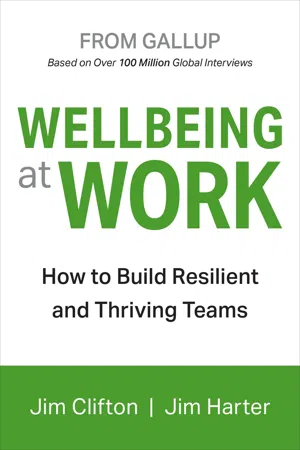
What if the next global crisis is a mental health pandemic? It is here now.One-third of Americans have shown signs of clinical anxiety or depression, and the current state of suffering globally has risen significantly.The mental health pandemic manifests everywhere, not least in your workplace. As organizations around the world face health and social crises, as well as economic uncertainty, acknowledging and improving wellbeing in your workplace is more critical than ever.Increasingly, leaders and managers must support mental health and cultivate resilience in employees — not just increase engagement and performance. Based on more than 100 million Gallup global interviews, Wellbeing at Work shows you how to do just that.Coauthored by Gallup’s CEO and its Chief Workplace Scientist, Wellbeing at Work explores the five key elements of wellbeing — career, social, financial, physical and community — and how organizations can help employees and teams thrive in those elements. The book also gives leaders ideas and action items to help employees use their innate talents and strengths to thrive in each of the wellbeing elements. And Wellbeing at Work introduces a metric to report a person’s best possible life: Gallup Net Thriving, which will become the “other stock price” for organizations.In a world where work and life are more blended than ever, maximizing employee wellbeing takes on greater urgency. Wellbeing at Work shows leaders how to create a thriving and resilient culture. If you and your leaders don’t change the world, who will? Wellbeing at Work includes a unique code to take the CliftonStrengths assessment, which reveals your top five strengths.
- 336 pages
- English
- ePUB (mobile friendly)
- Available on iOS & Android
eBook - ePub
Wellbeing at Work
About this book
Information
Subtopic
Human Resource ManagementIndex
BusinessTable of contents
- Important Information About Your Access Code
- Quote
- Introduction: The Mood of the World
- Part 1: What Is Wellbeing?
- Part 2: Your Workplace’s Wellbeing Opportunities
- Part 3: Risks to a Net Thriving Culture
- Part 4: Net Thriving Starts With Career Engagement
- Part 5: The Fastest Road to Net Thriving: Play to Strengths
- Appendixes
- About Gallup
- About the Authors
- Acknowledgements
- Image Descriptions
- Copyright
- Gallup Press
Trusted by 375,005 students
Access to over 1.5 million titles for a fair monthly price.
Study more efficiently using our study tools.
Frequently asked questions
Yes, you can cancel anytime from the Subscription tab in your account settings on the Perlego website. Your subscription will stay active until the end of your current billing period. Learn how to cancel your subscription
No, books cannot be downloaded as external files, such as PDFs, for use outside of Perlego. However, you can download books within the Perlego app for offline reading on mobile or tablet. Learn how to download books offline
Perlego offers two plans: Essential and Complete
- Essential is ideal for learners and professionals who enjoy exploring a wide range of subjects. Access the Essential Library with 800,000+ trusted titles and best-sellers across business, personal growth, and the humanities. Includes unlimited reading time and Standard Read Aloud voice.
- Complete: Perfect for advanced learners and researchers needing full, unrestricted access. Unlock 1.5M+ books across hundreds of subjects, including academic and specialized titles. The Complete Plan also includes advanced features like Premium Read Aloud and Research Assistant.
We are an online textbook subscription service, where you can get access to an entire online library for less than the price of a single book per month. With over 1.5 million books across 990+ topics, we’ve got you covered! Learn about our mission
Look out for the read-aloud symbol on your next book to see if you can listen to it. The read-aloud tool reads text aloud for you, highlighting the text as it is being read. You can pause it, speed it up and slow it down. Learn more about Read Aloud
Yes! You can use the Perlego app on both iOS and Android devices to read anytime, anywhere — even offline. Perfect for commutes or when you’re on the go.
Please note we cannot support devices running on iOS 13 and Android 7 or earlier. Learn more about using the app
Please note we cannot support devices running on iOS 13 and Android 7 or earlier. Learn more about using the app
Yes, you can access Wellbeing at Work by Jim Clifton,Jim Harter in PDF and/or ePUB format, as well as other popular books in Business & Human Resource Management. We have over 1.5 million books available in our catalogue for you to explore.