Learning to Read
eBook - ePub

Learning to Read

A Cognitive Approach to Reading and Poor Reading

  1. 158 pages
  2. English
  3. ePUB (mobile friendly)
  4. Available on iOS & Android
eBook - ePub

Learning to Read

A Cognitive Approach to Reading and Poor Reading

About this book

Originally published in 1985, Learning to Read presents a balanced view of contemporary research into the reading process and theories accounting for reading and poor reading.

The book focuses in particular on children who experience considerable difficulty in acquiring necessary reading skills. It considers how reading ability is assessed and the problematic subject of dyslexia. It also adopts a comprehensive approach to the cognitive factors behind poor reading, as well as possible developmental and environmental factors.

Learning to Read will appeal to those with an interest in how children learn to read and the development of research on this subject.

Frequently asked questions

Yes, you can cancel anytime from the Subscription tab in your account settings on the Perlego website. Your subscription will stay active until the end of your current billing period. Learn how to cancel your subscription.
No, books cannot be downloaded as external files, such as PDFs, for use outside of Perlego. However, you can download books within the Perlego app for offline reading on mobile or tablet. Learn more here.
Perlego offers two plans: Essential and Complete
  • Essential is ideal for learners and professionals who enjoy exploring a wide range of subjects. Access the Essential Library with 800,000+ trusted titles and best-sellers across business, personal growth, and the humanities. Includes unlimited reading time and Standard Read Aloud voice.
  • Complete: Perfect for advanced learners and researchers needing full, unrestricted access. Unlock 1.4M+ books across hundreds of subjects, including academic and specialized titles. The Complete Plan also includes advanced features like Premium Read Aloud and Research Assistant.
Both plans are available with monthly, semester, or annual billing cycles.
We are an online textbook subscription service, where you can get access to an entire online library for less than the price of a single book per month. With over 1 million books across 1000+ topics, we’ve got you covered! Learn more here.
Look out for the read-aloud symbol on your next book to see if you can listen to it. The read-aloud tool reads text aloud for you, highlighting the text as it is being read. You can pause it, speed it up and slow it down. Learn more here.
Yes! You can use the Perlego app on both iOS or Android devices to read anytime, anywhere — even offline. Perfect for commutes or when you’re on the go.
Please note we cannot support devices running on iOS 13 and Android 7 or earlier. Learn more about using the app.
Yes, you can access Learning to Read by John R. Beech in PDF and/or ePUB format, as well as other popular books in Education & Education General. We have over one million books available in our catalogue for you to explore.

Information

Publisher
Routledge
Year
2021
Print ISBN
9780367611453
eBook ISBN
9781000209754
Edition
1

Chapter One
AN INTRODUCTION

For most of us reading is an effortless process which enables us to gather information at a rapid rate, faster, in fact, than if we were listening to someone saying the same message. However, a significant proportion of the adult population cannot read with such ease. In many cases this is not due to deficiencies in intelligence, nor is it entirely due to poor schooling. Why, in this age of schooling until at least the age of 16, should there be a segment of the population which has experienced such difficulty in learning to read?
To the researcher in reading problems it is of particular interest that there is a proportion of children who are poor readers and who are no less intelligent than children of the same age who are normal readers. Consequently, researchers have been careful to account for the role of intelligence within their working definition of the reading disabled child. One idea is that a child is considered to be behind in reading if his reading is considerably behind what would be expected on the basis of his level of intelligence. This concept is central to our examination of the poor reader, as in most of the studies reviewed here, the effects of intelligence are controlled by making comparison with a control group matched in intelligence with the poor readers.
This book is aimed at reviewing research on the poor reader. A child classified as “dyslexic” comes under the classification of being a poor reader, but is usually defined more specifically than this. Because of the confusion usually surrounding this particular issue, the next chapter is devoted to a more detailed discussion of this topic. All that might be noted here is that both poor readers (as defined here) and dyslexics are poor at reading and are not unintelligent. The dyslexic is further defined to embrace a much smaller sample of children in which other possible factors such as poor home background are eliminated.
After discussing the dyslexia issue and also the prevalence of reading problems, we will examine how reading is normally taught in our schools. Generally speaking, teachers are fairly eclectic in their approach to reading instruction. Usually they use one or two reading schemes but embellish these with their own materials. Hopefully, they try to identify problem areas for some children and give further guidance in these areas. When a teacher is dealing with the same children day after day, a great deal of ingenuity is required to maintain an adequate interest level for the children. In the early stages this is achieved by allowing a great deal of freedom to play towards the end of the school day. For the normal child who progresses easily with reading, the information extracted from the reading materials becomes of interest in its own right. In the case of the poor reader, the incentive is not the same, especially when he becomes segregated from the rest of the class in order to be given extra reading tuition. Consequently it becomes even more important to sustain interest via rewards and incentives which have particular relevance to each poor reader.
If our knowledge about reading were more advanced, we would by now be using screening tests in order to predict which children are probably going to experience difficulties in the future. It is likely that early intervention would amply repay these early remedial efforts. Unfortunately, we do not have this precision at the moment, but the day is approaching when this will become a reality.
The core of the book is concerned with the factors underlying reading disability. Particular emphasis is given to such cognitive factors as verbal and visual processing. As a broad generalization, it seems that poor readers are deficient particularly at lower levels of verbal processing. They are less advanced in their ability to articulate words, to identify the individual sounds in words and in remembering sequences of words, such as in trying to remember a telephone number. They also demonstrate some deficiences in visual processing, but it is difficult sorting out whether this is due to any real visual processing difficulty or to their translating visual information into a verbal message. So their visual difficulties might also be due to poor verbal processing.
One view of the problem of poor reading is that the poor reader is lagging behind in the development of certain cognitive processes crucial to learning to read. Some might regard this view as somewhat fatalistic as it might imply that one has only to wait until the child is a little older before the teaching of reading can begin. However, teaching certain underlying cognitive skills may be a way of accelerating progress. From the viewpoint of the child, it is much better to try to keep up with one’s contemporaries rather than joining a younger class. Another viewpoint that might also be regarded as fatalistic is one suggesting that certain areas of the brain of the poor reader are damaged in some manner. As will be seen, post mortems on two retarded readers have indicated abnormalities in both cases; however, this is too small a sample to be conclusive. Even if there is evidence for brain damage, the plasticity of the brain is such that given adequate training, one would hope that a child with reading problems could still learn to read.
There is much clearer evidence that in the adult, at least, specific parts of the brain appear to serve specific roles within the reading process. This work comes from examining brain-damaged adults who display highly specific abnormalities. For instance, one category of patient can not read words as a whole, but has to examine each individual letter before concluding what the word might be. Several investigators have recently suggested that these specific impairments may be analogous to the kinds of impairments in reading which poor readers have. However, there is no strong experimental evidence, as yet, to support this contention.
We have discussed reading difficulties so far in terms of the impoverished development of cognitive processes, possibly due to biological immaturity. But the home environment also has a role to play in the development of reading. So much so, that any visitor to schools in poorer districts will find a much higher incidence of reading problems compared with more well-off districts. Having noted this relationship, we are hard pressed for an exact explanation why this should be the case. It seems that the involvement of the parent in the child’s reading is a very important factor. One study has shown that if parents are involved with their children’s reading, through a carefully controlled training program, this has a substantial effect on the progress of the children, compared with when the same programme is carried out within the school. Perhaps the overall effect of parents is mainly as a motivator to the child. Another possibility is that the language of the working class parent in the home may not be sufficiently rich to provide a stimulus to the necessary development of verbal processes. This argument is not a strong one and some have argued that the language used in some working class environments is in fact just as rich as in middle class ones.
Examining environmental effects is quite difficult in practice. Most studies have usually given parents questionnaires. But this relies on the interpretations of the parents. One problem I came across recently gathering data of this nature, was that the reports of the parents of poor readers were more suspect than those of parents of better readers. In this study by Peter Doyle and myself we gave the parents questionnaires about their attitudes to reading and estimates of the time they spent listening to their children reading. Within the questions we buried the items from a lie scale. These items include such questions as “I never tell lies” which virtually nobody would agree with unless they were “faking good” or were actually exceedingly virtuous! We found that the parents of the poor readers were faking good compared with the rest of the parents. This might suggest a disparity between what attention the parents of poor readers think they should give their children and the amount of time they actually give them.
Part of the aim of this book is to highlight the problems currently facing researchers within the field of reading. Reading research does not appear to be the kind of field that has produced any dramatic breakthroughs. On the other hand, in the last few years a lot of information has come to light on the reading process. One particular growth area has been the contribution of the relatively new science of Cognitive Psychology. This subject often emphasises the role of the component processes within dynamic systems. The nature of these processes can then be elucidated by careful experimentation. If the theory proves to be intractable to experimentation, it is not considered to be a scientific theory. The most frequently used paradigm to test out these theories has been that using response times and errors produced by subjects reacting to presented stimuli. The advent of the computer was the greatest catalyst for the development of this science. This initially provided an analogy in terms of the wiring (or hardware) which led to ideas such as short-term retention buffers being analogous to human short-term memory. Nowadays developments are concerned with such high-order computer programs as those controlling a robot or translating a visual scene. If we can specify the kinds of things a computer program has to go through in order to simulate mental activities that come naturally to humans, we might infer that similar processes are taking place inside our own heads. Many cognitive psychologists have now, as a result of these advances, turned to all kinds of practical applications and research in reading has been one of those areas which has benefited.

Chapter Two
DYSLEXIA AND INCIDENCE OF READING PROBLEMS

Before examining the problems of poor readers it would be useful to specify more precisely the group of children we are focussing on. As we mentioned earlier, there is some controversy surrounding the use of the term “dyslexia” as a term used to describe a particular group of poor readers. We will be examining a broader group of poor readers than this, but let us first examine the term dyslexia more closely.

1. WHAT IS DYSLEXIA?

A dyslexic child is generally regarded as a child who has substantial difficulties in learning to read, but does not have these difficulties in reading because of his social background, problems with hearing or eyesight or due to low intelligence. In other words, a child is considered to be dyslexic after possible causes of reading disability involving his environment or obvious physical or intellectual defects have been discounted.
What tends to cause confusion about the term is that a child may be a poor reader, but not be classified as being dyslexic as such. In Britain, for example, if one were to visit any primary school which was mainly composed of children of parents of low socio-economic status, there would probably be a substantial number of children in that school who could not read or only read a few words. But by the way dyslexia is defined these children would not be considered by researchers to be dyslexic. Instead, they would be classified as retarded readers due to a home environment which may be impoverished for a variety of reasons. The parents may possibly be unable to read very well, the language used in the home might be entirely different from that encountered in the child’s reading primers, the parents may never be seen reading so there is no model for the child to imitate, and so on. By contrast, in a school servicing a middle-class catchment area, there will hardly be any child who will be unable to read; but those who are unable to read might well be classified as dyslexic, provided that in other respects, such as in intelligence, they are otherwise normal. Of course, amongst working-class children who are poor readers there will also be a much smaller proportion of children who to all intents and purposes will be dyslexic. If the “dyslexics” had been brought up in a better socio-economic environment, they would still be unable to read.
Many investigators are intent on keeping to the narrow definition of dyslexia as outlined and doing research into the causes of the problem. While it is very important from the view of making progress in the field always to use groups defined by exactly the same criteria, there are others who would argue that from a pragmatic viewpoint there are many more retarded readers (e.g. working-class children of normal intelligence with reading problems) who deserve to be studied as well (e.g. Benton, 1978; Rutter, 1978). Nevertheless, according to Pavlidis (1981), there is some recent evidence that the two groups (that is, dyslexics vs working-class retarded readers of roughly average intelligence) can be clearly differentiated experimentally in terms of the nature of their eye movements. However, Stanley, Smith and Howell (1983) failed to find a difference in eye movements between a group of dyslexics and a control group of normal readers matched on age and non-verbal intelligence.
If a researcher wants specifically a sample of dyslexic children, this is what he would do in practice (based on Vellutino, 1979). Teachers from a number of schools would be asked to supply names of any children who are severely retarded in reading. As a first step these children are given a reading test and those more than two years below their reading grade at school would be selected. For instance in the USA this would be done for children in grade 3 or higher (ie. 8 years old or over). For grade 2 children the criterion would be adjusted to be at least one year behind and first graders would not be used. Obviously, in grade 1 (6 to 7-year-olds) the children are only beginning to read so the apparent differences between individual readers will be relatively small and perhaps temporary. In a typical sample for grade 3, the average retarded reader would be equivalent in reading to normal children roughly two-thirds of the way through grade 1 and by grade 6 he or she would be equivalent to normal children roughly less than half way through grade 3.
The rest of the criteria are not based directly on reading performance. The children are then given the Wechsler Intelligence Scale for Children (WISC) devised by Wechsler (1949). This is the most commonly used intelligence test for children and is composed of a number of subtests. It has two main parts consisting of a verbal test and a performance or nonverbal test. Only those who have an intelligence quotient (IQ) over 90 (the average score of children taking into account their age is 100) on either the verbal or performance scale would qualify as dyslexic. Thus, children who are dyslexic have problems in reading on grounds other than those based on intelligence.
Other grounds for exclusion would be: problems in acuity of sight or hearing, problems of gross neurological and physical disabilities, maladjusted children (i.e. those with a behavioural disorder) and finally, children would be excluded who were attending schools not within a suburban or middle-class area. Having employed all these exclusionary criteria, the typical researcher is left with a residue of children who would be classified as “probably dyslexic”. The general characteristics of this sample would probably be: that on average for every four boys in the sample there would only be one girl? they would have difficulties with such things as telling the time, naming the months and days of the week etc., perceiving spatial relationships including having difficulty distinguishing left from right; some might have minor signs of neurological impairment such as having abnormal reflexes (Vellutino, 1979).
Having given a generally accepted definition of dyslexia it is only fair to point out that the term itself is subject to much criticism. For instance, in the Bulletin of the British Psychological Society an article by Whittaker (1982), critical of the term “dyslexia” and calling those who used it “flat-earthers”, provoked a flurry of subsequent correspondence ranging from the light-hearted to the more serious. One correspondent wrote about the etymology of the actual word “dyslexia” as follows: ‘The Greek roots are simply “dys” (=“bad”) and “lexis” (=word). Dyslexia is a bad word. That is all there is to it’. More seriously, Whittaker in her article condemned the labelling of a child as dyslexic on the grounds that it erroneously suggests that it is a medical condition. Therefore it would be the responsibility of the medical profession rather than of psychologists which in turn implies some form of medically-based treatment. She also discusses how various researchers have tried to widen the term to include deficits in such skills as arithmetic (Miles, 1978) and language skills (the World Federation of Neurology in 1968).
Certainly, dyslexic children have problems in these areas? for instance, Thomson and Grant (1979) noted that on the WISC subtest of Arithmetic, dyslexic children performed poorly relative to normal children. But it seems to make the term “dyslexic” rather loose if it includes children with deficits in other areas, if this implies that they need not necessarily be deficient in reading to be classified as dyslexic. However, one can sympathise with the view that each dyslexic child demonstrates deficiences in most but not necessarily all of a particular cluster of skills. The skill of reading is just one of the cluster of skills which are causing problems and is not necessarily the fundamental one from which the others emanate. Perhaps part of the motivation for such criticisms of dyslexia by Whittaker is that instead of pouring money into special clinics treating dyslexia, she considers that more resources should be made available for remedial help in State schools.
Similarly, the Advisory Committee on Handicapped Children produced a report (the Tizard Report, 1972) on children with specific reading difficulties. It argued that a danger was that the narrowness of the term “specific developmental dyslexia” meant that resources could concentrate on this relatively small group of children to the detriment of those with difficulties in other skills, but not classified as dyslexic. Instead they recommended that the term “specific reading difficulties” should be used for this small group of children and that the needs of these children should be catered for within the context of the general problem of reading retardation of whatever kind. In other words, remedial education, using remedial teachers in each school, should be the vehicle with which to tackle the general problem of reading and the specific problem of those classified as having “specific reading difficulties”. They recommended that in practice most retarded readers should receive remedial help within the context of the ordinary school, be it at primary or secondary level. Otherwise they could be deprived of contact with normal children, particularly as the general development of language is more likely to be stimulated in such a context, which in turn would enhance their reading. The Advisory Committee went on to acknowledge that “a very small proportion” of reading disadvantaged children with severe problems will need to be temporarily withdrawn from their regular school in order to attend a Remedial Education Centre.
Over a decade later it does not seem that the level of support for the backward reader is sufficient under the present financial stringency. One headmaster of a school I visited, which contained a special unit, recently claimed that he had only ten pounds for each child in his school for the w...
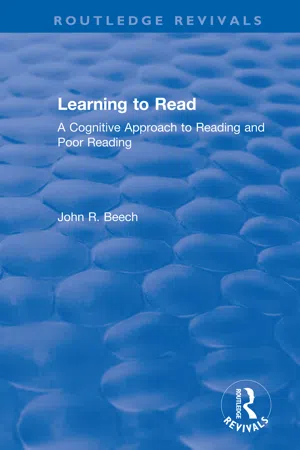
Table of contents

  1. Cover
  2. Half Title
  3. Title Page
  4. Copyright Page
  5. Original Title Page
  6. Original Copyright Page
  7. Contents
  8. Preface
  9. Acknowledgements
  10. 1. An Introduction
  11. 2. Dyslexia and the Incidence of Reading Problems
  12. 3. Teaching Children to Learn to Read
  13. 4. Cognitive Factors behind Poor Reading
  14. 5. Developmental and Biological Factors behind Poor Reading
  15. 6. Environmental Factors behind Poor Reading
  16. 7. The Theory and Practice of Learning to Read
  17. References
  18. Author Index
  19. Subject Index
  20. Appendix