This volume examines the shift toward positive and more accurate portrayals of mental illness in entertainment media, asking where these succeed and considering where more needs to be done. With studies that identify and analyze the characters, viewpoints, and experiences of mental illness across film and television, it considers the messages conveyed about mental illness and reflects on how the different texts reflect, reinforce, or challenge sociocultural notions regarding mental illness. Presenting chapters that explore a range of texts from film and television, covering a variety of mental health conditions, including autism, post-traumatic stress disorder (PTSD), depression, and more, this book will appeal to scholars of sociology, cultural and media studies, and mental health.
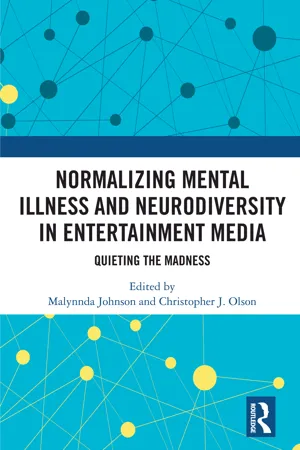
eBook - ePub
Normalizing Mental Illness and Neurodiversity in Entertainment Media
Quieting the Madness
- 216 pages
- English
- ePUB (mobile friendly)
- Available on iOS & Android
eBook - ePub
Normalizing Mental Illness and Neurodiversity in Entertainment Media
Quieting the Madness
About this book
Information
1 Introduction
Why depictions of mental illness matter
Malynnda Johnson and Tara Walker
Villains in various media have long been portrayed as “mad.” Looking closely at depictions of the classic villain reveals numerous mental illnesses on display. The use of characteristics such as wild eyes, unpredictable shifts in behavior, incessant muttering, or hiding away from people for long periods of time in cold dark caves invokes fear in the audience as they know what will happen next.
Beyond the media, the medical establishment itself has traditionally focused on mental illness as one end of a binary concept: a subject is either mentally ill or mentally healthy (Keyes, 2005). However, a far more nuanced approach to understanding how mental illness and health interact is necessary, both from a clinical perspective and from a media representation perspective. Such perspectives are vital given that an individual’s perceptions about any illness or health condition have tremendous impact not only on their own life but also on the lives of others. If a person believes that they are at risk for contracting an illness, they may choose not to engage in a behavior or to seek out preventative options. In the same way, understanding susceptibility to an illness, or health condition, impacts an individual’s behaviors. Yet a person’s beliefs and opinions about an illness also influence how they treat others. Often, when we can see the health condition a person is facing, feelings of empathy and compassion arise. We open doors for the girl with a broken leg. We reach out and grab the box on the top shelf for the man in a wheelchair. However, this is not the case for illnesses or other conditions that are misunderstood or invisible to the eye.
Illnesses resulting from personal choices (lung cancer, HIV, STIs, and cirrhosis of the liver) are often met with far less compassion and eagerness to help. People living with conditions that are less talked about or seen in person (alopecia, vitiligo, and dwarfism) are stared at and/or questioned, if not avoided altogether for fear of “catching” something. Yet each of these health concerns can often be treated, explained, and accepted by the general population. For those living with mental, emotional, and developmental disabilities, however, the ease of treatment, explanation, or acceptance is far less common.
The fear, stigma, and dehumanization surrounding mental health is partly due to the complex and often invisible nature of these conditions (Parker, Monteith, & South, 2020). To those unable or unwilling to understand, a person incapable of getting out of bed due to depression just seems to be “not trying hard enough.” Because of such misconception, onlookers may believe it is possible to just “push through the sadness” and “get on with life.” However, for the one embedded in the experience of depression, it may appear there is nothing to push toward and no light at the end of the tunnel. The thought process for anyone facing a mental health condition is simply different than those who are not, but this difference remains largely invisible. There are numerous explanations and possible causes of mental illnesses or developmental disabilities, including biochemical imbalance, trauma, or genetic and environmental factors. Yet, despite this diversity in thinking, there is little variance in portrayals and discussions of mental health and illness.
Perhaps it is because many mental health conditions remain largely invisible that media depictions are often exaggerated; media representations work to help audiences visualize an experience that is not always visual. Nevertheless, media depictions of mental health conditions have historically relied on stereotypes and misinformation. For example, media often use mental illness as an explanation for crime and villainous behavior as in many crime dramas and nightly news shows (McGinty, Webster, Jarlenski, & Barry, 2014; Ma, 2017). Furthermore, Granello and Gibbs (2016) highlight the importance of terminology: referring to people as “the mentally ill” has a much more stigmatizing effect than saying “people with mental illness.” The former associates the person fully with their disorder, while the latter cites the disorder as just one characteristic that makes up an individual’s experience. Yet it is not only the words used when discussing mental health that shape the way people think but also the representations and frames themselves. As such, people living with, and often struggling with, mental health issues continue to be stigmatized and therefore avoid seeking help.
Thankfully, throughout the past decade numerous books, movies, and television shows have featured characters that offer new and more accurate viewpoints of mental health lifestyles. These characters often speak openly about the struggles of living with depression, panic attacks, even autism. Each of these characters and storylines offers audiences the opportunity to see and hear what it feels like to live with a mind that works differently. As the chapters in this book demonstrate, while entertainment media still have a long way to go in terms of representation, significant strides are being taken to provide audiences with a far more realistic and less dramatized view of mental health. Many of the portrayals discussed in the chapters that follow offer complex and nuanced characters that have populated the screen more recently. These characters illustrate to audiences that people coping with mental, emotional, and/or developmental disabilities need not be labeled “mentally ill.”
Framing mental health
Representation and accurate depictions of any health topic are vital to overcome the stigma often surrounding mental health, but they also help those living with the conditions to see people who think and act like them. Identifying with a character not only allows an audience member to feel less alone and provide a sense of belonging (Derrick, Gabriel, & Hugenberg, 2009) but such identification might also offer the first opportunity to see that others endure the same experiences. This depends, of course, upon media produces providing thoughtful framing and writing of such characters.
When looking at how media representations have shaped perceptions of both mental illness and mental health, two media theories are particularly important to consider. The first, cultivation theory, supports the idea that media, such as television, have powerful effects on their audiences – more specifically, behaviors are cultivated by repeated exposure to media (Gerbner & Gross, 1976). In other words, by seeing/hearing the message repeatedly over time, our perceptions are formed. For example, most of the media coverage discussing mental illness has centered around crime and violence (Corrigan, P. W., Powell, K. J., & Michaels, P. J. (2013); McGinty et al., 2014). Researchers have also found that coverage of mass shootings is more likely to mention “dangerous people,” than “dangerous weapons,” sending the message that serious mental illness may even be a cause of mass shootings (McGinty et al., 2014).
Similarly, Bandura’s experiments regarding aggression and the development of social cognitive theory also helped to cement the idea that the media have a considerable impact on behavior. He provided evidence that television is “an effective tutor,” noting that desensitization and habituation occur after repeated exposure to television violence (1978, p. 16). Television helps people form impressions of realities they have not experienced firsthand (Bandura, 1978). One key finding from cultivation studies is the “mean world” syndrome: the idea that people with long-term exposure to television tend to think of the world as a more dangerous place full of untrustworthy people (Morgan, Shanahan, & Signorielli, 2009). However, the same would be true if the script were to be flipped. When media created realities focus on positive accounts of the world the viewpoint of the viewers would then shift. Therefore, by offering realistic or less dramatic conversations about mental health, as opposed to the barrage of negative and fear-induced language, media can help people’s thoughts and attitudes surrounding mental health to evolve.
While cultivation theory emphasizes the amount of exposure an audience member has to specific media, framing theory posits that audiences are affected by the way something is presented. Humans use frames to construct meaning, and primary frameworks are the starting point for forming these constructions (Goffman, 1974). Primary frameworks work as scaffolding to support perception, and transform something meaningless into something meaningful (Goffman, 1974). Entman (1993) devised four primary functions for frames: they define problems, diagnose causes of those problems, make moral judgments, and, lastly, suggest remedies. Media often contribute to the development of these frames, including when it comes to understanding mental health.
Framing mental health in the media
In Disease and Representation: Images of Illness from Madness to AIDS, Gilman (1988) writes, “Society, which defines itself as sane, must be able to localize and confine the mad, if only visually, in order to create a separation between the sane and the insane,” (p. 48). Most certainly, representations of mental illness in media have been doing just that for years – drawing a strict line between crazy and sane, and giving audiences a window into deviant behavior. Humans determine when differences exist, and when those differences matter socially (Link & Phelan, 2001). Once differences are identified, we tend to take them for granted; they become a kind of cognitive shortcut that requires oversimplification to function (Link & Phelan, 2001).
Overall, it is rather unlikely that the entertainment industry set out to degrade and devalue people with mental illness or developmental disorders when releasing unsavory portrayals. Nevertheless, regardless of intent, historians and media critics agree that mental illness has been “systematically stigmatized in Western culture” (Harper, 2009, p. 2). In film and television, for example, people with mental illnesses are often depicted as looking physically different from everyone else. Some of the most common visual clichés include messy “crazy” hair, enlarged pupils, and unkempt, dirty clothing. These kinds of cues may work to reassure audiences that there are clear physical boundaries between them and the characters on TV – mental illness happens to other people but not to them (Wahl, 1997). Visual cues of mental illness are as present in children’s media as they are in adult media. For example, children who watch Disney movies are often exposed to characters who are labeled as being mentally ill (Lawson & Fouts, 2004). Most of these characters are objects of ridicule or derision and this may encourage children to label and stereotype people, thinking terminology such as “loony” or “crazy” is funny (Lawson & Fouts, 2004).
Some of the most salient negative portrayals of mental illnesses have come from the horror film genre. For example, Cook (2007) argues that the film Halloween (John Carpenter, 1978) established a plot structure that many subsequent horror films followed – the idea of the mentally ill killer escaped from the local asylum menacing a community and targeting a group of friends. In Halloween, Michael Myers is characterized as a homicidal psychopath, and, indeed, this “homicidal maniac” trope is frequently identified in the horror movie genre (Goodwin, 2014). Recent films such as The Visit (M. Night Shyamalan, 2015) repeat the familiar plot device of the escaped mental patient, reifying social anxieties around the proximity of people with mental disorders to the public. Violent antagonists in horror films are also often depicted as schizophrenics or those dealing with split/ multiple personalities. The character of the Joker (from various Batman films and comics) has been portrayed as having numerous mental illnesses including schizophrenia, post-traumatic stress disorder (PTSD), and dissociative identity disorder (DID), formerly called Multiple Personality Disorder (Goodwin & Tajjudin, 2016).
Variations of DID have appeared in Hollywood movies for decades. Dr. Jekyll and Mr. Hyde (Rouben Mamoulian, 1931) offered audiences one of the earliest examples of the villain with a split personality. Psycho (Alfred Hitchcock, 1960) introduced audiences to the split character of Norman Bates and laid the groundwork for films such as Primal Fear (Gregory Hoblit, 1996) and Identity (James Mangold, 2003) (Butler & Palesh, 2004). Most recently, the film Split (M. Night Shyamalan, 2016) has been critiqued for its representation of DID (see Virzi, 2017; Alter, 2017; Nedelman, 2017; Rose, 2017), to the extent that audiences even boycotted the film (Davidson, 2017). Critics argue the film’s plot rests on the cliché of the mentally ill violent antagonist once again, further entrenching the idea that people diagnosed with serious mental illnesses pose a threat to society. Additionally, many films that rely on mental illnesses to provide backstories for villains are rife with misinformation: psychosis is often confused with psychopathy or linked with identity disorders, and schizophrenia is often used as a general term for any kind of mental illness (Goodwin, 2014).
In recent years, mental illness has also become a recurri...
Table of contents
- Cover
- Half Title
- Title Page
- Copyright Page
- Dedication
- Contents
- Acknowledgments
- List of tables
- List of contributors
- 1 Introduction: why depictions of mental illness matter
- 2 “Remember what Dr. Lopez said”: portrayals of mental health care in Nickelodeon’s The Loud House
- 3 “And I suffer from short-term memory loss”: understanding presentations of mental health in Pixar’s Finding Nemo and Finding Dory through communication theory of identity
- 4 Family narratives and mental illness in This Is Us
- 5 Cognitive differences in Star Trek: the case and evolution of Reginald Barclay
- 6 Popular culture and the (mis)representation of Asperger’s: a study on the sitcoms Community and The Big Bang Theory
- 7 Psychopath, sociopath, or autistic: labeling and framing the brilliance of Sherlock Holmes
- 8 When Saga Norén meets neurotypicality: a liminal encounter along The Bridge
- 9 The girl on the swing: an analysis of cues and depression in Joe Wright’s Pride and Prejudice (2005)
- 10 Depictions of depression and eating disorders in My Mad Fat Diary
- 11 “Portraying real feelings with comedy on top”: postpartum depression storylines and domestic sitcoms
- 12 Ruby Wax: comedy, celebrity capital, and (re)presentations of mental illness
- 13 Post-traumatic stress disorder in the films Taxi Driver and You Were Never Really Here: a comparative progressive approach
- 14 Bipolar and Shameless: showtime’s portrayal of living and working with bipolar disorder
- 15 Wrestling with eating disorders: transmedia depictions of body issues in WWE’s women’s professional wrestling
- 16 Conclusion: destigmatizing mental illness and neurodiversity in entertainment media
- Index
Trusted by 375,005 students
Access to over 1.5 million titles for a fair monthly price.
Study more efficiently using our study tools.
Frequently asked questions
Yes, you can cancel anytime from the Subscription tab in your account settings on the Perlego website. Your subscription will stay active until the end of your current billing period. Learn how to cancel your subscription
No, books cannot be downloaded as external files, such as PDFs, for use outside of Perlego. However, you can download books within the Perlego app for offline reading on mobile or tablet. Learn how to download books offline
Perlego offers two plans: Essential and Complete
- Essential is ideal for learners and professionals who enjoy exploring a wide range of subjects. Access the Essential Library with 800,000+ trusted titles and best-sellers across business, personal growth, and the humanities. Includes unlimited reading time and Standard Read Aloud voice.
- Complete: Perfect for advanced learners and researchers needing full, unrestricted access. Unlock 1.5M+ books across hundreds of subjects, including academic and specialized titles. The Complete Plan also includes advanced features like Premium Read Aloud and Research Assistant.
We are an online textbook subscription service, where you can get access to an entire online library for less than the price of a single book per month. With over 1.5 million books across 990+ topics, we’ve got you covered! Learn about our mission
Look out for the read-aloud symbol on your next book to see if you can listen to it. The read-aloud tool reads text aloud for you, highlighting the text as it is being read. You can pause it, speed it up and slow it down. Learn more about Read Aloud
Yes! You can use the Perlego app on both iOS and Android devices to read anytime, anywhere — even offline. Perfect for commutes or when you’re on the go.
Please note we cannot support devices running on iOS 13 and Android 7 or earlier. Learn more about using the app
Please note we cannot support devices running on iOS 13 and Android 7 or earlier. Learn more about using the app
Yes, you can access Normalizing Mental Illness and Neurodiversity in Entertainment Media by Malynnda Johnson, Christopher J. Olson, Malynnda Johnson,Christopher J. Olson in PDF and/or ePUB format, as well as other popular books in Politics & International Relations & Social Policy. We have over 1.5 million books available in our catalogue for you to explore.