Section 1: Solution and Infrastructure
In this section, we will first revise the different architecture practices and dimensions, because the word architect is sometimes misunderstood or abused. We will share our views on the different architecture dimensions that we cover throughout the book. The initial chapter will set the scene for your journey. Then, we will get you started with Azure and acquainted with the services that you can assemble to design and build solutions. We will also focus on an essential foundation – the infrastructure – and you will get to know how to leverage Infrastructure as Code and automation, to get an optimal return on investment out of your cloud expenditures.
In this section, we will cover the following topics:
- Chapter 1, Getting Started as an Azure Architect
- Chapter 2, Solution Architecture
- Chapter 3, Infrastructure Design
- Chapter 4, Infrastructure Deployment
Chapter 1: Getting Started as an Azure Architect
In this chapter, we will focus on what an architect's role entails and explain the various cloud service models that are made available by the Microsoft Azure platform. We will describe how the numerous maps in this book are built, what they intend to demonstrate, and how to make sense of them.
More specifically, in this chapter, we will cover the following topics:
- Getting to know architectural duties
- Getting started with the essential cloud vocabulary
- Introducing Azure architecture maps
- Understanding the key factors of a successful cloud journey
Our purpose is to help you learn the required vocabulary that is used across the book. You will also understand the duties of an Azure architect. We will explain the most frequently used service models and their typical associated use cases, which every Azure architect should know. We start smoothly, but beware that the level of complexity will increase as we go. Let's start by getting acquainted with the definition of an architect.
Technical requirements
The Maps provided in this chapter are available at https://github.com/PacktPublishing/The-Azure-Cloud-Native-Architecture-Mapbook/tree/master/Chapter01.
Getting to know architectural duties
Before we define what an Azure architect is, let's first define what an architect's role is and how our maps specialize to reflect these different profiles. The word architect is used everywhere on the IT planet. Many organizations have their own expectations when it comes to defining the tasks and duties of an architect. Let's share our own definitions as well as some illustrative diagrams.
Enterprise architects
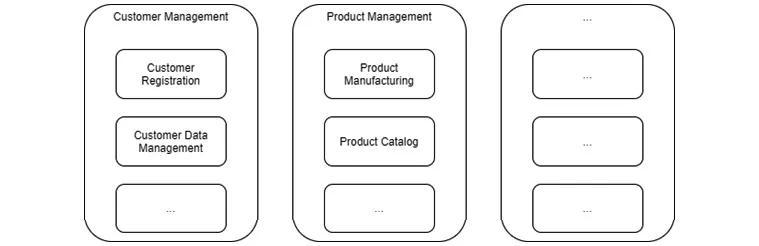
Enterprise architects oversee the IT and business strategies, and they make sure that every IT initiative is in line with the enterprise business goals. They are directly reporting to the IT leadership and are sometimes scattered across business lines. They are also the guardians of building coherent and consistent overall IT landscapes for their respective companies. Given their broad role, enterprise architects have a helicopter view of the IT landscape, and they are not directly dealing with deep-dive technical topics, nor are they looking in detail at specific solutions or platforms, such as Azure, unless a company would put all its assets in Azure. In terms of modeling, they often rely on the TOGAF (short for The Open Group Architecture Framework) modeling framework and ArchiMate. The typical type of diagrams they deal with looks like the following:
Figure 1.1 – Capability viewpoint: ArchiMate
As you can see, this is very high level and not directly related to any technology or platform. Therefore, this book focusing on Azure is not intended for enterprise architects, but they are, of course, still welcome to read it!
Domain architects
Domain architects own a single domain, such as the cloud. In this case, the cloud is broader than just Azure, as it would probably encompass both public and private cloud providers. Domain architects are tech-savvy, and they define their domain roadmaps while supervising domain-related initiatives. Compared to enterprise architects, their scope is more limited, but it is still too broad to master the bits and bytes of an entire domain. This book, and more particularly our generic maps, will certainly be of great interest for cloud domain architects. Diagram-wise, the domain architects will also rely on TOGAF and other architecture frameworks, but scoped to their domain.
Solution architects
Solution architects help different teams to build solutions. They have T-shaped skills, which means that they are specialists in a given field (the base of the T), but they can also collaborate across disciplines with the other experts (the top of the T). Solution architects are usually in charge of designing solution diagrams, and they tackle non-functional requirements, such as security, performance, and scalability. Their preferred readings will be our chapter dedicated to solution architecture, as well as some reference architectures. Solution architects may build both high-level technology-agnostic, and platform-specific diagrams. Azure solution architects may build reference architectures, such as, for instance, one that we can find on the Azure Architecture Center (https://docs.microsoft.com/en-us/azure/architecture/):
Figure 1.2 – AI at the edge with Azure Stack
The preceding diagram illustrates how to leverage both Azure Stack and Azure, together with artificial intelligence services. Such architectures can be instantiated per asset, but still remain rather high-level. They depict the components and their interactions, and must be completed by the non-functional requirements. We will explore this in more detail in the next chapter.
Data architects
Data architects oversee the entire data landscape. They mostly focus on designing data platforms, for storage, insights, and advanced analytics. They deal with data modeling, data quality, and business intelligence, which consists of extracting valuable insights from the data, in order to realize substantial business benefits. A well-organized data architecture should ultimately deliver the DIKW (Data, Information, Knowledge, Wisdom) pyramid as shown in Figure 1.3:
Figure 1.3 – DIKW pyramid
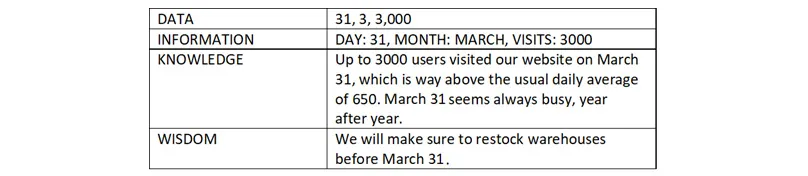
Organizations have a lot of data, from which they try to extract valuable information, knowledge, and wisdom over time. The more you climb the pyramid, the higher the value. Consider the following scenario to understand the DIKW pyramid:
Figure 1.4 – DIKW pyramid example
Figure 1.4 shows that we start with raw data, which does not really make sense without context. These are just numbers. At the information stage, we understand that 31 stands for a day, 3 is March, and 3,000 is the number of visits. Now, these numbers mean something. The knowledge block is self-explanatory. We have analyzed our data and noticed that year after year, March 31 is a busy day. Thanks to this valuable insight, we can take the wise decision to restock our warehouses up front to make sure we do not run short on goods.
That is, among other things, the work of a data architect to help organizations learn from their data.
Data is the new gold rush, and Azure has a ton of data services as part of its catalog, which we will cover in Chapter 6, Data Architecture.
Technical architects
Technical architects have a deep vertical knowledge of a platform or technology stack, and they have hands-on practical experience. They usually coach developers, IT professionals, and DevOps engineers in the day-to-day implementation of a solution. They contribute to reference architectures by zooming inside some of the high-level components. For instance, if a reference architecture, designed by a solution architect, uses Azure Kubernetes Services (AKS) as part of the diagram, the technical architect might zoom inside the AKS cluster, to bring extra information on the cluster internals and some specific technologies. To illustrate this, Figure 1.5 shows a high-level diagram a solution architect ...