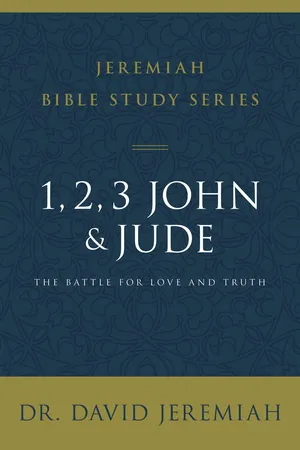
1, 2, 3, John and Jude
eBook - ePub

1, 2, 3, John and Jude

The Battle for Love and Truth

  1. 160 pages
  2. English
  3. ePUB (mobile friendly)
  4. Available on iOS & Android
eBook - ePub

1, 2, 3, John and Jude

The Battle for Love and Truth

About this book

Love one another, just as Jesus loves you...

Follow Dr. Jeremiah through the letters of 1, 2, 3, John and Jude in a chapter-by-chapter study that will help you understand what it meant to the people at the time it was written, and what it means to Christians today.

The Christians of the first century were facing a difficult battle. False teachers had emerged in their churches who were spreading a gospel that was contrary to the one proclaimed by Jesus. The situation was so distressing to John that he wrote a series of letters to call them to remember that Jesus' greatest command was for them to love God and to love one another.

Similarly, Jude called on believers to remember the truth of the gospel and persevere in the face of these attacks from false teachers.

Each of this study's twelve lessons is clearly organized to include:

  • Getting Started: An opening question to introduce you to the lesson.
  • Setting the Stage: A short reflection to explain the context of the study.
  • Exploring the Text: The Scripture reading for the lesson with related study questions.
  • Reviewing the Story: Questions to help you identify key points in the reading.
  • Applying the Message: Questions to help you apply the key ideas to their lives.
  • Reflecting on the Meaning: A closing reflection on the key teachings in the lesson.

—ABOUT THE SERIES—

The Jeremiah Bible Study Series captures Dr. David Jeremiah's forty-plus years of commitment in teaching the Word of God. In each study, you'll gain insights into the text, identify key stories and themes, and be challenged to apply the truths you uncover to your life. By the end of each study, you'll come away with a clear and memorable understanding of that Bible book.

Each study also contains a Leader's Guide.

Frequently asked questions

Yes, you can cancel anytime from the Subscription tab in your account settings on the Perlego website. Your subscription will stay active until the end of your current billing period. Learn how to cancel your subscription.
No, books cannot be downloaded as external files, such as PDFs, for use outside of Perlego. However, you can download books within the Perlego app for offline reading on mobile or tablet. Learn more here.
Perlego offers two plans: Essential and Complete
  • Essential is ideal for learners and professionals who enjoy exploring a wide range of subjects. Access the Essential Library with 800,000+ trusted titles and best-sellers across business, personal growth, and the humanities. Includes unlimited reading time and Standard Read Aloud voice.
  • Complete: Perfect for advanced learners and researchers needing full, unrestricted access. Unlock 1.4M+ books across hundreds of subjects, including academic and specialized titles. The Complete Plan also includes advanced features like Premium Read Aloud and Research Assistant.
Both plans are available with monthly, semester, or annual billing cycles.
We are an online textbook subscription service, where you can get access to an entire online library for less than the price of a single book per month. With over 1 million books across 1000+ topics, we’ve got you covered! Learn more here.
Look out for the read-aloud symbol on your next book to see if you can listen to it. The read-aloud tool reads text aloud for you, highlighting the text as it is being read. You can pause it, speed it up and slow it down. Learn more here.
Yes! You can use the Perlego app on both iOS or Android devices to read anytime, anywhere — even offline. Perfect for commutes or when you’re on the go.
Please note we cannot support devices running on iOS 13 and Android 7 or earlier. Learn more about using the app.
Yes, you can access 1, 2, 3, John and Jude by Dr. David Jeremiah in PDF and/or ePUB format, as well as other popular books in Theology & Religion & Biblical Studies. We have over one million books available in our catalogue for you to explore.

INTRODUCTION TO
The Letters of 1, 2, 3 John and Jude

“My little children, let us not love in word or in tongue, but in deed and in truth. And by this we know that we are of the truth, and shall assure our hearts before Him” (1 John 3:18–19). The Christians of the first century were facing a difficult battle. False teachers had emerged in their churches who were spreading a gospel that was contrary to the one proclaimed by Jesus, the disciples, and the early apostles. These teachers were creating strife and divisions within the Christian community. The situation was so distressing to John, the beloved disciple, that he wrote a series of letters to remind the believers of the truths that they had been taught—and to call them to remember that Jesus’ greatest command was for them to love God and to love one another. In a similar way, Jude—the half-brother of Jesus—called on believers to remember the truth of the gospel and persevere in the face of these attacks from false teachers.

1 JOHN

Author and Date

The writer of this letter does not identify himself, nor does he indicate his intended audience. However, he frequently refers to his readers as his “children” (see 1 John 2:12, 18, 28) and “beloved” (see 4:1, 7), which implies that he not only had affection for them but also held a degree of pastoral authority over them. In addition, the author establishes that he was an eyewitness to the life of Christ (see 1:1–3), and the vocabulary and style of the letter bears similarities to the Gospel of John. Early church fathers such as Irenaeus (AD 130–202) and Clement of Alexandria (AD 185–215), and Tertullian (AD 150–22) thus held that the writer was the disciple John. The letter was likely written c. AD 90, toward the end of John’s life in AD 100.

Background and Setting

While John does not identify his audience, it is apparent that he was writing to a group of churches who looked to him as their patron. A clue to their identity can be found in Revelation 2–3, also believed to be written by John, in which he addressed believers in Ephesus, Smyrna, Pergamos, Thyatira, Sardis, Philadelphia, and Laodicea. It is reasonable to assume that John had these same believers in mind when he wrote this letter. John likely wrote the letter from the isle of Patmos, where he had been exiled, and that his purpose was to warn these churches of false teachers who had infiltrated their congregations and were causing division and strife.

Key Themes

Several key themes are prominent in 1 John. The first is that believers in Christ must resist any teachings that are contrary to the true gospel. John wrote this letter to counteract the influence of Gnosticism in the early church. The Gnostics believed that matter is evil, so a good God could not have created the physical world, and taught that Jesus did not have a physical body. John was also confronting Cerinthianism, which held that Jesus was born a man, became divine at His baptism, and then became a man again at His crucifixion. John calls on believers to remember the truths they received about Christ (see 1 John 1:1–4; 2:18–29; 4:1–6; 5:6–21).
A second theme is that believers in Christ must maintain their fellowship in love. John goes to great lengths to emphasize the importance of the believers loving one another. He singles out love as a key identifying feature of Christianity and stresses that they are able to love one another because God first loved them—even while they were still sinners. If that love for others isn’t present, people can legitimately question their faith (see 1 John 1:5–2:17; 3:1–24).
A third theme is that believers in Christ must strive to walk in righteousness. John warns his readers that if they profess to be true followers of Christ, their “walk” must match their “talk.” It is not enough for them to just say that they are following Christ—their actions must show also that they are following after Jesus. Believers must avoid a lifestyle of sin, follow Jesus’ example in loving others, and resist the temptations of the world (see 1 John 4:1–5:5).

2 JOHN

Author and Date

The writer of this letter refers to himself as “the Elder” (2 John 1:1), a designation that led some church historians (such as Eusebius) to conclude it was not written by John the disciple. However, the similarity of language and subject matter between 1 and 2 John suggests the beloved disciple wrote both, and other early church leaders (such as Irenaeus) stated that he was the author. The vocabulary, structure, and grammar of the letter also bears similarities to the Gospel of John. It was likely written soon after the first letter, around AD 90.

Background and Setting

John addresses his second letter to “the elect lady and her children” (1 John 1:1). This could refer to an actual Christian woman and her children in a church, or it could be a metaphorical reference to a body of believers. The situation for writing the letter rose out of the common practice in the early church of members welcoming traveling ministers into their homes. The problem was that many false teachers were taking advantage of the believers’ generosity. So John wrote this letter to urge them not to show hospitality to any perverters of God’s truth.

Key Themes

Two key themes are found in 2 John. First, believers must remain faithful to the teachings of Jesus Christ that they have received. John calls on believers to know the truth and live in the truth. He rejoices that many are “walking in truth” and again pleads with the believers to “love one another” (see 2 John 1:1–6). Second, believers must beware of those who seek to deceive them. The church was less than one century old when the disciple penned the letters of 1 and 2 John, yet false teachings were already prevalent and rampant in the Christian communities. Once again, John urges believers to practice discernment and reject any teachings that are contrary to the message they received—and to keep on rejecting them until Christ returns. They were not to even allow those who professed such false teachings into their homes (see 2 John 1:7–13).

3 JOHN

Author and Date

The writer of this letter once again identifies himself as “the Elder” (3 John 1:1), so the same questions arise about its author as in 2 John. However, once again, the similarities among the letters—and the testimony of the early church fathers—point to John the disciple as the writer. It may have been written before or after the other two letters, but sometime around AD 90.

Background and Setting

John addresses his third letter to “the beloved Gaius” (2 John 1:1). Evidently, another leader, named Diotrephes, had asserted his power by refusing to allow traveling Christian teachers to minister to the congregation. Even worse, he was punishing any members who showed hospitality to those teachers. John wrote to confront Diotrephes and to commend and encourage Gaius, who was serving the community selflessly and walking in the truth of Christ.

Key Themes

As with 2 John, the letter of 3 John is personal in nature and so brief that little space is given for explicit themes. However, we find that John once again calls believers in Christ to walk in the truth and remain steadfast in the faith (see 3 John 1:1–11). The apostle mentions “truth” six times in the fourteen verses of the letter and emphasizes that truth goes hand in hand with steadfastness. John also stresses that believers in Christ should demonstrate hospitality to those who labor for the gospel (see verses 9–14). John highlights the ministry of Gaius, a church elder who selflessly welcomed traveling missionaries, but condemns the prideful acts of Diotrephes.

JUDE

Author and Date

The author of this letter identifies himself as “Jude, a bondservant of Jesus Christ” (Jude 1:1). Several men are named “Jude” or “Judas” in the New Testament (both are translations of the same name), but the most likely candidate for authorship is the half-brother of Jesus, who was also the brother of James. Early church leaders such as Clement of Alexandria, Origen (AD 184–253), Athanasius (AD 296–373), and Jerome (AD 342–420), all concurred with this designation. It is possible that Jude was written earlier than 1–3 John, sometime in the AD 60s to 70s.

Background and Setting

Much like John’s epistles, the letter of Jude was written to counter false teachings in the church. Jude’s statement that “certain men have crept in unnoticed” (Jude 1:4) suggests that the false teachers had infiltrated a particular church or a close group of churches. The fact that Jude was going to write to these believers about their “common salvation” (verse 3), but then switched his topic, testifies to the immediacy of the threat. Scholars have noted similarities between Jude and 2 Peter, suggesting that either Jude or Peter borrowed from the other.

Key Themes

Two key themes are prominent in the short letter of Jude. First, believers must be engaged in defending the faith. Not surprisingly, Jude would not allow complacency in the church when believers were under attack. He recognized the enemy’s strategy was to creep in unnoticed, so he compelled God’s people to remain vigilant so that false teachers would gain no ground in the war for people’s souls (see Jude 1:1–4, 20–23). Second, believers must be engaged in living out the faith. Jude uses key examples from ...

Table of contents

  1. Cover Page
  2. Title Page
  3. Copyright Page
  4. Ebook Instructions
  5. Contents
  6. Introduction to the Letters of 1, 2, 3, John and Jude
  7. Lesson 1: The Fullness of Joy (1 John 1:1–10)
  8. Lesson 2: Trust and Obey (1 John 2:1–14)
  9. Lesson 3: Loving the World (1 John 2:15–29)
  10. Lesson 4: We Shall Be Like Him! (1 John 3:1–12)
  11. Lesson 5: The Problem With Hate (1 John 3:13–24)
  12. Lesson 6: Loving God—Loving Each Other (1 John 4:1–11)
  13. Lesson 7: Casting Out Fear (1 John 4:12–21)
  14. Lesson 8: Commandment Keepers (1 John 5:1–10)
  15. Lesson 9: Assurance of Salvation (1 John 5:11–21)
  16. Lesson 10: Walking the Walk (2 John 1:1–13)
  17. Lesson 11: Living for Others (3 John 1:1–14)
  18. Lesson 12: Contending for the Faith (Jude 1:1–25)
  19. Leader’s Guide
  20. About Dr. David Jeremiah and Turning Point
  21. Stay Connected to Dr. David Jeremiah