- 304 pages
- English
- ePUB (mobile friendly)
- Available on iOS & Android
eBook - ePub
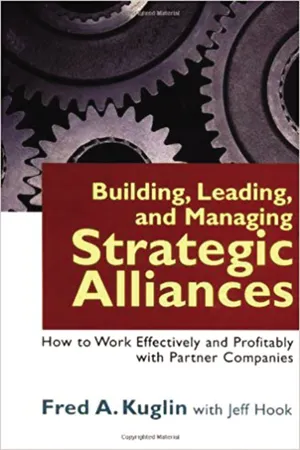
Building, Leading, and Managing Strategic Alliances
About this book
Changes in the world economic climate have fundamentally altered not only the way products are created, but also the way businesses form and thrive. Large organizations once grew by swallowing whole the smaller companies with which they worked. Now, growth for both large and small companies is fostered and nurtured by strategic alliances. This timely book illustrates five types of strategic alliances and how to structure them to achieve the goals of the component companies. Drawing from industries such as communications, healthcare, appliances, and defense, the book covers: * How to determine the right type of alliance, and structure it to meet each company's stated goals * Sharing knowledge and building inter-company teams * Successfully ending an alliance. Filled with sample legal documents and agreements, frameworks and guidelines, the book is an essential resource for companies considering strategic alliances.
CHAPTER ONE
What Is an Alliance?
Toto, We’re Not in Kansas Anymore!
One of my recent business trips to Europe took me to Paris, Brussels, Helsinki, Amsterdam, and London. In each city, I had the pleasure of interfacing with executives of top global and European companies. As a global alliance partner with a leading global professional services firm, it was my role to work with clients and extend the joint service offerings we developed with our alliance partner. It was also my role to work with the many members of our alliance partner organization and other members of my firm to both educate and promote the value of the alliance.
While I was in Helsinki, I checked my voicemail to stay in touch with the day-to-day events back home. I have a very competent staff, and everyone has my reach numbers when I travel. (After this trip, I will also have an international cellular phone to make sure that I am reachable 24/7.) When I was retrieving my messages, I was surprised to find an excited message from the CFO of one of our alliances, who had picked up rumors that my firm had invested in one of the alliance’s top competitors. Before I finished retrieving my messages, there was a second message from the CFO asking whether I had found the answer to his question.
The CFO message was puzzling at best. First, the CFO was a consummate professional who was almost always controlled with his actions. Second, I had a greeting on my voicemail that informed the caller that I was out of the country on firm business. Third and most important, our firm had made not only an investment but also a commitment to our alliance partner to exclusively focus on a specific industry sector with their technology solutions. Our firm is very large, and the chance of someone developing competing alliances was always present. However, when it comes to exclusivity in an industry, the industry sector leader has to approve all alliances. In addition, any investment has to go through our new investment group.
Quickly I sent to both the industry sector leader and the new investment leader an urgent voicemail asking whether the rumors were true. Their replies came back negative, just as I had anticipated and hoped they would. However, there was an event that triggered the rumors. A separate company had decided to spin off an in-house technology solution that was similar to the one with our alliance partner. Our industry sector leader was approached with the opportunity to invest in the new spin-off. Despite the attractiveness of investing in a pre-IPO spin-off, our industry sector leader declined the offer.
Needless to say, I was relieved with the answers I received. However, I knew that in our firm’s matrix organization, the chance of someone violating the terms and spirit of our alliance agreement was always present. It did not happen frequently, but when it did, the energy to fix the violation was exceeded only by the energy to calm executive anxieties.
This scenario also reinforced the ever-present belief that it is a small world. When I investigated what had happened with this separate company and its spin-off, I was informed that only its three most senior people knew of the firms that they had invited to be investment partners. If I add the two people within our firm, then the sphere of influence and knowledge of this offer was five people. Despite this small inner circle of people in the know, word leaked out and reached our investment alliance partner at Internet speed! The lesson here is that alliance behavior has to be consistent at all times.
The reason for alliance behavior to be consistent at all times is that successful alliances are built on trust. It takes a long time and personal relationships to build up trust. It takes only one event to destroy this trust, no matter whether the event was intentional or unintentional. One set of behaviors in the face of the alliance partner and another set of behaviors behind the partner’s back are a recipe for mistrust—and a failed alliance relationship!
Definitions of “Alliance”
The definition of the word “alliance” varies from executive to executive, company to company, and industry to industry. Often I find that companies that have entered into an alliance don’t necessarily agree on what is meant by “alliance.” The fact is that there are many different types of alliances. Another fact is that companies must approach them in vastly different ways.
Webster defines the word “alliance” as: 1. An allying or close association, as of nations for a common objective, families by marriage, etc. 2. An agreement for this 3. The countries, groups, etc. in such association.”1
Another way to define “alliance” is to look at synonyms. According to Webster’s Thesaurus, “alliance” can be defined by the following synonyms: “(The state of being allied) connection, membership, affinity, participation, cooperation, support, union, agreement, common understanding, marriage, kinship, relation, collaboration, partnership, coalition, affiliation, bond, and (The act of joining) fusion, combination, and coupling . . .”2
Webster’s Dictionary definition and the Thesaurus words used to describe “alliance” appear to be as broad and as deep as one would want.
It is important to understand the common objective of an alliance before one seriously considers entering into an alliance agreement. The first step has to be the categorization of the types of alliances in order to connect the concept of an alliance with the successful creation and implementation of an alliance. Let’s look at one way to categorize the types of alliances.
Types of Alliances
There are five basic categories or types of alliances.

Let’s take a look at each alliance type and its definition. (Please note that in many cases, alliances between companies can involve two or more categories or types of alliances.)
Sales Alliance
A “sales alliance” occurs when two companies agree to go to market together to sell complementary products and services. For example, i2 Technologies (i2), which sells eBusiness and Advanced Planning and Scheduling (APS) technologies, goes to market with a professional services provider like Cap Gemini Ernst & Young (CGE&Y) that will provide program management and systems integration services. This type of “sales alliance” usually revolves around targeted clients or targeted industries.
Exclusivity is not a requirement around a sales alliance. For example, i2 has multiple sales alliances with professional services providers, while CGE&Y has multiple sales alliances with similar technology providers. Where the trust factor comes into play is the partnership agreements around specific clients or specific industries.
The focus of a sales alliance is to create sales. Usually this revolves around joint selling activities with specific clients. As such, the “rules of the road” are usually client- and sales-process-related.
Solution-Specific Alliance
A solution-specific alliance evolves when two companies agree to jointly develop and sell a specific marketplace solution. For example, Whirlpool, Hearst, and Boston Consulting Group joined together in an alliance to develop and sell an Internet eMarketplace that was to be an objective, comprehensive information source for appliance buyers. This eMarketplace, called Brandwise.com, was intended to provide up-to-date information on products—their performance, availability, and prices. Retailers who would become part of the eMarketplace alliance would pay Brandwise.com a percentage of the sale (e.g., 5 percent) for any referrals that became sales. As such, Hearst, Boston Consulting Group, Whirlpool, and the retailers who formed Brandwise.com were all part of a solution-specific alliance.3
Exclusivity may or may not be “in play” with a solution-specific alliance. Many times, one alliance partner will own the solution developed, whereas the other alliance partner will have a “preferred partner” designation as a result of the joint solution development work. At times, the ultimate customer may like the solution and one of the partners but may not want to do business with the other partner. A solution-specific alliance may provide for this scenario and the “sale” of a solution, despite another, nonjoint development partner being selected by the customer. For example, let’s go back to the agreement (an extension of their alliance agreement) entered into by i2 Technologies and CGE&Y to jointly develop and sell an eFulfillment solution to the marketplace. Although many clients are approached jointly by i2 and CGE&Y, there are clients that prefer to work either with one of CGE& Y’s competitors or with one of i2’s competitors. In this agreement, as long as there is a register for what clients are joint clients and what clients are “open,” there exists a mutual understanding and expectation of how each company will behave in the marketplace. This builds the foundation of trust on which both companies can operate.
Again, the focus of the solution-specific alliance is joint selling of a jointly developed solution. Usually this type of alliance has specific parameters and incentives to maximize the return to both parties for their part of the joint development effort, regardless of other competitors potentially participating at clients’ requests.
Geographic-Specific Alliance
A geographic-specific alliance is developed when two companies agree to jointly market or co-brand their products and services in a specific geographic region. This type of alliance has existed for years in the beer industry. For example, Fosters is a very popular beer brewed by the Foster Brewing Company of Australia. Rather than export its beer to North America and incur the high cost of shipping from Australia to North America, Foster’s entered into an alliance with Molson Canada. Foster’s licenses its beer brands through a licensing agreement with Molson. Molson brews the Foster’s beer, according to Foster’s precise formula and distributes it through its normal distribution channels. Foster’s avoids having to pay for the export supply chain or spend the capital to build a North American brewery, while gaining access to an important geographic market. Molson gains additional product volume in both its brewery and its distribution network, driving efficiencies in both manufacturing and distribution.4
Another example is in the global appliance industry. When Maytag announced in November 2000 that it was looking at expanding into Europe through potential strategic alliances, it was rumored that this alliance would be with AB Electrolux of Sweden. According to informed ...
Table of contents
- Cover Page
- Title Page
- Copyright Page
- Contents
- Acknowledgments
- Introduction
- 1. What Is an Alliance?
- 2. Great Idea, But How Do I Get Started?
- 3. 3G Wireless Networks: The Future Is Now . . . or Is It?
- 4. Telecom Providers and 3G Wireless Device Manufacturers: A $1 Trillion Investment, Yet Where’s the Value?
- 5. Mission Impossible? From Intense Competitor to Alliance Partner!
- 6. Transportation: Win-Win Must Mean Profit-Profit
- 7. Health Care: Alliances and a Healthy Supply Chain
- 8. Software Companies and Consulting Firms: Alliances Viewed from Both Sides
- 9. Know When to Hold, and Know When to Fold
- 10. Critical Success Factors In Establishing Alliances
- 11. The Alliance Hall of Fame
- Index
Trusted by 375,005 students
Access to over 1.5 million titles for a fair monthly price.
Study more efficiently using our study tools.
Frequently asked questions
Yes, you can cancel anytime from the Subscription tab in your account settings on the Perlego website. Your subscription will stay active until the end of your current billing period. Learn how to cancel your subscription
No, books cannot be downloaded as external files, such as PDFs, for use outside of Perlego. However, you can download books within the Perlego app for offline reading on mobile or tablet. Learn how to download books offline
Perlego offers two plans: Essential and Complete
- Essential is ideal for learners and professionals who enjoy exploring a wide range of subjects. Access the Essential Library with 800,000+ trusted titles and best-sellers across business, personal growth, and the humanities. Includes unlimited reading time and Standard Read Aloud voice.
- Complete: Perfect for advanced learners and researchers needing full, unrestricted access. Unlock 1.5M+ books across hundreds of subjects, including academic and specialized titles. The Complete Plan also includes advanced features like Premium Read Aloud and Research Assistant.
We are an online textbook subscription service, where you can get access to an entire online library for less than the price of a single book per month. With over 1.5 million books across 990+ topics, we’ve got you covered! Learn about our mission
Look out for the read-aloud symbol on your next book to see if you can listen to it. The read-aloud tool reads text aloud for you, highlighting the text as it is being read. You can pause it, speed it up and slow it down. Learn more about Read Aloud
Yes! You can use the Perlego app on both iOS and Android devices to read anytime, anywhere — even offline. Perfect for commutes or when you’re on the go.
Please note we cannot support devices running on iOS 13 and Android 7 or earlier. Learn more about using the app
Please note we cannot support devices running on iOS 13 and Android 7 or earlier. Learn more about using the app
Yes, you can access Building, Leading, and Managing Strategic Alliances by Fred A. Kuglin,Jeff Hook in PDF and/or ePUB format, as well as other popular books in Business & Finance. We have over 1.5 million books available in our catalogue for you to explore.