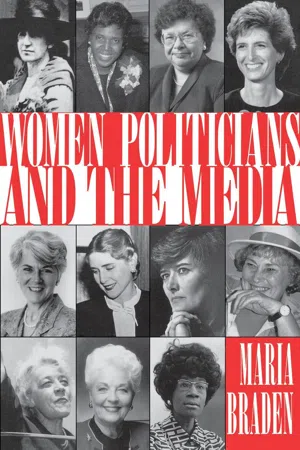
All American politicians face the glare of media coverage, both in running for office and in representing their constituents if elected. But for women seeking or holding high public office, as Maria Braden demonstrates, the scrutiny by newspapers and television can be both withering and damaging—a fact that has changed little over the decades despite the emergence of more women in politics and more women in the news media.
Particularly disturbing is the fact that the increase in the number of women reporters appears to have had little effect on the way women candidates are portrayed in the media. Some women reporters, in fact, seem intent on proving that they can be just as tough on women candidates as their male counterparts, thus perpetuating the misrepresentations of the past.
Braden examines the political fortunes of Jeannette Rankin, the first woman elected to the U.S. House; those of the congressional "glamour girls" of the 1940s, Clare Boothe Luce and Helen Gahagan Douglas; the long Senate career of Margaret Chase Smith; the political struggles of diverse women of more recent decades, including Bella Abzug, Elizabeth Holtzman, Nancy Kassebaum, Barbara Jordan, Dianne Feinstein, and Ann Richards; and the disastrous vice presidential bid of Geraldine Ferraro.
Braden traces a persistent double standard in media coverage of women's political campaigns through the past eighty years. Journalists dwell on the candidates' novelty in public office and describe them in ways that stereotype and trivialize them. Especially demeaning are comments on women's appearance, personality, and family connections— comments of a sort that would rarely be made about men candidates. Are they too pretty or too plain? What do their clothes say about them? Are they "feminine" enough or "too masculine"? Are they still just ordinary housewives or are they neglecting their families by heading for Washington or the state house?
Braden's study is based on both media accounts and the revealing personal interviews she conducted with a broad range of recent women politicians, including Margaret Chase Smith, Bella Abzug, Kay Bailey Hutchison, Nancy Kassebaum, and Ann Richards. All describe agonizing struggles to get across to the public the message that they are serious and competent candidates capable of holding high office and shaping our nation's course.
- 248 pages
- English
- ePUB (mobile friendly)
- Available on iOS & Android
eBook - ePub
Women Politicians and the Media
About this book
Information
Publisher
The University Press of KentuckyYear
2021Print ISBN
9780813108698
9780813119700
eBook ISBN
9780813181677

GOING FORWARD, WALKING BACKWARD
“The press was as kind as it knew how to be. It meant well and did all for us it knew how to do. We couldn’t ask it to do more than it knew how.” [Laughter] — Susan B. Anthony, 1893
SUSAN B. ANTHONY DIDN’T THINK MUCH OF THE PRESS. BUT SHE WAS SAVVY ENOUGH to lace her speech with gentle irony instead of insulting reporters directly. Journalists had heaped ridicule on the women’s suffrage movement for years, but Anthony knew that news coverage was a key to getting the women’s message to the public—and that biased coverage was better than no coverage at all. More than a century later, women politicians are still discovering what Anthony had learned—that journalists often ask women politicians questions they don’t ask men. That reporters describe women politicians in ways and with words that emphasize women’s traditional roles and focus on their appearance and behavior. That they perpetuate stereotypes of women politicians as weak, indecisive, and emotional. That they hold women politicians accountable for the actions of their children and husbands, though they rarely hold men to the same standards.
News coverage of women politicians is not always blatantly sexist, but subtle discrimination persists. In some ways this bias is harder to pin down and eradicate. Perhaps it was to be expected that reporters in 1916 would ask Jeannette Rankin, the first woman elected to Congress, how she liked having an office across from an eligible bachelor. But it’s harder to understand why journalists continue to ask inane questions that trivialize and stereotype women politicians.
In 1993, for example, reporters asked Representative Marjorie MargoliesMezvinsky (D-Pennsylvania) over and over what it was like to be a woman in Congress. “It began to feel as though they thought this was the only thing I knew about,” she says. In 1994 reporters kept asking New Jersey governor Christine Todd Whitman, “What’s it like to be a woman governor?” Whitman would ask her press secretary through clenched teeth, “How am I supposed to answer that?” In 1995 a female reporter for the Village Voice labeled Congresswoman Susan Molinari (R-New York) “perky,” and a male Washington Post reporter described veteran Senator Nancy Kassebaum (R-Kansas) as “demure”—words that would never be used to describe a man. Molinari shrugs off such adjectives, saying she doesn’t have time to worry about labels. But words add up. If they are repeated often enough in the media, their cumulative effect is to diminish a woman’s stature as an effective legislator.
When the news media imply that women are anomalies in high public office, the public is likely to regard them as bench warmers rather than as an integral part of government. In Senator Barbara Boxer’s phrase, they are frequently depicted as “strangers in the Senate”—and in the House and the governor’s mansion. More women than ever hold high-level government positions, yet they are still portrayed by the media as novelties. Being perceived as different can be an advantage, however. In fact, some of the more persistent media stereotypes sometimes work to the benefit of women politicians. The media have often portrayed women as political outsiders, whether they are or not—and that’s an asset when the country’s mood is strongly anti-incumbent. Barbara Boxer (D-California) was depicted as an “outsider” in her 1992 Senate race, for example, even though she had served five terms in the House and had gotten caught up in the House banking scandal. And Carol Moseley-Braun (D-Illinois) was portrayed as an outsider in her Senate race the same year, although as recorder of deeds for Cook County, she was a cog in the Democratic political machine.
It’s better to be portrayed as a novelty than not to be mentioned at all, and the news media play an important role in whether a candidate gets noticed in the first place. One of the worst things that can happen to a politician is to receive little or no media coverage. Yet academic studies show that’s what often happens to women candidates, especially if they’re newcomers. “Bias is easy to spot,” former Washington Post editor Ben Bradlee has said, “except for the bias of omission.”
Reporters and editors don’t conspire to stereotype, trivialize, or ignore women as a way of keeping them from running for public office. Nor do they plot to denigrate women when they succeed. In fact, for most of this century journalists have prized the notion of objectivity—that a news story should be free of bias and personal opinion. But news, after all, is whatever journalists say it is. It is said that the news media mirror society, but that is not exactly the case. The news media reflect certain aspects of the social and political culture. Journalists may be idealistic and conscientious individuals, but no matter how hard a journalist tries to adhere to the creed of objectivity, news stories reflect the values of both the individual and his or her news organization. Rather than mirroring the whole of society, the media have tended to reflect the values of those who assign, report, and produce the news, a majority of whom have been white males.
When Jeannette Rankin ran for Congress eighty years ago, for example, women were not expected to work outside the home but rather to be accomplished at what were considered the “womanly” arts of cooking, sewing, and singing. Newspapers of the day reflected that cultural expectation. Women, for the most part, didn’t make news. Men were in the public arenas of government and business, while women’s domain was private. Women’s work was represented in newspapers by “hearth and home” columns that dealt with gardening, cooking, sewing, and social matters. The few women employed by newspapers worked on the women’s pages, primarily writing society news. The rest of the paper was male turf, written by men for men.
The media operate much like a camera with a telephoto lens, zooming in on certain issues, events, and people and bringing them into sharp relief. But only so much will fit in the frame. Other things must be left out, and still others will be in the background of a picture, out of focus and considered unimportant. Just as there’s a finite amount of film in the camera, there’s limited space in a newspaper and limited time on a broadcast, so only a certain number of events or people can be represented. Walter Lippmann was one of the first to note, more than seventy years ago, that journalists “do not try to keep an eye on all mankind. . . . The news is not a mirror of social conditions, but the report of an aspect that has obtruded itself.” Journalists act as “gatekeepers,” deciding what will pass through to the public. Reality is filtered through their brains and packaged according to traditional news values, and the result is called news. As sociologist Michael Schudson wrote in Discovering the News, “The daily persuasions of journalists reflect and become our own.” Voters’ attitudes are shaped both by the kind of information delivered by the news media and by the way it is delivered. So, for example, reporters who tagged Kentucky governor Martha Layne Collins as a former beauty queen and referred to her male primary opponent as a physician were not inaccurate—Collins had won a minor pageant twenty-five years earlier. But in labeling her a beauty queen they chose to devalue her more substantive experience as a teacher and elected official.
News is based on fact, so it’s true, but it isn’t necessarily the whole truth. Facts are tested for newsworthiness against a set of traditional news values, which include prominence, unusualness, timeliness, conflict, and controversy. Those values are still taught in journalism schools across the country as a guide to framing stories for maximum reader interest, even though studies by Carol Gilligan and others have shown that women tend to be more interested in such values as compromise and collaboration and less interested in controversy and conflict. But it is harder for journalists to nail down a story based on consensus than it is to report on the friction between opposing viewpoints.
As Edward Jay Epstein has said in News From Nowhere, television news in particular tends to focus on conflict. “It is generally assumed that high ranking figures of authority involved in heated conflicts or challenges to their authority are more likely to produce news than news makers who are explicating developments or policies in a complex world. The more heated the dispute or challenge, the more certain the news story.” Newspapers reflect this emphasis too. Political stories that contain conflict and controversy are likely to get more space and better play than stories about compromise and consensus. Many political stories, particularly election campaign coverage, are framed in terms of conflict, with more emphasis given to the “horse race”—who is winning and who is losing—than to substantive coverage of issues. Some politicians seem dismayed by that emphasis.
Nancy Kassebaum, respected for her skillful moderation of opposing views in the Senate committee she chairs, says a continuing problem for women politicians is that they may not be geared to power politics, and consensus-building doesn’t play well in the press. But she says that’s changing. Former Senate majority leader George Mitchell has said the media’s equation of controversy with news has undermined the public’s belief in their elected representatives. “If it’s not controversial, it’s not news,” he said. “If it lends itself to sensationalism, it achieves a high level of attention.”
Being the first or being unusual also rates media attention and tends to bump less obvious but equally important attributes. In the traditional “man bites dog” mode, it makes good copy to portray women as outsiders, to represent them as doing something new and unusual—something that deviates from a traditional role. “Women are at their most newsworthy when they are doing something ‘unladylike,’ especially arguing with each other,” observed Kathleen Newland in The Sisterhood of Man. Representative Bella Abzug (D-New York), for instance, introduced significant legislation, but the media often got caught up in describing her floppy hat or assertive, “unladylike” manner. As long as the news media take that approach, women are less likely to see national political office as an attractive opportunity.
Image is a primary concern for office holders and office seekers in our media-saturated society, and it continues to be one of the biggest problems women face in running for high public office. A double standard has long existed in the press, with details about the way women look frequently inserted in news stories about women politicians but not in stories about men. Sometimes that’s as a result of references made by opponents during election campaigns, but sometimes description reminiscent of society-page writing creeps into political reporting about women for no apparent reason.
Perhaps it was to be expected back in the 1920s and 1930s when women stood out against the congressional backdrop of dark suits and cravats. Someone like Kentucky Democrat Katherine Langley was bound to make a splash in the press when she appeared on the House floor in the late 1920s “gowned in midnight blue trimmed in brilliant red.” But the press attention to dress went a little further than simply noting her unusual garb. One Capitol Hill reporter claimed that Langley’s dress actually interfered with floor business. “She offends the squeamish by her unstinted display of gypsy colors on the floor and the conspicuousness with which she dresses her bushy blue-black hair.”
Even more conventionally dressed congresswomen who blended in with their male counterparts have been described in detail. In terms of media coverage, it may be worse for a woman to be attractive than homely. That’s what Illinois Republican Charlotte Reid discovered when she was sworn into Congress in 1963. The Chicago Tribune reported that “the gallants of the House observed primarily that she was beautiful.” And in 1969, despite many legislative successes, Reid made headlines when she wore a black wool, bell-bottomed pantsuit on the House floor. Yet, she complained to an interviewer, “No one paid much attention to my speech on behalf of the Equal Rights Amendment.”
In the 1960s, during her first campaign for public office, Republican Massachusetts congresswoman Margaret Heckler found she could neutralize the public response to her gender by wearing a gray flannel suit at every campaign stop. She says that allowed her to blend into “the gray Massachusetts sky and the gray male political arena” so the voters would be forced unconsciously to identify her with the issues and forget about the fact that she was a woman. The strategy apparently worked because after her victory her opponent said he had belatedly discovered some devastating material about her background that he would have used against her during the campaign: “You’re a mother,” he said accusingly, “you have children.”
Media attention to the physical appearance of women continued through the 1970s and 1980s, and examples still crop up. The coverage of First Lady Hillary Clinton’s changing hairstyle is a continuation of the practice of focusing on women’s physical appearance rather than their capabilities. Senator Barbara Mikulski (D-Maryland), first elected to the House in 1976, said her physical appearance was always cited in the Baltimore press. She joked that a typical story might say, “Barbara Mikulski, who is short and round, in her uphill fight against the political machine, said today, ‘No more expressway in southeast Baltimore.’” But the press never described her opponents as “middle-aged, pot-bellied incumbents who are facing a downhill race against Barbara Mikulski.” Mikulski said one of the major problems in her unsuccessful 1974 campaign for a Senate seat was that she didn’t fit the image of a U.S. senator: “You know, an Ivy League-looking male, over fifty and over six feet tall.” At just over five feet tall, Mikulski couldn’t change her gender or her height. So she used humor in her successful congressional campaign two years later. She went on a seven-day fast and a vegetarian diet. “I told people it showed I could keep my mouth shut for a week,” she said. “But it also showed them that when I make up my mind to do something, I can follow a goal.”

Senator Barbara Mikulski (D-Maryland) began her congressional career in 1976 when she was elected to the U.S. House of Representatives.
In 1982, the respected Des Moines Register covered prosecutor Roxanne Conlin’s unsuccessful campaign for governor of Iowa. During the campaign the paper featured six photos showing different hairstyles Conlin had worn over the previous eleven years. Her opponent, needless to say, was not shown in progressive stages of baldness. Former Texas governor Ann Richards, whose hair has been described variously by reporters as a helmet, a symbol of traditional values, and a “patented corona of frozen white hair [radiating] light,” says she has learned that a woman in public life can’t change her hairstyle. “How you look is how you are. Once you look a certain way and are in the public eye, you do not ever change it,” she says, because the public will believe you are capricious and can’t make up your mind. “If you’re in public life, you better get you a hair style you like as long as you remain in the public eye.” Richards doesn’t consider her spectacular coif a symbol of anything, media speculation notwithstanding. “It’s how I started fixing my hair twenty years ago. If I had thought of it, I would have done something much simpler,” she says. “I didn’t know I would be doing this for the rest of my life.” Finally, some parity: A half page photo in the Sunday New York Times soon after the 1994 elections depicted House Speaker Newt Gingrich having his hair done at the Capitol beauty salon. Male politicians are being subjected to the same trivial coverage as women.
Not only are women politicians locked in by images, they are also trivialized by the gender-specific words journalists commonly use to describe them. Former congresswoman Mary Rose Oakar (D-Ohio) was referred to by the Cleveland Plain Dealer in 1985 as “the plucky former amateur actress.” Democratic vice presidential candidate Geraldine Ferraro was frequently called “spunky” and “feisty” when she campaigned in 1984. Sociologist Deborah Tannen, a specialist in language use, says journalists probably meant no harm by their description of Ferraro, “but their words bent back and trivialized the vice presidential candidate. . . . Most damaging of all, through language, our images and attitudes are buttressed and shaped.”
Ferraro was also followed by the label “bitch.” The media didn’t always spell out the word, nor did they originate the term. In one notorious instance, they were echoing Barbara Bush’s quip to reporters aboard a campaign plane that the woman campaigning against her husband was “a_________, rhymes with rich.” Barbara Bush was lashing out at Ferraro in defense of her husband, Vice President George Bush—a traditional wifely protective role that journalists could understand. But journalists have had a harder time shaking off the assumption that women politicians are primarily responsible for the behavior of their families. References to husbands and children have cropped up repeatedly in news stories about women ...
Table of contents
- Cover
- Title
- Copyright
- Dedication
- Contents
- List of Illustrations
- Acknowledgments
- 1. Going Forward, Walking Backward
- 2. The First and Only
- 3. The “Glamour Girls” of Congress
- 4. A Rose by Any Other Name
- 5. The Push for Equal Rights
- 6. Battling Bella
- 7. Are We There Yet?
- 8. Almost a Bridesmaid
- 9. 1992 and All That
- 10. The Kamikaze Campaign and Politics As Usual
- 11. Nearing the Millennium
- 12. From a Woman’s Point of View
- 13. Ms. President?
- Notes
- Bibliography
- Index
Trusted by 375,005 students
Access to over 1.5 million titles for a fair monthly price.
Study more efficiently using our study tools.
Frequently asked questions
Yes, you can cancel anytime from the Subscription tab in your account settings on the Perlego website. Your subscription will stay active until the end of your current billing period. Learn how to cancel your subscription
No, books cannot be downloaded as external files, such as PDFs, for use outside of Perlego. However, you can download books within the Perlego app for offline reading on mobile or tablet. Learn how to download books offline
Perlego offers two plans: Essential and Complete
- Essential is ideal for learners and professionals who enjoy exploring a wide range of subjects. Access the Essential Library with 800,000+ trusted titles and best-sellers across business, personal growth, and the humanities. Includes unlimited reading time and Standard Read Aloud voice.
- Complete: Perfect for advanced learners and researchers needing full, unrestricted access. Unlock 1.5M+ books across hundreds of subjects, including academic and specialized titles. The Complete Plan also includes advanced features like Premium Read Aloud and Research Assistant.
We are an online textbook subscription service, where you can get access to an entire online library for less than the price of a single book per month. With over 1.5 million books across 990+ topics, we’ve got you covered! Learn about our mission
Look out for the read-aloud symbol on your next book to see if you can listen to it. The read-aloud tool reads text aloud for you, highlighting the text as it is being read. You can pause it, speed it up and slow it down. Learn more about Read Aloud
Yes! You can use the Perlego app on both iOS and Android devices to read anytime, anywhere — even offline. Perfect for commutes or when you’re on the go.
Please note we cannot support devices running on iOS 13 and Android 7 or earlier. Learn more about using the app
Please note we cannot support devices running on iOS 13 and Android 7 or earlier. Learn more about using the app
Yes, you can access Women Politicians and the Media by Maria Braden in PDF and/or ePUB format, as well as other popular books in Politics & International Relations & Politics. We have over 1.5 million books available in our catalogue for you to explore.