This book analyses the French political crisis, which has entered its most acute phase in more than thirty years with the break-up of traditional left and right social blocs. Governing parties have distanced themselves from the working classes, leaving behind on the one hand, craftsmen, shop owners and small entrepreneurs disappointed by the timidity of the reforms of the neoliberal right and, on the other hand, workers and employees hostile to the neoliberal and pro-European integration orientation of the Socialist Party.
The Presidency of Fran?ois Hollande was less an anomaly than the definitive failure of attempts to reconcile the social base of the left with the so-called "modernisation" of the French model. The project, based on the pursuit of neoliberal reforms, did not die with Hollande's failure; it was taken up and radicalised by his successor, Emmanuel Macron. This project needs a social base, the 'bourgeois bloc", designed to overcome the right/left divide by a new alliance between the middle and upper classes. But this, as we have seen recently on the streets of Paris and elsewhere, is a precarious process.
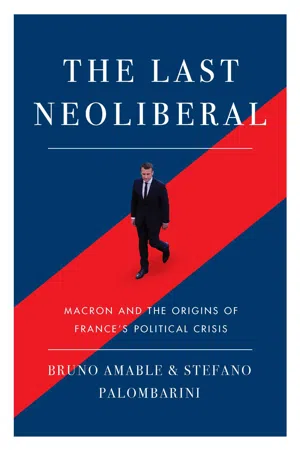
eBook - ePub
The Last Neoliberal
Macron and the Origins of France's Political Crisis
- 192 pages
- English
- ePUB (mobile friendly)
- Available on iOS & Android
eBook - ePub
The Last Neoliberal
Macron and the Origins of France's Political Crisis
About this book
Information
CHAPTER 1
The Political Crisis: The Absence of a Dominant Social Bloc
CHARACTERIZING THE POLITICAL CRISIS THEORETICALLY
Judging by the French population’s growing distrust of political institutions and personnel, there is good reason to believe that the country is experiencing a political crisis. In a 2012 survey for Cevipof,1 only 31 per cent of respondents said they had confidence in the presidency as an institution, 28 per cent in the National Assembly, and 26 per cent in the government. In this same survey, 85 per cent had reached the conclusion that political officials had ‘little or no interest’ in their opinion, 52 per cent had no confidence in either left or right to govern the country, and only 12 per cent were ‘very’ or ‘quite’ confident in political parties. If we tot up the answers to the question ‘What do you feel when politics is being discussed?’, we find only 20 per cent of responses are positive: whether expressing interest (13 per cent) hope (6 per cent) or respect (1 per cent). Conversely, negative feelings – distrust (38 per cent), disgust (26 per cent), weariness (12 per cent) and fear (3 per cent) accounted for four-fifths of those surveyed. Of those surveyed, 0 per cent described their feelings in terms of enthusiasm.
The use of the term ‘crisis’, very widespread in social science literature, spans several different meanings. So it is important to specify the exact meaning this word has in a political economy context. If we want to understand the deep crisis of political representation, we can hardly settle for setting up a counterposition between ‘the French’ and elected officials. There are differentiated interests even within ‘civil society’. We should not expect that any political authority is ever going to represent all of them.
The first step towards a positive analysis of the French crisis is therefore to give up on any notion of the general interest or common good, of the ‘right’ or ‘optimal’ policy with which everyone could supposedly identify. Public policies instead ought to be analysed as attempts to mediate between differentiated interests – especially socioeconomic interests – which cannot be reduced to any shared perspective. This leaves space for a variety of political strategies to draw different boundaries between those interests they propose to defend or, alternatively, to sacrifice. It is therefore only logical that some part of the electorate will not identify with whatever set of political choices are made. Crisis is a question of extent. If no consensus is possible around any particular political strategy, when political support falls to such low levels, the system’s stability will come under threat.
We first need to analyse the mechanisms that produce political support, in order to understand what is blocking these mechanisms in today’s France. To that end, we first need to reflect on the fact that the evolutions of the economy and of the political go together – and mutually condition one another. Today it is commonplace to analyse the impact that public policy choices have on economic dynamics. But we also need to take account of the opposite movement, running from the economic to the political. The process of economic accumulation is at the origin of a series of – multiple, and partly contradictory – expectations, which each call for political decisions that will protect their interests. Political and electoral support are rooted in the selection and satisfaction of some part of these expectations. The modalities of the production and distribution of wealth thus evolve over the course of time – as does the distribution of the power to take the decisions imposed across society as a whole. Indeed, these developments also mutually determine one another. The reproduction of a social structure is possible if the accumulation of wealth and the accumulation of political power, as framed by institutions, mutually reinforce one another (see Figure 1.1).
Figure 1.1 The institutions at the heart of political economy

The economic and the political evolve together, but they respond to different drives. Indeed, the fact that they operate according to heterogeneous logics is at the heart of the reproduction of society, which can thus never be guaranteed in advance. The evolution of the socioeconomic context is always accompanied by transformations in the relations of force. Yet we can speak of a given society being reproduced, so long as the frontier between the dominant groups (those whose interests are protected by public policy choices) and the dominated ones (those whose interests are sacrificed) is not put into doubt. And yet society’s evolutions can lead to crises of varying intensity. Crisis coincides with a challenge to the social order that threatens to throw up obstacles to either political or economic accumulation.
However, frontal opposition to the existing relations of force – the simple refusal to engage in the production and distribution of wealth – is rare. When such resistance does arise, after all, it is heavily punished, whether by unemployment, poverty or exclusion. Even economic-type opposition thus ordinarily makes up part of the sociopolitical sphere: such is the case with social conflicts, which have, of course, not been lacking in France in recent years. In turn, sociopolitical opposition itself comes up against limits: it can even be violently repressed – and, of course, the state has a monopoly on legitimate violence. Here, too, we could point to an abundance of recent examples. Democratic societies are organized in such a manner that opposition to the social order is especially expressed in electoral processes. It is electoral turnout and election results that indicate whether the dominant groups are numerous and powerful enough to confirm the existing relations of force.
Any political strategy must necessarily choose between different social interests. A social bloc is made up of the groups protected by a given strategy; it is dominant if it is able to validate politically the mediation strategy that provides its own foundation. Thus, the reproduction of a society – that is, the maintenance of a stable boundary between the dominant and dominated interests – depends on the existence of a dominant social bloc. And so, too, does political stability – which is to say, the possibility that the powers-that-be can generate sufficient support to ensure their own viability.
The multiple strategies for political mediation between different interests clash on a terrain defined by institutions, which should be understood as the rules of the social game. These rules do not respond to criteria of effectiveness or social justice any more than do the strategies themselves. Institutions are the product of political conflicts; these conflicts result in compromises which are then inscribed in enduring rules that stand above ordinary political conflict. Of course, a political strategy may well set itself the objective of seeking institutional change. But pursuing that goal means reopening a conflict that has temporarily been resolved by way of an institutionalized compromise.
Ordinarily, therefore, the mediation between different interests takes place within an institutional framework which defines constraints that political action must respect if it wants to avoid feeding social conflict. Even so, it may be that no political mediation strategy is able to guarantee the viability of a dominant social bloc within the existing institutional framework. We would term such a situation a political crisis – and this is precisely the kind of crisis that is today tearing through France.
The crisis situation directly manifests itself in political instability: the powers-that-be are unable to take any action that will renew the support they need in order to ground their own legitimacy. Instability is thus a consequence of the political crisis, which is itself rooted in the difficulty in constructing a dominant social compromise.
This type of crisis is most simply expressed in election results. Since the end of the 1970s, each French government seeking a fresh mandate at the polls has met with defeat. This is the clearest manifestation of the country’s political crisis, which has now been going on for almost forty years. The outgoing majority has, on each occasion, become a minority after the subsequent test at the ballot box; the only exceptions to this rule are owed to the fact that the winners vaunted their opposition to their own camp. Such was the case of Jacques Chirac, elected president in 1995, but in the form of an outsider hostile to the outgoing Balladur government; Nicolas Sarkozy did the same in 2007, after having operated as an internal adversary within the Villepin government, standing opposed to the ‘immobilism’ of the Chirac presidency. Other electoral symptoms of the French political crisis include Jean-Marie Le Pen’s progress to the second round of the 2002 presidential election, the victory of the ‘No’ side – against the recommendations made by all the ‘parties of government’ – in the 2005 referendum on the European Constitutional Treaty, and indeed the rise over the last three decades of a party considered an ‘anti-systemic’ force, the Front National. These are well-known events, and they have been widely discussed. In our view, they ought to be seen as consequences of a political crisis rooted in the difficulty of forming a dominant social compromise.
In a crisis situation, political actors effectively have no solutions available to them. Within the existing institutional framework, their strategies will be doomed to failure: a political failure, corresponding to the impossibility of bringing together a dominant social alliance. This is bound to bring a collapse in the support that political actors need if they are to assert themselves. The political crisis thus has an immediate impact on the institutions themselves. Faced with the impossibility of forming a dominant bloc within a given institutional architecture, institutional change – and the broadened social conflict this change will provoke – will itself be integrated into the various political strategies.
Once again, this change does not at all respond to objectives of economic effectiveness or social justice: it will be adapted to suit the profile of the social bloc that each strategy proposes to bring together. The various political projects thus distinguish themselves in terms of the nature of the institutions they seek to modify and the content of the changes they envisage. This might play out, for instance, in terms of the greater or lesser importance that party programmes accord to rewriting the labour code, to the renegotiation of the European treaties, or indeed to the rules that structure the financial markets. What institutions are most in need of changing, and in what direction should they be changed? To answer these questions, we need to understand the profile of the social alliances that political actors seek to form – and not, necessarily, the economic effectiveness of the strategies they propose. Thus, the conflict over institutional reforms that has characterised France’s political landscape for several years is now, in turn, a direct consequence of the political crisis.
THE POPULAR CLASSES, WITHOUT POLITICAL REPRESENTATION
From a theoretical point of view, the political crisis coincides with the difficulty of stably grounding any social bloc capable of sustaining a political strategy. From this perspective, the specific characteristic of the French crisis lies in the more or less complete exclusion of the popular classes as a whole from the social alliances on which governmental action (of left or right) has in recent decades sought to base itself.
The popular condition corresponds to a subaltern and subordinate position in the division of labour.2 Even so, it is fundamentally important for our analysis that we do not consider the popular classes as a homogeneous bloc. As Olivier Schwartz has emphasized
the notion of the ‘popular classes’ brings together under a single name a whole array of groups and situations that may in fact be very heterogeneous. Those considered as belonging to the popular classes today can include peasants, blue or white-collar workers, foremen and supervisors, small artisans or traders, the employees of a public company, the young and marginalised, etc. The popular classes’ expecta tions are thus far from identical, for these classes are differentiated by their conditions of existence and their work situations, the social trajectories and experiences most typical of their members, the constraints to which they are subject, the practices and knowledges that they elaborate in order to deal with these constraints, etc. This set of conditions gives rise to cultural traits and ways of life that may mark out far more than just differences of nuance.3
As we shall see, in the period that preceded the political crisis, there were fractions of the popular classes present in both the left-wing bloc (blue-collar workers, low-skilled white-collar workers) and the right-wing bloc (artisans, small traders, the underprivileged rural population). However, from the 1980s onwards, these two blocs cracked up and ultimately exploded; since that point any attempt to recompose them has ended in failure. The impossibility of integrating the popular classes into a ‘governmental’ alliance has even been positively theorized: for the Terra Nova foundation, it is instead now the Front National that ‘takes up the position of the party of the popular classes, and it will be difficult to counter this’.4
In Terra Nova’s view – which expresses a sort of received wisdom among political ‘elites’ – the FN is an anti-systemic party condemned to opposition. Hence, to delegate the representation of the popular classes to this party amounts to excluding the interests of the weakest from any political exchange. Indeed, the project of forming a ‘bourgeois bloc’,5 as discussed in this book, rests precisely on the political marginalization of the popular classes. In this project, which articulates a new alliance between the middle and upper layers of the old left-and right-wing blocs, the popular classes are excluded.
If the crisis in the representation of the popular classes has become generalized, we will focus more specifically on those social groups who historically sought – and sometimes found – the answer to their expectations within the political left. The left has never represented the popular classes as a whole, but rather a very sizeable part of those classes. To simplify things – without drifting too far from the reality – we could say that the left was long supported by the waged popular classes, which is to say, those whose relation of subordination was formalized in an employment contract.
Figures 1.2, 1.3 and 1.4 show the votes for the parties of left (including the far left) and right (including the far right), as well as abstention, as distributed by socio-occupational category, according to election polls for the years 1978 and 2012.
Figure 1.2 Vote share for left-wing parties according to socio-professional classification

Figure 1.3 Vote share for right-wing parties according to socio-professional classification

Figure 1.4 Abstention according to socio-professional classification

The 1978 figures show relatively clearly that the popular vote favoured the left and stood at a distance from the right. Conversely, the study of the 2012 electorate reveals the popular classes’ disaffection with the left and rising support for right-wing and far-right parties – but, most importantly of all, their increased levels of abstention. According to INSEE,6 in 2012 blue-collar workers still represented more than 20 per cent of the active population, and even a slightly greater proportion of the total population if we also include pensioners. If we combine this percentage with the figure for white-collar workers (whose average salary is lower than their blue-collar counterparts), we arrive at around half of th...
Table of contents
- Cover Page
- Halftitle Page
- Title Page
- Copyright Page
- Contents
- List of Tables and Figures
- Preface
- Introduction
- Chapter 1: The Political Crisis: The Absence of a Dominant Social Bloc
- Chapter 2: The Parti Socialiste’s Identity, at the Heart of the Crisis
- Chapter 3: The Bourgeois Bloc: A New Hegemonic Bloc?
- Chapter 4: The Processes of Political Recomposition
- Chapter 5: France’s Model of Capitalism, at the Heart of Political Conflict
- Afterword to the English Edition
- Notes
Trusted by 375,005 students
Access to over 1.5 million titles for a fair monthly price.
Study more efficiently using our study tools.
Frequently asked questions
Yes, you can cancel anytime from the Subscription tab in your account settings on the Perlego website. Your subscription will stay active until the end of your current billing period. Learn how to cancel your subscription
No, books cannot be downloaded as external files, such as PDFs, for use outside of Perlego. However, you can download books within the Perlego app for offline reading on mobile or tablet. Learn how to download books offline
Perlego offers two plans: Essential and Complete
- Essential is ideal for learners and professionals who enjoy exploring a wide range of subjects. Access the Essential Library with 800,000+ trusted titles and best-sellers across business, personal growth, and the humanities. Includes unlimited reading time and Standard Read Aloud voice.
- Complete: Perfect for advanced learners and researchers needing full, unrestricted access. Unlock 1.5M+ books across hundreds of subjects, including academic and specialized titles. The Complete Plan also includes advanced features like Premium Read Aloud and Research Assistant.
We are an online textbook subscription service, where you can get access to an entire online library for less than the price of a single book per month. With over 1.5 million books across 990+ topics, we’ve got you covered! Learn about our mission
Look out for the read-aloud symbol on your next book to see if you can listen to it. The read-aloud tool reads text aloud for you, highlighting the text as it is being read. You can pause it, speed it up and slow it down. Learn more about Read Aloud
Yes! You can use the Perlego app on both iOS and Android devices to read anytime, anywhere — even offline. Perfect for commutes or when you’re on the go.
Please note we cannot support devices running on iOS 13 and Android 7 or earlier. Learn more about using the app
Please note we cannot support devices running on iOS 13 and Android 7 or earlier. Learn more about using the app
Yes, you can access The Last Neoliberal by Bruno Amable,Stefano Palombarini,Stefano Palombarin in PDF and/or ePUB format, as well as other popular books in Politics & International Relations & French History. We have over 1.5 million books available in our catalogue for you to explore.