![]()
(b. 1937, d. 2005)
THE LATE DOUGLAS BULLARD was born into a hearing family and grew up in Georgia and Florida. At the age of three, he lost his hearing due to spinal meningitis. He graduated in 1952 from the Central Institute for the Deaf in St. Louis, Missouri. Bullard was a Gallaudet graduate (class of 1964), an Alaskan geologist, and a former president of the Florida Association of the Deaf. He was also known for his storytelling in ASL. Islay was published in 1986 by TJ Publishers. It is the first novel known to be written in a hybrid version of English and glosses on American Sign Language. The selection below is the first chapter from that book and is edited by poet and publisher John Lee Clark. Islay
Islay
Chapter One
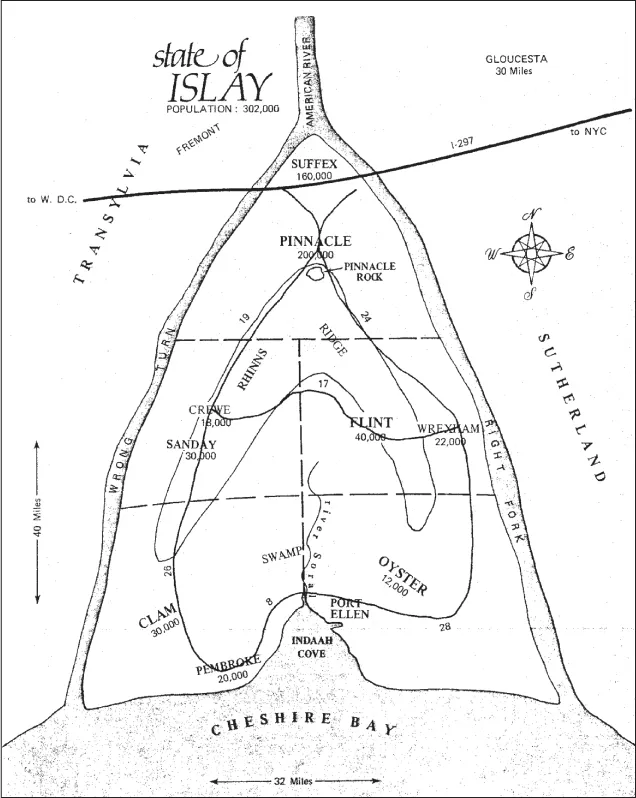
ITS PECULIAR POSITION on the map, hidden away in a recess like a hind tit tucked up under the tenderloin of the great states of the Union, gave the distinct impression that the State of Islay was an afterthought, which indeed it was. At first glance Islay appears to be a river delta where the American River spills into Chesire Bay on the south. On closer look, however, a sharp chevron-shaped ridge of hills called the Rhinns is what splits the river into two forks so that Islay has a nice-looking delta shape, with an inviting southern coast where Chesire Bay, encroaching a low area between the ridges, creates a smaller bay—Indaal Cove. Overall, the little island is only 32 miles along its southern coast and some 40 miles from Suffex at the northern apex down to the coast.
Seems very small, commented Mary, her mouth pushed very small, and folded her arms, hiding her hands out of communication.
Exactly! Perfect for my, I mean our plan, Lyson beamed. And larger than Rhode Island but fewer people. Look! He pointed out the legend in the corner. See? Official Highway map Islay! Altogether only 302,074 people. About half live there, Suffex. Mary stared at him as at an eccentric, and dropped her shoulders. Forget lock door, you! Why?
Tell you! Lyson crossed his heart and stamped his foot. Did lock!
She shook her head at the door. How? How? She tested the knob again. It was locked as locked can be.
Nothing can do! Lyson pleaded with small hops. Mortima herself promised shut-up.
Wonderful promise! She wagged her head and plunked away at an imaginary harp.
Lyson bared his teeth like a cringing dog. Smile and be satisfied that myself upset, very upset, same you—
Stupid hobby!
Not stupid! Let me explain—He set the bridges back upright. They were the only link between the island and America. In the old days before the Interstate System, there only was a rickety wooden trestle a lane and half wide across the Wrong Turn between Suffex and the great state Transylvia, just below Fremont. This made it easy to overlook Islay. Exactly what the people of Islay wanted. And what Lyson wished was still true, but the Federals thought otherwise.
Insisting that the people of Islay step up into the twentieth century along with the rest of the country, the Federals some years ago punched a freeway through Islay, near the top of the delta just below the capital of Suffex. And they ceremoniously burned down the old bridge, ostensibly in observation of the opening of the new freeway bridges but more likely in recognition of the old bridge’s notoriety as an attractive nuisance, in particular for Chevy joustin’ matches. The bridge had won this game of chicken all too often, robbing the United States military of potential knights and jockeys for its own engines of war. Lyson had read all this, he said, in response to Mary’s weary brow, in The History of Islay The Little State That Could.
Look! He smoothed the map and spread it out on the table, pushing aside little cars and trucks. Her arms still folded, Mary followed his finger as it traced the great green line of Interstate 297 slashing through the tip of the delta below Suffex, connecting it with Transylvia across Wrong Turn to the west, and Sutherland to the east across Right Fork. The heaviness, the very green of the line brought forth the image of a nation in motion, in a hurry, hurtling inexorably right by the insignificant little state with hardly a glance. Lyson began rumbling his lips like heavy trucks but he checked himself at Mary’s sharp glance.
Remember? he said, hastily wiping his mouth. Ourselves drove through many times going to New York. Remember?
Maybe, she shrugged.
See! Most people never notice Islay! That’s why perfect for deaf! The force of his gesture lifted his torso in a little hop. Notice, only two! He urged her eyes to note the fact that there were only two exits from the freeway into the State of Islay. His eyebrows wiggled significantly but her arms remained folded. There! he tapped the map and ran a finger along the one and only highway that wound in a perimeter around the state, first down Right Fork and the coast, then up Wrong Turn back to Suffex. Only a few towns appeared on this map of Islay, and the names appeared as ancient as England itself. Crewe on Wrong Turn about halfway down from Suffex. Wrexham on Right Fork opposite. Pembroke basking on the coast at Indaal Cove, with little Port Ellen in its own little cove on one side of the bay. Lyson clamped his lips tight together so they would not flutter or splutter as his finger traveled up and down the map. He held up five fingers meaningfully, Imagine!
Mary allowed a shoulder to do all her communication.
Can’t you see? Lyson gave a little leap on stiff legs. Perfect for my—I mean our plans. Only five towns, easy for us deaf conquer, control—
Mary sagged. Nice dream. That your hobby?
Not so! Real dream! I mean goal!
Wish never!
Lyson looked so sad, so put down, she explained, Wish you didn’t forget lock door. She double-checked. Still locked.
Lyson flipped some pages in the book The History of Islay The Little State That Could and came up with this anecdote: “From the time of the colonies through the War for Independence to the War Between the States, Islay was claimed by the great States of Transylvia on the west and Sutherland on the east to be a county belonging to the other. In short, it was an unwanted orphan shifted back and forth across the River American, its parentage and legitimacy denied and its heritage uncertain. It was not until its most illustrious son, Slappy Wenchell, returned home a full Colonel from the War Between the States, his eyes wide from seeing the world, did Islay find its rightful sovereignty among the States of the Union. Colonel Wenchell gathered all the veterans of the War into a mighty army and petitioned Congress for full statehood for Islay.
“Miraculously, it was easier done than thought. The Senators from Transylvia and Sutherland were surprisingly its most vigorous supporters, and the motion passed swiftly through Congress, making Islay a state! Only after the fact did it come to light that the Senators of Transylvia and Sutherland had each thought Islay to be a county belonging to them.”
Lyson tapped the book with the back of his hand. Interesting history!
Yes, interesting, Mary agreed politely with a twist of the head.
Fascinating! Lyson insisted as he turned the pages of the book. More read.
“Having seen the splendors of the whole wide America, as far west as Nashville and as far south as Savannah, Colonel, now Governor, Wenchell decided in the year 1888 to erect a stupendous, beautiful, and outstanding monument to his Army. For this he chose a bandstand! Governor Wenchell believed that the only ones to appreciate useless monuments such as heroes on horses or obelisks were pigeons, and even then he suspected such appreciation to be less than wholehearted, for witness how spattered such edifices become in time. But, said Wenchell, a bandstand would be a more fitting and appreciated monument to his Army, which he noted proudly still assembled every year to whoop it up. A monument to the finer elements of the human spirit: horns, drums, cymbals, and strings rather than to the baser: guns, swords, and cannon. The Governor knew what he was doing and no expense was spared after he commissioned the best architect in Islay for the job. This was the young Sam Phelps, whose forebears had laid out the streets of Suffex in colonial times and had built the Wenchell Mansion, now the Governor’s Mansion, as well as many of the finer homes of Suffex.
“Alas, Governor Slappy Wenchell never lived to see the completion of his beloved monument. It took many long and arduous years of travel, study, and consultation with world-famed architects and conductors in Paris, Venice, Rome, Athens, Palestine, Egypt, and the Caribbean before Mr. Phelps came across exactly the right design in a little village in Massachusetts. There in Rockport at the head of a little cove by the sea stood the most exquisitely beautiful little bandstand he ever saw. It was almost entirely in stone and its roof was crowned by a magnificent little lantern, so that tears came to his eyes.”
Mary looked up sharply, and Lyson blinked. Look! He hastened to draw her attention to the doll house. Thirty-seven feet and four inches, diameter. Sixty-three feet, seven and half inches from ground to peak. He smiled and bit his lower lip at the same time. Huge, eh?
Oh, wiggled her little finger.
Interesting! Tentatively, encouragingly.
Interesting, politely said.
Imagine! he extolled.
Imagine! she bristled. Mortima saw!
Beautiful! Hope she like it, he said.
Exactly! she exclaimed. Exactly! She loved what she saw!
She promised! he jumped.
Dream dream dream—wiggled her index fingers slowly up from her forehead away into never-never, her eyes cros...