International perspectives about literacy and deaf students is an uncharted intellectual landscape. Much of the literacy research in deaf education is conducted in English-speaking countries—primarily the United States—but 90% of deaf children live outside the U.S. and learn various signed and spoken languages, as well as diverse writing systems. Many of these children face significant educational challenges. In order to improve the literacy outcomes of deaf students around the world, it is imperative to study how children are using their local signed and spoken languages along with Deaf culture to learn to read and write. This volume fills a void in the field by providing a global view of recent theoretical and applied research on literacy education for deaf learners.
Literacy and Deaf Education: Toward a Global Understanding is organized by region and country, with the first part discussing writing systems that use alphabetic scripts, and the second part focusing on countries that use non-alphabetic scripts. Some examples of the wide spectrum of topics covered include communication methodologies, curriculum, bilingual education, reading interventions, script diversity, and sociocultural development, including Deaf cultural developments. The contributors provide the results from literacy projects in fifteen countries and regions.
This volume aims to widen the knowledge base, familiarize others in the field with these initiatives, and improve global understandings and outcomes of literacy teaching and learning in deaf education from birth to high school.
Signed chapter summaries are available on the Gallaudet University Press YouTube channel.

eBook - ePub
Literacy and Deaf Education
Toward a Global Understanding
- English
- ePUB (mobile friendly)
- Available on iOS & Android
eBook - ePub
Literacy and Deaf Education
Toward a Global Understanding
About this book
Information
Topic
EducationSubtopic
Education GeneralI
South and Central America

1
TECLAS: A Reading Comprehension Intervention for Chilean Deaf Adolescents
María Rosa Lissi, Christian Sebastián, Martín Vergara, Cristián Iturriaga, Catalina Henríquez, and Sergio Hofmann
The difficulties deaf students face in order to develop written language skills are still a challenge for educators and researchers (Benedict, Rivera, & Antia, 2015; Marschark et al., 2009). Studies carried out in Chile have also shown that the reading level of our deaf students is way below that of their hearing peers (Herrera, 2010; Lissi, Raglianti, Grau, Salinas, & Cabrera, 2003). This is quite alarming if we take into account that our hearing students already show a reading level that is below the average of countries in the Organization for Economic Cooperation and Development (Agency for Quality Education, 2014).
It has been reported that deaf students’ difficulties with reading are associated with a limited syntactic and lexical command of the language of written texts—Spanish in the case of Chile1—which is a second language for signing deaf students; a lack of background knowledge about text content; a lack of knowledge about the structure of written texts; and a limited repertoire of cognitive and metacognitive strategies, among other things (Luckner & Handley, 2008).These difficulties have been reported mostly in US students, but have also been supported by studies carried out in Chile (Lissi et al., 2003; Lissi, Sebastián, Vergara, Iturriaga, & Henríquez, 2015). As a consequence of these restrictions, along with the frustration felt during activities aimed at improving their reading skills, deaf adolescents show little motivation and interest in reading, and they tend to avoid tackling written texts. This has been reported among US deaf students (Parault & Williams, 2010) and Chilean deaf adolescents (Lissi, Sebastián, Iturriaga, & Vergara, 2017b). One of the least investigated aspects in this area is the use of reading comprehension strategies, which is interesting, since research on hearing children has shown that good readers in the United States have developed higher metacognitive competence and use more reading strategies than their Chilean counterparts, which enables them to adopt a more active, goal-oriented approach to written texts (National Reading Panel, 2000).
Reading comprehension instruction tends to focus more on narrative texts than expository texts (Jitendra, Burgess, & Gajria, 2011). The problem is that understanding expository texts becomes increasingly critical in order to learn in school, especially after 5th grade (Akhondi, Malayeri, & Samad, 2011), and particularly in the case of deaf students from countries like Chile, for whom the learning process inside the classroom tends to be hampered by limitations in teacher-student communication (Lissi et al., 2017a). Taking these facts into consideration, throughout the past six years, our research team has developed several studies on Chilean deaf adolescents’ reading skills and practices, with a special focus on “reading to learn” (Chall, 1997). Here, we will discuss the challenges involved in the development of instructional activities to teach deaf adolescents cognitive and metacognitive strategies that promote expository text comprehension. This will be done through the description and analysis of an eight-month intervention, with teachers of the deaf and their students at a large regular high school with an enrollment of more than 50 deaf adolescents. The intervention, in the form of a reading strategies workshop for deaf students, which we named TECLAS2 had five ideas as its pillars (see Figure 1). The evaluation of the TECLAS intervention, through assessment of students’ improvement in reading comprehension and strategy use, compared with a similar group without the intervention, showed some discrete but encouraging results, which suggest that this type of approach could contribute to the development of reading comprehension strategies, particularly metacognitive ones (Lissi et al., 2016). The intervention involved constant analysis and reflection about the work being done, which allowed our team to gain a deeper understanding of the challenges faced by deaf education in our country, especially those involved in teaching literacy skills to deaf and hard of hearing adolescents.
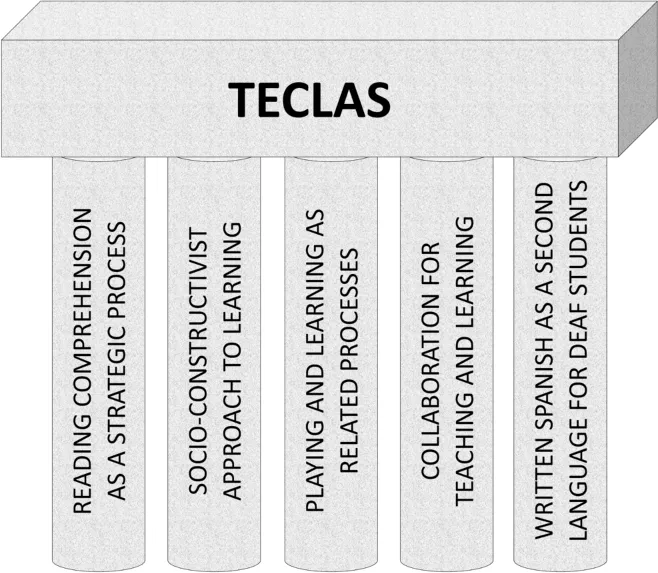
Figure 1. The five pillars of TECLAS
In the first part of this chapter, we present some background information about deaf education in Chile, and we delve into the theoretical framework and empirical findings that supported the design of the TECLAS intervention.
EDUCATION OF DEAF STUDENTS IN CHILE
From its beginnings, special education in Chile has followed an independent path, separated from regular education. It was not until 1990, with implementation of Decree No. 490, that mainstreaming programs were formally created in public schools, enabling the inclusion of students with special needs in regular classrooms (Decree of Education No. 490 of 1990; Godoy, Meza, & Salazar, 2004). Even though current regulations for special education have been moving toward a more social view of disabilities, mainstreaming programs have been strongly influenced by a medical approach, which has conflicted with socioanthropological perspectives that value deaf culture and sign language (SL) as an important part of deaf education. As stated by López, Julio, Morales, Rojas, and Pérez (2014), the medical model is based on a pathological view of human differences, and therefore it focuses on diagnosis and individual treatment. According to Skliar (1997), when this approach is used with deaf students, education takes a rehabilitation objective and directs its efforts to prepare them to become as similar as possible to their hearing peers. On the contrary, from a socioanthropological perspective, deaf students are seen as members of a cultural and linguistic minority who use SL and have particular ways of functioning from a cognitive and sociocultural viewpoint (Skliar, 1997).
In Chile, many deaf youth will be exposed only to Spanish in their homes, but they never fully acquire Spanish. When they become exposed to Chilean Sign Language or Lengua de Señas Chilena (LSCh)—usually not until they get to school—this becomes their first or preferred language because it is fully visually accessible to them, and then they learn Spanish (reading and writing) as a second language.
Currently, deaf students receive education both in special schools and in regular schools with mainstreaming programs. However, there are only 13 schools for deaf students around the country, and they are not certified to provide formal education beyond the 8th grade. In 2016, there was a total of 2,045 deaf students enrolled in schools that receive public funding.3 Among them, 596 students attended some type of special school, and 1,449 attended regular schools with mainstreaming programs (Ministerio de Educación, 2016; Pérez, 2016, in González & Pérez, 2017). Despite this, regular schools with mainstreaming programs are often not prepared to offer learning opportunities that take into account the particular characteristics and needs of deaf students (Herrera, 2010; Lissi et al., 2017a).
With regard to higher education, there is not precise information regarding the number of deaf students enrolled (Herrera, 2010). Although opportunities to access higher education and to receive some accommodations have been slowly increasing during the past few years, many higher education institutions still pose many obstacles for deaf students.
Recent Findings on Chilean Adolescents and Reading
In a recent study, our team interviewed 46 deaf adolescents from 7th to 12th grade in order to learn about their experiences, beliefs, preferences, and practices regarding reading (Lissi, Sebastián, Iturriaga, & Vergara, 2017b). The results show that for many of them, reading—especially in school contexts—is seen as a difficult, unpleasant task that requires too much effort, and, as a consequence, they try to avoid it as much as they can. Deaf students tend to see reading as a hearing person’s activity, and therefore do not feel very competent at it. They tend to attribute this mainly to their limited vocabulary knowledge, which suggests an understanding of the reading process as restricted to identifying the meaning of each word in the text.
In another study, Lissi et al. (2015) used a “think-aloud” procedure, based on the work of Banner & Wang (2010), to explore the reading strategies used among deaf adolescents. The results showed that they make little use of strategies to try to comprehend a text. Even though all students encountered several unknown words in the texts, only a small group reported using specific word identification strategies to approach them. The most competent readers showed a more active attitude, while less competent readers felt frustrated and lost motivation when faced with too many unknown words.
Given the scarcity of research and interventions on comprehension of expository texts with Chilean adolescents, the authors developed the TECLAS project. Below, we present its theoretical background.
THEORETICAL BACKGROUND OF TECLAS
The project we analyze here took into consideration the findings of previous studies, as well as relevant theoretical frameworks, in order to articulate an intervention that is supported by the five pillars we present (see Figure 1).
Reading Comprehension as a Strategic Process
Among the different factors that have an influence on reading comprehension, the use of cognitive and metacognitive strategies stands as an important one (Afflerbach, Pearson, & Paris, 2008). The use of strategies involves a change in the way students face written texts, from a rather passive stance to an active, goal-oriented approach (National Reading Panel, 2000). Among deaf readers, Banner and Wang (2010) found that adults showed a more active approach to reading than students, and they used more and better strategies. Strategies used by competent readers included establishing a purpose for reading, using previous knowledge, using mental imagery, creating questions, summarizing, paraphrasing, predicting, visualizing, and identifying key points. Other studies reveal limited use of cognitive and metacognitive strategies among deaf readers, a tendency to use less complex strategies, such as rereading or relying on images, and a preference for meaning construction strategies over monitoring and improving comprehension strategies (Maina, Kochung, & Oketch, 2014; Morrison et al., 2013; Schirmer, 2003). Developing a more strategic stance to face written material should become a key component of any reading intervention with deaf students.
A Socioconstructivist Approach to Teaching and Learning
The design of an intervention that aims to promote learning for students must first of all establish the concept of learning used by researchers. TECLAS is founded on a socioconstructivist perspective, which integrates ideas from neo-Piagetian and Vygotskian traditions in order to understand the teaching-learning process (Sebastián & Lissi, 2016). From this perspective, learning is understood as the transformation of prior knowledge structures, as a consequence of facing challenges in the form of cognitive conflicts, in a safe and nonthreatening context. This context should provide the necessary support to solve emergent cognitive conflicts through the transformation of prior structures (Bourgeois, 2009; Rosas & Sebastián, 2001). This way, and according to Piaget’s statements, when facing a new learning situation or object, students do so with knowledge structures that they have previously constructed throughout their lives, and they will attempt, at first, to act upon or interpret such situations or objects, based on these structures (Sebastián & Lissi, 2016). If these previous structures allow them to interact with the new learning situation or object—assimilate, in Piagetian terms—there is no opportunity for transformation or learning. However, there are moments in which it is not possible to assimilate the object; this produces a disequilibrium, which takes the form of a cognitive conflict when it is ackn...
Table of contents
- Cover
- Half Title
- Title Page
- Copyright Page
- Contents
- Foreword, DONALD F. MOORES AND MARGERY MILLER
- Preface, JEAN F. ANDREWS AND QIUYING WANG
- Acknowledgments
- Part I. South and Central America
- Part II. North America
- Part III. Europe, Africa, and the Middle East
- Part IV. China
- Part V. East Asia
- Epilogue
- Contributors
- About the Editors
- Index
Trusted by 375,005 students
Access to over 1.5 million titles for a fair monthly price.
Study more efficiently using our study tools.
Frequently asked questions
Yes, you can cancel anytime from the Subscription tab in your account settings on the Perlego website. Your subscription will stay active until the end of your current billing period. Learn how to cancel your subscription
No, books cannot be downloaded as external files, such as PDFs, for use outside of Perlego. However, you can download books within the Perlego app for offline reading on mobile or tablet. Learn how to download books offline
We are an online textbook subscription service, where you can get access to an entire online library for less than the price of a single book per month. With over 1.5 million books across 990+ topics, we’ve got you covered! Learn about our mission
Look out for the read-aloud symbol on your next book to see if you can listen to it. The read-aloud tool reads text aloud for you, highlighting the text as it is being read. You can pause it, speed it up and slow it down. Learn more about Read Aloud
Yes! You can use the Perlego app on both iOS and Android devices to read anytime, anywhere — even offline. Perfect for commutes or when you’re on the go.
Please note we cannot support devices running on iOS 13 and Android 7 or earlier. Learn more about using the app
Please note we cannot support devices running on iOS 13 and Android 7 or earlier. Learn more about using the app
Yes, you can access Literacy and Deaf Education by Qiuying Wang, Jean F. Andrews, Qiuying Wang,Jean F. Andrews in PDF and/or ePUB format, as well as other popular books in Education & Education General. We have over 1.5 million books available in our catalogue for you to explore.