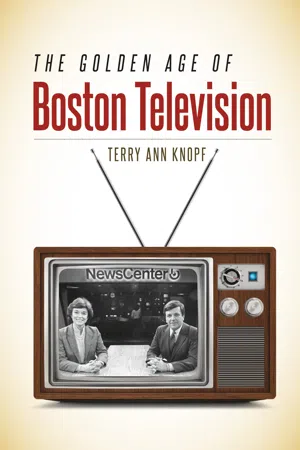
There are some two hundred TV markets in the country, but only one—Boston, Massachusetts—hosted a Golden Age of local programming. In this lively insider account, Terry Ann Knopf chronicles the development of Boston television, from its origins in the 1970s through its decline in the early 1990s. During TV's heyday, not only was Boston the nation's leader in locally produced news, programming, and public affairs, but it also became a model for other local stations around the country. It was a time of award-winning local newscasts, spirited talk shows, thought-provoking specials and documentaries, ambitious public service campaigns, and even originally produced TV films featuring Hollywood stars. Knopf also shows how this programming highlighted aspects of Boston's own history over two turbulent decades, including the treatment of highly charged issues of race, sex, and gender—and the stations' failure to challenge the Roman Catholic Church during its infamous sexual abuse scandal. Laced with personal insights and anecdotes, The Golden Age of Boston Television offers an intimate look at how Boston's television stations refracted the city's culture in unique ways, while at the same time setting national standards for television creativity and excellence.
- English
- ePUB (mobile friendly)
- Available on iOS & Android
eBook - ePub
The Golden Age of Boston Television
About this book
Information
Publisher
University Press of New EnglandYear
2017Print ISBN
9781611689051
9781611689044
eBook ISBN
9781512601046
: PART ONE :
THE TRANSFORMATION OF THE BOSTON TV MARKET
THE TRANSFORMATION OF THE BOSTON TV MARKET
1 | MARKET FORCES SET THE STAGE |
It is often said that things just happen—but do they? At any given time, events may seem to take place randomly, occurring as they may. But with the passage of time comes greater perspective, along with the realization that certain seemingly disparate events were actually connected and provide meaning to the past.
Throughout the years of commercial television, there have been between 200 and 210 local television markets across the country, according to Nielsen, the marketing company that also measures television ratings. But only one out of the 200-plus markets became the site of the Golden Age of local television—Boston. The question is, why? Boston’s Golden Age of local television didn’t just happen overnight or occur willy-nilly. Rather, it grew out of a confluence of factors and forces: the basic broadcast television structure in the United States; the rare occurrence when not one, but two Boston TV stations underwent license changes, each becoming locally owned—Channel 5 in 1972 and Channel 7 in 1982; an economic boom in Massachusetts during the 1980s when companies, including the local TV stations had money—lots of it—to spend; and finally, television trends at the national level, such as cable, that would affect the Boston market.
To understand the television structure, we begin with a few basics. When television was first introduced to Americans in the late 1940s, few people realized how popular the medium would become, and no doubt even fewer had any inkling of the powerful effect it would exert on American culture. By 1955, half of all the homes in America had a TV set; today, of course, nearly every household has one or more. As television took hold in the country, three commercial broadcast networks came to dominate the landscape—NBC, CBS, and ABC. These networks formed relationships with local stations around the country. The federal government permitted the networks to own some of the local stations (called owned-and-operated, or O&Os); others were simply affiliated with the networks (called “network affiliates”). With the exception of the Public Broadcasting Service (PBS), it was a decentralized, market-oriented television system.
The “Big Three,” as the networks were called, provided a significant amount of programs to local stations. Licensed by the Federal Communications Commission (FCC), created by the 1934 Federal Communications Act to regulate local TV stations, the locals carried network newscasts and primetime, daytime, and sports programming. For airing those programs, the locals received money in return—officially called “compensation.” Periods of time during the day were also reserved for the affiliates for local programming in news, talk shows, and syndicated programs, where they were allotted time to sell local commercials. Though highly profitable for both parties, the arrangement could be (and still is) a volatile one, especially when it came to how much compensation a local station received. There was also the issue of “preemptions,” i.e., when a local station elected to produce its own shows or carry syndicated programming that could typically generate even greater profits.
As a check on the powerful Big Three networks, the FCC initially limited the number of local stations (O&Os) each could own. At first it was three; then five; then seven; and by 1985, twelve. During the years of the Reagan Administration, which was strongly committed to government deregulation, the FCC continued to relax its media ownership rules.1 For obvious reasons, each of the networks selected O&Os in the country’s most heavily populated (hence more lucrative) markets—New York (#1), followed by Los Angeles (#2), and Chicago (#3). Rarely able to deviate from the parent company’s wishes, the O&Os were forced to take much of the network programming, basically functioning as cash cows. By contrast, while Boston was considered a major market (ranked #6), its VHS stations (1–13) were simply affiliated with the networks. Thus, by not being O&Os, the Boston stations had considerably more freedom to preempt the networks and offer many more locally produced shows. And it was during the Golden Age that the locals could more easily thumb their noses at the networks and go their own merry way, often much to the networks’ chagrin.
The FCC also had the power to award, renew, and revoke station licenses. The Federal Communications Act of 1934 states that the FCC should assess the “character . . . of the applicant to operate the station,” and ensure that the “public interest . . . would be served by the granting” of a license. Indeed, the possibility that broadcasters could lose their licenses, worth millions of dollars, was one that certainly caught their attention:
“Revocation” is perhaps the deadliest word to a television or radio station.
Applied to a station’s license, it sounds the cataclysmic death knell of a broadcast operation that can render a multimillion-dollar investment worthless.2
However, the FCC’s penalty of revocation—its ultimate weapon—has rarely been imposed.
In their book The Reluctant Regulators, Barry Cole and Mal Oettinger, both experts on the FCC, wrote: “Renewal tends to be automatic, provided the applicants’ papers are in order.” In fiscal year 1976 alone, they reported that of the 2,972 processed (not counting radio) applications, less than one-quarter of 1 percent (0.0027) of the applicants were denied a license.3 This is what makes the situation in the Boston market so unusual. For over the course of a single decade, not one, but two Boston TV stations would each lose its license: WHDH-TV (Channel 5), owned by the Boston Herald Traveler Corporation, in 1972, followed by WNAC-TV (Channel 7), owned by General Tire, in 1982. Both cases were extremely complicated, with numerous twists and turns; both took years to settle; and, most significantly, both stations would wind up locally owned. And while the two license changes do not appear directly connected, but simply stand as an interesting anomaly, each would profoundly unsettle and invigorate the market, though in different ways. And in combination, both decisions would become important factors in ushering in Boston’s Golden Age of local television.
CHANNEL 5 LICENSE CHANGE (1972)
In what seemed like routine fashion, WHDH-TV (Channel 5), owned by the Boston Herald Traveler Corporation, along with WHDH 850 AM radio and its FM sister 94.5, went on the air November 26, 1957, having been granted a license from the FCC. In what was considered a pro forma move, the losing applicants appealed the FCC decision to the District of Columbia, U.S. Circuit Court of Appeals. But in the meantime, during hearings being held by the House Committee on Legislative Oversight in 1958, almost by happenstance, it was disclosed that in the winter of 1954 and spring of 1956 then-FCC chairman George C. McConnaughey had lunch at the request of Robert Choate, the CEO of the Boston Herald Traveler Corporation, at a time when WHDH, Inc., and several other applicants were under consideration to operate the Boston station. This raised the issue of “ex parte,” a legal term that also describes a judge—in this instance, the FCC chairman—who communicates with one party to a lawsuit to the exclusion of the other party or parties. In a decision that shocked many observers, the Court of Appeals remanded the case back to the FCC for reconsideration. The revelation was doubly upsetting to the FCC, which was already embarrassed over The $64,000 Question and Twenty One TV quiz show scandals, as well as the “payola” scandals involving record companies and radio stations in violation of FCC rules.
And so began a bitter, bruising, confusing, and hugely expensive legal battle between the Boston Herald Traveler Corporation and several other parties that would go on for another fifteen, years until 1972, making it the longest regulatory case in the country’s history.4 Over the years, this famous case would involve hundreds of petitions, briefs, filings, and appearances at the FCC and the U.S. Court of Appeals, while involving three presidential administrations—Eisenhower, Kennedy, and Nixon. Three times the case would go before the U.S Supreme Court, and each time it would be turned down.
The stakes were high. At the time, WHDH, worth an estimated $50 million, was vitally important because profits from the TV station helped keep the Herald Traveler, Boston’s only Republican newspaper, in business. Shortly after WHDH lost its license, the paper would fold. But the case had larger implications as well. The FCC had never before taken away the license of a TV station in a major market; many broadcasters in the industry were now concerned that they, too, could lose their licenses. And with public complaints surfacing about the overconcentration of media properties in so few hands, the 155 publishers who also owned some 260 television stations around the United States were also very jittery.
With WHDH on the air, but remaining under a cloud, a new group called Boston Broadcasters, Incorporated (BBI), entered the fray in 1963, filing an application for ownership with the FCC. BBI quickly emerged as an intriguing, if not formidable challenger among the three groups vying for the license. Besides the usual complement of businesspeople, this group featured a glittering array of civic leaders and distinguished academics, including Leo Beranek, a former MIT professor and a prominent acoustics expert who had written a classic textbook in this field; Oscar Handlin, the Pulitzer Prize–winning American historian from Harvard; John Knowles, general director of the Massachusetts General Hospital; Robert Gardner, an anthropologist, filmmaker, and Harvard professor (his grandmother was Isabella Stewart Gardner); and Henry Jaffe, an Emmy Award–winning TV producer and entertainment attorney. The group was also notable for its unusually ambitious plans set forth in its application, among other things promising to air more local programming than any other station in the country.
With the case entangled in the courts until the very end, each side came to despise and demonize the other, hurling about claims of dirty tricks and illegal activities. Harold Clancy, a relentless, tough-talking Irishman who headed the Boston Herald Traveler Corporation, was convinced that BBI had placed a spy in his company. BBI charged that Clancy had used as many as thirty reporters to watch as BBI’s daily trash was thrown out by janitors who cleaned BBI offices in downtown Boston; the reporters would then follow the garbage truck to a dumping ground located Quincy. (Clancy admitted to assigning nine reporters to the task.5) BBI officials were also convinced that their offices were being bugged. The paranoia was palpable, with their attorneys warning, “Watch your phones! They’re being tapped. Watch whom you talk to in bars. You’re probably being tailed. Don’t talk to strange women.”6
Finally, by early March of 1972 and by a vote of four to one, the FCC ordered WHDH to go off the air on March 19, at 3 o’clock in the morning, with permission granted for WCVB-TV as the new station’s call letters. Leo Beranek, BBI’s president, came up with the station’s new call letters, having drawn them on a cocktail napkin during a lunch at Locke-Ober—“C” as in channel, “V” as in the Roman numeral for five, “B” as in Boston.7 Not even a last-ditch appeal to the U.S. Supreme Court by Clancy, which failed, could change the outcome. The only negative for the new station owners was that CBS, fearing a wave of network preemptions on what would have been its second-largest affiliate and its largest affiliate on the East Coast, switched its affiliation to WNAC-TV, leaving WCVB to affiliate with a reluctant ABC.
If euphoric was the word to describe the new station owners, Harold Clancy and his legal team were devastated. The handover of the station to BBI revealed the level of their anger and resentment with Clancy, dogged as ever, going down fighting to the bitter end. WHDH’s final movie airing on its last night was called Fixed Bayonets. WCVB signed on at 3:05 a.m. with a brief “Hello World.” Still, the new station officials weren’t taking any chances. Before going on the air, they made sure that armed police were placed around the new station’s Needham headquarters—just in case.8
Historically, the FCC decision was important on several counts. It struck a blow against unsavory ex parte meetings, of which there had been all too many by government regulatory officials; it established the importance of media diversification during a time of growing multiple ownerships; and it set a precedent that FCC renewals should not be automatic, but should include assessing a station’s performance. But perhaps its greatest significance was discerned by Nicholas Johnson, then a young, reform-minded, highly independent FCC commissioner. Issuing his own “concurring statement” in the FCC’s decision, he wrote, “In America’s eleven largest cities there is not a single network-affiliated VHF television station that is independently and locally owned. They are all owned by the networks, multiple station owners, or major local newspapers.”9
He added that it would be “healthy” to have “at least one station among these politically powerful thirty-three network-affiliated properties in the major markets that is truly locally owned, and managed independently of the other local mass media.” In the ensuing years, WCVB (Channel 5), Boston’s new kid on the block, would prove the wisdom of those words.
CHANNEL 7 LICENSE CHANGE (1982)
The WNAC-TV case was marked by double irony. It denoted only the second time the FCC had ever denied a license renewal, both in Boston—the first involving WCVB in 1972. And while WNAC-TV was number seven on the TV dial, it had to be one of the unluckiest stations ever. Owned by General Tire, Channel 7 made its debut on June 21, 1948, just twelve days after WBZ (Channel 4), Boston’s oldest TV station, signed on the air. From the beginning, its corporate owner had high ambitions, expanding its media properties to include WOR-TV and WOR AM-FM radio stations in New York, KHJ-TV in Los Angeles, and RKO Radio Pictures. In 1959, the company changed its name to RKO General when it closed down its film division.
The circumstances concerning the loss of Channel 7’s license in 1982 were quite different from those of Channel 5—though just as prolonged and convoluted. In addition to its power to award, renew, and revoke a local station’s license, the FCC was given the authority to assess the “character . . . of the applicant to operate the station,” and ensure that the “public interest . . . would be served by the granting” of a license. As usual, the stakes were high—with the possibility that a broadcaster could lose its license worth millions of dollars.
By 1969, RKO was under challenge by two competing investor groups from Boston, D...
Table of contents
- Cover Page
- Title Page
- Copyright
- Dedication
- Contents
- Acknowledgments
- Introduction
- Part I. The Transformation of the Boston TV Market
- Part II. Local Television and Boston’s Culture
- Epilogue: Fade to Black
- Notes
- Index
- Illustrations
Trusted by 375,005 students
Access to over 1.5 million titles for a fair monthly price.
Study more efficiently using our study tools.
Frequently asked questions
Yes, you can cancel anytime from the Subscription tab in your account settings on the Perlego website. Your subscription will stay active until the end of your current billing period. Learn how to cancel your subscription
No, books cannot be downloaded as external files, such as PDFs, for use outside of Perlego. However, you can download books within the Perlego app for offline reading on mobile or tablet. Learn how to download books offline
Perlego offers two plans: Essential and Complete
- Essential is ideal for learners and professionals who enjoy exploring a wide range of subjects. Access the Essential Library with 800,000+ trusted titles and best-sellers across business, personal growth, and the humanities. Includes unlimited reading time and Standard Read Aloud voice.
- Complete: Perfect for advanced learners and researchers needing full, unrestricted access. Unlock 1.5M+ books across hundreds of subjects, including academic and specialized titles. The Complete Plan also includes advanced features like Premium Read Aloud and Research Assistant.
We are an online textbook subscription service, where you can get access to an entire online library for less than the price of a single book per month. With over 1.5 million books across 990+ topics, we’ve got you covered! Learn about our mission
Look out for the read-aloud symbol on your next book to see if you can listen to it. The read-aloud tool reads text aloud for you, highlighting the text as it is being read. You can pause it, speed it up and slow it down. Learn more about Read Aloud
Yes! You can use the Perlego app on both iOS and Android devices to read anytime, anywhere — even offline. Perfect for commutes or when you’re on the go.
Please note we cannot support devices running on iOS 13 and Android 7 or earlier. Learn more about using the app
Please note we cannot support devices running on iOS 13 and Android 7 or earlier. Learn more about using the app
Yes, you can access The Golden Age of Boston Television by Terry Ann Knopf in PDF and/or ePUB format, as well as other popular books in Social Sciences & Popular Culture. We have over 1.5 million books available in our catalogue for you to explore.