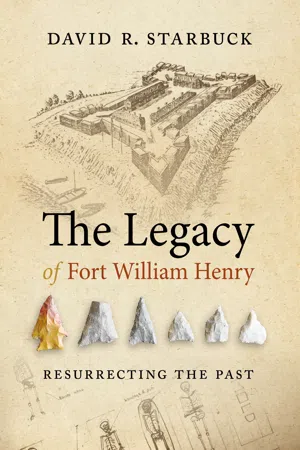
Fort William Henry, America's early frontier fort at the southern end of Lake George, New York, was a flashpoint for conflict between the British and French empires in America. The fort is perhaps best known as the site of a massacre of British soldiers by Native Americans allied with the French that took place in 1757. Over the past decade, new and exciting archeological findings, in tandem with modern forensic methods, have changed our view of life at the fort prior to the massacre, by providing physical evidence of the role that Native Americans played on both sides of the conflict. Intertwining recent revelations with those of the past, Starbuck creates a lively narrative beginning with the earliest Native American settlement on Lake George. He pays special attention to the fort itself: its reconstruction in the 1950s, the major discoveries of the 1990s, and the archeological disclosures of the past few years. He further discusses the importance of forensic anthropology in uncovering the secrets of the past, reviews key artifacts discovered at the fort, and considers the relevance of Fort William Henry and its history in the twenty-first century. Three appendixes treat exhibits since the 1950s; foodways; and General Daniel Webb's surrender letter of August 17, 1757.
- English
- ePUB (mobile friendly)
- Available on iOS & Android
eBook - ePub
About this book
Trusted by 375,005 students
Access to over 1.5 million titles for a fair monthly price.
Study more efficiently using our study tools.
Information
1
The Brief Life of a Frontier Fort
“Directly on the shore of the lake, and nearer to its western than to its eastern margin, lay the extensive earthen ramparts and low buildings of William Henry. Two of the sweeping bastions appeared to rest on the water which washed their bases, while a deep ditch and extensive morasses guarded its other sides and angles. The land had been cleared of wood for a reasonable distance around the work, but every other part of the scene lay in the green livery of nature.... In its front might be seen the scattered sentinels, who held a weary watch against their numerous foes; and within the walls themselves, the travelers looked down upon men still drowsy with a night of vigilance. Toward the southeast, but in immediate contact with the fort, was an entrenched camp, posted on a rocky eminence ... in which Hawk-eye pointed out the presence of those auxiliary regiments that had so recently left the Hudson [River].”
JAMES FENIMORE COOPER,
The Last of the Mohicans
THIS IS HOW Fort William Henry first appeared to Hawk-eye, the noble protagonist in James Fenimore Cooper’s 1826 novel, The Last of the Mohicans. Then, the edge of Lake George lay somewhat closer to the fort than it does today, and the “entrenched camp” located to the southeast contained reinforcements recently arrived from Fort Edward, sent by Major General Daniel Webb to bolster the British position at the southern end of Lake George. (These were Massachusetts troops and the 60th [Royal American] Regiment of Foot, and they camped within what is now the Lake George Battlefield Park.)
Cooper and his contemporaries recognized that in August of 1757 this strategically positioned frontier fort had become the setting for the most horrific events of the French and Indian War, when a small British garrison was assaulted by a vastly superior force of French and Indians. Cooper was one of early America’s greatest authors, and The Last of the Mohicans helped define for his time what it meant to be an American.
Introduction
Because The Legacy of Fort William Henry is largely about new findings, I do not wish to retell stories that may already be all too familiar. There currently are several excellent book-length treatments of the history of Fort William Henry, including Betrayals (Steele 1990), The Siege of Fort William Henry (Hughes 2011), Massacre at Fort William Henry (Starbuck 2002), and Relief Is Greatly Wanted (Dodge 1998). Shorter, chapter-length descriptions of the fort appear in Empires in the Mountains (Bellico 2010), Chronicles of Lake George: Journeys in War and Peace (Bellico 1995), The Great Warpath (Starbuck 1999b), and The Archaeology of Forts and Battlefields (Starbuck 2011); and pertinent articles have been published by Timothy Todish (1993), Brenda Baker and Christina Rieth (2000), Maria Liston and Brenda Baker (1995), and myself (1990, 1993, 1998, 2001, and 2008).
Fort William Henry, the northernmost British outpost in the colony of New York during the 1750s, has major significance in American history as the first bastioned British fort in the North American colonies, with French-style bastions in all four corners that helped catch enemy attackers in a crossfire (fig. 1.1). The log fort faced north, toward a French enemy that had also laid claim to Lake George (fig. 1.2), and thus military conflict was almost inevitable. Fort William Henry came under siege on August 3, 1757, by French and Indians newly arrived from Fort Carillon (later renamed Fort Ticonderoga). Constructed just two years earlier, Fort William Henry was subjected to a steadily worsening bombardment for six days as siege trenches and cannon fire grew ever closer. The fort’s garrison suffered heavy casualties, even as its commander, Irish-born Lieutenant Colonel George Monro, waited nearby in the entrenched camp of reinforcements. The fort’s subsequent surrender and the massacre that followed were later described in The Last of the Mohicans, and in that sad distinction, the fall of Fort William Henry became the single best-remembered event of the French and Indian War. The French army then destroyed the fort with fire before they returned to Fort Carillon. Since gruesome events are far more likely to be remembered than architectural innovations or stories about daily life on the American frontier, the destruction of Fort William Henry will no doubt be memorialized for centuries to come.
Fortunately, archeology conducted in the 1950s enabled this bastioned timber fort to rise again as a popular international attraction (fig. 1.3). In the twenty-first century, Fort William Henry continues to greet modern visitors from its beautiful, high terrace overlooking Lake George, called the “Queen of American Lakes.” This reconstructed fort provides fascinating information about eighteenth-century military life, even as it tells one of the grimmest stories of warfare on the American frontier.
Historical Context
In 1646 Father Isaac Jogues named this body of water Lac du St. Sacrement and claimed it for France, marking the first European intrusion into the region (fig. 1.4). In later years, French and British armies turned much of what is now northern New York State into a vast battlefield as they fought for control of North America and, indeed, much of the world. The French and Indian War was one of many American wars in the eighteenth century, and less famous struggles such as King William’s War, Queen Anne’s War, and King George’s War provided a foretaste of the fight of George Washington and the Virginia militia against the French in July 1754 at Fort Necessity in Pennsylvania, followed by the Battle of Lake George in the following year.
The Battle of Lake George on September 8, 1755, brought war to the northernmost parts of the colony of New York and pitted the British under General William Johnson against the French under Jean Erdman, Baron Dieskau. In bloody fighting, both Colonel Ephraim Williams and King Hendrick, the Mohawk leader, were killed, but the British held the field of battle at the end of the day. What followed was a fort-building race, as the French began construction of Fort Carillon thirty-five miles north on Lake Champlain, and Captain William Eyre of the 44th Regiment of Foot — following the orders of General Johnson — began construction of Fort William Henry at the southern end of Lake George. A far larger British base, Fort Edward, was simultaneously constructed about sixteen miles to the south, and the two British forts faced off against the French for the next two years.
Eyre became the first commander of Fort William Henry, and he designed the fort with four log barracks buildings (with casemate rooms underneath), storehouses, officers’ quarters, a hospital, a powder magazine, and sheds, all of which lay within a central parade ground. A dry moat flanked the fort on three sides, and thirty-foot-thick walls of earth and logs surrounded the whole. Diamond-shaped bastions were constructed at the corners, and entry into the fort was via a bridge that crossed the moat. A “necessary” for human waste was located at the northeast corner of the fort. The location of the log fort put it in danger from the outset: it was on land claimed by the French. The garrison of between 2,200 and 2,300 was a mixture of British and provincial soldiers and included a company of the 35th Regiment, a company of the 42nd Highlanders, two companies of the 44th Regiment of Foot, and two companies of the 48th Regiment of Foot. Ranger units were also present, including Speakman’s Company, Hobb’s Company, and Richard Rogers’s Company. Their leader, Lieutenant Colonel George Monro of the 35th Regiment, was a career soldier and a Scotsman.
During the two-year face-off between the French and British forts, there was just one serious attack on Fort William Henry. About 1,600 French and Indians, led by Canadian Governor-General François-Pierre de Rigaud de Vaudreuil, attacked the fort on March 19, 1757, and then destroyed the New Jersey Regiment (called the Jersey Blues) at Sabbath Day Point on Lake George. Finally, in August 1757, General Louis-Joseph de Montcalm-Gozon, Marquis de Saint-Veran, led an army against the fort that included between eight and ten thousand French regulars, Canadian militia, and Indians. Most traveled down the lake in bateaux and artillery rafts; others traveled by land down the west side of Lake George.
General Montcalm sent a letter to Colonel Monro, requesting that he surrender, and when Monro refused, the French proceeded to construct entrenchments that partially encircled the fort. The siege began on August 3. British cannons and mortars gave out, ammunition ran low, and the British surrender finally came on August 9. Given the brave British defense, the French granted generous terms of capitulation appropriate to European-style warfare, and the British garrison promised not to take up arms against the French for the next eighteen months. They were allowed to take their (unloaded) weapons with them, and in the aftermath of the surrender, the British garrison was escorted through the eastern gate of the fort under a French armed guard that probably consisted of about three hundred soldiers. The British army spent that night in the entrenched camp southeast of the fort and departed for Fort Edward early on the following day, August 10.
It was then that some of Montcalm’s Indian allies (Abenakis from Canada) killed and scalped the sick and injured, after which they attacked the retreating soldiers on the Military Road that ran to Fort Edward. The French escort utterly failed to protect their British prisoners, more of whom were killed and scalped. Some escaped into the woods and eventually made their way to Fort Edward, and hundreds of others were subsequently dragged away as prisoners to Canada, where they were held for ransom. Ian Steele (1990) has argued that the massacre switched fairly quickly from the killing of victims to the taking of prisoners.
Early chroniclers claimed that as many as 1,500 British were killed, but more recent analyses — based on period documents — have numbered the dead at the time of the massacre between 185 (Steele 1990, 143) and 308 (Dodge 1998, 97). A series of misunderstandings and betrayals had led to the postsurrender murder of many of the fort’s defenders, and modern historians point out that Montcalm’s Indian allies — who came from as many as forty different tribes — had been promised scalps and plunder in exchange for their participation in the expedition from Canada. The surrender agreement worked out between Montcalm and Monro effectively prevented Indians from receiving any booty, and the attack on the prisoners, the so-called massacre, was a belated attempt to obtain trophies and honor.
After the surrender, the French removed any supplies they could use, burned the fort to the ground on August 11 and 12, and then returned to Fort Carillon. Most then went north to Canada for the winter. After the siege, some of the Indians who had accompanied Montcalm dug into the graves in the military cemetery that lay outside the fort’s walls, scalped the corpses, and stole blankets and clothing. Among the dead who were disinterred and mutilated was Richard Rogers, one of the brothers of the famed Major Robert Rogers who had raised and commanded Rogers’ Rangers (Rogers 2002). Richard Rogers was one of those in the cemetery who had died from highly contagious diseases, and smallpox contracted from the cemetery was transmitted to Indians, who carried it along the trails running north to Canada. The smallpox that those who made it home brought with them led to the death of thousands of Indians in eastern Canada, as the disease decimated entire villages. It may be argued that the violation of Richard Rogers’s body was a powerful motivation for Robert Rogers’s attack on the Abenaki village of Saint Francis (Odanak) two years later — no doubt Robert believed himself to be justified in avenging his brother.
The surrender of the British garrison to Montcalm provided the basis for James Fenimore Cooper’s The Last of the Mohicans, and the popularity of Cooper’s highly fictionalized account has lingered in modern movies and memorabilia. The protagonists — Hawk-eye (also known as Natty Bumppo), Uncas, Chingachgook, the Huron Magua, and Colonel Monro’s two beautiful daughters (Cora and Alice) — are probably better known than many of the commanding officers of that period. Movies and television shows have perpetuated old stereotypes and created new ones, and the 1936 movie version of Cooper’s novel, with Randolph Scott, and the 1992 version, with Daniel Day-Lewis, are but two of many interpretations of the story. None of these characters ever existed, of course, and there is no clear evidence as to whether Colonel Monro ever married or had daughters. Monro survived the siege but lived only three months longer, dying of apoplexy on an Albany street on November 3, 1757.
In June 1758, the army of General James Abercromby camped on what had been the entrenched camp southeast of the fort and built an earthwork (with cannons) on the ruins of Fort William Henry. This was prior to Abercromby’s failed attack on Fort Carillon on July 8 of that year. In July 1759 General Jeffery Amherst’s army burned the ruins of Fort William Henry and spread clean dirt on top before he successfully captured Fort Carillon and renamed it Ticonderoga. Much of the war came to a conclusion on September 13, 1759, with General James Wolfe’s attack on Quebec, the capital of New France, and the subsequent surrender of that city to the British a few days later. Both Wolfe and Montcalm were killed in that engagement (Parkman 1962), and just a few weeks later, on October 6, Rogers’s Rangers attacked the village of Saint Francis (Odanak) and essentially ended the recurring Indian attacks that had plagued British settlements for years (Rogers 2002; Zaboly 2004). There was little military action after that date, although Montreal fell to the British on September 8, 1760. Finally, in 1763, the Treaty of Paris formally ended the French and Indian War, and with it many of France’s claims to the North American continent.
Interest in Fort William Henry was by no means over, however, for in August 1783 General George Washington visited the site while on an inspection tour and walked over the ruins. In 1826 The Last of the Mohicans sparked renewed interest, but the ruins of the fort were increasingly neglected. A few paths ran across the surface of the fort, and much later a gazebo was added (fig. 1.5). The top of the fort’s well continued to peek above the surface of the ground, which it has continued to do up until the present day. Fortunately, the dormancy of the site did not last, and the stage was being set for a renewal of interest in the fort and its tragic st...
Table of contents
- Cover Page
- Title Page
- Copyright
- Contents
- Preface
- 1. The Brief Life of a Frontier Fort
- 2. Beginnings: Native Americans on Lake George
- 3. The Reconstruction of the Fort in the 1950s
- 4. The 1990s: Archeology inside Barracks, Dumps, and a Well
- 5. New Archeology at the Fort: 2011–12
- 6. The Dead Have Stories to Tell: Forensic Anthropology at the Fort
- 7. Artifacts Discovered at the Fort
- 8. Why Is Fort William Henry Relevant Today?
- Appendix 1 : The Exhibits at Fort William Henry
- Appendix 2 : Foodways at Fort William Henry: An Interim Progress Report, by Jene C. Romeo
- Appendix 3 : Major General Daniel Webb’s Surrender Letter, August 17, 1757
- Further Reading
- Index
Frequently asked questions
Yes, you can cancel anytime from the Subscription tab in your account settings on the Perlego website. Your subscription will stay active until the end of your current billing period. Learn how to cancel your subscription
No, books cannot be downloaded as external files, such as PDFs, for use outside of Perlego. However, you can download books within the Perlego app for offline reading on mobile or tablet. Learn how to download books offline
Perlego offers two plans: Essential and Complete
- Essential is ideal for learners and professionals who enjoy exploring a wide range of subjects. Access the Essential Library with 800,000+ trusted titles and best-sellers across business, personal growth, and the humanities. Includes unlimited reading time and Standard Read Aloud voice.
- Complete: Perfect for advanced learners and researchers needing full, unrestricted access. Unlock 1.5M+ books across hundreds of subjects, including academic and specialized titles. The Complete Plan also includes advanced features like Premium Read Aloud and Research Assistant.
We are an online textbook subscription service, where you can get access to an entire online library for less than the price of a single book per month. With over 1.5 million books across 990+ topics, we’ve got you covered! Learn about our mission
Look out for the read-aloud symbol on your next book to see if you can listen to it. The read-aloud tool reads text aloud for you, highlighting the text as it is being read. You can pause it, speed it up and slow it down. Learn more about Read Aloud
Yes! You can use the Perlego app on both iOS and Android devices to read anytime, anywhere — even offline. Perfect for commutes or when you’re on the go.
Please note we cannot support devices running on iOS 13 and Android 7 or earlier. Learn more about using the app
Please note we cannot support devices running on iOS 13 and Android 7 or earlier. Learn more about using the app
Yes, you can access The Legacy of Fort William Henry by David R. Starbuck in PDF and/or ePUB format, as well as other popular books in Social Sciences & Early American History. We have over 1.5 million books available in our catalogue for you to explore.