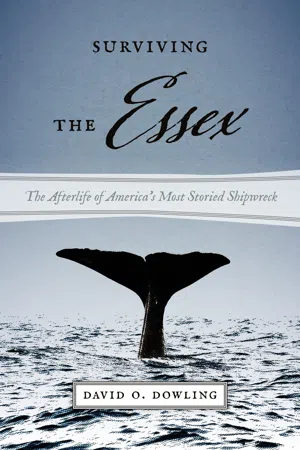
Surviving the "Essex" tells the captivating story of a ship's crew battered by whale attack, broken by four months at sea, and forced—out of necessity—to make meals of their fellow survivors. Exploring the Rashomon-like Essex accounts that complicate and even contradict first mate Owen Chase's narrative, David O. Dowling examines the vital role of viewpoint in shaping how an event is remembered and delves into the ordeal's submerged history—the survivors' lives, ambitions, and motives, their pivotal actions during the desperate moments of the wreck itself, and their will to reconcile those actions in the short- and long-term aftermath of this storied event. Mother of all whale tales, Surviving the "Essex" acts as a sequel to Nathaniel Philbrick's In the Heart of the Sea, while probing deeper into the nature of trauma and survival accounts, an extreme form of notoriety, and the impact that the story had on Herman Melville and the writing of Moby-Dick.
- English
- ePUB (mobile friendly)
- Available on iOS & Android
eBook - ePub
About this book
Chapter 1

WHO SHOT OWEN COFFIN?
After the Essex collided with a whale on November 20, 1820, in the South Pacific west of the Galápagos Islands, most of the stunned crew determined to row their tiny open boats some three thousand miles east to the South American coast. Their decision was based in part on a fear of cannibals on nearby islands to the West. Covering such a vast distance into a formidable trade wind without restocking provisions along the way, however, seemed suicidal. Ducie Island, located due south, appeared an ideal spot to restock. After landing on Henderson Island, seventy miles west of Ducie, they soon found their resources depleted and abandoned their quest for the Chilean coast. Instead, they resolved to make the more reasonable journey to Easter Island, a third of the way to South America. Such a decision apparently reflected the crew’s diminished fear of cannibals and a corresponding willingness to employ their diplomatic skills to avert any danger. With acute starvation and malnutrition setting in, they felt they had no choice but to travel for the aptly named isle, site of their potential rebirth and resurrection.1
But undoing their original plan to sail for South America proved more difficult than anticipated. This was because following that plan, and the journey to Henderson Island, had set them on a more difficult trajectory for Easter Island, which was a tantalizing several hundred miles due east of the wreckage site. In their ill-equipped open boats with makeshift canvas sails, which had been frantically slashed from the masts of the sinking Essex, the sailors were helpless against the stiff gales that tossed them about. The best trajectory they could muster was a derelict southeastern stagger.2 The elements played havoc with their eastbound tack, as if controlled by a vengeful Poseidon bearing down on Odysseus. As in the ancient Greek depiction of Odysseus’s seafaring struggles, the sufferings of the Essex seamen against the elements can be traced to one rash action.3
That decision, at the wreckage site more than a thousand miles to the North, was engineered by the first mate, Owen Chase, who had roused the crew’s support to sail for the mainland, overturning Captain George Pollard Jr.’s plan to cover one-third that distance, following a favorable southwesterly wind for the Marquesas Islands or Tahiti. The decision instead to sail due south placed them virtually out of reach of Easter Island, apparently dooming them to a slow journey toward South America. Like Sophocles’s Oedipus, who inadvertently kills his father and then does all he can to avoid the horrifying prospect of wedding his mother, the sailors may have tried to escape their fate, only to realize its grim inevitability. As is widely known, the Oedipus story centering on unintended consequences borne of good intentions seized the imagination of Sigmund Freud; likewise, the saga of the Essex, including its rich psychological elements, riveted antebellum readers.4
The Essex trauma would feature its own archetypical taboos rivaling those of Oedipus Rex. Namely, Oedipus kills his own father, and Pollard issues the order to kill his own teenage cousin. As if randomly choosing a crew member to execute for sustenance were not weighty enough, Owen Coffin was the beloved son of Pollard’s aunt and uncle, with whom he had been close on Nantucket. On February 2, 1821, the day Coffin died, he was eighteen and Pollard was twenty-nine, making the captain something between a father and a brother figure to the youth, with whom he shared a family resemblance.5 In the innumerable retellings of the Essex tragedy, this killing of one’s kin becomes the iconic moment of terror, the men’s darkest hour. Oedipus’s moment of terror lies in his realization that he was his father’s killer; like Oedipus, Pollard would have preferred to die than consume the flesh of his own relative.6 And murder, in this instance, preceded cannibalism, adding to the realization of the crew’s, and Pollard’s, darkest nightmare.
The most conspicuous scene separating one Essex account from another is the shooting of Owen Coffin. No other detail is more contested, or retold with such ritual significance, as the drawing of lots that eventuated in his execution. With four men left in Pollard’s open boat and all provisions depleted, including the flesh and blood of their dead shipmates, they resolved to draw straws. After Coffin drew the fatal straw, Pollard offered to take his place. Refusing, Coffin accepted his fate, which was solemnly delivered in a single gunshot.7
Many retellings of the lottery exaggerated and sensationalized the facts for dramatic effect.8 “The Shipwreck of the Essex,” a ballad published in Cornwall, England, offers a remarkable measure of the distance traveled by the Essex story, the speed at which it traveled, and the liberties taken with Chase’s Narrative. The ballad distorts the deadly lottery by sentimentalizing Coffin, who “was to die, / For his wife and poor children most bitterly did cry.” Of course the teenage Coffin had neither wife nor children. Nor does the poet miss the full dramatic import of the parricide suggested in Pollard’s complicity in the killing of his cousin: “the captain and cabin boy…cast lots who should die, / But it happened to fall on the poor cabin boy.” The ballad also, in attempting to portray the selection process as exceedingly fair and democratic, reports falsely that, instead of once, “eight different times lots amongst them were drawn.”9 Such rhetoric presumably reflected an attempt to divert attention from the savagery to follow. Thus the event and the actions of the sailors are characterized simultaneously as murderous and empathetic. In turn, this tableau of seeming contradiction resonated more than any other with those who encountered the story.
The sacrifice of Owen Coffin tapped for audiences a powerful realization that they, too, might draw the short straw in their personal lotteries. They also sympathized more basically with Coffin’s death. For Melville himself, the first reading of Chase’s narrative was moving precisely because he, sailing on the Acushnet, had recently passed the site of the tragedy. Even more powerful than geographic proximity was a sense of shared mortal risk linked with traveling aboard a whaling vessel. This could happen to me, Melville apparently understood while at the gam. Could I take the bullet if so selected? Alternatively, could he pull trigger against his best friend and coconspirator, Toby, who had defected from the Acushnet while on Nuku Hiva, in the Marquesas Islands? The ghost of Owen Coffin undoubtedly haunted Melville in 1841, as he recalled how “the reading of this wondrous story upon the landless sea, and close to the very latitude of the shipwreck had a surprising effect upon me.”10 That surprising effect for those encountering the story merged a palpable sense of mortality with the more complicated moral conundrum associated with killing a shipmate to survive. Melville, along with twenty years of readers and tale tellers before him, acutely felt this human vulnerability.11
The shooting of Owen Coffin was the signal event of both Chase’s Narrative and the journal that the cabin boy Thomas Nickerson ultimately sought to publish decades later. Coffin’s death, as intimated already, signified a blood ritual not unlike that spurred by Ahab, when he exhorts the crew to pledge death to Moby Dick in the “Quarter-Deck” chapter. The communal embrace of cannibalism brought about the galling realization among the crew that the practice would continue as long as provisions were inadequate and the men were starving. The civilized method of the lottery, indeed, would give way to the most primitive acts imaginable.
Not only does the killing of Coffin symbolize the transformation of the civilized ambassadors of American whaling into savage brutes. It also raises questions about the leadership errors that might have prompted this outcome. Such questions more pointedly challenge the fairness with which the lottery itself was carried out. The familial relationship between Coffin and Pollard, furthermore, casts doubt on the captain’s concern for a relative. Such concern was highly valued by the culture. Questions include the following: Was Coffin’s killing unnecessary? Was Pollard to blame? Did Pollard sin unpardonably by failing to intervene and take the bullet himself? Or was Chase to blame for his own earlier errors of preemptive leadership? Other rudimentary questions, such as who shot Owen Coffin and what event followed another, are difficult to answer, given the wild variance in the documentary evidence.
This question of who shot Coffin renders our otherwise respectable Essex seamen at their moment of deepest crisis. As the sensational detail that helped sell so many books, the corresponding scene captures the transformation of the men at the journey’s breaking point. The rawest component of their experience may have been the “whisper of necessity” that likely crept upon them.12
THE SMOKING GUN
Chase’s Narrative, the ur-text of the Essex tragedy, states clearly, “On the 1st of February, having consumed the last morsel, the captain and the three other men that remained with him, were reduced to the necessity of casting lots. It fell upon Owen Coffin to die, who with great fortitude and resignation submitted to his fate.” Chase, through his ghostwriter, then relates that “they drew lots to see who would shoot him: he placed himself firmly to receive his death, and was immediately shot by Charles Ramsdale [sic]” and not Captain Pollard. The narrator sympathizes with Ramsdell, as his name was correctly spelled, for suffering the “hard fortune it was to become his executioner.”13
Although long considered authoritative, Chase’s account contains huge omissions designed to grant credit to the writer at Pollard’s expense. In particular, Chase did not include Pollard’s offer to take Coffin’s lot for him. In Nickerson’s rendition, moreover, it was Pollard and not Ramsdell who shot Coffin. His account states that when “they were compelled again to cast lots,” identifying “who should draw the fatal trigger,” destiny rather than ill-luck pointed to the captain. “As if fate would have it, the awful die turned upon Captain Pollard[.] For a long time [he] declared that he could never do it, but finally had to submit.” At stake in determining who shot Coffin was Pollard’s reputation as hero or coward. A hero would have not permitted the killing of his own kinsman eleven years his junior, but instead would have taken the bullet for him. Nickerson clearly suggests that Pollard had precisely this inclination, given that the captain insisted “that he would take the lot himself, but to this Coffin would not listen for a moment.”14
Indeed, for failing to follow through on his purported offer to Coffin, Pollard was later maligned on Nantucket. This detail was so unsettling to most locals that they twisted the facts further to vilify Pollard, as Cyrus Townsend Brady reported in an early twentieth-century study on Nantucket lore surrounding the incident. Even as late as 1904, Brady writes, “a tradition still current in Nantucket has it that the lot fell to the captain, whereupon his cousin, already near death, feeling that he could not survive the afternoon, offered and insisted upon taking his [cousin’s] place.”15 Here, then, it hadn’t been Coffin who drew the fatal straw but Pollard, who was portrayed as both an unforgivable coward and even a swindler of his own relative.
Like the Nantucket rumor suggesting that Pollard had drawn the lot himself, however, Nickerson’s narrative of the critical moment represents a callous lie. Both, of course, seize on the implication that Pollard missed an opportunity to show loyalty to his crew by sacrificing his life for them. More subtly, Nickerson’s account, written in 1876, more than a half-century after the event, shares with the Nantucket rumor a desire to punish Pollard for allowing the situation to unfold to begin with.16 The willingness of the Nantucket community to alter details to blame Pollard suggests a deeper cathartic function in finding a scapegoat, for reasons moral and practical, after tragedy strikes. The effect is not only to cleanse the survivors of any sense of guilt or shame for partaking in cannibalism, but also to exonerate Nantucket for supporting the perilous commercial whaling enterprise altogether. Placing the smoking gun in Pollard’s hand indeed exculpates the surviving crew and the entire whaling industry, while reinforcing the reasonableness of the dangers of the trade so as to encourage and perpetuate its continuation as usual.17
When Pollard returned to Nantucket after his rescue, he brought news of Coffin’s death to the youth’s mother, who herself turned on Pollard, blaming him for failing to save her son. As for Nickerson, in his 1876 letter pitching his story to the pulp journalist Leon Lewis, he offers a token defense of Pollard’s honor but more prominently portrays the captain as an object of scorn. In the hands of a sensationalist like Lewis, such an introduction would have been sure to lead to Pollard’s ruined reputation. In Nickerson’s perfunctory defense, “Captain Pollard was not nor could he be thought to have dealt unfairly with this trying matter.” But the very next sentence shifts to Coffin’s mother’s reaction: “On [Pollard’s] arrival he bore the awful message to the mother as her son desired, but she became almost frantic with the thought, and I have heared [sic] that she never could become reconciled to the captain’s presence.” Thereafter, Nickerson again limply defends the captain, writing that he “lived on the island, greatly respected by all whose business or pleasure brought them in contact with and died lamented by a large circle of friends.” But this circle obviously did not include Coffin’s mother, or the rumormongers responsible for the claim that Pollard had handed the lot to his vulnerable cousin. In Nickerson’s alteration of the narrative, wherein the captain, rather than Ramsdell, “pulls the fatal trigger,” the former cabin boy is playing into the deceptive narrative inaugurated by his shipmate Owen Chase.18
As a tavern owner on Nantucket in his final decades, Nickerson was positioned at the heart of the small island’s gossip mill. Despite having participated in the event himself, he undoubtedly had been exposed to its myriad narratives, and apparently believed the hard angle on Pollard would capture Lewis’s imagination and ultimately prove most salable. Oddly, the compendium of notes he had furnished for Lewis contradicts his version of the event described in the letter. In the notes he alleges that Coffin “was immediately shot by Charles Ramsdell who became his executioner by fair lot.” Was this simply an error accountable to Nickerson’s advancing age and shaky memory? Or was this an intentional alteration of the facts designed to spice up the tale, which he anticipated would bring handsome profits through installments in the New York Ledger, Lewis’s home paper? Further, had Nickerson, deciding to embellish the event in the letter, simply neglected to go back to his memoir, labeled “Desultory Sketches from a Seaman’s Log,” to revise this key detail? Most likely, Nickerson would not have enjoyed the onerous task of searching through the fair copy of 105 leaves written in his own hand to make the change, especially since he had already invested considerable time penciling in revisions and additions to the manuscript near the time he transferred it to Lewis.
Such controversy over the drawing of the lots was no trivial matter, but in fact determined Pollard’s ungenerous and unjust reception by Coffin’s mother and the Nantucket community. Pollard’s recovery from the trauma, seen in his surprisingly stable mental condition and will to survive literally in darkness as a night watchman, suggests that his former actions were unassailable. The historical revisionism at his expense suggested not only a classic example of scapegoating but also a morally unambiguous way of understanding an extremely complex set of circumstances. Perhaps Coffin’s mother and the Nantucket community were seeking somehow to define ideal behavior by delineating its opposite in the invented actions and behaviors of the captain.
According to Nickerson’s original account, Pollard actually advised against using the lottery in the first place, preferring to simply await the first death, evidence that further exonerates him from the claim that he pursued the lottery with the malicious goal of sacrificing his cousin. For their parts, both Chase and Nickerson confirm that Coffin insisted on going through with the lottery, perhaps with the intention of sacrificing himself. For all antebellum versions of the narrative, the larger Christian context would suggest Coffin as the self-sacrificial messiah. One survivor, Th...
Table of contents
- Cover Page
- Title Page
- Copyright
- Dedication
- Contents
- Acknowledgments
- Prologue
- Chapter 1. Who Shot Owen Coffin?
- Chapter 2. Damage Control
- Chapter 3. Nickerson and Lewis: Selling the Tale
- Chapter 4. Lightning Strikes Twice: The Two Brothers
- Chapter 5. Night Watchman
- Chapter 6. The Real Ahab
- Coda: A Whale’s Motives
- Notes
- Index
Trusted by 375,005 students
Access to over 1.5 million titles for a fair monthly price.
Study more efficiently using our study tools.
Information
Publisher
ForeEdgeYear
2016Topic
HistoryPrint ISBN
9781611689075
9781611689419
Subtopic
Military & Maritime HistoryeBook ISBN
9781611689426
Index
HistoryFrequently asked questions
Yes, you can cancel anytime from the Subscription tab in your account settings on the Perlego website. Your subscription will stay active until the end of your current billing period. Learn how to cancel your subscription
No, books cannot be downloaded as external files, such as PDFs, for use outside of Perlego. However, you can download books within the Perlego app for offline reading on mobile or tablet. Learn how to download books offline
We are an online textbook subscription service, where you can get access to an entire online library for less than the price of a single book per month. With over 1.5 million books across 990+ topics, we’ve got you covered! Learn about our mission
Look out for the read-aloud symbol on your next book to see if you can listen to it. The read-aloud tool reads text aloud for you, highlighting the text as it is being read. You can pause it, speed it up and slow it down. Learn more about Read Aloud
Yes! You can use the Perlego app on both iOS and Android devices to read anytime, anywhere — even offline. Perfect for commutes or when you’re on the go.
Please note we cannot support devices running on iOS 13 and Android 7 or earlier. Learn more about using the app
Please note we cannot support devices running on iOS 13 and Android 7 or earlier. Learn more about using the app
Yes, you can access Surviving the Essex by David O. Dowling in PDF and/or ePUB format, as well as other popular books in History & Military & Maritime History. We have over 1.5 million books available in our catalogue for you to explore.