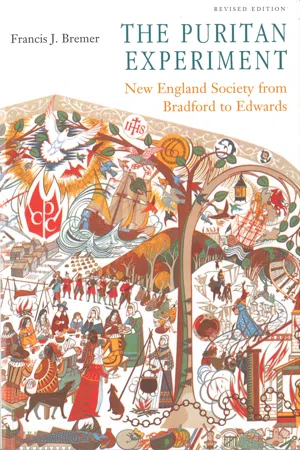
This revised and updated edition of an out-of-print classic once again makes the broad background of Puritanism accessible to students and general readers. Based on a chronology that begins with the Act of Supremacy in 1534 and ends with Jonathan Edwards's death in 1758, Francis J. Bremer's interpretive synthesis of the causes and contexts of the Puritan movement integrates analyses of the religious, political, sociological, economic, and cultural changes wrought by the movement in both Old and New England. From meeting house architecture to Salem witch trials, from relations with Native Americans to the founding of the nation's first colleges, he details with style and grace "a living system of faith" that not only had profound significance for tens of thousands of Englishmen and Americans in the sixteenth and seventeenth centuries, but also affected the course of history in the New World.
Trusted by 375,005 students
Access to over 1.5 million titles for a fair monthly price.
On 6 February 1556, in the reign of Queen Mary, Bishop John Hooper was brought to Glouchester, the seat of his diocese, where he was burned at the stake. A confirmed religious reformer who had traveled to the centers of continental Protestantism during the reign of Henry VIII, Hooper had returned to England upon the accession of Edward VI so as to work for further reform of the English church. His opposition to the wearing of clerical vestments had resulted in a quarrel with Archbishop Cranmer and a brief spell in prison as a result. But whatever his differences had been with Cranmer, he stood firm with the archbishop against Roman Catholicism and in the effort to shape a new England modeled after the practice of the early church. And, with Cranmer, he became a victim of the Marian persecutions.
Almost seventy years later John Winthrop, the lord of Groton Manor and a respected member of the English gentry, led a Puritan exodus to the wilderness of America. Many who had ventured to the New World before him had never gotten there, falling prey to shipboard diseases or North Atlantic tempests. And the story of those who had reached the American shores offered little comfort to Winthrop and those who journeyed with him. The mortality rate of the Virginia colony had been horrifying—between 1619 and 1625 over two-thirds of the English colonists had perished from disease, Indian attack, or starvation. Yet John Winthrop gave up his home, his position as a justice of the peace, and the comforts of his English life to try to build a model community on the coast of New England.
When we ask what Puritanism was we are seeking to understand the nature of a faith that had profound significance for tens of thousands of Englishmen and Americans in the sixteenth and seventeenth centuries. The chapters that follow attempt to describe what Puritanism meant at various times and in different settings, primarily in the seventeenth-century world. In the process we wish to bear in mind that men such as Winthrop, though they were more likely to play public roles, were not the only Puritans. Women such as Anne Askew suffered for their faith in Reformation England; Anne Bradstreet poetically expressed the meaning of Puritan piety as well as many of her male counterparts; and women formed the majority of the members in New England’s churches. It should also be kept in mind that Puritanism, like any vibrant and living system of faith, adapted to its times, and that, valuable as it is to understand the spirit that Hooper, Winthrop, and Bradstreet shared, it is equally important to recognize the changes that occurred in Puritanism over time.
Henry VIII and Edward VI
Where does the story of the Puritans and Puritanism begin? Marshall Knappen, in his classic study of Tudor Puritanism, opened his discussion with William Tyndale’s criticism of the inadequacies of the reforms initiated by Henry VIII when the king took England out of the Catholic community in the 1530s. And while Knappen has been taken to task by some scholars for this early dating of the movement, his approach has the merit of identifying as the earliest and most constant characteristic of Puritanism the belief that the Church of England had not been sufficiently purged of the theology and worship of Roman Catholicism. As the clergyman-founder of Connecticut, Thomas Hooker, later phrased it, Henry VIII’s “mistake was that he cut off the head of Popery, but left the body of it yet within his realm!” That, of course, was about what the king intended. For while the Reformation on the continent was, since its beginnings with the teachings of Martin Luther, primarily religious in intent and leadership, England’s alignment with Protestantism was begun by its monarch for essentially political reasons.
The church in England, upon the accession of Henry VIII in 1509, was divided into twenty-seven dioceses, each with a bishop at its head. Administratively, these dioceses were grouped into two provinces—York in the north and Canterbury in the south—each under an archbishop who oversaw not only his own diocese but also the others in his province. While officially coequal, the archbishop of Canterbury held greater political and ecclesiastical influence than his counterpart of York because of his proximity to the center of government and the inclusion in his province of the great universities of Oxford and Cambridge. Both archbishops were traditionally responsible only to the pope for their conduct of church affairs, and this ecclesiastical loyalty had often in English history irritated relations between the monarchy and the papacy. That friction reached its peak in Henry’s reign.
English Catholics, including internationally respected scholars such as Thomas More and John Colet, had frequently criticized the operations of the church in England, pointing to the clergy’s sparse education, an abundance of superstitious practices, and the mismanagement of church finances. But when Henry asserted his independence from Rome he was not inspired by a desire to reform ecclesiastical abuses. His motivation was essentially political, spurred by the pope’s refusal to annul his marriage to Catherine of Aragon, a refusal that itself had as much to do with international politics as it did with canon law. Nevertheless, despite his own continued belief in Roman Catholic dogma and his acceptance of its devotional practices, Henry was forced to make occasional concessions to Protestant religious reform. Isolated from Catholic Europe, the king had to relax pressure on English reformers if he hoped to gain support from Protestant nations. The course of reform was an uncertain one because it depended more on Henry’s assessment of changing domestic and diplomatic currents than on any clear religious vision, and some Englishmen of strong Protestant sympathies found it more effective to work for reform from overseas. From the safety of exile they applauded the king for having moved away from Rome, but criticized him for not having traveled far enough away. William Tyndale and John Hooper were but two members of the exile community who imbibed reform ideas from continental Protestants and printed religious tracts to be smuggled into England for the enlightenment of their countrymen.
When Henry VIII died in 1547, many thought that reconciliation with Rome was possible and potentially easy, so little had Henry affected the essence of English worship. But the rapid pace of religious change in the brief reign of Edward VI (1547–1553) made it clear that a reversal could never be painless—and was perhaps not even possible. The archbishop of Canterbury, Thomas Cranmer, was the chief architect of the new policies. Demonstrating much more initiative than he had in the previous reign, Cranmer established contacts with John Calvin of Geneva, with Luther’s lieutenant Philip Melanchthon, and with other continental reformers. He attempted to draw those leaders together in an international Protestant conference to iron out the differences between the various communions. Under his guidance the Church of England moved closer to the practices of the “best reformed churches.” He invited reformers Peter Martyr and Martin Bucer to Oxford and Cambridge respectively, thus ensuring that future generations of English clergy would reflect a Protestant theological orientation. Clerical marriage was officially approved; a Protestant Book of Common Prayer was published in 1549, followed by a more reformed Second Edwardian Prayer Book in 1552; images were removed from the churches, and communion tables in the naves replaced church altars. One month before his death, the young king endorsed Cranmer’s Forty-Two Articles of doctrine, which reflected the Protestant view on all points at issue in the church.
Not all Englishmen welcomed these new directions. On the eve of the Reformation most ordinary Englishmen seem to have found adequate spiritual sustenance in the worship available to them in their parish churches. In part this was because the abuses complained of by the reformers were not universal by any means. English lay men and women of the sixteenth century attended mass, engaged in devotional practices, and contributed to the beautifying of the church fabric as enthusiastically as had any of their forebears. The Reformation in England was not caused by a groundswell of popular demand for change. There was a broad spectrum of views on reform and a wide variation in the intensity with which these views were held. Many Englishmen remained sympathetic to Catholicism. Some of them were convinced that the Roman way was the true way, others simply favored the old ways because they were the comfortable ways. But some Englishmen clearly embraced and promoted reform. Still others were swept along, accepting with little demur the changes being instituted, concerned primarily that they be able to express their piety, and willing to accept the judgment of authority as to the proper means of doing so.
Among the leaders of state and church, Catholics, of course, hoped for a return to the Roman fold and resented every step away from that goal. And in the Protestant camp there was dissension. Hooper and John Knox wanted faster and more thorough change. The former had developed a strong orientation to reform during his time abroad. Returning from Zurich in 1549 he had cooperated with Cranmer in the archbishop’s early program of reform, but soon chafed over the slow pace set by Canterbury. His radical stance led to a three-week imprisonment when he preached against the use of clerical vestments in worship, condemning them as symbolic of the concept of a sacrificial priesthood. Hooper outwardly reformed and was installed as bishop of Gloucester in 1550, but he remained a voice for more thorough purification of the church. John Knox, in exile from Scotland for his radical Calvinist views, played a similar role in the Edwardian church. Had the king not succumbed to tuberculosis at an early age, Hooper and Knox might have formed the nucleus of a loosely organized Puritan opposition to the hierarchy. As events transpired, one became a Marian martyr, the other a Marian exile.
Mary Tudor and the Marian Exiles
The rule of Mary Tudor (1553–1558), Henry VIII’s daughter by Catherine of Aragon, was a testing time for English Protestantism. Her attempts to restore Catholicism to England kept the fires of Smithfield burning with the flesh of martyrs and sent about eight hundred of her Protestant subjects into exile. While her persecution of dissenters was little different than that to be found elsewhere in Europe at the time (as well as in England in her father’s reign—albeit on a smaller scale), her victims were immortalized by one who fled to fight another day. John Foxe’s compilation of their stories in what became known as the Book of Martyrs would strengthen the faith and offer inspiration to future generations of reformers.
Many of those Englishmen spent the five-year reign of Queen Mary in the centers of continental Protestantism, where they established their own churches and entered into dialogue with figures such as Heinrich Bullinger and John Calvin. But even in exile, English protestants could not agree among themselves, and their debates on the continent foreshadowed the issues that would divide the Church of England in later decades. The English church had been founded without a firm theological base and had been evolving a reformed, more Protestant faith when Edward died. Some among the exiles sought to continue that process, working to model their belief and forms of worship more closely upon those of the continental Protestants among whom they lived, in order to aid in the formation of a universal “reformed way.” William Whittingham and others looked to Geneva as their model and urged it on their colleagues. This would eventually be the sentiment that fueled the Elizabethan Puritan movement. Others opposed this internationalist ideal and strove to preserve the “English face” of the church in exile, arguing in particular that to depart from the religious system of the 1552 Prayer Book would be to betray the cause for which Cranmer, Hooper, and others were dying.
Elizabeth
When Queen Mary died in 1558 she was succeeded by her sister Elizabeth, who restored Protestantism to the realm and, through her longevity, assured its permanence. To staff her church the new queen looked to the returning exiles, but she found them demanding a role in the structuring of the new church. The result was a compromise. Elizabeth had preferred a return to the type of church symbolized by the 1549 Prayer Book; the exiles were committed to the 1552 Prayer Book at the least, with many seeking a much more Reformed practice. The resulting Elizabethan settlement of 1559 was dictated by the politics of the situation and designed to contribute to the solidity of Elizabeth’s grasp on the throne. It essentially restored the 1552 church with a number of conservative amendments. That meant a liturgy that was far more traditional—Catholic—than that of any other Protestant faith, and one that would serve as an ongoing irritant for those who wished liturgical practice to reflect the increasingly Calvinist faith of the church leaders. It also served to sustain the spirit of those who resisted the drift toward Geneva. Few of the returning exiles were happy with the new religious regime, but most were willing to work within it—if not in positions of authority that would require them to enforce unpalatable decrees, at least in parish posts.
The Elizabethan Puritan movement arose from the activities of those who were less willing to compromise. Some clergy attached themselves as chaplains to private households, served as lecturers, or assumed other positions outside the official structure and discipline of the church. These dissidents strove initially for a liturgy purged of “popish remnants.” According to historian Patrick Collinson,
Apart from the vestments, the surplice and the outdoor dress of the clergy, the first and foremost of their gravamina, the puritans would object with monotonous consistency to signing with the cross and addressing interrogatories to the infant in baptism, baptism by midwives, the rite of confirmation, kneeling at the communion and the use of wafer bread, the giving of the ring in marriage, the purification of women after childbirth, the retention of such terms as “priest” and “absolution,” the observance of saints’ days, bowing at the name of Jesus and “exquisite singing in parts” and organs. More radically, some of them would complain of the “longe-someness of the service” which seemed out of proportion in a Reformed Church and implied a subordinate place for the sermon.
That Puritanism grew to include a challenge to the episcopal structure can be attributed primarily to the queen, who attempted to suppress dissent but whose efforts resulted only in the broadening of its attack. A variety of factors contributed to frustrating the queen’s efforts to curb Puritanism. The very nature of the church helped to make such opposition possible. Organizationally, the division of the realm into provinces and dioceses had remained as it was in the reign of Henry VIII. But churches that had been under the control of monasteries and religious orders had fallen under lay control. The rights to the tithes of such parishes had originally been assigned (“impropriated”) to the monastery or religious order that had the associated right of appointing a stipendiary curate to serve the parish. When Henry VIII confiscated the monasteries and dissolved the religious orders, these rights of impropriation were given or sold by the king to lay supporters, who in turn could sell them or transfer them as they could any other property. Such churches were free from episcopal supervision. Thus, in Elizabeth’s time many clergy were appointed by laymen, and the support of some such laymen assured the Puritans of a number of positions free from episcopal supervision. Further complicating attempts to suppress the Puritan clergy was the sympathy they received from some of the bishops, who could be counted on to overlook much. Finally, the movement enjoyed the support of many prominent laymen, including influential figures at court such as the earl of Leicester, Sir Walter Mildmay, and Sir Francis Walsingham.
The quarrel between Elizabeth and her Puritan subjects began in earnest in 1565 with the same dispute over the use of vestments that had caused the rift between Thomas Cranmer and John Hooper. The Puritans, accepting the continental Protestant argument, contended that the use of vestments set the minister apart from his congregation and was symbolic of the Roman Catholic conception of the priesthood. Criticism of vestments had been widespread in the Convocation of 1563 (the clerical assembly that met during sessions of Parliament and was that body’s ecclesiastical counterpart). In 1565 it became evident to Elizabeth that many of the clergy were not wearing the prescribed vestments and she instructed her archbishop of Canterbury, Matthew Parker, to enforce the regulations. The beneficed clergy of London were particularly affected by Parker’s campaign, but throughout the realm many were deprived of their livings for refusing to conform.
Irked at the bishops’ reluctance to make reforms—and at their obstruction on issues such as the use of vestments—the Puritan clergy tried to improve the church by turning to parliamentary action. A number of religious reforms were proposed in the Parliament of 1566, but they were dropped when the queen made known her displeasure at the legislature’s interference with church affairs. But it had been Parliament that had declared Elizabeth to be the head of the church, and there would always be some members who believed that Parliament consequently had authority to alter the church settlement. In 1571 another reform bill was introduced; its sponsor was imprisoned for his efforts. Still hoping for relief, two of the clerical leaders of the movement, John Field and Thomas Wilcox, published An Admonition to Parliament (followed shortly by A Second Admonition to Parliament), which appealed unsuccessfully to the Parliament of 1572.
The call for parliamentary relief caused Parker, at the behest of the queen, to launch another major effort to suppress nonconformity. More clergymen were deprived of their posts, and some sought refuge on the continent to avoid more severe penalties. But then, when hopes of relief were seemingly exhausted, Parker died in 1575 and was succeeded by Edmund Grindal. Though not a member of the Puritan movement, Grindal had been one of the more progressive of the Elizabethan bishops. He had accepted office from the queen with reluctance and in the hope that he could bring about needed changes, particularly in the promotion of preaching.
It soon became apparent that under Grindal’s direction conformity to the standards of 1559 would be loosely enforced. The new archbishop took aggressive steps to root out papists from the church. He also worked to develop a preaching ministry, particularly through the encouragement of prophesyings. These were ministerial conferences (to which laymen were later allowed as observers) in which distinguished clergymen lectured to and discussed the faith with their colleagues. Reformers applauded both of the initiatives. Grindal also sought to reform ecclesiastical abuses and authorized publication of the English language Geneva Bible, printed with Calvinist annotations for household use.
In 1576 all of these progressive tendencies were checked. Elizabeth provoked a crisis by commanding that prophesyings in the province of Canterbury must cease. The gulf dividing the queen from Grindal—and from the Puritans—became obvious. Elizabeth wanted a conservative church that would bolster the crown. In her view, three or four preachers were sufficient for a shire; she was content with a ministry capable of reading the Scriptures and reciting approved homilies. Grindal dissented, stressing the importance of preaching the Word—and he was suspended.
The removal of Grindal from authority marked another turning point for the Puritan movement. As episcopal vacancies opened thereafter they were filled by men who were less sympathetic to th...
Table of contents
Cover
Title Page
Copyright
Contents
Preface
Chronology
1. The Origins and Growth of the Puritan Movement
2. Puritanism: Its Essence and Attraction
3. Sources of the Great Migration
4. Massachusetts: The Erection of a City on a Hill
5. Variations on a Theme: Connecticut, New Haven, Rhode Island, and the Eastern Frontier
6. Orthodoxy in New England: The Colony Level
7. Orthodoxy in New England: The Community
8. New England and Puritan England
9. The New England Way in an Age of Religious Ferment
10. Changes in Restoration New England
11. Challenges to the Faith: Pluralism and Declension
12. An Oppressed People: New England’s Encounters with Metacom, Governor Andros, and the Witches
13. Art and Science in Colonial New England
14. Race Relations
15. New Directions: Puritanism in the Neglected Decades
16. Enlightenment and Evangelicalism
Suggestions for Further Reading
Index
Illustration
Frequently asked questions
Yes, you can cancel anytime from the Subscription tab in your account settings on the Perlego website. Your subscription will stay active until the end of your current billing period. Learn how to cancel your subscription
No, books cannot be downloaded as external files, such as PDFs, for use outside of Perlego. However, you can download books within the Perlego app for offline reading on mobile or tablet. Learn how to download books offline
Perlego offers two plans: Essential and Complete
Essential is ideal for learners and professionals who enjoy exploring a wide range of subjects. Access the Essential Library with 800,000+ trusted titles and best-sellers across business, personal growth, and the humanities. Includes unlimited reading time and Standard Read Aloud voice.
Complete: Perfect for advanced learners and researchers needing full, unrestricted access. Unlock 1.5M+ books across hundreds of subjects, including academic and specialized titles. The Complete Plan also includes advanced features like Premium Read Aloud and Research Assistant.
Both plans are available with monthly, semester, or annual billing cycles.
We are an online textbook subscription service, where you can get access to an entire online library for less than the price of a single book per month. With over 1.5 million books across 990+ topics, we’ve got you covered! Learn about our mission
Look out for the read-aloud symbol on your next book to see if you can listen to it. The read-aloud tool reads text aloud for you, highlighting the text as it is being read. You can pause it, speed it up and slow it down. Learn more about Read Aloud
Yes! You can use the Perlego app on both iOS and Android devices to read anytime, anywhere — even offline. Perfect for commutes or when you’re on the go. Please note we cannot support devices running on iOS 13 and Android 7 or earlier. Learn more about using the app
Yes, you can access The Puritan Experiment by Francis J. Bremer in PDF and/or ePUB format, as well as other popular books in History & Early American History. We have over 1.5 million books available in our catalogue for you to explore.