
eBook - ePub
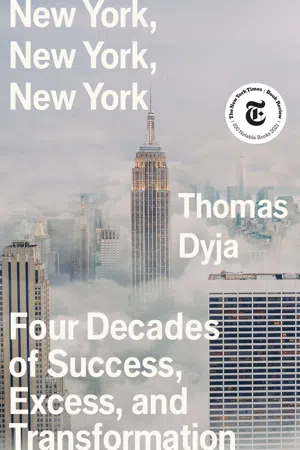
New York, New York, New York
Four Decades of Success, Excess, and Transformation
- 544 pages
- English
- ePUB (mobile friendly)
- Available on iOS & Android
eBook - ePub
About this book
A New York Times Notable Book
A lively, immersive history by an award-winning urbanist of New York City’s transformation, and the lessons it offers for the city’s future.
Dangerous, filthy, and falling apart, garbage piled on its streets and entire neighborhoods reduced to rubble; New York’s terrifying, if liberating, state of nature in 1978 also made it the capital of American culture. Over the next thirty-plus years, though, it became a different place—kinder and meaner, richer and poorer, more like America and less like what it had always been.
New York, New York, New York, Thomas Dyja’s sweeping account of this metamorphosis, shows it wasn’t the work of a single policy, mastermind, or economic theory, nor was it a morality tale of gentrification or crime. Instead, three New Yorks evolved in turn. After brutal retrenchment came the dazzling Koch Renaissance and the Dinkins years that left the city’s liberal traditions battered but laid the foundation for the safe streets and dotcom excess of Giuliani’s Reformation in the ‘90s. Then the planes hit on 9/11. The shaky city handed itself over to Bloomberg who merged City Hall into his personal empire, launching its Reimagination. From Hip Hop crews to Wall Street bankers, D.V. to Jay-Z, Dyja weaves New Yorkers famous, infamous, and unknown—Yuppies, hipsters, tech nerds, and artists; community organizers and the immigrants who made this a truly global place—into a narrative of a city creating ways of life that would ultimately change cities everywhere.
With great success, though, came grave mistakes. The urbanism that reclaimed public space became a means of control, the police who made streets safe became an occupying army, technology went from a means to the end. Now, as anxiety fills New Yorker’s hearts and empties its public spaces, it’s clear that what brought the city back—proximity, density, and human exchange—are what sent Covid-19 burning through its streets, and the price of order has come due. A fourth evolution is happening and we must understand that the greatest challenge ahead is the one New York failed in the first three: The cures must not be worse than the disease.
Exhaustively researched, passionately told, New York, New York, New York is a colorful, inspiring guide to not just rebuilding but reimagining a great city.
A lively, immersive history by an award-winning urbanist of New York City’s transformation, and the lessons it offers for the city’s future.
Dangerous, filthy, and falling apart, garbage piled on its streets and entire neighborhoods reduced to rubble; New York’s terrifying, if liberating, state of nature in 1978 also made it the capital of American culture. Over the next thirty-plus years, though, it became a different place—kinder and meaner, richer and poorer, more like America and less like what it had always been.
New York, New York, New York, Thomas Dyja’s sweeping account of this metamorphosis, shows it wasn’t the work of a single policy, mastermind, or economic theory, nor was it a morality tale of gentrification or crime. Instead, three New Yorks evolved in turn. After brutal retrenchment came the dazzling Koch Renaissance and the Dinkins years that left the city’s liberal traditions battered but laid the foundation for the safe streets and dotcom excess of Giuliani’s Reformation in the ‘90s. Then the planes hit on 9/11. The shaky city handed itself over to Bloomberg who merged City Hall into his personal empire, launching its Reimagination. From Hip Hop crews to Wall Street bankers, D.V. to Jay-Z, Dyja weaves New Yorkers famous, infamous, and unknown—Yuppies, hipsters, tech nerds, and artists; community organizers and the immigrants who made this a truly global place—into a narrative of a city creating ways of life that would ultimately change cities everywhere.
With great success, though, came grave mistakes. The urbanism that reclaimed public space became a means of control, the police who made streets safe became an occupying army, technology went from a means to the end. Now, as anxiety fills New Yorker’s hearts and empties its public spaces, it’s clear that what brought the city back—proximity, density, and human exchange—are what sent Covid-19 burning through its streets, and the price of order has come due. A fourth evolution is happening and we must understand that the greatest challenge ahead is the one New York failed in the first three: The cures must not be worse than the disease.
Exhaustively researched, passionately told, New York, New York, New York is a colorful, inspiring guide to not just rebuilding but reimagining a great city.
Frequently asked questions
Yes, you can cancel anytime from the Subscription tab in your account settings on the Perlego website. Your subscription will stay active until the end of your current billing period. Learn how to cancel your subscription.
No, books cannot be downloaded as external files, such as PDFs, for use outside of Perlego. However, you can download books within the Perlego app for offline reading on mobile or tablet. Learn more here.
Perlego offers two plans: Essential and Complete
- Essential is ideal for learners and professionals who enjoy exploring a wide range of subjects. Access the Essential Library with 800,000+ trusted titles and best-sellers across business, personal growth, and the humanities. Includes unlimited reading time and Standard Read Aloud voice.
- Complete: Perfect for advanced learners and researchers needing full, unrestricted access. Unlock 1.4M+ books across hundreds of subjects, including academic and specialized titles. The Complete Plan also includes advanced features like Premium Read Aloud and Research Assistant.
We are an online textbook subscription service, where you can get access to an entire online library for less than the price of a single book per month. With over 1 million books across 1000+ topics, we’ve got you covered! Learn more here.
Look out for the read-aloud symbol on your next book to see if you can listen to it. The read-aloud tool reads text aloud for you, highlighting the text as it is being read. You can pause it, speed it up and slow it down. Learn more here.
Yes! You can use the Perlego app on both iOS or Android devices to read anytime, anywhere — even offline. Perfect for commutes or when you’re on the go.
Please note we cannot support devices running on iOS 13 and Android 7 or earlier. Learn more about using the app.
Yes, you can access New York, New York, New York by Thomas Dyja in PDF and/or ePUB format, as well as other popular books in History & North American History. We have over one million books available in our catalogue for you to explore.
Information
I. Renaissance
Chapter One “I Love New York” Day
Standing alone, bald, and surprisingly tall, Ed Koch watched the snow fall through the windows of Tavern on the Green while the guests filed in for Hugh Carey’s “I Love New York” Day lunch. Only six weeks into his term and the City had already spent twice the year’s budget for snow plowing.
He’d been born in the Bronx, around the corner from Charlotte Street, back when garmentos were escaping from the Lower East Side. The kids who grew up in Crotona fought at Anzio and Guadalcanal, then came home for a few years of City College before making their own escape to the suburbs. As the shops along Jennings Street closed, torahs given to new congregations, Robert Moses gouged the Cross Bronx Expressway through the borough’s gut, pushing more Whites out to Co-op City. Black and Puerto Rican families moved into their apartments, so the landlords let the broken windows stay broken. Then the drugs hit, along with the fires started by owners to collect insurance, by bored kids and worried fathers who knew that fire victims got preference for the projects, until history was consumed and it all became just “the South Bronx.” Services were pulled back until all that was left were the sirens of Engine 82 and Ladder 31, up to 150 times a day. Koch wasn’t from a place as much as a time passed.
These days New Yorkers were rustling through closets in search of their own lost times: Depression-era Annie filled the Alvin Theatre; the Manhattan Transfer and film noir retrospectives; Bette Midler in her peep-toed pumps; anything that reached back to the mythic New York that had died in 1975 when the City had nearly gone bust. London and Chicago had great fires, San Francisco an earthquake; the disaster that forced New York into its future was the Fiscal Crisis. To understand how the City pulled itself up, it’s important to know what knocked it down.
Five-borough New York was still young when Governor Al Smith and Mayor Fiorello La Guardia stitched them together into a “workers’ paradise” with its own free university, hospitals, low transit fares, and lots of public housing that balanced the mansions along Fifth Avenue. The third maker of modern New York was Robert Moses, whose power came from his ability to please those in both the public housing and the mansions. Tall and severe, part of New York’s “Our Crowd” of German Jews, he built the radiating system of highways, parks, and beaches for the State then, as City Parks Commissioner, a frenzy of bridges, parks, roads, and pools that put the Depression-era unemployed to work on a regional plan crafted by blue bloods largely to keep them at arm’s length. New Yorkers adored Moses for providing both bread and circuses, but he became besotted with his own considerable genius. After a disastrous run for governor in 1934 exposed his distaste for the hoi polloi, Moses used the tolls from the Triborough Bridge to subsidize a network of public authorities answering only to him. A series of weak mayors then handed him control of the City’s planning and construction, and in the name of urban renewal, he destroyed healthy neighborhoods, scattered their social capital, deepened segregation, ignored mass transit, and undercut manufacturing by favoring highways over railroads.
In 1953, the City’s balance of power wobbled when reformer Robert Wagner won City Hall with the votes of the Blacks and Puerto Ricans moving into the buildings, jobs, and benefits left behind by Whites headed to the suburbs. Wagner made all civil servants subject to the unions, which let him sidestep the borough machines and political clubhouses and deal directly with a big chunk of the City’s working-class vote. When Medicaid passed in the early ’60s, the State forced the City to foot a large percentage and worse, because now the poor could use private hospitals, its aging public hospital system became one huge, unnecessary but politically untouchable expense. So to keep paying for the Workers’ Paradise, Wagner went down two slippery slopes: he increased borrowing and imposed new taxes that sped up the exodus of Whites and corporations. His successor, handsome young John Lindsay, took over in 1965 as a breath of fresh air focused on social justice and modernizing the City’s sclerotic systems. The new mayor’s idealism and city plan were a rebuke of Moses, whose reign finally ended when the MTA took over his seat of power, the Triborough Bridge Authority. Lindsay used Great Society programs like Model Cities to reconnect the people to their city after decades of Moses’s control, creating community boards and pumping Federal money into long-ignored neighborhoods.
Then it all fell apart.
In October 1969, with the Amazin’ Mets dousing the mayor with champagne after their surprise World Series win, New York’s economy began an 84-month swoon. Nixon chopped away at the Great Society, and the optimism of Lindsay’s first term curdled. Generational and economic change met sloppy, weak governance; Model Cities proved to be corrupt and chaotic, and the capital budget was raided to pay expenses, a breach of responsible accounting that made long-term maintenance and planning impossible. “Nobody was willing to say no,” said one official, and it was true whether you wore a three-piece suit, a dashiki, or a hard hat. Especially if you wore a hard hat. Even as New York’s public union members led the charge to the suburbs, the unions, not City Hall, seemed in charge; a corrupt NYPD watched the murder rate more than quadruple between 1961 and 1972, while striking sanitation workers let garbage pile in the streets. School decentralization led to a battle in Brownsville that tore apart the alliance between Blacks and Jews. People Power devolved into entropy, and the urban legend of Kitty Genovese, screaming for help while her neighbors listened, became the truth of the city: No one will help you, so why should you care about anyone else? New Yorkers hadn’t reconnected with governance; they’d split further apart. Experts deemed the city ungovernable.
Larger, global forces added fuel to the crisis. With Daniel Bell announcing The Coming of Post-Industrial Society, Japan and Germany emerged as industrial competitors, London overtook New York as the premiere financial market, and the US lost its first war. And then the Oil Crisis. In theory, bad economic times should pull prices down, but the glut of global petrodollars kept pushing inflation up while high unemployment held wages down, giving birth to Stagflation. Lindsay raised taxes to make up for sliding revenues, but it wasn’t enough, and here’s where the nosedive began. State funds and property taxes come to the City twice a year, so to maintain cash flow it has to regularly borrow hundreds of millions of dollars. The banks had always played along because it was easy money, and as the debt rose, the City floated short-term bonds of various sizes and flavors that were really just increasingly dodgy ways of getting money to pay interest on existing debt. By the end of Lindsay’s second term, the City was living week to week, and the budget had no basis in reality. “The only agenda,” says one former staffer, “was to keep the city afloat.” By the time a rumpled five foot two accountant out of the Brooklyn machine named Abe Beame took over City Hall in 1974, Wall Street was on to New York’s problems. Robert Caro’s damning biography of Moses, The Power Broker, revealed the corruption beneath New York’s imperial rise, while on the Bowery, a bar called CBGB became the center of what Legs McNeil also called his new magazine: Punk. “Punk wasn’t about decay,” said McNeil. “Punk was about annihilation… Nothing worked, so let’s get right to Armageddon.”
The State’s own problems brought things to a head. Governor Nelson Rockefeller had, with the help of his brother David, Chairman of Chase Manhattan Bank, created hundreds of public authorities with exotic bond issues that had the effect of letting the State print its own money. When the Urban Development Corporation (UDC), builder of large-scale affordable housing, defaulted in March 1975, the banks announced they wouldn’t buy any more City bonds. This wasn’t New York’s first fiscal crisis, and everyone believed the City would ultimately pay its bills, so the real reason was economic philosophy. Though the banks had it in their power to restructure the debt, most of the business elite felt the Workers’ Paradise and other big cities had been kept alive since the New Deal with political pork that just subsidized bad (read: Democratic) management. Here was an opportunity to take control of what they considered the most inept, bloated, bleeding-heart government of them all: New York City. So on April 14, 1975, New York found itself unable to redeem a $600 million bond issue, and the credit market shut its doors.
Beame’s City Hall was indeed inept. When Governor Carey asked just how many people the City employed, Deputy Mayor James Cavanaugh had pulled out an envelope with some numbers jotted on the back. “Many things which would in other cities or in a corporation be on computers,” admitted one insider, “were handled by people writing out in pen.” While City workers labored around the clock to patch failing systems, Beame named an economic panel with no economists. Impeaching the feckless mayor was considered before Carey assembled an advisory board of bankers, businessmen, and officeholders called the Municipal Assistance Corporation, or MAC. Led by Lazard Frères’s elegant, pursed-lipped Felix Rohatyn, it had emergency authority to issue bonds, though it could find no takers. One State senator who’d caught a ride back from Albany on the State jet said the diminutive Beame at this point looked “so distraught and so unhappy… you wanted to pick him up and put him on your lap.” In September 1975, Carey effectively suspended democracy in New York City by creating a new and much more powerful Emergency Financial Control Board (EFCB) to take in all City revenue and direct all major expenditures. Beame was forced to restaff his City Hall with business-savvy officials and some actual businessmen.
With City Hall no longer in charge of how to spend its own tax dollars, Rohatyn assembled traditional competitors like labor, banking, business, and real estate interests to plan its next moves, putting New York City under the control of a network of powerful interests political scientists call a “crisis regime.” Bankruptcy, it was decided, would devastate everyone, so the union pension funds bought bonds while the banks gave extensions on interest payments and bought bonds, too, now at much higher rates than before. Real estate developers prepaid their taxes. The lights stayed on, the ballot box remained, but the Workers’ Paradise was over. In October, this united front pled the city’s case to a Washington tired of paying urban subsidies, but the resulting Daily News headline “FORD TO CITY: DROP DEAD” shifted sympathies. David Rockefeller personally lobbied the White House, and on Thanksgiving Eve, as Macy’s blew up its balloons, President Ford announced a deal for Federal aid through 1978.
Over the next two years, the City laid off some 61,000 employees. When State courts ruled the deal illegal, panicking banks demanded that the EFCB become a permanent unelected body overseeing the City’s government. New York—and America—faced a Rubicon moment. To his credit, Rohatyn refused, saying, “It would mean the end of democracy.” Instead, the EFCB would remain in charge until City Hall could deliver three balanced budgets in a row without Federal help. Two years had passed since then, and the state of emergency remained. Albany and Washington still provided 40% of the City’s operating revenue and a plan had to be in place by summer for new Congressional funding or New York would be right back where it was in 1975, this time with all deferrals deferred and extensions extended. And for all the snow piling up outside Tavern on the Green, June wasn’t far away.
Inside Tavern on the Green, Diana Ross and Yul Brynner chatted with Governor Carey. Americans hated nearly everything about New York City except for Broadway, so the State had launched a campaign around a logo dashed off by its designer Milton Glaser in the backseat of a cab. Though just three letters and a red heart, “I Love New York” had drawn a record 16.7 million visitors in 1977 despite the Blackout, Son of Sam, and Charlotte Street, so the $400,000 tourism budget had been multiplied by ten for things like this party to debut a slightly elegiac disco jingle touting Broadway. For symbolic reasons, if not culinary (Times restaurant critic Mimi Sheraton considered its food “below minimum standards of acceptability”), there was no better place for it than Tavern on the Green, revived by new owner Warner LeRoy with heavy applications of Tiffany glass and chintz. “I just love it here,” Andy Warhol had said at the reopening. “I want to come back someday and get a chicken sandwich on potato bread. It’s only $2.50.” Today he was here with Paulette Goddard on his arm for free veal, prawns, and avocado.
Outside, the busy city observed Valentine’s Day. “It was really a celebration,” Warhol wrote in his diary, “a big holiday.” New York, so close to death, was freshly beloved by New Yorkers. “It’s in danger of dying,” said Paul Mazursky, “so there’s something tender about it.” Though Annie took place during the Depression, “Tomorrow” was very much a song about today, and if you were still here, some crazy part of you loved the place no matter what, the intimacy and decay, the smell of cabbage crashing into bacalao, opera and salsa battling in the air shaft. Woody Allen was scouting locations for Manhattan. Isaac Bashevis Singer ordered the soup of the day again at the Famous Dairy Restaurant on 72nd, and Edward Gorey donned his big fur coat to see Suzanne Farrell dance Balanchine. White-gloved waiters polished samovars at the Russian Tea Room, while in a warm, quiet corner at The New Yorker, Mr. Shawn applied his pencil. Metropolitan Life by Fran Lebowitz just hit the shelves at Scribner’s. Chevy Chase was about to replace Raymond Burr as host of that week’s Saturday Night Live, and at 8:00 p.m. Robert LuPone would again shout “Step, kick, kick, leap, touch!” to start tonight’s performance of A Chorus Line. Banjo-hitting shortstop Bucky Dent had stirred things up today in spring training, begging Yankees manager Billy Martin to let him bat in clutch moments.
On the Upper East Side, the old-money types lurched toward sequins. Just yesterday Halston had opened his new showroom at Olympic Towers (Scaasi said it would be bare shoulders for the spring, and dots dots dots!). Every night neurotic, romantic Liza Minnelli blew her lines in The Act with “brashness, pathos and desperate energy.” International jet setters, unable to pass the boards of any of the dozen or so Park Avenue co-ops they’d deign to inhabit, consoled themselves by shake shake shaking their booties amid the nightly roller-skating, disco ball–spinning, coke-sniffing debauch at Studio 54. “It’s like the last days of Rome,” shouted writer Bob Colacello into the large powdered ear of Diana Vreeland. She responded, “I should hope so, Bob.”
There were countless other New Yorks to love then, too, networks freely and frequently intersecting. Temples, parishes, and private schools; ethnic New York that made a nice ragu Sundays, played Gaelic in Riverdale, slurped borscht at the Kleine Konditorei. Fulton Street simmered with mobsters and fishermen while across town in the Meatpacking District, both sides of beef and gay men hung from hooks. A port city, New York had always been a gay city. In the ’20s, when your public appearance defined gender, “fairies” had solicited “men” in Bryant Park and posed Elmo-style for photos with tourists in Times Square where, during World War II, thousands of American soldiers and seamen would discover new truths about themselves. Despite postwar rigidity over gender and sexuality, New York’s “Sad Young Men” had developed an awareness of their identity and their rights that led to the Stonewall Riots. Since then, gay men had been exploring the boundaries of sex as a language, forming what Charles Kaiser called their own “completely democratic society,” a network that connected men across lines of class and race. Some, like writer Larry Kramer, wondered if they’d gone too far. “[A]ll we do is live in our Ghetto and dance and drug and fuck,” shouted the narrator of his novel Faggots. A coterie of adventurous, envious straights imitated gay life through glam-punk androgyny or by cavorting with other love-handled swingers on the wrestling mats at Plato’s Retreat, but otherwise most New Yorkers considered homosexuality something to hate and fear. Koch’s election was a watershed. As a congressman he’d supported gay rights, and the presence of Bess Myerson at his side during the campaign had fooled no one. While Gay New York claimed Koch as one of their own, he suspected that Cuomo’s teenaged son Andrew had distributed the “Vote for Cuomo, not the homo” flyers in Queens. One of his first acts in office was to ban discrimination based on “affectional preference.” New York’s unique sass, its fast-talking, funny, cynical attitude part Jewish, part Black, part working class, came with a healthy dollop of camp. Susan Sontag’s “ultimate Camp statement”—that somethin...
Table of contents
- Cover
- Title Page
- Dedication
- Epigraph
- Introduction
- Part I: Renaissance
- Part II: Reconsideration
- Part III: Reformation
- Part IV: Reimagination
- Epilogue
- Photographs
- Acknowledgments
- About the Author
- Notes
- Index
- Copyright