Pivot
eBook - ePub

Pivot

Eight Principles for Pivoting through Disruption

  1. 304 pages
  2. English
  3. ePUB (mobile friendly)
  4. Available on iOS & Android
eBook - ePub

Pivot

Eight Principles for Pivoting through Disruption

About this book

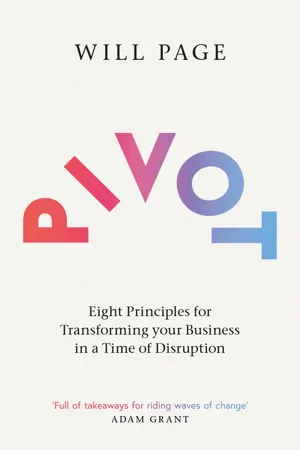
A stunning new insight into how the most crucial lesson you can learn in today’s challenging business environment is how to change the fundamentals of what you do, rather than carry on fighting a battle that is already lost.

The near destruction of the music industry at the hands of online piracy and its subsequent recovery on the backs of digital streaming platforms is more than just the biggest story of disruption and reinvention of the digital age. It is also a trove of insights on how to confront the metamorphosis we are all facing in dealing with the Covid-19 era, as accelerating tech and economic changes reshape our work, our play and our very minds. 

Will Page, Spotify’s first chief economist, extrapolates music’s journey into eight guiding principles for pivoting through the ubiquitous disruption in nearly all industries. Expect the unexpected with transferable lessons coming from Starbucks, Tupperware and even Groucho Marx. The notion of 'Tarzan Economics' ties these principles together: a framework for recognising and acting on disruption, by letting go of the old vine and grabbing onto the new. Page joyfully brings these insights to life and provides a guide for knowing not just how to grab the new vine, but when. He assesses the new dynamics of the 'long tail', identifies friends and foes in the battle for scarce attention and provides a practical tool for discovering the right role for each of us to succeed in this new modern world.

As we emerge from the unprecedented disruption of a global pandemic, Tarzan Economics shows all of us - individuals, organisations and institutions - that if the vine we are holding onto is withering, we can have confidence to reach out for a new one in 2022 and beyond.
Frequently asked questions

Yes, you can cancel anytime from the Subscription tab in your account settings on the Perlego website. Your subscription will stay active until the end of your current billing period. Learn how to cancel your subscription.
No, books cannot be downloaded as external files, such as PDFs, for use outside of Perlego. However, you can download books within the Perlego app for offline reading on mobile or tablet. Learn more here.
Perlego offers two plans: Essential and Complete
  • Essential is ideal for learners and professionals who enjoy exploring a wide range of subjects. Access the Essential Library with 800,000+ trusted titles and best-sellers across business, personal growth, and the humanities. Includes unlimited reading time and Standard Read Aloud voice.
  • Complete: Perfect for advanced learners and researchers needing full, unrestricted access. Unlock 1.4M+ books across hundreds of subjects, including academic and specialized titles. The Complete Plan also includes advanced features like Premium Read Aloud and Research Assistant.
Both plans are available with monthly, semester, or annual billing cycles.
We are an online textbook subscription service, where you can get access to an entire online library for less than the price of a single book per month. With over 1 million books across 1000+ topics, we’ve got you covered! Learn more here.
Look out for the read-aloud symbol on your next book to see if you can listen to it. The read-aloud tool reads text aloud for you, highlighting the text as it is being read. You can pause it, speed it up and slow it down. Learn more here.
Yes! You can use the Perlego app on both iOS or Android devices to read anytime, anywhere — even offline. Perfect for commutes or when you’re on the go.
Please note we cannot support devices running on iOS 13 and Android 7 or earlier. Learn more about using the app.
Yes, you can access Pivot by Will Page in PDF and/or ePUB format, as well as other popular books in Business & Business Strategy. We have over one million books available in our catalogue for you to explore.

Information

1 TARZAN ECONOMICS

Let’s Party Like It’s 1999
Twenty years ago, when compact disc sales were scaling new heights (and doing so at ever-higher prices), record-industry executives could weigh their profits on scales. This isn’t just a figure of speech – label executives would regularly buy and sell stacks of CDs based on their weight, rather than their music. So predictable was the insatiable demand for a disc in a plastic case that each pallet of CDs sold translated into predictable quantities of cash to calculate their profits.
Pallets of CDs carried virtually no data whatsoever. Labels didn’t even care if it was the Stones or the Killers, just whether it was stones or kilos. Yet while it is easy to mock how business was done back then, the music industry did more business in the era of CDs than it has done since. By 2000 the global value of the music industry was close to $25 billion. Twenty years on, the value of the recorded music industry is just over a tenth off reaching that peak – and that’s before we adjust for inflation.
The hilarious 2008 novel Kill Your Friends puts you inside the minds of egotistical talent scouts during the peak-CD-era 1990s with a story of how a major-label A&R manager would respond to the question ‘What music do you like?’ The author likens this to ‘asking an arbitrageur what kind of commodities he likes. Or saying to an investment banker, ‘Hey what’s your favourite currency?’ The music industry was reaching its peak and was about to find out how far down it had to travel. It might have known what it was worth (or at least, how much it weighed), but it had no idea how much it could lose.
To understand why the old vine was so hard to let go of (and why people are still nostalgic about it today), we need to appreciate just how excessively crazy the good times were, with emphasis on the word ‘excess’. Label executives would take helicopters to their private jets. Analytics back then was once described to me bluntly, using a simple bar chart: ‘You give me one bar that’s bigger than another bar and I’ll sell the shit out of it.’ The excesses came down to a combination of the scarcity of physical CD products (unlike digital files, there can only be so many), the leverage that came with the ability to control their supply and a sprinkle of fear and greed topped off with line after line of cocaine. I’ll never forget learning the expression ‘so bent it’s straight’ as a way of capturing how the old vine held itself together. Here are three of my greatest hits so you can learn why such excesses apply to more than just music.

PAYOLA WAS SO BENT IT WAS STRAIGHT

The first scam is ‘payola’, wherein record labels would pay an ‘independent radio promoter’ to get their new songs played on radio stations so they could draw a crowd and achieve a profitable return in sales. The word ‘independent’ in the job title of independent radio promoter matters. He (and it was always a he) was neither an employee of a label nor of the radio station and was free to pick his first partner in this two-way negotiation. Contrary to how payola is often perceived, he would consistently pick the radio station first to ask if they intended to put a forthcoming hit record on heavy rotation. If the station replied ‘Sure, we love that record, we’re going to play it all day once it’s out’, that was all he needed to know.
Next he would go to the label and auction the slot, pitching: ‘If you lay out twenty thousand dollars, I reckon we can get this record on heavy rotation with the biggest local radio-station network.’ The song was going to be played even if the promoter hadn’t been involved, but his knowledge of one side’s intentions allowed him to play off the naivety of the other. The money was paid over to the independent promoter, the station received a handsome kickback for trading its insider knowledge and the music was played without any distortion of market forces that payola is often thought to create. The label paid to play what was already going to be played.

GIVEN THE RULES, CHARTS WERE SO BENT THEY WERE STRAIGHT

The second scam is known as chart-hyping – promotional techniques used by record labels to ‘hype the chart’ and get a song into the Top 40, as the gap between 41 and 40 is way bigger than 40 and 39. Once in the charts, momentum would carry you upwards. One label executive famously claimed that the most important form of transportation was the ‘bandwagon’ – as everyone wanted to be on it! Charts made the bandwagon more visible, and therefore more popular.
Long before electronic point-of-sale systems provided universal data on what songs the public was purchasing, chart companies had to deal with imperfect information – asking a select few shops to report their sales and extrapolating from the surveys. (Shamefully, television and radio measurements still resort to similar extrapolative techniques today.)
For a record label to hype its song into the charts, all it needed to know was which shops the chart company was surveying and then send in fake buyers to purchase multiple quantities of the record to ramp up demand. Better still, these canny promoters often had intimate relationships with the select few influential retailers, offering anything from free goods to holidays to get their co-operation. A pencil mark in the diary to indicate a sale was all that was needed to move the needle. Once a song had charted, it would get the promotional momentum needed to produce a positive return on investment.

THE RULES FOR CERTIFICATION WERE SO BENT THEY WERE STRAIGHT

The third example of warped behaviour is certification, where albums were awarded gold and platinum status upon reaching a sales threshold of 500,000 and 1 million sales respectively. To understand how this process got bent out of shape, we need to differentiate between shipments (what labels delivered to retailers) and sales (what customers purchased). Certification was based on the former, not the latter. What went unsold was returned to the label’s warehouse with no downside for the retailers. The undercurrent that led to over-shipments was the ‘sale or return’ stance retailers took: if the label asked the retailer ‘How many Guns N’ Roses albums do you want?’, the retailer would reply with ‘How many will you give me?’ More was better than some.
Record label executive bonuses, meanwhile, were based on shipments, not sales. If the label manufactured and distributed a million copies of a new record it would qualify for platinum certification and executives would hit the jackpot. If that record didn’t sell (what was known as a ‘stiff’) and the retailer returned half a million copies, this would obviously affect the label’s finances, but not the platinum certification or the bonus of the executive. This is the origin of the expression ‘ship platinum, return gold’.
These are three of my greatest hits in the long list of music-business skulduggery, and I could name a hundred more – but this type of thing isn’t confined to music. Political lobbyists have always had their own version of payola, where they accept cash from wealthy donors in exchange for exclusive access to politicians they were going to meet anyway. Financial traders have long played their own game of chart hyping, knowing when to go long on a stock that is about to enter a market within a market such as the FTSE 100 or Dow Jones Industrial Average, and when to short it just before it falls out. And company directors who focus solely on quarterly earnings will often design their own certification system for determining executive pay, setting short-term targets that are easy to reach but can cause pain long after bonuses have been paid out.

Music is a microcosm for good (and bad) behaviour everywhere. The reason the industry was able to game its own system was control of a market, control of a crowd and (most importantly) the copyright. In both legal matters and conventional economics, syntax matters. Copyright stands for the right to control copying.
This right came to a sudden and alarming halt when the music industry and its customers woke up to Napster in June 1999. Overnight, millions of fans found themselves able to swap and exchange music files using the novel MP3 format. If you had a fast-enough internet connection, Napster would allow you to download any pop song within seconds without spending a penny. Within ten months of its launch, Napster had over 10 million users and had spawned many copycats.
Rather than ‘embrace the internet wholeheartedly’ (as The Economist suggested), the record labels embarked on a decade-long journey of trying to reject the changes it brought. In so doing, they also rejected the opportunities the internet could bring. Instead of granting popular digital models like Napster a licence to make them legitimate, the labels used litigation to fight them, for fear of upsetting the revenues that were still pouring in from those pallets of CDs.
In late 1999, the Recording Industry Association of America (RIAA), representing the record labels of the United States, successfully sued Napster, claiming it had facilitated piracy of music on an unprecedented scale. In 2002, the RIAA sued the illegal file-sharing site Madster (formerly Aimster), and the Metro-Goldwyn-Mayer Studios Inc. (MGM) sued Grokster, another file-sharing site, the following year. Soon after, the RIAA labels sued the developers of LimeWire. It was the Whack-A-Mole school of litigation, and the moles kept popping up. The energy (not to mention the money) the lawyers and lobbyists spent trying to whack them created an unwanted side effect: increased consumer awareness of the incredible ‘free lunch’ services the file-sharing sites provided. When the Motion Picture Association of America (MPAA) went after the BitTorrent tracker The Pirate Bay in its home country of Sweden in 2006, the media backlash was so huge it inspired a feature film aptly titled TPB AFK: The Pirate Bay Away From Keyboard.
While Whack-A-Mole was playing out among the illegal streaming services, in 2004 the RIAA also embarked on its most controversial strategy: suing individual consumers. By the spring of 2007, the RIAA admitted that more than 18,000 individuals had been sued by its member companies and news reports showed the number as of October 2007 to be at least 30,000. If the litigation route was doing a bad job at losing this unwinnable battle, the public relations offensive was about to get much worse.

In 2004, the US recording industry pivoted from litigation against teenagers to engaging with them by partnering with Apple and the soft drink giant Pepsi to promote 100 million free download codes on the fledgling iTunes service – one free download with every winning bottle purchased. The television ad campaign was set to Green Day’s uber-hip cover of ‘I Fought the Law’, originally penned by Sonny Curtis and performed by his band The Crickets. It’s been covered by many bands, including The Clash, and featured lingering close-ups of pensive kids who had been prosecuted for illegal file-sharing, bannered with words like ‘incriminated’, ‘accused’ and ‘busted’ in convict-style fonts. Let that be a lesson to any thirsty teenager watching: these kids had broken the law, and they hadn’t won.
The ad concluded with a teenage girl sitting by her Apple laptop, describing herself as one of the kids who was prosecuted for downloading music from the internet. She leans back from her computer with confidence and says: ‘I’m here to announce, in front of everyone, we’re still going to download music free off of the internet,’ before declaring ‘and there’s not a thing anyone can do about it’ and chuckling the commercial to its conclusion. The difference: this former music thief would hereby be downloading her music legally.
The idea was to fight free with free. Pepsi would legally give songs away from the iTunes store. But the download code bargain had a catch: the music may have been made free, but the Pepsi was not. Sugary soft drinks were the loss leader to rescue copyright from the thieves that surrounded it. Yet the promotion didn’t increase the sales of Pepsi. Not because the kids didn’t want free music – they just didn’t need to buy a bottle of Pepsi to get it.
These kids were crafty: by simply walking into a grocery store, grabbing a bottle from the fridge cabinet and angling it against the light, you could read the code underneath the cap, note it down and get the music literally for free. No need to spend money on Pepsi or damage your teeth any further. As the teenage star of the advert predicted, they would still download music for free and there wasn’t a thing anybody could do about it – not even the soft drinks industry.
For an industry that was fast running out of ideas to fight what the consumer clearly wanted – easy, frictionless access to digital music – it was a terrible outcome. Every time execs came up with a new idea to counter digital disruption, they wound up shooting themselves in the foot. File-sharing had become big business, but this market for free goods was without a viable business model. To other creative industries, it was digital anarchy, and fear crept in that it would soon spread to destroy their incomes. They had reason to be frightened. As the internet pipes got bigger, so did the size of files that could be transferred – putting high-resolution audio, television and film next in line.
It looked like a tug-of-war: consumers wanted frictionless access to all the world’s music, and the industry wanted to retain control. Consumers were happily swinging to the digital vine that offered faster, cheaper, neater and cooler access to all the world’s music, whereas the industry clung on to the old vine and aggressively refused to take part.
Rather than grasp the new vine of opportunity, the music industry redoubled its resistance and the situation worsened. Piracy was out of control, and recorded music revenues were cratering. Adding insult to injury, the industry’s chosen response – attacking the consumer – was creating a PR backlash. Some of the individuals targeted by the RIAA were economically vulnerable, and the settlements extracted would only prove profitable to the law firms leading the prosecutions. For outside observers, this type of behaviour wasn’t going to win many hearts and would persuade even fewer minds. The industry had got itself stuck in sinking sand, spending millions on litigation, losing billions in revenue, and losing its cool – which is not a good look in the music industry.
It was during this chaotic time that I was trying to get into the music business. ...

Table of contents

  1. Cover
  2. Title Page
  3. Dedication
  4. Epigraph
  5. Prologue: We All Have a Napster Moment Ahead: Can You See Yours?
  6. Introduction: My Job is to Help You See Around Corners
  7. Chapter 1: Tarzan Economics: Let’s Party Like It’s
  8. Chapter 2: Paying Attention
  9. Chapter 3: Drawing a Crowd
  10. Chapter 4: Make or Buy
  11. Chapter 5: Self-interest vs. Common Good
  12. Chapter 6: Pivotal Thinking
  13. Chapter 7: Judging the State We’re In
  14. Chapter 8: Big Data, Big Mistakes
  15. Conclusion: Builders and Farmers
  16. Annex: Groucho Marxism Maths
  17. Acknowledgements
  18. Bibliography
  19. Index
  20. Copyright