A top-rated series of textbooks designed to help students reach their highest potential. Easy to follow with logical sequencing and a step-by-step approach to problem-solving. Comprehensive module summaries, detailed worked examples and plenty of activities to prepare students for exams. Lots of typical exam-type questions so students understand what is expected of them. Simple defi niti ons for new terms to remove language barriers.
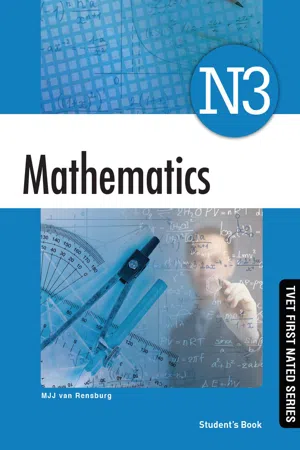
- 272 pages
- English
- PDF
- Available on iOS & Android
eBook - PDF
About this book
Key takeaways
AI-Generated Insights
Insight 1
Apply fundamental algebraic operations, including working with exponents, factors, and fractions, to simplify expressions and solve various types of equations and word problems. This includes manipulating technical formulae relevant to engineering contexts.
Insight 2
Analyze and represent various functions, including those involving exponents, surds, and logarithms, by constructing and interpreting their graphs in a coordinate system. This includes identifying properties of straight lines, circles, ellipses, parabolas, and hyperbolas.
Insight 3
Utilize differential calculus to determine gradients, limits, and turning points of functions, and apply trigonometric principles to solve equations, prove identities, and analyze geometric problems involving triangles and rotating vectors.
Information
Table of contents
- Front Cover
- Title Page
- Imprint Page
- Contents
- MODULE 1: Orientation
- Unit 1.1: The importance of terminology
- Unit 1.2: Symbols frequently used in Mathematics
- Unit 1.3: The operations × , ÷ , + and -
- Unit 1.4: Variables
- Unit 1.5: Coefficients
- Unit 1.6: Examples of terms
- Unit 1.7: Similar terms
- Unit 1.8: Addition and subtraction of algebraic terms
- Unit 1.9: Laws for exponents
- Unit 1.10: Fractions
- Unit 1.11: Multiplication and division by fractions
- Unit 1.12: Factors
- Unit 1.13: Simplification of fractions
- Unit 1.14 Addition and subtraction of fractions
- Unit 1.15: The pocket calculator
- MODULE 2: Factors and fractions
- Unit 2.1: The common factor
- Unit 2.2: The quadratic trinomial
- Unit 2.3: Squares
- Unit 2.4: Cube functions
- Unit 2.5: Algebraic fractions
- MODULE 3: Exponents, surdsand logarithms
- Unit 3.1: Exponents
- Unit 3.2: Surds
- Unit 3.3: Logarithms
- MODULE 4: Equations, word problems and manipulation of technical formulae
- Unit 4.1: Equations
- Unit 4.2: Word problems
- Unit 4.3: Manipulation of technical formulae
- MODULE 5: Geometry of co-ordinates
- Unit 5.1: Different forms of a straight line
- Unit 5.2: Equations of straight lines
- Unit 5.3: The circle
- MODULE 6: Sketch graphs
- Unit 6.1: A straight line
- Unit 6.2: A circle with its centre at the origin
- Unit 6.3: The ellipse
- Unit 6.4: The parabola
- Unit 6.5: The hyperbola xy = c
- Unit 6.6: The cube function
- Unit 6.7: The form of y = axn
- MODULE 7: Differential calculus
- Unit 7.1: Average gradient and speed
- Unit 7.2: Limits
- Unit 7.3: Differentiation
- Unit 7.4: Turning points
- MODULE 8: Trigonometry
- Unit 8.1: Exact values
- Unit 8.2: Trigonometric equations
- Unit 8.3: Identities
- Unit 8.4: Solving triangles
- Unit 8.5: Sketch graphs
- Unit 8.6: Rotating vectors
- Answers
- Glossary
Trusted by 375,005 students
Access to over 1.5 million titles for a fair monthly price.
Study more efficiently using our study tools.
Frequently asked questions
Yes, you can cancel anytime from the Subscription tab in your account settings on the Perlego website. Your subscription will stay active until the end of your current billing period. Learn how to cancel your subscription
No, books cannot be downloaded as external files, such as PDFs, for use outside of Perlego. However, you can download books within the Perlego app for offline reading on mobile or tablet. Learn how to download books offline
We are an online textbook subscription service, where you can get access to an entire online library for less than the price of a single book per month. With over 1.5 million books across 990+ topics, we’ve got you covered! Learn about our mission
Look out for the read-aloud symbol on your next book to see if you can listen to it. The read-aloud tool reads text aloud for you, highlighting the text as it is being read. You can pause it, speed it up and slow it down. Learn more about Read Aloud
Yes! You can use the Perlego app on both iOS and Android devices to read anytime, anywhere — even offline. Perfect for commutes or when you’re on the go.
Please note we cannot support devices running on iOS 13 and Android 7 or earlier. Learn more about using the app
Please note we cannot support devices running on iOS 13 and Android 7 or earlier. Learn more about using the app
Yes, you can access Mathematics N3 Student's Book by MJJ van Rensburg in PDF and/or ePUB format, as well as other popular books in Technology & Engineering & Engineering General. We have over 1.5 million books available in our catalogue for you to explore.