Featuring helpful examples and top tips throughout, this handy guide equips students with the tools to understand, respond to and apply lecturer feedback in order to continuously improve their academic performance. Chapters take students through the entire feedback process, from handling common feelings associated with feedback and making sense of criticism through to creating an effective action plan and applying feedback across their course.
Using Feedback to Boost Your Grades will be an invaluable toolkit for students of all subject areas and levels who want to take control of their academic progress and make the most of the feedback they receive.
- English
- ePUB (mobile friendly)
- Available on iOS & Android
eBook - ePub
Using Feedback to Boost Your Grades
About this book
Information
Topic
Study AidsSubtopic
Study GuidesPART 1
REACTING TO FEEDBACK
So, imagine you’ve just had an assignment returned to you, with some feedback.
◗What will the feedback look like, and what might it say?
◗Will it be detailed or concise, clear or confusing?
◗How will you respond, both immediately and longer term?
This part of the book will explore initial reactions and first steps.
1 Your feelings about feedback
Whatever form your feedback takes, the moment when you first receive it can provoke a range of emotions.
How you react will depend on various factors, which we will explore later in the book. But as an immediate response, you might find yourself feeling:
 |  |  |
◗Happy with your mark and your feedback ◗Satisfied with your mark but eager to do better | ◗Unsurprised, relaxed | ◗Confused by the marker’s comments ◗Disappointed and deflated because you put in a lot of work, but the mark or the feedback doesn’t reflect this |
◗Relieved that you’ve passed a difficult task ◗Pleased that the feedback and grade suggest you’ve mastered a given skill. | ◗Detached from the feedback because you feel you’ve ‘moved on’ from that assignment and your attention is elsewhere. | ◗Angry that your work has been criticised ◗Surprised or shocked because the markers were looking for something different from what you thought ◗Frustrated that there were things you didn’t include, or mistakes that could have been avoided ◗Inadequate, disappointed with yourself or ‘not good enough’, if your confidence has taken a knock. |
It’s natural to feel upset if you get a lower mark than you were expecting, or to feel resistant to criticism of your work. This happens to all students at some point, but if you respond effectively, receiving a disappointing mark can make you a better learner in the long run.
Ask yourself what you can gain from the experience and from your marker’s feedback. Remember that any comment that seems negative is focused on the work and how it could be improved – it isn’t a comment about you!
Some productive first steps
◗Wait a few days before considering your feedback again. Sometimes the comments take a while to sink in and make sense. A little distance can help you to view your work and the feedback more objectively.
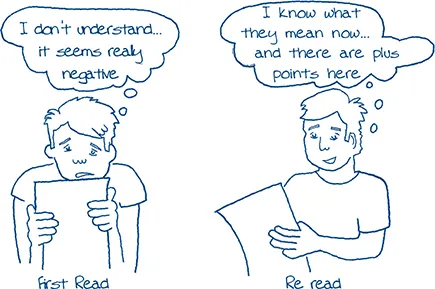
◗Reread your assignment in the light of the feedback. You may then begin to see what your marker means. Emotions will be easier to deal with as you put the feedback into context. It’s also useful to have another look at your original assignment brief and learning outcomes – there’s more about this in Part 2.
◗Focus on the positive as well as the negative. It’s natural to fixate on criticism but you should also reflect on the aspects your tutor praised. Look for ticks or positive comments which show that your tutor is impressed with the way you’ve dealt with certain aspects of the assignment.
◗Think forwards! Take a proactive, positive attitude and plan how you’ll do things differently in the future. Learning is a continuous process and the way you engage with feedback is a major part of that.
◗Think sideways! Consider similarities or connections with other pieces of feedback you’ve had. There’s more on this in Parts 4 and 5.
Some things to avoid
◗Ignoring the feedback: Avoid the temptation to simply file the assignment away, even if you’re focusing on other things.
◗Reading it just once and thinking: ‘I must remember what they said for next time!’ Chances are, you won’t!
◗Comparing yourself to others: It can be useful to discuss your feedback with your peers, to see if there are common things to work on and support each other with. However, try not to get too hung up on the grades that other people are receiving, and whether they’re higher or lower than yours. You’re not in competition; you’re each on a personal learning journey.
After you’ve got over the initial high or disappointment, it’s a great idea to stand back and remind yourself of the point of the feedback you’ve received, and how it can benefit you. Chapter 2 looks at the usefulness of some different types of feedback.
2 What’s important about feedback?
Of course, you need a mark or gr...
Table of contents
- Cover
- Half Title
- Title Page
- Copyright
- Contents
- Acknowledgements
- Introduction
- Part 1: Reacting to feedback
- Part 2: How was I assessed?
- Part 3: Making sense of your feedback
- Part 4: Taking action
- Part 5: Applying feedback across your course
- Conclusion
- References
- Useful sources
- Index
Trusted by 375,005 students
Access to over 1.5 million titles for a fair monthly price.
Study more efficiently using our study tools.
Frequently asked questions
Yes, you can cancel anytime from the Subscription tab in your account settings on the Perlego website. Your subscription will stay active until the end of your current billing period. Learn how to cancel your subscription
No, books cannot be downloaded as external files, such as PDFs, for use outside of Perlego. However, you can download books within the Perlego app for offline reading on mobile or tablet. Learn how to download books offline
Perlego offers two plans: Essential and Complete
- Essential is ideal for learners and professionals who enjoy exploring a wide range of subjects. Access the Essential Library with 800,000+ trusted titles and best-sellers across business, personal growth, and the humanities. Includes unlimited reading time and Standard Read Aloud voice.
- Complete: Perfect for advanced learners and researchers needing full, unrestricted access. Unlock 1.5M+ books across hundreds of subjects, including academic and specialized titles. The Complete Plan also includes advanced features like Premium Read Aloud and Research Assistant.
We are an online textbook subscription service, where you can get access to an entire online library for less than the price of a single book per month. With over 1.5 million books across 990+ topics, we’ve got you covered! Learn about our mission
Look out for the read-aloud symbol on your next book to see if you can listen to it. The read-aloud tool reads text aloud for you, highlighting the text as it is being read. You can pause it, speed it up and slow it down. Learn more about Read Aloud
Yes! You can use the Perlego app on both iOS and Android devices to read anytime, anywhere — even offline. Perfect for commutes or when you’re on the go.
Please note we cannot support devices running on iOS 13 and Android 7 or earlier. Learn more about using the app
Please note we cannot support devices running on iOS 13 and Android 7 or earlier. Learn more about using the app
Yes, you can access Using Feedback to Boost Your Grades by Helen Cooper, Michael Shoolbred in PDF and/or ePUB format, as well as other popular books in Study Aids & Study Guides. We have over 1.5 million books available in our catalogue for you to explore.