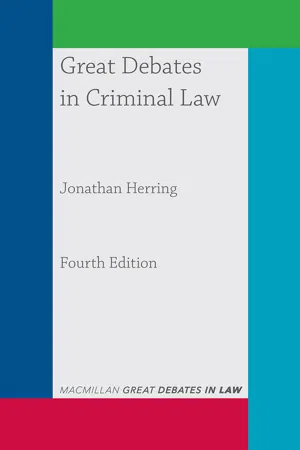
This textbook is an introduction to more advanced writings on criminal law, primarily designed to allow students to think critically and analyse specific topics. Each chapter is structured around key questions and debates that provoke deeper thought. It asks questions such as: Why do we have the laws that we have? Could the criminal law look differently? How should the law be applied to novel situations? Does the law in fact reflect prejudices?
The aim of the book is not to present a complete overview of theoretical issues in criminal law, but rather to illustrate the current debates among those working in shaping the area. The text features summaries of the views of notable experts on key topics and each chapter ends with a list of guided further reading.
New to this Edition: - A new debate on the law on body modification - Fresh discussion of the law on dishonesty - Important new case law on causation - Detailed discussion of developments on the law on accessory - Significant developments on the law on sexual offences
What acts should constitute criminal offences? No one would dispute that murder, rape and burglary should be. However, for other kinds of conduct it is not so obvious. Should allowing a dog to foul a park be a criminal offence? Or walking around nude in a public place?1 Or hunting foxes with dogs?
Such questions are the subject of intense political and academic debate.2 Yet exploring the principles which should be used in making criminalization decisions (decisions about whether conduct should be criminal) is important. It indicates what the aims of the criminal law are. This can raise some key political debates over the role of the state. Is it the job of the law to make citizens virtuous? Is it to protect people’s freedoms? Or is it to promote a fair and just community? In this chapter we shall be considering some of the key debates over criminalization. At the end we shall take, by way of example, the question of whether it should be a criminal offence not to recycle your rubbish. This will show how some of the rather theoretical debates play out when considering a topical issue.
Debate
What is the harm principle?
Introduction
Most discussions of criminalization start with ‘the harm principle’.3 This principle is seen as a line between that conduct which is suitable for criminalization and that conduct which is not. John Mill, seen by some as the architect of the harm principle, writes:
‘The only purpose for which power can be rightfully exercised over any member of a civilized community against his will is to prevent harm to others. His own good, either physical or moral, is not a sufficient warrant. He cannot rightfully be compelled to do or forebear ... because in the opinion of others to do so would be wise or even right.’4
Joel Feinberg put it this way:
‘It is always a good reason in support of penal legislation that it would be effective in preventing (eliminating, reducing) harm to persons other than the actor (the one prohibited from acting) and there is no other means that is equally effective at no greater cost to other values.’
This quotation captures the essence of the harm principle. Conduct should not be criminal unless it is harmful to others. Conduct which does not harm others should not be criminalized, however much of that conduct might be thought by other people to be immoral.
The harm principle is seen as playing an important role in protecting individual autonomy. This is the idea that each person should be able to decide for themselves how they will live their lives and what they will spend their time doing. Each person should be able to do that free from outside interference unless what they are doing harms someone else. So I should be able to eat unhealthily; spend my time watching silly television programmes; or write books on law, without the state interfering in my lifestyle choices. As long as I am not harming anyone else I should be free to do these things, even if the government or other people may regard them as immoral or not good for me.
The harm principle opposes moralism. This is the view that it is permissible to render behaviour criminal simply on the ground that it is immoral. Such a view sees the law as having a role in making people virtuous. Steven Wall, promoting moralism, explains it this way:
‘It is a proper function of the criminal law to promote good character, and to restrain or discourage people from engaging in activities that cause moral harm to themselves or to others. Having and sustaining a good character is part of living well. And the law, including the criminal law, may have a role to play in enabling or assisting those who are subject to it in achieving this good.’5
Moralism is highly unpopular these days, and there are few people who believe that simply providing evidence of immorality per se is sufficient to justify criminalizing it - not least because criminalization is not a very good way of persuading people to be more moral.
Lord Devlin6 has provided one of the more sophisticated versions of moral-ism. He argued that society’s moral values are an indispensable part of its structure. Allowing seriously immoral behaviour could undermine society’s social fabric. This would lead to social disintegration. Of course, in those terms his argument in fact becomes justified under the harm principle. His theory has relatively few supporters today. First, there are the difficulties in ascertaining what the moral values are that underpin our multi-cultural, multi-faith society. Second, even if there are certain generally accepted moral principles, it is not clear that the fact they are breached by a few actually harms society. Does anyone really believe that, if the law prohibiting necrophilia were repealed, society would descend into moral anarchy? It seems unlikely. In short, Lord Devlin’s argument would have force if the factual premises were correct, but they are not.
There are few people who openly oppose the harm principle. But this is because the exact meaning and role of the harm principle is much debated. We will now consider two areas where there is much disagreement. First, what exactly is meant by harm in this context? Second, what precisely is the role the harm principle plays?
What Does Harm Mean?
As indicated, one of the reasons for the popularity of the harm principle is that the notion of harm is so vague that it is able to cover a wide range of views. You could justify making just about anything illegal, if you took a broad view of what is harm. We shall consider here some of the main disagreements over the meaning of harm in the academic literature. It is important to remember during the following discussion that the standard view is that the harm principle authorizes criminal punishment, but does not require it. Even though the harm principle may permit punishment, there are many other factors that should be considered before it is decided that criminalization is appropriate. So, when considering the meaning of harm we should bear in mind that if conduct is harmful that does not mean it should necessarily be criminal. However, if something is not harmful it should not be criminal. That suggests that harm should be given a broader meaning than is sometimes understood.
Does It Include Harm to Self us Well us Harm to Others?
The harm principle clearly permits criminalization where the conduct harms other people, but what happens where the only person harmed is the actor? To some the harm principle does not extend to harm to self. Indeed Mill’s classic formulation, outlined above, refers to ‘harms to others’. Yet it is not difficult to find criminal offences which are designed to protect people from their own folly: a law requiring the wearing of seatbelts; the wearing of crash helmets for motorbike riders; the law forbidding assisted suicide. That said, there are plenty of examples of where a person is permitted to do conduct which causes themselves harm, which if they did harming others, would be outlawed. Rock climbing might be one example, as indeed is cutting oneself as an expression of self-harm.7
One view is that the harm principle insists on harm to others, but it should be appreciated that harm to oneself can be a harm to others. One obvious example would be that if seatbelts were not worn there would be many more injuries on the roads, placing a greater burden on the National Health Service and ambulance services. All of this will impact on others in the population. Further it might be said that harm to a person is likely to impact on their family and friends. Where the law appears to outlaw harm to self, in fact it may be justified by virtue of the fact that it is protecting others from harm.
That response is all well and good, but it is so broad that in effect nearly all harm to self could be seen as in some way a harm to others. If so, restricting the criminal law to cases involving harm to others is not a significant restriction.
It may be that a better response is to relate back to the principle of autonomy. We have a basic freedom to do as we wish. Generally, as we have seen, the law does not criminalize acts which will only harm the actor. The very rare cases where the law criminalizes behaviour based on harm to self are cases where the interference in liberty is minimal. Having to wear a seatbelt is hardly likely to interfere in an individual’s life goals. Prohibiting rock climbing would severely impact on the lifestyle choices of some. So maybe the position is that harm to self can be included within the harm principle, but criminalization is only justified if the interference in individual liberty is minimal.
Are Offence or Anxiety Harms?
Another major source of dispute is whether harm in this context includes the feelings that other people may have about the conduct of an individual. If a person in a public street behaved in a way which caused distress, offence or anxiety to passers-by, would that be a harm so that the harm principle could authorize criminalization? Consider, for example:
Hypothetical
Albert is sitting on a bench in a public park reading a pornographic magazine. Several passers-by are distressed and offended by his conduct. Can their offence justify criminalization of his conduct? He claims that he is not harming anyone and that one of the main points of the harm principle is to disallow criminalization based on a moral judgment. When people are offended by someone else’s conduct this is, on one view, another w...
Table of contents
Cover Page
Halftitle Page
Series
Title Page
Copyright Page
Contents
Preface
Table of Cases
Table of Legislation
1 Criminalization
2 Causation
3 Mens Rea
4 Assaults
5 Sexual Offences
6 Homicide
7 Property Offences
8 Inchoate Offences
9 Accomplices
10 Defences
11 Strict Liability
Index
Trusted by 375,005 students
Access to over 1.5 million titles for a fair monthly price.
Study more efficiently using our study tools.
Frequently asked questions
Yes, you can cancel anytime from the Subscription tab in your account settings on the Perlego website. Your subscription will stay active until the end of your current billing period. Learn how to cancel your subscription
No, books cannot be downloaded as external files, such as PDFs, for use outside of Perlego. However, you can download books within the Perlego app for offline reading on mobile or tablet. Learn how to download books offline
Perlego offers two plans: Essential and Complete
Essential is ideal for learners and professionals who enjoy exploring a wide range of subjects. Access the Essential Library with 800,000+ trusted titles and best-sellers across business, personal growth, and the humanities. Includes unlimited reading time and Standard Read Aloud voice.
Complete: Perfect for advanced learners and researchers needing full, unrestricted access. Unlock 1.5M+ books across hundreds of subjects, including academic and specialized titles. The Complete Plan also includes advanced features like Premium Read Aloud and Research Assistant.
Both plans are available with monthly, semester, or annual billing cycles.
We are an online textbook subscription service, where you can get access to an entire online library for less than the price of a single book per month. With over 1.5 million books across 990+ topics, we’ve got you covered! Learn about our mission
Look out for the read-aloud symbol on your next book to see if you can listen to it. The read-aloud tool reads text aloud for you, highlighting the text as it is being read. You can pause it, speed it up and slow it down. Learn more about Read Aloud
Yes! You can use the Perlego app on both iOS and Android devices to read anytime, anywhere — even offline. Perfect for commutes or when you’re on the go. Please note we cannot support devices running on iOS 13 and Android 7 or earlier. Learn more about using the app
Yes, you can access Great Debates in Criminal Law by Jonathan Herring in PDF and/or ePUB format, as well as other popular books in Diritto & Diritto penale. We have over 1.5 million books available in our catalogue for you to explore.