A revised new edition of a popular and long-established textbook, updated to include the most relevant developments in employment law today. This edition sees barrister Tom Brown join Deborah Lockton on the writing team, providing insightful commercial experience into this dynamic field.
The text steers readers confidently though the complexities of this diverse subject, highlighting its practical and theoretical underpinnings. The book covers the most recent developments in one of the fastest moving areas of the law, explaining the rights of employees and responsibilities of employers.
Reinforced with summaries, exercises and extensive further reading, it helps students get to grips with the subject.
An ideal textbook for students on an LLB or GDL/CPE course taking a module on Employment Law.
New to this Edition:
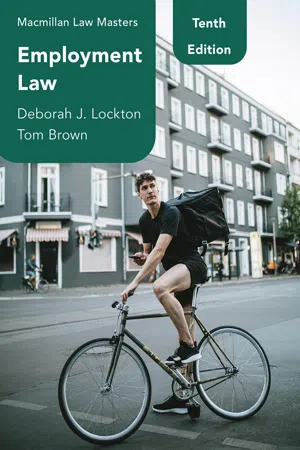
- A new section on employees and workers in the gig economy and modern day slavery
- Brand new section on whistleblowing
- New 'hot topics' sections that look in greater depth at some of the most vexed legal questions of our time, provoking further discussion and research
- English
- ePUB (mobile friendly)
- Available on iOS & Android
eBook - ePub
Employment Law
About this book
Information
Part I
Introduction to employment law
Introduction to employment law
The scope of this book
You are probably studying lots of legal subjects which will never affect you personally: if you are fortunate, you will never be prosecuted for a criminal offence, and you won’t be the victim of another’s negligence. But you will probably be an employee at some point, and you may be an employer. Even if you are never an employee or employer, the chances are that you will work and be paid for it and that most people you know will be employed. Working in return for pay is a fact of life for most of us. Hard-working lawyers may spend more time at work than with their families, and their working relationships may be almost as important as their personal relationships. Our jobs are often an important part of our sense of identity, and they affect how others perceive us. The law of work – which this book calls ‘employment law’, but which is also called labour law – regulates the rights and obligations of almost all working people in the United Kingdom in the twenty-first century. But the effects of employment law extend far beyond legal institutions.
Although most working relationships are now based on contract, employment law is about much, much more than contract law; because work and pay are so important to so many people, there has been a social content to the law of work for centuries.
Some historical aspects of the legal regulation of work
Some working relationships pre-date modern concepts of employment: in the middle ages, there were systems of structuring work or obligations to provide service as part of a complex social hierarchy, in return for land from which an income could be derived or for other forms of payment. This came to be known as feudalism, although historians debate the helpfulness of this term and precisely what ‘feudalism’ involved.
In many respects, outside the social hierarchy were slaves who were seen as property rather than human beings with even the most basic rights. Although the involvement of the British Empire in the enslavement of people from Africa diminished between the seminal case of Somerset v Stewart (1772) 98 ER 499 and the Slavery Abolition Act 1833, that Act did not see the immediate end of slavery throughout the British Empire, and people who were emancipated from slavery by the Act in 1843 were required to continue working for their former masters as apprentices (while slavery continued for more several decades in the United States). Far from being a historical phenomenon, the Modern Slavery Act 2015 recognises the continued existence of slavery within the United Kingdom in the twenty-first century, for example through the enforced sexual exploitation of women, by forcing young people to cultivate cannabis, or by forcing vulnerable people to work as agricultural labourers or on building sites. The Modern Slavery Act 2015 recognises slavery, servitude, and forced and compulsory labour, as well as the trafficking of human beings domestically and internationally as violations of fundamental human rights and as criminal offences. A more detailed consideration of modern slavery is outside the scope of this book, but it is important to understand working relationships in the context of the most extreme forms which they can take, especially since there may not be any immediately obvious differences between an employed agricultural worker, and an agricultural worker who is held in modern slavery.
Slavery is not, however, the only aspect of working relationships which has been regulated within this country for centuries: as Lord Ackner explained in Bristow v City Petroleum Ltd [1987] 1 WLR 529, since about 1464, well over 500 years ago, Parliament had enacted Truck Acts, intended to address the evil of employers paying their employees’ wages in goods at a value decided by the employer, and thereby depressing the value of work done. As Lord Ackner explained, the Truck Acts ‘established the obligation, [...] of uniformly paying the whole wages of artificers in the current coin of the realm. [...] They were, in truth, part of a system of legislation regulating the relation of a master and workman, this part of it being in favour of the workman, who, as an individual, was deemed weaker than his master and therefore liable to oppression.’
Inequality between employers and employees
This acknowledgement by Parliament and the courts of the inequality between the powers of ‘master’ and ‘servant’ – now employer and employee – has been an important factor in the legal regulation of working relationships for centuries.
Protecting the value of pay for work done is a very limited protection, however, if an employee may be dismissed at an employer’s whim and lose his or her ability to make money. Paid employment may be one of the most important things a person has, and losing a job can have devastating consequences. For those working in dangerous occupations, inadequate protection against injury could cost a person not only their job but their life. And what of those who are unable to obtain employment at all because of societal prejudice? Well into the twentieth century, certain occupations were inaccessible to women, and there was an expectation that a woman would give up paid employment on marriage; women had no choice to do otherwise, because they could not enforce a right to be employed on equal terms with men, or not to be dismissed. People from ethnic minorities, LGBT people, disabled people, and older people have often fared as badly, or worse, in securing or keeping their desired employment; compulsory (and different) retirement ages for men and women long made it entirely normal for men and women to cease work at 60 and 65, even if they wanted to work for longer. More recently still, the full extent of the sexual harassment of women working in the entertainment industry, and other industries, has begun to emerge. Women continue to receive unequal pay for their work and face discrimination because of pregnancy and maternity.
The development of workplace legislation
The twentieth century, therefore, saw the growth of two parallel systems of legal regulation which (along with some important innovations in the common law as it applies to employment contracts) have addressed the relative inequality in power between employers and employees, and the discrimination which some employees face:
Firstly, individual employment rights have been created by Parliament to protect employees against losing their jobs for unfair reasons or because of inalienable characteristics such as sex, age, race, disability, sexuality, or belief. Health and safety legislation has required employers to provide safe workplaces, and prohibitions on harassment have been introduced. Rights to a minimum rate of pay and to paid holiday have been introduced. Some of these workplace rights derive from EU law, but the United Kingdom often had similar protection in place before EU law required it: for example race discrimination and disability discrimination were prohibited by domestic legislation long before EU law required Member States to provide for it.
Secondly, the role of trade unions as a way to harness the collective power of employees in balance against the power of employers has evolved, again largely through legislation. Trade unionism (which had been criminalised until 1871) emerged in the late nineteenth century, alongside the emergence of the Labour party as a political force for working class people, and the links between trade unions and the Labour party remain significant. The powers of trade unions have expanded and contracted under successive Labour and Conservative governments.
With the expansion of protection, other challenges have emerged. The protection of a broader range of characteristics creates the potential for clashes of rights: what should happen where two people both seek to rely on characteristics worthy of protection but only one characteristic can prevail? This has been seen most frequently in clashes between the rights of LGBT people and religious people, each claiming that their right to respect should take priority.
Comparative regulation of work
The United Kingdom’s regulation of work is not a universal model emulated worldwide. The United States has relatively limited protection for workers; about 10 per cent of US workers belong to trade unions, compared with about 25 per cent in the UK.
About 70 per cent of Scandinavian employees belong to trade unions; in Scandinavia, the principal mechanism for employment protection is via collective agreements between trade unions and employers, rather than from individual statutory or contractual employment rights.
Meanwhile in Germany, a system of employee co-determination (mitbestimmung) is operated through works councils and employee representation on boards of directors: for businesses with 2,000 or more employees, employee board members make up just under half of the supervisory board. Through participation on a board or works council, employees’ collective interests are protected.
Employment law and politics
Regulation (or deregulation) of work is an intensely political issue, and one usually bound up with broader socio-economic issues: most states have an interest in the economic productivity of their citizens, because states depend on tax and social insurance contributions to fund public expenditure, including pensions and social assistance for those who are not working because of sickness or old age. For some politicians, the deregulation of employment and the freedom of employers to dismiss at will is the answer; for others, the solution is increasing employment protection. Unemployment is usually a politicised topic. So too has the availability of work for non-citizens become an increasingly politicised issue in many countries, leading to growing regulation of the entitlement to work: in the United Kingdom, nationals from the EU and the European Economic Area currently have a right to work (and United Kingdom nationals have a corresponding right to work throughout the European Economic Area). But the Home Secretary may restrict the right of non-EEA nationals to work in the United Kingdom, and the Immigration Act 2016 made it is a criminal offence for a non-EEA national to work without permission to do so. The same Act imposed an obligation on public authorities not to employ people in customer-facing roles unless they speak fluent English. These new restrictions on employment reflect a current political focus on immigration.
The development of the common law of employment
Alongside these legislative interventions in working relationships, the courts have had a more limited role to play in developing the common law to reflect modern employment relationships. These developments include the identification by the courts of an implied term of mutual trust and confidence between employer and employee. This implied term regulates many aspects of an employer’s dealings with its employees, including how an employer runs its business; how it deals with employee grievances; how it determines bonuses; and in the work an employer gives to its skilled employees. The role of the courts has also been central in protecting employers’ confidential information and trade secrets while allowing employees to leave their jobs and work for someone else. However, recently, the courts have rejected attempts to develop further the common law of employment, relying on the extent of Parliamentary regulation of working relationships as a reason not to develop a parallel system of common law regulation: Johnson v Unisys Ltd [2001] IRLR 279. The common law jurisdiction of the courts runs in parallel with the expanding jurisdiction of Employment Tribunals to decide disputes between workers and those for whom they work, and the Employment Appeal Tribunal to provide authoritative guidance on employment law, including the common la...
Table of contents
- Cover Page
- Halftitle Page
- Editor
- Title Page
- Copyright Page
- Contents
- Preface
- Table of cases
- Table of legislation
- Part I Introduction to employment law
- Part II The employment relationship
- Part III Constraints on the employment relationship
- Part IV Termination of employment
- Part V Trade unions and the law of industrial action
- Index
Trusted by 375,005 students
Access to over 1.5 million titles for a fair monthly price.
Study more efficiently using our study tools.
Frequently asked questions
Yes, you can cancel anytime from the Subscription tab in your account settings on the Perlego website. Your subscription will stay active until the end of your current billing period. Learn how to cancel your subscription
No, books cannot be downloaded as external files, such as PDFs, for use outside of Perlego. However, you can download books within the Perlego app for offline reading on mobile or tablet. Learn how to download books offline
Perlego offers two plans: Essential and Complete
- Essential is ideal for learners and professionals who enjoy exploring a wide range of subjects. Access the Essential Library with 800,000+ trusted titles and best-sellers across business, personal growth, and the humanities. Includes unlimited reading time and Standard Read Aloud voice.
- Complete: Perfect for advanced learners and researchers needing full, unrestricted access. Unlock 1.5M+ books across hundreds of subjects, including academic and specialized titles. The Complete Plan also includes advanced features like Premium Read Aloud and Research Assistant.
We are an online textbook subscription service, where you can get access to an entire online library for less than the price of a single book per month. With over 1.5 million books across 990+ topics, we’ve got you covered! Learn about our mission
Look out for the read-aloud symbol on your next book to see if you can listen to it. The read-aloud tool reads text aloud for you, highlighting the text as it is being read. You can pause it, speed it up and slow it down. Learn more about Read Aloud
Yes! You can use the Perlego app on both iOS and Android devices to read anytime, anywhere — even offline. Perfect for commutes or when you’re on the go.
Please note we cannot support devices running on iOS 13 and Android 7 or earlier. Learn more about using the app
Please note we cannot support devices running on iOS 13 and Android 7 or earlier. Learn more about using the app
Yes, you can access Employment Law by Deborah J. Lockton,Tom Brown in PDF and/or ePUB format, as well as other popular books in Law & Business Law. We have over 1.5 million books available in our catalogue for you to explore.