Help your students develop a critical mindset with this practical guide. Becoming a Critical Thinker begins by unpicking where knowledge comes from before showing students how to recognise biases and approach evidence objectively. Subsequent chapters equip students with the tools to evaluate different sources of information, critique the literature and write persuasive, critical arguments of their own. A final chapter explores the value of critical thinking in the workplace. Throughout, real-world examples illustrate the value of critical thinking in both academia and everyday life, and activities allow students to put new skills into practice.
Becoming a Critical Thinker is an essential introduction to critical thinking for undergraduates of all subject areas.
- English
- ePUB (mobile friendly)
- Available on iOS & Android
eBook - ePub
Becoming a Critical Thinker
About this book
Information
Topic
Study AidsSubtopic
Study GuidesCHAPTER
1
Why Critical Thinking Matters: Research, Knowledge and Epistemology
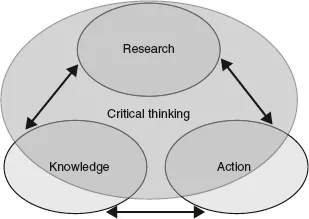
Why critical thinking matters
Have you ever asked yourself why critical thinking is valued? What is it about critical thinking that makes it such a desirable attribute?
The answer is both simple and complex. First, we don’t have complete knowledge – there is a lot about our world that we still don’t know or don’t understand. The history of knowledge has also shown us that what we think we know can sometimes turn out to be false. Secondly, there are a lot of problems in the world, big and small, that need solving. While we want to find the right solutions to those problems, we don’t always know what the right solutions are and there may be more than one solution to choose from, depending on the context. How do we know which is the best?
It is not easy for humans to find out the truth about the world, to discover what reliable knowledge is and to work out what a possible solution might be. The world is a complex system of inter-related parts. Make a change here and it may have negative consequences there. What works in one situation may not work in another. To complicate matters even more, human thinking is fallible; we know we can make mistakes. How things appear is not always the way they are. We are prone to all sorts of influences on our thinking that can affect our perception and our objectivity and these influences can have an impact on the kinds of conclusions we reach. We need to be careful and cautious. We need a rigorous thinking process that will enable us to overcome our limitations and minimise our mistakes in order to come to the most reliable conclusions we can – basically to make our thinking better. This process is critical thinking.
The importance of critical thinking
Assumptions
• There is good and bad thinking – some thinking practices are better than others.
• Good thinking practices produce better, more reliable outcomes.
• We want to develop good thinking practices because we want the best outcomes.
• Critical thinking is considered to be the exemplar of good thinking practice.
• Thinking practices can be improved.
Conclusion – We can all become (better) critical thinkers.
We use critical thinking for a purpose – we apply our critical thinking skills to an issue, a problem, an idea or a situation to reach a better outcome, such as:
• Increased knowledge and understanding
• A possible or better solution to a problem
• A new or broader perspective on an issue
• A change of belief or practice
• Confirmation of an old idea or current practice.
So what is the critical thinking process?
While there is a lot of debate and disagreement about what critical thinking is, there are a few accepted definitions available that share key characteristics (Facione, 1990; Paul and Elder 2001, 2010). The following definition attempts to capture those features while directing the process of critical thinking towards its purposes, whether that is within the university, at work or in a broader community context.
Critical thinking is the process of analysing, evaluating and critiquing information in order to increase our understanding and knowledge of reality. It includes the capacity to reason well in order to come to an objectively justifiable conclusion about something. It is the skill or ability to assess and evaluate the way information is presented, to draw out the relevant or reliable claims and to use reasoning and logic to justify well-founded conclusions based on the information or knowledge distilled from this critical process. It is to come to the best conclusion or decision we can, based on what we currently know.
The following chapters will set out how we can become (better) critical thinkers. Applying critical thinking skills to the problems we encounter can help us to come to well-informed and well-thought out conclusions, decisions and solutions. If our actions are based on reliable information and inference rather than on ill-informed or even false beliefs, then we are likely to achieve better outcomes. Our actions will resonate with the way the world is.
A first step in becoming a critical thinker is in understanding where our knowledge or information comes from.
• What is the process of knowledge creation?
• What is a fact?
• What makes something (a fact) a reliable piece of information?
• How does a fact become knowledge?
• Why should we accept some statements of facts but not others?
• How do we know that we know? Can we believe our senses?
Research
Let’s start within the university context. What is unique about a university is that it is both a repository of knowledge and a place where knowledge is created. At a university, not only do you have access to knowledge on a range of topics but you can have access to a range of knowledgeable people – academics who are experts in their chosen field. They have become experts not just by knowing a lot but by adding to the knowledge in their field. They have undertaken research and discovered new and interesting things.
Research is the systematic exploration of a topic undertaken in order to increase knowledge and understanding. The research process is used to establish or confirm facts, reaffirm the results of previous work, solve new or existing problems and support and/or develop new theories, ideas and approaches.
We conduct research to increase our knowledge base, to explore new ideas and to see if old ways still hold. We conduct research because we know things change and old ideas may no longer work or be relevant. Research is not conducted haphazardly; it needs to be thorough and targeted towards what it is attempting to find out. The outcomes can contribute to knowledge of all kinds – of the physical world (including the laws governing that world), space, human behaviour, health, culture and society.
The process of research
Research is usually driven by what are called ‘hypotheses’, statements or propositions that one sets out to find evidence for (to verify or confirm) or against (to falsify). These could also be in the form of research questions – i.e. why do birds fly in formation? Once data or evidence has been gathered relevant to that research question, then a possible answer (hypothesis) is generated that could then be tested – i.e. birds fly (change their position of flight or flap their wings) to give themselves the best aerodynamic advantage.

Research is curiosity or needs driven; it is a systematic exploration and inv...
Table of contents
- Cover
- Half-Titlepage
- Seriespage
- Titlepage
- Copyright
- Contents
- Foreword
- Glossary
- Chapter 1 Why Critical Thinking Matters: Research, Knowledge and Epistemology
- Chapter 2 Overcoming Barriers – Cognitive Biases
- Chapter 3 Overcoming Barriers – Problems with Perception
- Chapter 4 Knowledge Claims – Recognising and Writing an Argument
- Chapter 5 Critiquing the Logic of the Argument – Logical Thinking and Common Fallacies
- Chapter 6 Critical Thinking and Digital Literacy: Evaluating the Information Source
- Chapter 7 Critiquing the Literature – How Do You Know That Is So?
- Chapter 8 Critiquing the Evidence: Quantitative and Qualitative Research Methodologies
- Chapter 9 Writing an Argument – Making It Persuasive
- Chapter 10 Writing (Critical) Literature Reviews
- Chapter 11 Critical Thinking as Critical Self-Reflection
- Chapter 12 Critical Thinking in the Workplace
- References
- Index
Trusted by 375,005 students
Access to over 1.5 million titles for a fair monthly price.
Study more efficiently using our study tools.
Frequently asked questions
Yes, you can cancel anytime from the Subscription tab in your account settings on the Perlego website. Your subscription will stay active until the end of your current billing period. Learn how to cancel your subscription
No, books cannot be downloaded as external files, such as PDFs, for use outside of Perlego. However, you can download books within the Perlego app for offline reading on mobile or tablet. Learn how to download books offline
Perlego offers two plans: Essential and Complete
- Essential is ideal for learners and professionals who enjoy exploring a wide range of subjects. Access the Essential Library with 800,000+ trusted titles and best-sellers across business, personal growth, and the humanities. Includes unlimited reading time and Standard Read Aloud voice.
- Complete: Perfect for advanced learners and researchers needing full, unrestricted access. Unlock 1.5M+ books across hundreds of subjects, including academic and specialized titles. The Complete Plan also includes advanced features like Premium Read Aloud and Research Assistant.
We are an online textbook subscription service, where you can get access to an entire online library for less than the price of a single book per month. With over 1.5 million books across 990+ topics, we’ve got you covered! Learn about our mission
Look out for the read-aloud symbol on your next book to see if you can listen to it. The read-aloud tool reads text aloud for you, highlighting the text as it is being read. You can pause it, speed it up and slow it down. Learn more about Read Aloud
Yes! You can use the Perlego app on both iOS and Android devices to read anytime, anywhere — even offline. Perfect for commutes or when you’re on the go.
Please note we cannot support devices running on iOS 13 and Android 7 or earlier. Learn more about using the app
Please note we cannot support devices running on iOS 13 and Android 7 or earlier. Learn more about using the app
Yes, you can access Becoming a Critical Thinker by Sandra Egege in PDF and/or ePUB format, as well as other popular books in Study Aids & Study Guides. We have over 1.5 million books available in our catalogue for you to explore.