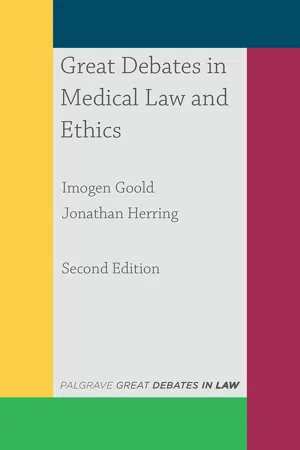
This textbook is an ambitious and engaging introduction to the more advanced writings on medical law and ethics, primarily designed to allow students to 'get under the skin' of the topic and begin to build their critical thinking and analysis skills. Each chapter is structured around key questions and debates that provoke deeper thought and, ultimately, a clearer understanding. The aim of the book is not to present a complete overview of theoretical issues in medical law and ethics, but rather to illustrate the current debates which are currently going on among those working in and shaping the area. The text features summaries of the views of notable experts on key topics and each chapter ends with a list of guided further reading.
A perfect book for students taking a module in medical law, or for those wanting to deepen their knowledge.
New to this Edition:
- The Supreme Court decision in Montgomery receives extensive discussion and analysis
- Recent developments on the best interests test under the Mental Capacity Act are explored
- The latest case law on end of life decision making is set out
- Debates over whether abortion should be decriminalised are examined
- The Charlie Gard case is considered
- English
- ePUB (mobile friendly)
- Available on iOS & Android
eBook - ePub
Great Debates in Medical Law and Ethics
About this book
Information
© Imogen Goold and Jonathan Herring 2018
Imogen Goold and Jonathan HerringGreat Debates in Medical Law and EthicsPalgrave Great Debates in Lawhttps://doi.org/10.26777/978-1-352-00229-4_11. General Ethical Theories
Imogen Goold1 and Jonathan Herring2
(1)
St Annes College, University of Oxford, Oxford, United Kingdom
(2)
Exeter College, University of Oxford, Oxford, United Kingdom
Introduction
It is interesting how many law degree courses and textbooks are entitled ‘Medical Law and Ethics’. It would be unthinkable to write a textbook on medical law or design a course on it without including a discussion of general ethical theories, often as the opening chapter or seminar. Indeed, that is exactly what we have done with this book. But our colleagues don’t do that with other subjects on the legal curriculum. Books on contract law, land law or constitutional law, for example, do not tend to emphasise ethical principles in the same way. It would look odd to have a book entitled ‘Tort Law and Ethics’, although that is de rigueur for medical law.
In one sense it is not surprising that medical law and medical ethics are linked. After all, we would not want the law to be requiring medical professionals to act in an unethical way. Indeed, we would hope that the law would reflect and reinforce the general moral principles which should guide doctors. It is also an acknowledgement that medical professionals will be seeking to comply with both their legal and ethical requirements at the same time. It therefore makes sense that they should be integrated.
On the other hand it is important to realise the differences between the way the law works and the way ethics work. First, generally the law sets down the minimum that must be done to avoid committing a legal wrong. Ethics, by contrast, is often asking a different question and is seeking to ascertain what is the ideal moral behaviour in these circumstances. If you like, the law tells you how not to be a devil, while ethics often asks what it means to be an angel.
Second, the law must be enforced in courts. This means it must be susceptible of legal proof. Its requirements and regulations tend, therefore, to focus on matters capable of evidence in a courtroom. Ethicists do not worry about proof and are more likely to discuss matters (such as motive) which are less capable of objective assessment.
Third, the law must be capable of providing guidance. People need to know in advance what the law requires. For medical professionals, ethical issues often arise in an emergency and so the law’s requirements need to be relatively straightforward and simple to follow. This is less of a concern for ethicists, who in their analysis will want to tease out every ambiguity in providing an authoritative discussion. In brief, legal regulations tend to be short and somewhat crude, lacking the length and sophistication that a full ethical analysis can provide.
In this chapter we shall explore the ethical foundations of medical law. We shall look at four important issues, examining some of the key themes in medical ethics: autonomy; paternalism; utilitarianism; and relativism. Inevitably these topics are huge and there is much that could be said.
Debate 1
Is respect for autonomy the most important ethical principle?
This question is particularly appropriate in a liberal, pluralist society. As such a society, we place considerable importance on people freely forming and following their own choices about how to live.1 In simple terms, we don’t like being told what to do. To some degree the legal system takes the approach advocated by John Stuart Mill, that we should have the maximum freedom to make choices about our own lives, but not to the extent that others’ similar degree of autonomy should be impinged upon. According to Mill, the ‘only purpose for which power can be rightfully exercised over any member of a civilised community, against his will, is to prevent harm to others’.2 This reflects the principle of autonomy. Each person should be free to develop and live out their vision of the ‘good life’.
This approach has also found favour with many contemporary writers on ethics. Ronald Dworkin has argued that people have a right, and a responsibility, to ‘confront the most fundamental questions about the meaning and value of their own lives for themselves, answering to their own consciences and convictions’.3 The alternative would be for the government, or the law, to tell people how they should choose to live. Most people think that is unacceptable.
In this debate we will explore whether respect for autonomy should be the most important ethical principle. To get you thinking, here is a scenario to consider:
Scenario to ponder
Mildred suffers from body dysmorphic disorder. This is a recognised condition which causes people to feel a part of their body is alien to them and they strongly wish to have it removed. Mildred detests her legs. She asks a doctor to remove them. She emphasises it is her body and she should be able to do what she wants to with it. She relies on the principle of autonomy to claim the doctor should be permitted to remove her legs.
Why is Autonomy so Important?
The freedom to make our own choices is important because what we choose, and the goals and values we have, are themselves important to us.4 Further, as Will Kymlicka rightly points out, ‘freedom of choice, while central to a valuable life, is not the value which is centrally pursued in such a life’ – it is the projects that we value that are important, and therefore freedom to choose to pursue them is crucial to our being able to live fulfilled lives.5 We need to be allowed to choose to pursue them, not to have other goals and values that we do not value forced upon us. That is true even if the goals that are imposed upon us are worthwhile.
Freedom to make our own choices is also important because, in doing so, we are able to experiment with life, as John Stuart Mill argued, and to grow in the process by testing our ideas about what we want, re-evaluating and thereby determining which projects will make our lives go best. In addition, exercising these capacities of choice and reasoned decision making is in itself an aspect of self-fulfilment, because in exercising them we improve them. As Mill stated:
The human faculties of perception, judgment, discriminative feeling, mental activity, and even moral preference, are exercised only in making a choice. … The mental and moral, like the muscular powers, are improved only by being used.6
For each of these reasons, interventions that override this capacity to choose may decrease our quality of life, and should be presumed to be objectionable. This capacity should be overridden only where sufficient justification can be found.
What is Autonomy?
The basic idea behind autonomy is straightforward. It is about people being free to determine for themselves how they wish to live their lives. This is why, for example, a law forbidding consensual same-sex activity would infringe the principle of autonomy. It would prevent people pursuing activities they want to do. However, the concept is far more complex than it at first appears. We will now explore some of the ambiguities around it.
Autonomy and capacity
Autonomy requires that we respect the choices that people make, but only if they are ‘autonomous choices’. What does that mean? Antonia Cronin suggests:
Autonomy is the capacity of persons to reflect critically upon their first-order preferences, desires, wishes and so forth and then readiness to accept or attempt to change these in the light of higher-order preferences and values. By exercising such a capacity, persons define their nature, give meaning to their lives and take responsibility for the kind of person they are.7
But to other commentators this is far too demanding. Consider, for example, Simon reaching out for his tenth chocolate truffle. In one sense he has chosen to eat ten chocolates, and that was his autonomous choice. Imagine, however, that his friend Thia grabbed the chocolates away at the last minute. Thia might argue that Simon had recently started a diet and determined to eat fewer calories. She might say she was acting in Simon’s autonomy interests in promoting his autonomous decision to eat healthily. Indeed, she might refer to Cronin’s quote and say that she was promoting Simon’s ‘higher-order preference’ (to eat healthily) over his ‘desire’ (to taste the delicious chocolate).
We will be exploring this issue further in Chapters 3 and 4. But for now notice that even if you decide to respect someone’s decision, it is not always clear what their decision is, or which decision you should respect.
What is the difference between autonomy and liberty?
It can be helpful to distinguish between autonomy and liberty, or between positive and negative autonomy as it is sometimes called. It is one thing to say ‘I should be left alone to do what I want with my life’ (liberty or negative autonomy) and another to say ‘I should be enabled to do what I want with my life’ (autonomy or positive autonomy). This distinction is especially important in the area of medical treatment.
The law certainly protects liberty strongly. If you do not consent to medical treatment, a doctor cannot force that treatment upon you (provided you have the capacity to refuse treatment). However, this does not mean you have the right to demand certain treatment.8 In short, the law may strongly protect your right to say ‘no’ to treatment, but it does not give you the right to demand it.
However, debates over autonomy can be more complex than this. Some commentators believe that the state can have a duty to enable people to pursue their life goals in some circumstances.9 Disabled people have the right to have their disability accommodated; those with infertility may have a right of access to assisted reproduction; children may have the right to education so that they have the skills they need; and so on. What is generally agreed, however, is that the right to be left alone (liberty) is more strongly protected than the claim that you should be given the services you need to fulfil your goals (autonomy...
Table of contents
- Cover
- Front Matter
- 1. General Ethical Theories
- 2. Consent
- 3. Capacity
- 4. Medical Negligence
- 5. Reproduction
- 6. Abortion
- 7. Organ Donation
- 8. Selling and Owning Human Body Parts
- 9. Death
- 10. Ending Life
Trusted by 375,005 students
Access to over 1.5 million titles for a fair monthly price.
Study more efficiently using our study tools.
Frequently asked questions
Yes, you can cancel anytime from the Subscription tab in your account settings on the Perlego website. Your subscription will stay active until the end of your current billing period. Learn how to cancel your subscription
No, books cannot be downloaded as external files, such as PDFs, for use outside of Perlego. However, you can download books within the Perlego app for offline reading on mobile or tablet. Learn how to download books offline
Perlego offers two plans: Essential and Complete
- Essential is ideal for learners and professionals who enjoy exploring a wide range of subjects. Access the Essential Library with 800,000+ trusted titles and best-sellers across business, personal growth, and the humanities. Includes unlimited reading time and Standard Read Aloud voice.
- Complete: Perfect for advanced learners and researchers needing full, unrestricted access. Unlock 1.5M+ books across hundreds of subjects, including academic and specialized titles. The Complete Plan also includes advanced features like Premium Read Aloud and Research Assistant.
We are an online textbook subscription service, where you can get access to an entire online library for less than the price of a single book per month. With over 1.5 million books across 990+ topics, we’ve got you covered! Learn about our mission
Look out for the read-aloud symbol on your next book to see if you can listen to it. The read-aloud tool reads text aloud for you, highlighting the text as it is being read. You can pause it, speed it up and slow it down. Learn more about Read Aloud
Yes! You can use the Perlego app on both iOS and Android devices to read anytime, anywhere — even offline. Perfect for commutes or when you’re on the go.
Please note we cannot support devices running on iOS 13 and Android 7 or earlier. Learn more about using the app
Please note we cannot support devices running on iOS 13 and Android 7 or earlier. Learn more about using the app
Yes, you can access Great Debates in Medical Law and Ethics by Imogen Goold,Jonathan Herring in PDF and/or ePUB format, as well as other popular books in Law & Medical Law. We have over 1.5 million books available in our catalogue for you to explore.