Aims to give students the understanding, confidence and tools to use report writing conventions to communicate their purpose, whatever their subject and whatever report they are writing. Real-life examples of student reports illustrate good writing style and effective communication. Diagrams and illustrations are used to make key points.
eBook - ePub
Report Writing
About this book
Information
1The purpose of reports
Reports are formally structured and communicate the findings of investigations in a clear, logical way.
Your investigation may be a scientific experiment, a site visit, a series of observations, research into a process or procedure … but whatever different types of investigation you do as part of your course, you will need to report:

The content and structure of your report are determined by the needs of your audience and the purpose of your report … but how do you know who your audience are and what they want?
Read the brief!
Reports normally have a brief, or a set of instructions, telling you the requirements of your investigation.
In a work situation the brief may be set by your clients or your manager, and they will expect you to follow it! At university your brief is most likely to be set by your tutors … and they also will expect you to follow it!
You will get the crucial information you need from reading your brief carefully:
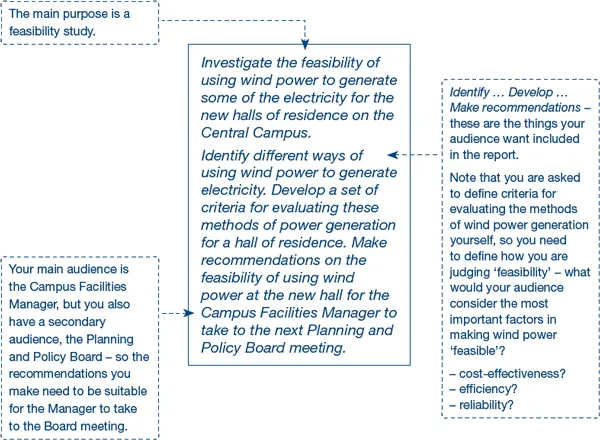
Even a short brief contains a lot of information about what you are expected to do.
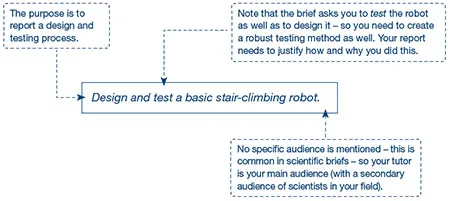
Your brief tells you about the investigation you are carrying out, but you also need to know other essential requirements of your assignment, such as:
In addition to this, read your assessment criteria – these will give you valuable information about what you need to demonstrate in your report and the ‘learning outcomes’ you are expected to fulfil.
Who are the audience?
A report is a piece of informative writing, which means that it has an intended audience who will want to find things out from reading your report.
Your brief or assignment description should tell you who your intended audience are, and this will have an important influence on the content of your report: you need to tailor the information to suit the needs of your audience.

Reports about the same subject written for different audiences might each have a very different content and tone.
Write a report on a speech and language diagnostic assessment for a child with mild phonological difficulties.
How might the report differ if you were writing it for …
Write a report on the habitat and population of rare great crested newts on the site of a disused factory.
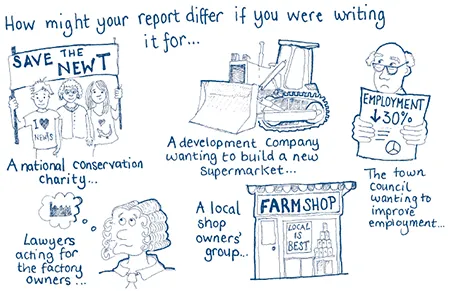
Audiences have vested interests in the information being reported and motivations for wanting the investigation conducted. As a report writer, you need to take these needs into consideration.
This is why, even though your brief is set by your tutor, they may ask you to write for an imaginary client or a professional situation. In these circumstances, you need to consider who would use the information that you are reporting and how they would use it – for example, would your recommendations be passed on to a secondary audience or used to advise clients or managers? What would be relevant and useful for these audiences?
If your main audience is your tutor, they still want to know that you can report the findings of your investigation in a logical and relevant way, relating them to the overall purpose of the investigation.
What is the purpose?
As a report is a piece of informative writing, it not only has an audience who want to be informed, it also has a purpose – there is a reason for wanting the information.
Table of contents
- Cover
- Half Title
- Series Title
- Title Page
- Copyright
- Contents
- Acknowledgement
- Introduction
- 1 The purpose of reports
- 2 Gathering your information
- 3 Structuring your report
- 4 Business plans, reflective placement reports, project proposals and dissertations
- 5 Presenting your findings
- 6 Demonstrating critical thinking in reports
- 7 Writing concisely
- 8 Report writing at work
- References
- Glossary
- Index
Trusted by 375,005 students
Access to over 1.5 million titles for a fair monthly price.
Study more efficiently using our study tools.
Frequently asked questions
Yes, you can cancel anytime from the Subscription tab in your account settings on the Perlego website. Your subscription will stay active until the end of your current billing period. Learn how to cancel your subscription
No, books cannot be downloaded as external files, such as PDFs, for use outside of Perlego. However, you can download books within the Perlego app for offline reading on mobile or tablet. Learn how to download books offline
Perlego offers two plans: Essential and Complete
- Essential is ideal for learners and professionals who enjoy exploring a wide range of subjects. Access the Essential Library with 800,000+ trusted titles and best-sellers across business, personal growth, and the humanities. Includes unlimited reading time and Standard Read Aloud voice.
- Complete: Perfect for advanced learners and researchers needing full, unrestricted access. Unlock 1.5M+ books across hundreds of subjects, including academic and specialized titles. The Complete Plan also includes advanced features like Premium Read Aloud and Research Assistant.
We are an online textbook subscription service, where you can get access to an entire online library for less than the price of a single book per month. With over 1.5 million books across 990+ topics, we’ve got you covered! Learn about our mission
Look out for the read-aloud symbol on your next book to see if you can listen to it. The read-aloud tool reads text aloud for you, highlighting the text as it is being read. You can pause it, speed it up and slow it down. Learn more about Read Aloud
Yes! You can use the Perlego app on both iOS and Android devices to read anytime, anywhere — even offline. Perfect for commutes or when you’re on the go.
Please note we cannot support devices running on iOS 13 and Android 7 or earlier. Learn more about using the app
Please note we cannot support devices running on iOS 13 and Android 7 or earlier. Learn more about using the app
Yes, you can access Report Writing by Michelle Reid in PDF and/or ePUB format, as well as other popular books in Study Aids & Study Guides. We have over 1.5 million books available in our catalogue for you to explore.