This concise and user-friendly guide explains why referencing is an essential part of good writing and shows students how to reference correctly. It also develops students' understanding of what plagiarism is and how they can avoid it in their work. Featuring clear explanations and examples throughout, this book will help students to draw on the work of others in their field in a responsible and ethical way.
This is an indispensable resource for all students that need to get to grips with referencing.
New to this Edition:
- Extensively revised and updated, with new extracts and examples to reflect changes in referencing norms and practices
- Features more advice on introducing quotations and citations
- Contains even more examples of referencing from real students' work across a range of disciplines
- English
- ePUB (mobile friendly)
- Available on iOS & Android
eBook - ePub
Referencing and Understanding Plagiarism
About this book
Information

UNDERSTANDING REFERENCING
Part 1 gives an overview of what referencing is, why it matters and how it is part of the overall task of understanding, researching (and using referencing tools), planning and writing an assignment.
What’s different about writing at university?
Quite a lot is different. That’s true no matter where you studied before.
Universities are research environments. Most tutors and lecturers do research of some sort and base their writing on the style used in the books, articles and reports they read for their research: that’s where they, too, publish. So it follows that students are also expected to develop the ‘academic’ style that matches their field of study.
So what is UK ‘academic’ style?
Well, of course, it varies from subject to subject – dance, science and business are massively different, so the style of writing expected in different areas of study will vary too. But let’s try a few generalisations!
You are NOT expected to:

You ARE expected to:
You are ALWAYS expected to:
So on to referencing
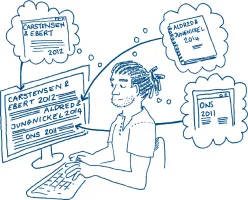
You provide evidence by telling the reader about the source of your information. The reference is the link between what you write and the evidence on which your writing is based. It turns what you write from being just your thoughts and reactions into something that links your ideas with the writings of other people who have thought and written about the same issue. It is how you carry out and share your research process.
1
The essentials of referencing
This chapter gives a quick overview of why and how to reference. From here you can read on through Part 1 to get a better understanding of referencing as central to your research and writing. Or you can decide to fast forward to another part of the book. You can always come back later!
Reference, reference, reference – why do I have to reference everything?
The one overarching reason why you need to reference is to show your reader where the evidence for what you say has come from. This will enable them to:
The reader will also be able to see:
All this feeds into your reader’s impression of your competence as a researcher and your ‘professionalism’ as a student. Your tutor will approach your work feeling positive – and that has got to be a good thing!
What does your reader need to know? The bare essentials
The six strategic questions1 make a useful checklist of the information you need to know about your source.
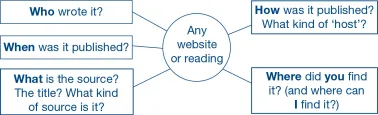
The answers you need to give to your reader in your reference are:
Rachel Aldred and Katrina Jungnickel wrote an article (published) in 2014. The title is Why culture matters for transport policy: the case of cycling in the UK. It was published in the Journal of Transport Geography in volume 34, the January edition, on pages 78–87. And this is where you can find it: doi:10.1016/j.jtrangeo.2013.11.004.
In reference form (author-year Harvard style), this becomes:

All referencing styles provide details that answer the same questions – they are just set out differently.
The Digital Object Identifier (DOI or doi) is a unique and permanent number used to identify sources, especially academic and scholarly articles, research reports and datasets, and official or government publications. The DOI will take you directly to the source or ‘object’ in a search.
Help your reader to find your source
It isn’t good enough just to list everything you have read for an assignment at the end of your writing. At best this just tells your reader that you’ve been busy; at worst it gives the impression that...
Table of contents
- Cover
- Title Page
- Copyright
- Contents
- Acknowledgements
- Introduction
- Part 1:Understanding referencing
- Part 2: Writing and referencing
- Part 3: Understanding plagiarism
- Part 4: Referencing: the practicalities
- Part 5: Other referencing styles
- References
- Useful sources
- Index
Trusted by 375,005 students
Access to over 1.5 million titles for a fair monthly price.
Study more efficiently using our study tools.
Frequently asked questions
Yes, you can cancel anytime from the Subscription tab in your account settings on the Perlego website. Your subscription will stay active until the end of your current billing period. Learn how to cancel your subscription
No, books cannot be downloaded as external files, such as PDFs, for use outside of Perlego. However, you can download books within the Perlego app for offline reading on mobile or tablet. Learn how to download books offline
Perlego offers two plans: Essential and Complete
- Essential is ideal for learners and professionals who enjoy exploring a wide range of subjects. Access the Essential Library with 800,000+ trusted titles and best-sellers across business, personal growth, and the humanities. Includes unlimited reading time and Standard Read Aloud voice.
- Complete: Perfect for advanced learners and researchers needing full, unrestricted access. Unlock 1.5M+ books across hundreds of subjects, including academic and specialized titles. The Complete Plan also includes advanced features like Premium Read Aloud and Research Assistant.
We are an online textbook subscription service, where you can get access to an entire online library for less than the price of a single book per month. With over 1.5 million books across 990+ topics, we’ve got you covered! Learn about our mission
Look out for the read-aloud symbol on your next book to see if you can listen to it. The read-aloud tool reads text aloud for you, highlighting the text as it is being read. You can pause it, speed it up and slow it down. Learn more about Read Aloud
Yes! You can use the Perlego app on both iOS and Android devices to read anytime, anywhere — even offline. Perfect for commutes or when you’re on the go.
Please note we cannot support devices running on iOS 13 and Android 7 or earlier. Learn more about using the app
Please note we cannot support devices running on iOS 13 and Android 7 or earlier. Learn more about using the app
Yes, you can access Referencing and Understanding Plagiarism by Kate Williams,Mary Davis in PDF and/or ePUB format, as well as other popular books in Study Aids & Study Guides. We have over 1.5 million books available in our catalogue for you to explore.