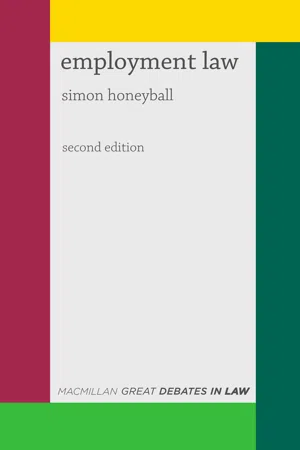
This textbook is an ambitious and engaging introduction to the more advanced writings on employment law, primarily designed to allow students to 'get under the skin' of the topic and begin to build their critical thinking and analysis skills. Each chapter is structured around key questions and debates that provoke deeper thought and, ultimately, a clearer understanding.
The aim of the book is therefore not to present a complete overview of theoretical issues in employment law, but rather to illustrate the current debates which are currently going on among those working in shaping the area. The text features summaries of the views of notable experts on key topics and each chapter ends with a list of guided further reading.
In this chapter I consider the most fundamental issue of employment law – what is meant by the word ‘employment’. I look first at what is involved in the process of defining ‘employment’. Is it, for example, a matter of discovering what the word entails, in much the same way that a scientist uncovers facts about an identified physical entity, or is it perhaps better seen as a process of constructing an idea in the most beneficial and logical way? I then turn to the idea that ‘employment’ is best seen as a conceptual tool, the meaning of which is determined by the purposes for which the concept is needed. This leads to an examination of the issue as to whether the question of what is meant by ‘employment’ is a matter of law or fact, and why that is important. I then examine the debate concerning whether employment can be seen as a unified concept, albeit sometimes viewed from different perspectives, or if the different definitions of employment in various parts of the law indicate that it is simply that the same word is used for convenience to cover a variety of closely-related, yet nevertheless different, ideas. Finally, I examine the idea that the concept of ‘employment’ should be abandoned altogether.
Debate
What is involved in defining ‘employment’?
It is clearly crucial to any consideration of debates in employment law, as well as to the practice of employment law, to understand what is meant when we use the term ‘employment’. This is for a number of reasons, of which I mention just two here. First, we need to delineate the subject matter of our enquiry – to make sure that we are all referring to the same fundamental idea, and not talking at cross-purposes. Secondly, we need to recognize that there are other concepts in this area that are similar and with which employment could be confused, or even thought of as synonymous. For example, employment is, of course, a relationship in which employees are parties on one side, but the law also recognizes (or has recognized) other ideas identifying those who are in a formal legal relationship working for another. So, people who have legal protection against the entity for whom they work so as not to be unfairly dismissed are described in law as employees. However, the law that applies to members of trade unions describes them as workers.1 In the nineteenth century those who worked for others were generally referred to as servants.2 Some people work for others as office-holders.3 Other terms that have been employed in law are ‘artificers’,4 ‘workmen’5 and ‘labourers’.6 These are not necessarily mutually exclusive ideas. For example, a worker is someone in law who has the characteristics of an employee, but has other characteristics too. In other words, the term ‘worker’ has been defined more widely than ‘employee’, and so an employee can at once be both an employee and a worker.7 To add further confusion to this, some people who are often described as independent contractors are also referred to as ‘self-employed’. It is often necessary to identify someone as an independent contractor precisely to establish that they are not an employee, and so to include the term ‘employed’ in their description is somewhat confusing.8 A further complication is that governments sometimes refer to introducing new types of employment relationship. So, for example, in 2013 the Coalition Government created the new concept of ‘employee shareholders’ – see Growth and Infrastructure Act 2013, s. 31. In essence, though, these workers are ordinary employees who simply agree to give up some employee protection rights in exchange for some rights to shares and preferential tax treatment.
It is important to understand, however, that while it is often necessary to approach the definition of employment in this analytical and technical way, for general discursive purposes there is no objection to the word ‘employment’ being used to cover a variety of types of work relationships. I personally prefer the description ‘the law of work’ to ‘employment law’ simply because it does cover the panoply of work relationships and not just employment, but the idea has not, as yet, taken widespread root.9 That is why the title of this book is as it is. That is, at least, a significant improvement on descriptions such as ‘the law of master and servant’ or even ‘labour law’,10 both of which connote a rather narrower idea, even if the reality was somewhat different when these terms were in greater vogue than they now are.
I began above by referring to the importance of understanding what is meant when we use the term ‘employment’. I could have written that differently. I could have said that it is important to understand what, in law, the term ‘employment’ means. It might be thought that there is little difference between the two ways of posing the issue. However, the first refers to the meaning of the concept of employment as understood by those who use, hear or read the word. The second connotes the idea that there is some objective, true, or correct meaning. These are very different ideas, and of course they raise issues not just for the legal concept of employment. They arise in the consideration of the meaning, or definition, of any term used in law and elsewhere. Nevertheless it is worth considering how this distinction impacts, or at least should impact, on how we understand the concept of employment in legal practice as well as in legal theory.
I would like to make one further introductory observation but, before I do that, I should point out that it is increasingly important to identify ‘employment’, not to establish which individuals are employees – the traditional concern – but which are employers. This is particularly the case because of the growing fragmentation of types of work relationships with the growth of employment agencies, personal service contracts and so on. In these cases the person for whom the employee is working is not necessarily that person’s employer.11 Employment law has grown up around the paradigm model of a person agreeing to work for another person or entity on a simple contractual basis. But the world of work has become much more complicated than that, with a variety of different types of work relationships often with an increasingly complex foundation. However, there are signs that the courts are beginning to be prepared to take a radical approach, and determine that, regardless of classical theory, an employment relationship may exist between parties between whom there is no direct express contractual nexus. So, for example, in Dacas v Brook Street Bureau (UK) Ltd12 in 2004 an employment agency appealed against a decision of the Employment Appeal Tribunal, overturning the employment tribunal, to the effect that the defendant was employed by the employment agency. The Court of Appeal allowed the agency’s appeal on the basis that the tests of employment, such as the requirement for a necessary degree of mutuality of obligation, had not been established. There was no cross-appeal against the tribunal’s decision that the end-user (the Council) for whom the defendant worked was not the defendant’s employer either, and so the Court of Appeal was not in a position to find that it was. However, two of the judges (Mummery and Sedley LJJ) gave strong indications that they would even have held the end-user to have been the defendant’s employer, even though there was no express contractual relationship between them. The possibility existed that the contract could have been implied. The Court of Appeal retreated from this idea in the later case of James v London Borough of Greenwich13 but this does show that the courts are at least willing to entertain the possibility of expanding the simple contractual explanation of employment into more complex areas.14
In the present context it is also interesting to note that, for reasons which will become clear below, not only was the identification of any employer the primary issue here, but the Court of Appeal assumed that a finding that the worker was not employed for the purposes of her unfair dismissal claim entailed the idea that neither the employment agency nor the Council would have been vicariously liable for any torts she may have committed. In other words, it was impliedly accepted that the unified approach pertained.15
DOES THE MEANING OF ‘EMPLOYMENT’ INVOLVE A PROCESS OF DISCOVERY OR STIPULATION?
It would seem to follow from the idea that ‘employment’ has an objective meaning, quite independent of the way the word is used, that there is just one meaning of the term in law. That is an idea I will examine in a later Debate in this chapter. But it also involves the notion that, because of its independence from actual usage, there is a meaning of the term waiting to be discovered by those who want to apply it. So, when the courts develop tests for identifying who is an employee, what they are trying to do is to discover what the ‘true’ meaning of employment is. In developing the so-called ‘control test’ in the nineteenth century,16 or the ‘integration test’ in the mid twentieth century,17 or later the ‘economic reality test’ or ‘multiple test’,18 they are on a voyage of lexicographical discovery. Rather like a scientist applying a litmus test, or a woman using a pregnancy test, the judges on this view are engaged in a process which they hope will inform them as to the correct position, this time in law. Just as a scientist seeks to discover the presence or absence of acidity, or a woman seeks to discover whether or not she is in fact pregnant, the judges apply their tests in order to ascertain whether or not the party before them is an employee and therefore eligible to bring a claim, or belongs to some other category such as an independent contractor which might exclude them from doing so. This approach to the issue raises several further questions, such as how a word can come to have an objective meaning aside from that which is determinable from usage.
An alternative view is that the meaning of the term ‘employment’ has no objective meaning. The only meaning a word can have is that which has been assigned to it by human agency. As there is (in English at least) no formal mechanism by which meanings are attached to everyday words, such words when they are taken up by law are either specifically defined in law (for example, in the interpretation section of a statute) or are left to their own devices, as it were, in the field of ordinary meaning. This is sometimes referred to as common usage. So, the meanings of words are simply those that are to be determined by how they are used. The question: ‘what is the meaning in law of the term “employment”?’ could elicit the answer: ‘it means what the judges say it means’. In other words, when judges developed the tests for defining employment as described above, they were not developing tests to inform them whether someone was an employee or not, but to lay down rules as to who should be considered an employee. That, of course, is of great importance because, for example, whether someone is an employee is a gateway to claiming employment protection rights. Only an employee may claim for unfair dismissal,19 or for redundancy,20 or for certain discrimination rights21 and so on. On this view, therefore, the judges – not the legislature or some other objective agency – are those who determine who should be eligible to claim. To some this might not seem surprising as the courts make such decisions every day. However, the important point here is that the judges are not simply applying tests that they have been given to see if a particular would-be claimant is eligible to claim, which everyone accepts as part of the role of the ...
Table of contents
Cover
Title Page
Copyright
Contents
1. The Idea of Employment
2. The Employment Contract and Theory
3. The Employment Contract and Practice
4. Discrimination at Work
5. Termination of Employment
6. Collective Aspects of Employment
7. Human Rights and Employment
8. The Employment Legal System
Trusted by 375,005 students
Access to over 1.5 million titles for a fair monthly price.
Study more efficiently using our study tools.
Frequently asked questions
Yes, you can cancel anytime from the Subscription tab in your account settings on the Perlego website. Your subscription will stay active until the end of your current billing period. Learn how to cancel your subscription
No, books cannot be downloaded as external files, such as PDFs, for use outside of Perlego. However, you can download books within the Perlego app for offline reading on mobile or tablet. Learn how to download books offline
Perlego offers two plans: Essential and Complete
Essential is ideal for learners and professionals who enjoy exploring a wide range of subjects. Access the Essential Library with 800,000+ trusted titles and best-sellers across business, personal growth, and the humanities. Includes unlimited reading time and Standard Read Aloud voice.
Complete: Perfect for advanced learners and researchers needing full, unrestricted access. Unlock 1.5M+ books across hundreds of subjects, including academic and specialized titles. The Complete Plan also includes advanced features like Premium Read Aloud and Research Assistant.
Both plans are available with monthly, semester, or annual billing cycles.
We are an online textbook subscription service, where you can get access to an entire online library for less than the price of a single book per month. With over 1.5 million books across 990+ topics, we’ve got you covered! Learn about our mission
Look out for the read-aloud symbol on your next book to see if you can listen to it. The read-aloud tool reads text aloud for you, highlighting the text as it is being read. You can pause it, speed it up and slow it down. Learn more about Read Aloud
Yes! You can use the Perlego app on both iOS and Android devices to read anytime, anywhere — even offline. Perfect for commutes or when you’re on the go. Please note we cannot support devices running on iOS 13 and Android 7 or earlier. Learn more about using the app
Yes, you can access Great Debates in Employment Law by Simon Honeyball in PDF and/or ePUB format, as well as other popular books in Law & Labour & Employment Law. We have over 1.5 million books available in our catalogue for you to explore.