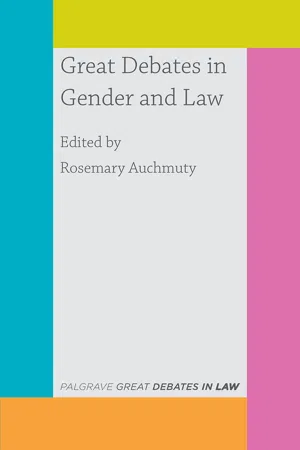
The first textbook to consider gender perspectives in relation to the whole undergraduate law curriculum in England and Wales. Gender is of central importance in every area of law and every area of people's lives but is rarely mentioned in the formal LLB syllabus; this book is designed to fill some of those gaps. 18 chapters, written by experts in the field, cover all the core modules on the English LLB together with 11 of the most popular options.
Aimed at students and lecturers on undergraduate and postgraduate Gender and Law modules, the book will also be useful for all LLB and LLM students studying English law, who may use it to accompany their studies from their first to their final year, and also for prospective law students, legal scholars from outside England and Wales, and scholars in other disciplines.
- English
- ePUB (mobile friendly)
- Available on iOS & Android
eBook - ePub
Great Debates in Gender and Law
About this book
Information
© Rosemary Auchmuty. Individual chapters © respective authors 2018
Rosemary Auchmuty (ed.)Great Debates in Gender and LawPalgrave Great Debates in Lawhttps://doi.org/10.26777/978-1-137-61100-0_11. Contract Law
Prof.Rosemary Auchmuty1 and Máiréad Enright
(1)
University of Reading, School of Law University of Reading, Reading, United Kingdom
Contracts project our intentions outwards, prolonging our autonomy into an uncertain future.1 They allow people to create new legal structures; to ‘make arrangements for themselves, and so to change their respective rights and duties’.2 Law promises to support that creative agency; women often distrust that promise. The first debate here introduces critiques of freedom of contract which are concerned with gender and power. The second explores efforts to address those critiques through relational contract theory. For reasons of space, I focus here on the common law rather than statute, and on commercial contracting rather than consumer law.
Debate 1
Is ‘freedom of contract’ really freedom?
Berlant uses the phrase ‘cruel optimism’3 to describe things we desire and hope for even though they are obstacles to our flourishing. ‘Freedom of contract’ exemplifies cruel optimism. The cases you read during your studies involve people who bargain for things – dream homes,4 beautiful objects,5 financial security,6 or maybe even chances of fame7 – that speak to their identity and goals. Marx wrote of contractual exchange that ‘what seems to throb there is my own heartbeat’.8 However, contractual freedom is a thin equality of opportunity, in limited circumstances, to participate in certain capitalist projects. ‘Classical’9 contract law emerged alongside capitalism, as markets became objects of specialist knowledge and regulation. Contract law supposedly mirrors the market, responding to bargains rather than shaping them. ‘Freedom of contract’ promises that states make no detailed public plan for market transactions. Nineteenth-century laissez-faire economists maintained that, left to their own devices, individuals would voluntarily exchange scarce resources with one another, allowing them to gravitate to their most efficient uses.10 Law, accordingly, insists that, although the state stands ready to resolve disputes,11 intervention is exceptional and only takes place at the end of the contract’s life. Then law defers to our intentions.12 Thus, contract is ‘private’ rather than ‘public’ law, produced by autonomous individuals rather than by government fiat.
We should be suspicious of easy distinctions between (public) governmental regulation and (private) self-regulation. Law actively constructs opportunitiesfor judicial intervention in contractual disputes: those are neither obvious nor neutral.13 For example, the promise of judicial deference to parties’ intentions is misleading. One of the first lessons you learn is that subjective intentions do not matter to contract doctrine: only the outward ‘objective’ appearance of agreement counts.14 As Radin writes, law idealises the bargaining process as an occasion for detailed communication and clear expression of voluntary consent to each contractual term. But law does not actually require any such communication. It is enough for contract terms to bind us that we assent to them, for example by signature.15 The law on incorporation of terms means that we need not always have specific knowledge of each element of our obligations. Informed consent is not always required: it is enough that we have ‘reasonable notice’ of the contract’s terms (whether or not we fulfil the corresponding duty to read them).16 Thus, passivity, not shared creativity, is often contract’s hallmark.17
Nevertheless, courts treat contracts as if they embodied freely choosing subjects’ active intentions. This fiction18 has a pragmatic technical function: it allows courts, by formalistically reasoning through contractual disputes, to bypass the lived difficulties of contracting. Thus, it eliminates a source of market uncertainty: if we know that the vagaries of human intention have limited impact on judicial decision-making, we feel more confident about entering into complex contracts. This minimalist approach makes some transactions more secure and more readily calculable. It also performs a political function.19 It allows courts to bypass detailed engagement with the conditions in which contractual intention is formed, producing rules that are ‘singular, daunting, rigid and cocksure’.20 Leaving messy reality behind, law can turn to idealised narratives of contractual freedom. The idea of ‘objectivity’, so often repeated in your contract course, suggests rigour and certainty, but also responsiveness to shared market rationality. That rationality, however, may not be shared by all market actors:21 the preferred practices of some are made the universal rule in order to discipline others. This is where gender inequality comes in.
Ideal contractual subjects are strong, independent, self-possessed and productive. They are autonomous beings who possess and trade in concrete legal rights.22 This ideal is rooted in a particular theory of equality. Classical contract theorists were influenced by liberal political thinkers who argued that men should be owners of their own labour and property, and trade them freely with others. Contract was often contrasted with status:23 freedom to contract implies equal capacity to bargain in the market, unshackled from traditional authority. This vision of universal equality seems admirable, but some subjects will have to work harder than others to claim that equality.24 Recall nineteenth-century feminist struggles for married women’s right to form property and employment contracts. As Pateman writes, the originary contract between men and women was the sexual contract, under which married women supposedly willingly subordinated themselves to their husbands.25 Women were not fully in possession of themselves,26 but were rather objects to be exchanged between men.27
Contract law now formally includes a wider range of subjects, including women, but substantive inclusion is another matter. We have said that contract rarely enquires into the forces that produce our thoughts, plans or desires: it flattens and generalises experience. If contract law presumes some equality between market actors, it is ‘equal measure’28 with idealised commercial men. Contract makes persons equivalent to one another in an abstract sense, apportioning and ratio...
Table of contents
- Cover
- Front Matter
- 1. Contract Law
- 2. Tort Law
- 3. Public Law
- 4. Criminal Law
- 5. Land Law
- 6. Equity and Trusts
- 7. EU Law
- 8. International Law and Human Rights
- 9. Family Law
- 10. Employment/Labour Law
- 11. Health Law, Medicine and Ethics
- 12. Company Law and Corporate Governance
- 13. Intellectual Property Law
- 14. Jurisprudence/Legal Theory
- 15. Legal History
- 16. Law and Literature/Literary Jurisprudence
- 17. Sexuality
- 18. Legal Professions
- Back Matter
Trusted by 375,005 students
Access to over 1.5 million titles for a fair monthly price.
Study more efficiently using our study tools.
Frequently asked questions
Yes, you can cancel anytime from the Subscription tab in your account settings on the Perlego website. Your subscription will stay active until the end of your current billing period. Learn how to cancel your subscription
No, books cannot be downloaded as external files, such as PDFs, for use outside of Perlego. However, you can download books within the Perlego app for offline reading on mobile or tablet. Learn how to download books offline
Perlego offers two plans: Essential and Complete
- Essential is ideal for learners and professionals who enjoy exploring a wide range of subjects. Access the Essential Library with 800,000+ trusted titles and best-sellers across business, personal growth, and the humanities. Includes unlimited reading time and Standard Read Aloud voice.
- Complete: Perfect for advanced learners and researchers needing full, unrestricted access. Unlock 1.5M+ books across hundreds of subjects, including academic and specialized titles. The Complete Plan also includes advanced features like Premium Read Aloud and Research Assistant.
We are an online textbook subscription service, where you can get access to an entire online library for less than the price of a single book per month. With over 1.5 million books across 990+ topics, we’ve got you covered! Learn about our mission
Look out for the read-aloud symbol on your next book to see if you can listen to it. The read-aloud tool reads text aloud for you, highlighting the text as it is being read. You can pause it, speed it up and slow it down. Learn more about Read Aloud
Yes! You can use the Perlego app on both iOS and Android devices to read anytime, anywhere — even offline. Perfect for commutes or when you’re on the go.
Please note we cannot support devices running on iOS 13 and Android 7 or earlier. Learn more about using the app
Please note we cannot support devices running on iOS 13 and Android 7 or earlier. Learn more about using the app
Yes, you can access Great Debates in Gender and Law by Rosemary Auchmuty in PDF and/or ePUB format, as well as other popular books in Diritto & Teoria e pratica del diritto. We have over 1.5 million books available in our catalogue for you to explore.