This guide shows how a 'critical' approach is fundamental to all aspects of study from start to finish. It gives practical advice and models for critical thinking and writing, and real examples from students' work. The layout is varied and accessible, with engaging illustrations and an informal, direct style.
eBook - ePub
Getting Critical
About this book
Information
PART 1
GETTING A CRITICAL MINDSET
1 Getting strategic
Part 1 takes a good look at how to get that critical mindset in your studies. It’s all about asking questions – right from the beginning, before you dive into your courses.

As you go through the book, you will gain more insight into what these qualities look like in practice, and how you can develop them in your own work.
Six strategic questions are used by many people to get themselves started in tackling a task, whether it’s planning a project, getting to grips with reading, or writing something:
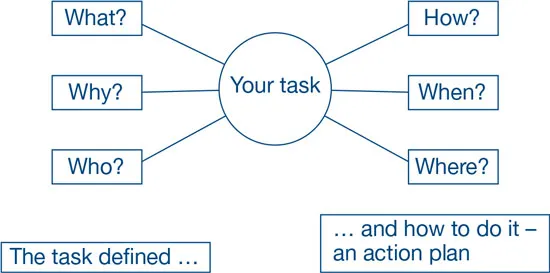
Try this in relation to your course handbook, or materials for one module or unit.
A strategic reading of a course handbook!
You may not have one single handbook for each course or module you are taking, setting out the programme and assessment tasks for the term or semester. If your materials are online (on Moodle, for example) you may have to compile your own ‘course handbook’ from several documents. Get hunting!
These documents contain essential guidance. Somewhere in there it will tell you what you have to do, and often quite a lot about how to set about it, as well as the practicalities – like when it needs to be done by.
Your critical approach to your studies starts here! Check through these materials and read them carefully to make sure you have all the information you need to answer the strategic questions.
The task defined
The first three key questions (on the left in the table) will help you to get the measure of the task(s) you have been set.
| What exactly do you have to produce? | … in your next essay/ assignment? |
What format? Essay? Report? Specific format? Presentation? Tests? | |
Any guidance about structure, layout and style? | |
How long? | |
What % marks does the task count for? | |
What topic(s)? |
| Why are you being asked to do this? | |
External reasons: the ‘learning outcomes’ you are expected to achieve. | |
Internal reasons: your private purpose – interest in the subject, personal satisfaction. |
| Who are you writing for? It helps you write if you can visualise your reader. | |
Your tutor is always your audience. What do you know about what s/he wants to see? | |
Do you have another real audience, for example giving a presentation to your seminar group? | |
Or an imagined audience, like writing a report (for a company for example), or an article for a particular journal? |
Most writing tasks do not specify an audience (beyond the obvious – your tutor or a colleague). You may find it helpful to imagine a ‘default’ audience when you write.
Write as if …
… you are addressing someone with the same experience and knowledge of the general subject area as yourself, but who has not yet covered this particular topic/ module/course. If you do this you will not be tempted to:
Talk on their level, using clear, simple language; use short sentences; and draw on the specialist language, conventions and style of your subject when you need to.
And how to do it – an action plan
| How …? What guidance are you given about what to include? | … in your next essay/ assignment? |
For example: Use of appendices? Style of referencing? Acceptable and unacceptable practice? |
| When …? is the deadline for the final hand-in? | |
Are there earlier deadlines for drafts and various elements? | |
How will you balance working towards one deadline with working towards others? And life, job etc.? |
Table of contents
- Cover
- Title Page
- Copyright
- Contents
- Acknowledgements
- Introduction
- Part 1: Getting a critical mindset
- Part 2: Getting critical in research and reading
- Part 3: Getting critical in writing
- Part 4: Critical steps
- References
- Useful sources
- Index
Trusted by 375,005 students
Access to over 1.5 million titles for a fair monthly price.
Study more efficiently using our study tools.
Frequently asked questions
Yes, you can cancel anytime from the Subscription tab in your account settings on the Perlego website. Your subscription will stay active until the end of your current billing period. Learn how to cancel your subscription
No, books cannot be downloaded as external files, such as PDFs, for use outside of Perlego. However, you can download books within the Perlego app for offline reading on mobile or tablet. Learn how to download books offline
Perlego offers two plans: Essential and Complete
- Essential is ideal for learners and professionals who enjoy exploring a wide range of subjects. Access the Essential Library with 800,000+ trusted titles and best-sellers across business, personal growth, and the humanities. Includes unlimited reading time and Standard Read Aloud voice.
- Complete: Perfect for advanced learners and researchers needing full, unrestricted access. Unlock 1.5M+ books across hundreds of subjects, including academic and specialized titles. The Complete Plan also includes advanced features like Premium Read Aloud and Research Assistant.
We are an online textbook subscription service, where you can get access to an entire online library for less than the price of a single book per month. With over 1.5 million books across 990+ topics, we’ve got you covered! Learn about our mission
Look out for the read-aloud symbol on your next book to see if you can listen to it. The read-aloud tool reads text aloud for you, highlighting the text as it is being read. You can pause it, speed it up and slow it down. Learn more about Read Aloud
Yes! You can use the Perlego app on both iOS and Android devices to read anytime, anywhere — even offline. Perfect for commutes or when you’re on the go.
Please note we cannot support devices running on iOS 13 and Android 7 or earlier. Learn more about using the app
Please note we cannot support devices running on iOS 13 and Android 7 or earlier. Learn more about using the app
Yes, you can access Getting Critical by Kate Williams in PDF and/or ePUB format, as well as other popular books in Study Aids & Study Guides. We have over 1.5 million books available in our catalogue for you to explore.