Shona Elliott led her organization to become a Top 100 Employer and within Creating Value as a Senior Leader, she teaches leaders how to retain their employees, increase employee engagement, and create high-performing teams that achieve their organization's goals.
In Create Value as a Senior Leader, leaders learn:
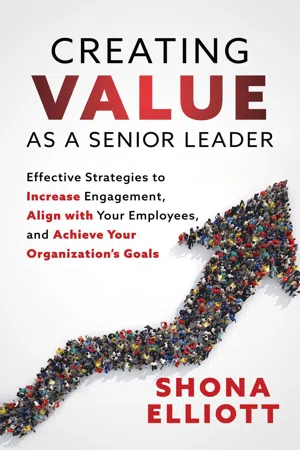
eBook - ePub
Creating Value as a Senior Leader
Effective Strategies to Increase Engagement, Align with Your Employees, and Achieve Your Organization’s Goals
- English
- ePUB (mobile friendly)
- Available on iOS & Android
eBook - ePub
Creating Value as a Senior Leader
Effective Strategies to Increase Engagement, Align with Your Employees, and Achieve Your Organization’s Goals
About this book
Creating Value as a Senior Leader helps leaders retain their best employees, create value, and keep talent on their team.Why their good employees leave and how to prevent it
What they can do to keep their best employees
The secret to maintaining great relationships with employees
The easiest way to boost employee engagement
How to align their employees with strategic and departmental goals
How to motivate their employees to positively contribute to their organization's success
Information
Chapter 1:
Another One Bites the Dust
“One of the tests of leadership is the ability to recognize a problem before it becomes an emergency.”
Have you ever woken up on Monday morning, after a brief respite from the daily grind, and immediately thought of all the work awaiting you and your team that day? Your day is filled with projects, deadlines, complaints, budgets to review from your team, poor departmental performance indicators to explain, and off-target financial indicators to resolve. Worse yet, one of your key managers resigned last month, and now your remaining managers are working short-handed. You pull yourself together, get coffee, and head in early to work, hoping you will have some time before the first of your back-to-back meetings to review the reports your leaders submitted to you over the weekend. You get to your office and within a few minutes, one of your highly valued leaders, who is leading several key projects, comes in to chat. With a shaky voice and envelope in hand, she begins what feels like a recited speech, and it dawns on you what she will say next: “Thank you for the opportunity to work for you, but unfortunately, I have taken a position elsewhere.”
Just like that, what was already a difficult day becomes exponentially more difficult. Instead of listening to the rest of her prepared “speech,” your mind immediately jumps to what manager you can reassign her projects to, and you make a mental note to call Human Resources to begin the recruitment process. Now, out of eight managers, you are down two, and you wonder if this is becoming a pattern—perhaps a sign of a bigger issue that is brewing. Unfortunately, you don’t have time to look for your department’s turnover rates, let alone review and interpret the data. Looking back, you recall hearing your leaders mention an increase in complaints and a decrease in productivity, saying they too have had a number of key employees leave their teams in the past six months. Again, you think that if you had more time, you would request your team’s turnover rates from Human Resources to see exactly how bad the exodus has been, but for now, you need to find a way to transfer the knowledge and information your departing manager has to another one of your leaders. Ah yes, if only you had taken advantage of the knowledge management and succession planning strategies the Human Resources team had discussed last year, you would be in a better position to handle this resignation. Oh, and now you are late for your 8:00 a.m. weekly senior leadership team meeting. So much for getting to work early to get a jump on the day. Happy Monday.
Every leader has turnover; it is inevitable. However, when normal attrition (due to retirements and relocations) turns into key employees and leaders leaving for better opportunities for the same pay (or, at times, less pay) more and more often, you know something is not right. In real time, it is hard to pinpoint when resignations of key employees are a signal of a larger problem. The first resignation happens, and you chalk it up to your former employee wanting a different experience or opportunity elsewhere. Perhaps you blame it on better benefits or compensation. As more resignations occur, you can’t shake the feeling that something else is driving your employees from your team. Unfortunately, you can’t pull yourself away from the vicious cycle of hiring, onboarding, fire-fighting, and getting the necessary work accomplished while trying to retain your dwindling talent pool to dive deep into the cultural issues that may impact your employees’ loyalty.
When you hear your managers complain about being short-staffed, increasing overtime, and seeing performance indicators miss their targets, while perhaps observing market-share loss and decreased customer satisfaction, you know in your gut there is a bigger issue at play. However, as you are on the replace-hire-onboard hamster wheel, you are unable to pause, take a deep breath, and evaluate exactly why your managers are leaving your team.
As you think of a way to dig yourself out of the hole you are in, you sadly recall the days when you were excited at the prospect of being a senior leader. Where you could be in a position to provide value to the organization and make a real difference for your customers, your employees, and your organization. You begin to wonder exactly what the value is that you provide to your organization. You are so busy managing the day-to-day emergencies that you have no time to invest in any of the senior leadership attributes you know you should be focusing on. As you push those thoughts aside, you get to the business at hand and begin to research how to retain employees and reduce turnover. That’s when you see the barrage of generic advice on the Internet. While reading the blogs and articles, you feel that most of the advice recommended has already been implemented such as:
- Ensure you have competitive compensation packages and benefits.
- Provide opportunities for learning and advancement.
- Provide work-life balance.
- Administer proper training and onboarding.
- Hire the right employees.
Frustrated by the lack of real help and knowing you had already addressed most of what is suggested and still have a problem, you purchase this book hoping it will make a difference.
You have been a successful leader in the past and you are aware of the cost of high turnover. You know that for every team member lost, there is a significant cost to replace them. The cost to hire and onboard someone new—and the subsequent loss of productivity while the replacement is hired and trained—adds up quickly. Your business incurs overtime costs as a result of working short-staffed while trying to maintain the same levels of productivity. Intuitively, you also know the drain and negative impact on the remaining staff when they pick up the slack and work harder while carrying the burden of training the new team member. Even with knowing the high cost of turnover, you are unsure of how to reduce your employee churn.
Perhaps you are also aware of the indirect costs of not solving your retention issues. For example, you experience missed departmental and operational goals, the decrease in the quality of service or product your team produces, the loss of subject matter expertise and institutional knowledge, the increase in safety incidents, the decrease in staff and customer satisfaction scores, and the emergence of disrespectful behavior, to name a few. This can contribute to a less-than-ideal organizational culture. A culture with low morale, where staff are increasingly engaged in conflict and/or bullying. All these indirect costs impact your reputation, both as an employer and as an organization providing a product or a service. And what about the cost to you as a senior leader?
You are most likely aware of this vicious cycle. You have also invested a lot of time and energy being a senior leader. However, every minute you spend on the replace-hire-onboard hamster wheel, every minute you spend on managing the knowledge transfer of information and expertise from one manager to the next and one employee to the next, every minute you spend trying to find explanations for the increased overtime, decreased productivity and missed performance targets, you know you are not spending that time providing value as a senior leader, which is why you worked so hard for that promotion in the first place. Do I have your attention yet?
Do you dream of better days when your employees were loyal to you and committed to your organization? Do you wish you felt more connected to your team? When was the last time you felt joy, passion, and purpose in your leadership role? Do you long for a day with enough time to properly strategize, and plan the direction for your team? Do you imagine a day when you will strategize and invest time into understanding how you can create more value as a senior leader? Do you desire to create an environment for your team where you are optimizing the potential of every single employee, such that they are working cohesively as a team, providing the best service or product for your customers and achieving your organization’s goals? Perhaps your dream is to find a way to get off the hire-replace-onboard hamster wheel you and/or your managers have been riding so you can connect with your team and provide value to them as a leader. It is now your time to focus on the work you hoped to be doing as a senior leader in your organization. First things first, you will need to understand how to break this vicious cycle and prevent further damage to your team and organization.
Given the fact that you found the time to purchase this book and begin to read it, you now know that you need to somehow dedicate the time to solving your retention issues because the turnover cost, overtime, decrease in productivity, and lost market share is too high to lose more employees. Additionally, the failure to retain employees has a significant cost to you as a leader; the cost of spending your time firefighting, hiring, training, and replacing your employees robs you of the time and energy to focus on the work you signed up to do as a leader—to lead and provide value.
By the end of this book, you will reconnect with your purpose of being a senior leader and again feel joy in your role while retaining, and yes, engaging with your employees by connecting with them in a meaningful way. You will better understand what changes need to be made to achieve your performance targets, retain employees, and increase employee engagement and customer satisfaction. In addition, you will understand how you can create value as a senior leader in your organization. The good news is that you have already begun this transformative journey. You recognize that you have a problem and are not providing the value you know you can. More importantly, you have a desire to fix this problem, lead in a way that creates value, and show up as the senior leader you know you can be. You also understand that the generic retention advice is not going to get you across the employee retention finish line or put you in a position where you can create value as a senior leader. You started this transformation by picking up this book and are now already on your way to making a difference—for yourself and for those you lead. You are on an incredible path to create value as a senior leader for those you serve. Yes, serve. I’ll discuss more about that later!
Chapter 2:
My Leadership Journey
My leadership style has always been rooted in the belief that leaders are in service to their employees. Although I’m not formally trained in the philosophy of servant leadership, which is a philosophy that great leadership, relationships, and organizational results come from leaders putting others first, I have always approached my leadership roles with the perspective that we have a responsibility to create the ideal working environment for employees to succeed and do their best work. Unfortunately, in the busy world of management, not much time or priority is dedicated to connecting with employees and determining their needs, let alone understanding the environment and conditions in which they work. With the advancement of technology in society and leadership, we have become even more distracted, distant, and disconnected from our employees. Employees make or break an organization and are ultimately the only ones who can achieve an organization’s strategic plan, goals, and objectives. Bridging that disconnect by looking at your organization through your employees’ eyes helps you, as a senior leader, know what to pay attention to, building understanding around what your employees need to succeed.
My belief about being in service to those I lead came from watching my parents work so hard to provide a great life for our family. My mom went back to school to become a registered nurse (RN) after my siblings and I were all in elementary school. Her stories of being a critical care nurse, taking care of complicated and sick patients, were always interesting to me. I knew from a young age that I would not ever be a nurse or a physician. I was able to see early on how challenging the work was and how little it was valued by administration. Nurses and physicians work twelve to sixteen hours without breaks in some of the most physically demanding and emotionally challenging jobs, caring for those who cannot care for themselves. My mom would come home and tell me about her shifts, how she would chart during her lunch, be pulled to other nursing units where she had no experience, work overtime, and have new patient admissions added to her already-full workload, without ever being thanked. Instead of gratitude, the supervisor would alter schedules and assignments without much notice or explanation, not ever understanding the impact these changes had on her staff (my mom!). Listening to these stories for years and seeing the impact all this had on my mom, shaped my career decisions and certainly my leadership approach. Throughout my career in hospital administration, I would think of how certain policies and leadership styles would have impacted her happiness and fulfillment as a nurse and as a person.
My dad, on the other hand, was in a frontline leadership role for one of the “big three” automotive plants in Windsor, Ontario. Although my dad did not share as many stories as my mom, the stories I did hear taught me the importance of hard work, being fair and consistent as a leader, and always listening to those leaders closest to the employees. My dad would tell the stories of how he would make recommendations to reduce costs or improve efficiencies to his superiors, and when those suggestions were not acted upon, it usually resulted in additional expenses and lost productivity for his organization. My dad was a committed leader, respected by his team, and he knew a wealth of information about the working conditions and reality of the frontline staff. When my dad’s leaders did not make full use of this expertise, they missed out on opportunities to make impactful changes that would have furthered the goals of their organization. Understanding these leadership fundamentals helped form my leadership style and principles early on, for which I am grateful. I would not be the leader I am today without their influence.
My first manager role was for a clinical laboratory in the suburbs of Detroit, Michigan. During my second month on the job, I was informed that my phlebotomy team was going to be short-handed to collect the early morning blood specimens from patients in our nursing homes in Detroit. Given that we were running short and both our supervisor and phlebotomy team-lead had picked up a nursing home each, I volunteered to draw blood at a couple of the nursing homes as well. Fortunately, I had shadowed the supervisor of the phlebotomy team within my first month and had an orientation to the set-up of the nursing homes we serviced. In the world before smartphones, I purchased a map of Detroit, grabbed my nursing home assignment list, and set my alarm for 2:00 a.m. so I could cross the border from Windsor, Ontario into Detroit to begin my shift.
After completing my nursing home run, I returned to the main laboratory, dropped off my specimens, and began my normal day of “management.” Rose, the supervisor of the phlebotomy team who had been disappointed that she was not selected for the manager position I now held, came into my office with a mixed look of stunned respect and disbelief. She could not believe I woke up early to help the team and draw blood from the nursing homes in inner city Detroit. Rose was appreciative of the help. More importantly, she knew I was genuine in my desire to help and serve. Looking back on my career, I now recognize that my desire to assist and serve those I led started with my first leadership positions. In each of my frontline supervisor and manager roles, I always rolled up my sleeves and stepped in to help my employees.
My decision to pursue a doctoral program years ago was a pivotal point for me. After considering my formal education, which includes an honors bachelor’s degree in biochemistry, a master’s in business administration, and an advanced certificate in human resources, I felt I was missing formal education in an area that I was truly passionate about—organizational development. For fun, in addition to my day job as a vice president of a 1300 employee organization, I decided to enroll in a part-time doctoral program for organizational development. These studies focused on organizational change, effectiveness, and performance. Through its behavioral science approach, my studies assessed what influences and motivates both leaders and employees.
As part of my doctoral application, I had to submit what my “burning question” was in pursuing a Ph.D. This assignment was easy for me. My burning question was centered around the disconnect of senior leaders from the reality of the front lines. I had observed this disconnect (and at times as a senior leader been disconnected) throughout my career. The times when I felt the happiest in my role as leader, the times when I felt the most passion for my role, and perhaps the times when I felt I had the greatest impact, were the times when I was the most connected to the employees of the organization I worked for. The better I understood the working conditions of our employees and their reality, the better I could help serve them and make the necessary changes for the employees to show up and do their best work.
I enjoyed the four years of study on organizational change, change management, leadership, and systems, as it academically validated much of what I had learned in my years as a leader. Applied learning and building the bridge between academia and the reality of leadership was helpful for me. I incorporated that learning into my leadership practices going forward. I had completed most of the coursework for the doctoral program when I decided to put my thesis work on hold and accept the role of inaugural CEO for a new organization.
Even though I had put my dissertation on hold, I never lost my passion for being connected to employees on the front line, understanding and improving their work conditions, helping employees and leaders do their best work, and breaking the cycle of storytelling and mythology by management that occurs in organizations. Now, after having stepped backed from the world of senior leadership to care for my daughter at home, I thought I would continue to explore this passion and write about it. In my experience, I believe too many leaders are disconnected from the people they lead, feeling purposeless in their work as leaders. Consequently, they show up every day already busy—attending meetings, submitting budgets, writing reports—but not realizing their full potential as a leader.
My Connection with Employees
In my fifteen years of senior leadership experience in a variety of roles, industries, for-profit and not-for-profit organizations, and for companies in both Canada and the United States, I’ve learned that the only successful way to ensure you build a committed organization that achieves its strategies is through a meaningful connection with your employees. Sounds simple enough, right? Yes, the concept is a simple one, but in our fast-paced world of leadership, the consistent execution of this strategy is not. Unfortunately, something that should be intuitive to leaders is, at times, what we resist and avoid. It is easier to hide ourselves away in the office, boardroom, or in meetings than it is to be amongst those we lead. It is challenging to connect with our employees and face the reality of where we may not be meeting their needs. From experience, I know this all too well.
Having worked in a variety of different senior leadership roles and working alongside many talented senior leaders, I would constantly ask myself what value I brought to the senior leadership table. Given that I was usually the youngest of the senior leaders, I knew it was not my breadth of experience that provided the value, nor was it a designation such as RN, MD, PharmD, CMA, or CPA, which was usually a prerequisite to a senior leader role in healthcare. With only a BSc (Hons) and an MBA in hand, I was typically the least credentialed senior leader at the table.
What was my value as a senior leader without the lengthy seniority and degrees? After several years of experience, I bega...
Table of contents
- Cover
- Title
- Copyright
- Table of Contents
- Chapter 1: Another One Bites the Dust
- Chapter 2: My Leadership Journey
- Chapter 3: Our Journey Together
- Chapter 4: Understand Your “Why” and Your “What”
- Chapter 5: Understanding Your Employees’ “Why”
- Chapter 6: Dedicate Time and Energy to Connect
- Chapter 7: Walking in Your Employees’ Shoes
- Chapter 8: The Power of an Employee Engagement Team to Transform Culture
- Chapter 9: Action that Moves the Needle
- Chapter 10: Creating a Bi-Directional Communication Strategy
- Chapter 11: Proactive Employee Engagement
- Chapter 12: Recognition and Beyond
- Chapter 13: Celebrate. Team Building. Celebrate.
- Chapter 14: Take the Leap
- Chapter 15: This Is Not the End. This Is the Beginning.
- Acknowledgments
- Thank You!
- About the Author
- Endnotes
Trusted by 375,005 students
Access to over 1.5 million titles for a fair monthly price.
Study more efficiently using our study tools.
Frequently asked questions
Yes, you can cancel anytime from the Subscription tab in your account settings on the Perlego website. Your subscription will stay active until the end of your current billing period. Learn how to cancel your subscription
No, books cannot be downloaded as external files, such as PDFs, for use outside of Perlego. However, you can download books within the Perlego app for offline reading on mobile or tablet. Learn how to download books offline
Perlego offers two plans: Essential and Complete
- Essential is ideal for learners and professionals who enjoy exploring a wide range of subjects. Access the Essential Library with 800,000+ trusted titles and best-sellers across business, personal growth, and the humanities. Includes unlimited reading time and Standard Read Aloud voice.
- Complete: Perfect for advanced learners and researchers needing full, unrestricted access. Unlock 1.5M+ books across hundreds of subjects, including academic and specialized titles. The Complete Plan also includes advanced features like Premium Read Aloud and Research Assistant.
We are an online textbook subscription service, where you can get access to an entire online library for less than the price of a single book per month. With over 1.5 million books across 990+ topics, we’ve got you covered! Learn about our mission
Look out for the read-aloud symbol on your next book to see if you can listen to it. The read-aloud tool reads text aloud for you, highlighting the text as it is being read. You can pause it, speed it up and slow it down. Learn more about Read Aloud
Yes! You can use the Perlego app on both iOS and Android devices to read anytime, anywhere — even offline. Perfect for commutes or when you’re on the go.
Please note we cannot support devices running on iOS 13 and Android 7 or earlier. Learn more about using the app
Please note we cannot support devices running on iOS 13 and Android 7 or earlier. Learn more about using the app
Yes, you can access Creating Value as a Senior Leader by Shona Elliott in PDF and/or ePUB format, as well as other popular books in Business & Human Resource Management. We have over 1.5 million books available in our catalogue for you to explore.