MJ Akbar is among those who have made a significant impact on Indian society by their writing, whether as authors or editors. Founder and Editor-in-Chief of the seminal newsmagazine, Sunday, in 1976 and The Telegraph in 1982, he revolutionized Indian journalism in the 1970s and 80s. In the 1990s he launched The Asian Age, a multi-edition daily that once again had substantive impact on the profession. He has also served as the Editorial Director of India Today, Headlines Today and as the editor of the Deccan Chronicle and the Sunday Guardian. MJ, as he is popularly known, first entered public life in 1989, when he was elected to the Lok Sabha. He went back to media in 1993 and returned to the political area in 2014, when he joined the Bharatiya Janata Party (BJP) and became the party's national spokesperson during the 2014 campaign led by Prime Minister Narendra Modi. In July 2016, he was named the Minister of State for External Affairs by Prime Minister Modi.His seven books have achieved great international acclaim: India: The Siege Within; Nehru: The Making of India; Riot-after-Riot; Kashmir: Behind the Vale; The Shade of Swords: Jihad and the Conflict between Islam and Christianity, Tinderbox: The Past and Future of Pakistan and Blood Brothers, his only work of fiction. In addition, there have been four collections of his columns, reportage and essays.
- 432 pages
- English
- ePUB (mobile friendly)
- Available on iOS & Android
eBook - ePub
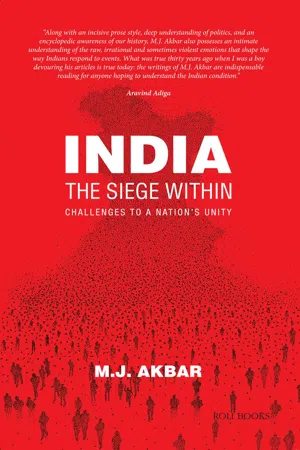
India: The Seige Within
About this book
Information


MJ Akbar is among those who have made a significant impact on Indian society by their writing, whether as authors or editors. Founder and Editor-in-Chief of the seminal newsmagazine, Sunday, in 1976, and The Telegraph in 1982, he revolutionized Indian journalism in the 1970s and 80s. In the 1990s he launched The Asian Age, a multi-edition daily that once again had substantive impact on the profession. He has also served as the Editorial Director of India Today, Headlines Today and as the editor of the Deccan Chronicle and the Sunday Guardian.
MJ, as he is popularly known, first entered public life in 1989, when he was elected to the Lok Sabha. He went back to media in 1993, and returned to the political area in 2014, when he joined the Bharatiya Janata Party (BJP) and became the party’s national spokesperson during the 2014 campaign led by Prime Minister Narendra Modi. In July 2016, he was named the Minister of State for External Affairs by Prime Minister Modi.
His seven books have achieved great international acclaim: Kashmir: Behind the Vale; India The Siege Within; Nehru: The Making of India; Riot-after-Riot; The Shade of Swords: Jihad and the Conflict between Islam and Christianity; Tinderbox: The Past and Future of Pakistan; and Blood Brothers, his only work of fiction. In addition, there have been four collections of his columns, reportage and essays.
OTHER TITLES BY MJ AKBAR
Blood Brothers: A Family Saga
Byline
Have Pen, Will Travel: Observations of a Globetrotter
Kashmir Behind the Vale
Nehru: The Making of India
The Shade of Swords: Jihad and the Conflict between Islam and Christianity
OTHER LOTUS TITLES
| Ajit Bhattacharjea | Sheikh Mohammad Abdullah: Tragic Hero of Kashmir |
| Anil Dharker | Icons: Men & Women Who Shaped Today’s India |
| Aitzaz Ahsan | The Indus Saga: The Making of Pakistan |
| Alam Srinivas & TR Vivek | IPL: The Inside Story |
| Amarinder Singh | The Last Sunset: The Rise & Fall of the Lahore Durbar |
| Amjad Ali Khan | My Father Our Fraternity: The Story of Haafiz Ali Khan |
| B.K. Trehan & Indu Trehan | Retired But Not Tired: Retirement Made Easy |
| Indira Menon | The Madras Quartet: Women in Karnatak Music |
| Jaiwant Paul | The Greased Cartridge: The Heroes and Villains of 1857-58 |
| John Lal | Begam Samru: Fading Portrait in a Gilded Frame |
| Lakshmi Vishwanathan | Women of Pride: The Devdasi Heritage |
| Roli Guide | |
| Madan Gopal | My Life and Times: Munshi Premchand |
| Madhu Trehan | Tehelka as Metaphor |
| Rachel Dwyer | Yash Chopra: Fifty Years in India Cinema |
| Ralph Russell | The Famous Ghalib: The Sound of my Moving Pen |
| Salman Akthar | The Book of Emotions |
| Sharmishta Gooptu | Bengali Cinema: An Other Nation |
| Shrabani Basu | Spy Princess: The Life of Noor Inayat Khan |
| S. Hussain Zaidi | Dongri to Dubai |
| Sunil Raman & Rohit Aggarwal | Delhi Durbar: 1911 The Complete Story |
| Swapan K. Bandyopadhyay | An Unheard Melody: Annapurna Devi an Authorised Biography |
| Thomas Weber | Going Native: Gandhi’s Relationship with Western Women |
| Thomas Weber | Gandhi at First Sight |
| Zubin Mehta | Zubin Mehta: The Score of My Life |
| FORTHCOMING TITLE | |
| Shahrayar Khan | Bhopal Connections: Vignettes of Royal Rule |
| Aruna Roy | The RTI Story: A People’s Movement for Transparency |
ROLI BOOKS
This digital e published in 2018
First published in 2003 by
The Lotus Coll on
An Imprint of Roli Books Pvt. Ltd
M-75, Greater Kailash- II Market
New Delhi 110 048
Phone: ++91 (011) 40682000
Email: [email protected]
Website: www.rolibooks.com
Copyright © M.J. Akbar, 2003
All rights reserved.
No part of this publication may be reproduced, transmitted, or stored in a retrieval system, in any form or by any means, whether electronic, mechanical, print reproduction, recording or otherwise, without the prior permission of Roli Books. Any unauthorized distribution of this e-book may be considered a direct infringement of copyright and those responsible may be liable in law accordingly.
eISBN: 978-81-9360-097-9
All rights reserved.
This e-book is sold subject to the condition that it shall not, by way of trade or otherwise, be lent, resold, hired out, or otherwise circulated, without the publisher’s prior consent, in any form or cover other than that in which it is published.
For Ammiji and Abbaji with love and gratitude
CONTENTS
Introduction
I. THE BIRTH OF PAKISTAN AND THE SURVIVAL OF INDIA
1. The Rationale of 1947
2. Mullah Power in Pakistan
3. Masters, Not Friends
4. The Believer
5. ‘Is the Weather Freezing?’
6. A Home for Gandhi’s Soul
7. The Rise of the Jailbird
8. The Man Who Changed the Map of India
9. The Roll-Call of Honour
10. The Great River
11. Past and Future
II. PUNJAB
1. The State of a Problem
2. An Old Fear
3. A Faith and Two Religions
4. Punjab versus Delhi: The First Sikh Homeland
5. The Identity Crisis
6. ‘Pagri Samhal, Jatta’
7. The Complex Minority
8. The Bargain Hunters
9. The Politics of Faith
10 Searching for Khalistan
11. Jarnail Singh Bhindranwale
12. Punjab: Death of a General
III. KASHMIR
1. Democracy in Paradise
2. Kings and Peasants
3. The Lion of Kashmir
4. Raiders of the Lost Cause
5. Nothing Proved
6. To Die an Indian
7. The Second Trial
8. Guilty till Proved Innocent?
9. ‘Glory to Mother Bharat’
10. A Phenomenon of Democracy
Index
INTRODUCTION
Carving up countries and kingdoms is as old as history. Boundaries, until quite recently, were no more than a measure of military strength or royal/national ambition. Partition was therefore the unsurprising fate of the defeated, or the merely unfortunate.
Before Europe set out to carve the world, it was busy carving itself up. The process was partially parallel; as some European powers seized the world, others tried to seize Europe. The logic of conquest in the tumult of nineteenth-century Europe often demanded partition. When wars were won by alliances, a division of the spoils became necessary. Victors supped on the vanquished, and sated themselves until their mistakes or miscalculations led to another shift in the balance of power, and perhaps role reversal. A country unlucky enough to be both strategically placed and weak, like Poland, was continually being redistributed in the name of someone else’s security. Maps were redrawn at great conferences or in secret deals, where greed, deceit, chicanery and maneuvering between kings and diplomats were far more complex than the comparatively straightforward encounters between generals on a battlefield.
The defeat of Napoleon, and the end to the havoc he created throughout Europe, released the energy of the victors for different, and dramatic, pursuits. The prevailing impetus of the age was empirical, in both the direct and implied senses of the term. Colonial rampage and expansion soon acquired a moral halo as victory fed notions of superiority which in turn were attributed to divine reward for earthly merit. The white man’s burden was easily nourished by sermons. Imperceptibly, the divine right of kings morphed into the divine right of races.
The two major victors of the Napoleonic wars were Britain and Russia. Whether because of the accident of geography, or the craft of good sense, they got out of each other’s way. Britain chose the sea routes to build her empire; Russia stretched towards the vast landmasses of the east and Muslim Central Asia. The pace of expansion echoed the sweep of Muslim armies in the seventh and eighth centuries and the Mongols of Chengiz Khan four centuries later.
France, understandably, withdrew from the race for the world, in which it had been heavily engaged before the Napoleonic storms; but later resurfaced to pick up parts of Africa and a nerve centre of South East Asia. Italy was too fragmented through the nineteenth century to be a world power. Spain stuck to the west of the Pope’s Line drawn in the fifteenth century to keep Spain and Portugal out of conflict with each other: Spain was assigned the Atlantic and Portugal the Indian oceans. Portugal consolidated her rich African colonies and Indian outposts.
Two European powers disturbed this comfortable distribution of the world. Austria and Germany sought their empires in Europe, leaving East Europe and West Asia to their World War I ally, the Ottomans of Turkey. As Austria waned in the nineteenth-century Germany waxed, united and energized. Germany’s ambitions sought space both to its east and west. It took two wars, the first a bit mistakenly called a world war, in the first half of the twentieth century for German ambition to self-destruct. The 1914–1918 war was bitter, costly, brutal and inconclusive because Germany, although defeated, was not ready to accept defeat.
Nor was the post-war world ready for a new order. America was as uncertain about the consequences of victory in 1918 as Germany was obstinate about her rejection of defeat. Britain, weakened, was yet to lose the arrogance of a nineteenth-century master race. The victors of World War I had no ideas beyond greed as they began to salivate over the carcass of the Ottoman empire and the colossal reserves of oil in the Arab and Persian deserts. It was still bright, but this was the evening light of the long English summer day. Winston Churchill might insist that the sun would never set on the British empire, but the vision of his class was impaired.
The British ruling class, a thin upper crust, could neither see the social upheaval created by the war at home, nor recognize the power of giants beginning to stir in the colonies. Mahatma Gandhi, with his acute eye, reached out to the British working class, even after boycotting their manufacture, and found a warm response. From their different perspectives, the workers of Britain and the enslaved of the colonies had one thing in common: both were hostile to the traditional British ruling class. Both wanted change. And both would get it at the same time, immediately after the World War II. It was not a coincidence that India became free when a Labour government was in power. Winston Churchill, after leading his country to victory in 1945, led his Conservative Party to a rout in the subsequent general election. He ruefully remarked, when given the Order of the Bath by the King for his wartime services, that he had been given the Order of the Boot by the people.
When the British got the Order of the Boot from India they did not leave without a reverse flick. It was called Partition. A reverse flick is always more subtle. It did not kill, but it tore off vital parts; and it left septic wounds that time failed to heal.
Partition, we have noted, was a price paid by losers in European wars. The idea was inversed by Europe’s victors when they began to colonize Asia and Africa. Partition was pointless in a colony, since the purpose was economic exploitation. The colonizers were not coy. Rabindranath Tagore, who preferred a poet’s unity between East and West rather than a revolutionary’s confrontation, could not but quote from a book that laid down the West’s colonial doctrines for Africa. I quote from Tagore’s famous essay, written in 1922, East and West:
The time has come when Europe must know that the forcible parasitism which she has been practicing upon the two large continents of the world – the two most unwieldy whales of humanity – must be causing to her moral nature a gradual atrophy and degeneration. As an example, let me quote the following extract from the concluding chapter of ‘From the Cape to Cairo’, by Messrs Grogan and Sharp, two writers who have the power to inculcate their doctrines by precept and example. In their reference to the African they are candid, as when they say, “We have stolen his land. Now we must steal his limbs.” These two sentences, carefully articulated, with a smack of enjoyment, have been more clearly explained in the following statement, where some sense of that decency which is the attenuated ghost of a buried conscience, prompts the writers to use the phrase ‘compulsory labour’ in place of the honest word ‘slavery’; just as the modern politician adroitly avoids the word ‘injunction’ and uses the word ‘mandate’. “Compulsory labour in some form,” they say, “is the corollary of our occupation of the country.” And they add: “It is pathetic, but it is historic,” implying thereby that moral sentiments have no serious effect in the history of human beings.
The British came to India when it was a ragman’s quilt and they patched as many pieces of it as they could. Goodwill played less part in the expansion of their empire than opportunity, and then the need to defend the economic gains of conquest. They used the wealth of India to conquer India; and the rewards of conquest were shared with home. The British were the only foreigners to rule India who had “home leave”; for those before them, India became home. Even if the Kushan, Turk, Afghan or Mughal was not born in India he died in India; if India was not his janmabhumi it was at least his mrityubhumi, and consequently the matrabhumi of his children. Before the British the wealth of any empire remained in the country.
There is a difference between those who came to India merely to loot, like Mahmud of Ghazni or Nadir Shah; and those who came to rule, whether the Kushans of eastern China or the Afghans beyond the Hindu Kush, or the Mongol-Turks of Central Asia. The British were unique: they fused the two, seamlessly. A statistic tells the story perhaps better than an...
Table of contents
- India Seige Within
Trusted by 375,005 students
Access to over 1.5 million titles for a fair monthly price.
Study more efficiently using our study tools.
Frequently asked questions
Yes, you can cancel anytime from the Subscription tab in your account settings on the Perlego website. Your subscription will stay active until the end of your current billing period. Learn how to cancel your subscription
No, books cannot be downloaded as external files, such as PDFs, for use outside of Perlego. However, you can download books within the Perlego app for offline reading on mobile or tablet. Learn how to download books offline
Perlego offers two plans: Essential and Complete
- Essential is ideal for learners and professionals who enjoy exploring a wide range of subjects. Access the Essential Library with 800,000+ trusted titles and best-sellers across business, personal growth, and the humanities. Includes unlimited reading time and Standard Read Aloud voice.
- Complete: Perfect for advanced learners and researchers needing full, unrestricted access. Unlock 1.5M+ books across hundreds of subjects, including academic and specialized titles. The Complete Plan also includes advanced features like Premium Read Aloud and Research Assistant.
We are an online textbook subscription service, where you can get access to an entire online library for less than the price of a single book per month. With over 1.5 million books across 990+ topics, we’ve got you covered! Learn about our mission
Look out for the read-aloud symbol on your next book to see if you can listen to it. The read-aloud tool reads text aloud for you, highlighting the text as it is being read. You can pause it, speed it up and slow it down. Learn more about Read Aloud
Yes! You can use the Perlego app on both iOS and Android devices to read anytime, anywhere — even offline. Perfect for commutes or when you’re on the go.
Please note we cannot support devices running on iOS 13 and Android 7 or earlier. Learn more about using the app
Please note we cannot support devices running on iOS 13 and Android 7 or earlier. Learn more about using the app
Yes, you can access India: The Seige Within by MJ Akbar in PDF and/or ePUB format, as well as other popular books in Politics & International Relations & Asian Politics. We have over 1.5 million books available in our catalogue for you to explore.