E. Jaiwant Paul is a man of varied interests, having authored eight other books, including Rani of Jhansi, The Story of Tea, The Unforgettable Maharajas, Har Dayal: The Great Revolutionary (co-author Shubh Paul), Arms and Armour: Traditional Weapons of India, Annals and Antiquities of Rajasthan and The Greased Cartridge. He is on the expert panel on weapons for several museums of Rajasthan. A hardcore corporate, he initially worked for Hindustan Unilever and was later Director of Brooke Bond, India. Thereafter he headed the National Mineral Water Company in Muscat, Oman. A keen cricketer and tennis player, he now lives in Delhi.
- 125 pages
- English
- ePUB (mobile friendly)
- Available on iOS & Android
eBook - ePub
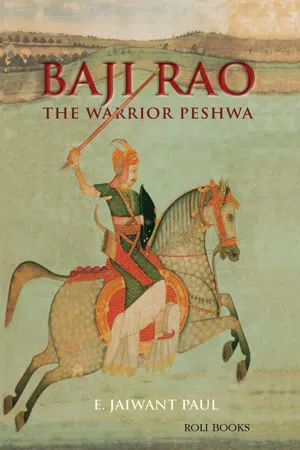
Baji Rao: The Warrior Peshwa
About this book
Trusted by 375,005 students
Access to over 1.5 million titles for a fair monthly price.
Study more efficiently using our study tools.
Information

BAJI RAO
THE WARRIOR PESHWA
OTHER TITLES BY E. JAIWANT PAUL
Annals & Antiquities of Rajasthan
By My Sword and Shield: Traditional Weapons of the Indian Warrior
Har Dayal: The Great Revolutionary
The Greased Cartridge: The Heroes and Villains of 1857-58
The Story of Tea
OTHER LOTUS TITLES
| Adi B. Hakim, Rustom B. Bhumgara & Jal P. Bapasola | With Cyclists Around The World |
| Ajit Bhattacharjea | Sheikh Mohammad Abdullah: Tragic Hero of Kashmir |
| Anil Dharker | Icons: Men & Women Who Shaped Today’s India |
| Aitzaz Ahsan | The Indus Saga: The Making of Pakistan |
| Ajay Mansingh | Firaq Gorakhpuri: The Poet of Pain & Ecstasy |
| Amarinder Singh | The Last Sunset: The Rise & Fall of the Lahore Durbar |
| Hamish Mcdonald | Ambani & Sons |
| John Lal | Begam Samru: Fading Portrait in a Gilded Frame |
| Lakshmi Vishwanathan | Women of Pride: The Devdasi Heritage |
| Lucy Peck | Agra: The Architectural Heritage |
| Lucy Peck | Delhi a Thousand Years of Building: An INTACH-Roli Guide |
| Madan Gopal | My Life and Times: Munshi Premchand |
| M.J. Akbar | Byline |
| M.J. Akbar | Blood Brothers: A Family Saga |
| Maj. Gen. Ian Cardozo | Param Vir: Our Heroes in Battle |
| Maj. Gen. Ian Cardozo | The Sinking of INS Khukri: What Happened in 1971 |
| Madhu Trehan | Tehelka as Metaphor |
| Monisha Rajesh | Around India in 80 Trains |
| Noorul Hasan | Meena Kumari: The Poet |
| Peter Church | Profiles in Enterprise: Inspiring Stories of Indian Business Leaders |
| Rajika Bhandari | The Raj on the Move: Story of the Dak Bungalow |
| Ralph Russell | The Famous Ghalib: The Sound of my Moving Pen |
| R.V. Smith | Delhi: Unknown Tales of a City |
| Salman Akthar | The Book of Emotions |
| Sharmishta Gooptu | Bengali Cinema: An Other Nation |
| Shovana Narayan | Kathak |
| Shrabani Basu | Spy Princess: The Life of Noor Inayat Khan |
| S. Hussain Zaidi | Dongri to Dubai |
| Sunil Raman & Rohit Aggarwal | Delhi Durbar: 1911 The Complete Story |
| Thomas Weber | Going Native: Gandhi’s Relationship with Western Women |
| Thomas Weber | Gandhi at First Sight |
| FORTHCOMING TITLES | |
| Kunal Purandare | Ramakant Achrekar: A Biography |
BAJI RAO
THE WARRIOR PESHWA
E. JAIWANT PAUL

ROLI BOOKS
This digital edition published in 2016
First published in 2016 by
The Lotus Collection
An Imprint of Roli Books Pvt. Ltd
M-75, Greater Kailash- II Market
New Delhi 110 048
Phone:++91 (011)40682000
Email: [email protected]
Website: www.rolibooks.com
Copyright © E. Jaiwant Paul
All rights reserved.
No part of this publication may be reproduced, transmitted, or stored in a retrieval system, in any form or by any means, whether electronic, mechanical, print reproduction, recording or otherwise, without the prior permission of Roli Books. Any unauthorized distribution of this e-book may be considered a direct infringement of copyright and those responsible may be liable in law accordingly.
eISBN: 978-93-5194-120-0
All rights reserved.
This e-book is sold subject to the condition that it shall not, by way of trade or otherwise, be lent, resold, hired out, or otherwise circulated, without the publisher's prior consent, in any form or cover other than that in which it is published.
To The Memory of
My Mother and Father
My Mother and Father
Contents
Prologue
The Mughals – Decadence and Decline
Nizam ul Mulk – Tiger of the Deccan
Rebuilding Maratha Might
Baji Rao Emerges
The Spectacular Palkhed Campaign
Conquest of Malwa
Generals to the Fore
Victory in Gujarat
Chattarsal’s Tryst with Baji Rao
Mesmerised by Mastani
Kanhoji Angre – Naval Strong Arm of the Marathas
Subjugation of the Portuguese
Brothers at Arms
A Strategist without Equal
Closing Years
Appendix
Glossary
Prologue
This is the story of Peshwa Baji Rao, the great Maratha general and statesman, who in the mid-eighteenth century changed the map of India. He transformed the Maratha nation state into an empire. His military genius and policy of extending the Maratha power towards north India had far-reaching and spectacular results and enabled the Marathas, within the next 25 years, to plant their bhagwa or swallow-tailed, deep orange coloured flag on the Indus.
Brave as a tiger and handsome as a god, Baji Rao was also a fascinating character. A man like him is difficult to explain in terms of heritage, training or upbringing. He was perhaps endowed with unusual yearnings of the life-force or with an unquenchable ambition and fervour that spurred him to struggle with destiny. In medieval times, conquests and victories in battles were the most charismatic of accomplishments. Born with a sword in his hand, Baji Rao became a legend while still a young man and tragically died while still in his prime.
Baji Rao had a galaxy of contemporaries, both friends and adversaries, who have left their mark on history. This is, therefore, necessarily also the story of the other great personages like Nizam ul Mulk, the distinguished founder of Hyderabad state; Sawai Jai Singh of Jaipur, general, statesman, astronomer and town planner; Kanhoji Angre, the daredevil naval commander who made life a misery for the English and the Portuguese; Raja Chattarsal, the heroic king who carved out an independent kingdom in Bundelkhand; and this is also the story of Mastani, Chattarsal’s daughter and Baji Rao’s great love. The paths of all these remarkable and dramatic people crossed, but each one of them was overshadowed by Baji Rao’s achievements and they owe their place in history mainly in relation to him. Other players in the drama are Ranoji Scindia, Malharrao Holkar, Udaiji Pawar and Pilaji Gaikwad, distinguished generals and founders of the great states of Gwalior, Indore, Dhar and Baroda.
In this account the markers of history are not ignored; sometimes, however, the stories of these great men, whose lives intertwined, come to the fore and dominate. But then history walks into these stories and steals the scene without the thunder of a cannon or beat of a kettledrum. Occasionally, the chronological order of events has been ignored to make the storytelling better.
After the death of Aurangzeb in 1707, the fortunes of the Marathas, particularly Baji Rao, became closely linked with those of Delhi. The later Mughals, who were nearing the end of their journey, therefore, provide the historical backdrop for this pageant. Here was one of the greatest empires on earth declining slowly into hopelessness and tragedy. The reigns of the six Mughal Emperors after Aurangzeb extended to a mere 41 years. Some were imbeciles, others degenerates, and they only hastened the demise of the dynasty. The country was at the crossroads of history and at that critical juncture, Peshwa Baji Rao marched on to the stage. Over the next two decades he dominated the scene conquering Gujarat, Malwa and Bundelkhand and even leading his army to imperial Delhi, while the Mughal Empire sank into decay and decline. Though Baji Rao had sworn to plant his flag on the Indus, death robbed him of this honour. His sons, however, after driving the Afghans out of the Punjab, fulfilled their father’s pledge.
This book is about war; of battles on land and battles at sea; of the thundering peal of cannons and the hailstorms of musket shots; of brilliant-bladed talwars and razor-sharp lances; of heroism and glory and cowardice and intrigue; of palaces and fortresses; and even of love. But then that was Baji Rao – the Warrior Peshwa.

Mastani – the love of Baji Rao’s life
Courtesy: Nisha and Karan Grover
The Mughals – Decadence
and Decline
and Decline
Baji Rao was a general without equal and his life was war; he spent it on the battlefield or in camp or on horseback. He had promised to raise the Maratha flag on the banks of the Indus in the north and the Krishna in the south. This inevitably meant continuous warfare with the Mughals in the north and Nizam ul Mulk in the Deccan. How could the Peshwa of a petty Maratha state take on the might of the Empire? The answer lies in the total decadence and decay of the later Mughals. Their sad story, therefore, sets the stage and must be told first. I have dwelled here upon the foibles of the later Mughals to illustrate the degeneration that had taken place in this once proud and powerful dynasty.
With the death of Emperor Aurangzeb ended the saga of one of the most magnificent and powerful empires in the world. The grand edifice which Akbar had built up and Shah Jahan and Aurangzeb had extended, tumbled down like a house of cards at the first whiff of adversity which an incompetent and spineless progeny could not face. The treasury was soon empty and the army became defeatist and past hope. The government could not control its subjects and the administration broke down. Aurangzeb was actually responsible himself for starting this dreadful decline by, what is today called, his fundamentalist religious policy and his never-ending military misadventures. His successors were all men of straw, who could do little to remedy the situation. Forty years after Aurangzeb, the Mughal Empire broke up into independent or semi-independent parts. This story of Aurangzeb’s successors is intricate because there are numerous actors who rose to prominence or even to sovereignty every few years and the game of intrigue and counter-intrigue went on all the time at the imperial court.
Aurangzeb had rightly feared that a civil war would break out among his sons. He is said to have left a will, which was found under his pillow, directing his three sons, Muzzam, Azam and Kam Baksh, to partition the empire peacefully. That was a vain hope. Muzzam tried to avoid war and he offered to meet his brother, Azam, in single combat and leave it for the sword to decide the issue. Azam declined saying, ‘Two swords cannot be kept in one scabbard.’
In the ensuing war of succession, Azam and Kam Baksh were killed in separate battles and Muzzam became Emperor of Hindustan with the title of Bahadur Shah. He was 65 when he came to the throne and his was a short reign. Khafi Khan, the chronicler of the times, called Bahadur Shah the Shah-a- be-Khabr or the Heedless King. During his reign the Rajputs were disaffected, the Sikhs and Jats were getting more militant and most important, the Maratha insurgency was growing in the south with the Marathas making devastating raids as far north as Malwa. The break-up of the Empire had started.
During his lifetime Bahadur Shah had always lived in fear of death or imprisonment, a fate that had overtaken some of his brothers and this must have unhinged his mind, for he suddenly issued an eccentric and a needlessly cruel order – one of several such orders – to destroy every dog in Lahore.
His death in 1712 was followed by another war of succession among his four sons. Three of them lost their lives in three sharp battles and Jahandar Shah ascended the throne. ‘In the brief reign of Jahandar Shah,’ observes Khafi Khan, ‘violence and debauchery had full sway. It was a fine time for minstrels and singers and all tribes of dancers and actors’ Jahandar Shah was besotted by a dancing girl, Lal Kunwar. He raised her to the status of a queen. She was much too beautiful to be cautious or wise. Lal Kunwar, despite her name, was a Muslim descended from Mian Tansen on the paternal side and from Rupmati and Baz Bahadur of Mandu from the maternal side.
Jahandar Shah was totally under the influence of this wanton woman. For four months they had Delhi and the banks of the Jamuna illuminated every evening with earthen oil lamps. So much oil was used that its price became exorbitant and finally, all oil in Delhi was expended. The Emperor and Lal Kunwar then took recourse to clarified butter (ghee) for the lamps, until that too ceased to be procurable. The citizens of Delhi, meanwhile, suffered as prices of all essential commodities spiralled.
One day, Jahandar Shah and Lal Kunwar were on the roof of the palace in the Lal Killa watching the traffic on the river. A boat full of people was crossing the swollen river.
Lal Kunwar said, ‘I have never seen a boat load of men go down.’
The besotted Jahandar Shah replied, ‘My love, we must widen your experience.’
An order was immediately given and the boat was toppled in the middle of the fast-flowing river, and out of the 80 people only nine could swim to the safety of the bank. Another story goes that after a night of carousing and drinking in the city, Jahandar Shah and Lal Kunwar were brought back to the palace in a carriage. Lal Kunwar was carried up to her chamber by her women, while Jahandar Shah lay in a drunken stupor on the floor of the carriage. The driver, assuming that the Emperor had disembarked, took the carriage to the rath khana or the coach house. When it was found that the Emperor was missing, there was alarm in the palace and people went running in all directions. Lal Kunwar had to be woken up and she vaguely remembered seeing Jahandar Shah asleep on the floor of the carriage. The officials finally rescued Jahandar Shah from the coach house and had him carried up to his chamber. But next morning the driver of the carriage was publicly hanged. Such were the Emperors of Hindustan at the time.
Jahandar Shah’s reign was a short one. He became a plaything in the hands of his prime minister and other nobles of the court. The most savage atrocities were committed in the name of justice. Chiefs and nobles who had fought against him and alongside his brothers in the war of succession, were cut to pieces limb by limb. Others were decapitated and their bodies thrown to dogs and vultures for a meal.
The scenes changed rapidly soon after. Farrukhsiyar was a nephew of Jahandar Shah and his father had been defeated and killed by Jahandar Shah in the war of succession. Farrukhsiyar, overcoming his fears, decided to avenge the death of his father. He had no friends; the treasure chest was empty and he had no army. His only hope was to get the support of the two influential brothers, Sayyid Hussain Ali Baraha and Sayyid Abdullah Khan Baraha, who were governors of Bihar and Allahabad, respectively. They were under a debt of gratitude to Farrukhsiyar’s father as it was only due to him that they had been given the governorship of the two provinces. Farrukhsiyar threw his turban at their feet and promised them the most important positions in the Empire if they helped him. The Sayyid brothers, ambitious, avaricious and full of guile, thought this was an opportunity not to be missed. They knew Jahandar Shah was a man of straw and could be defeated. Hussain Ali held Farrukhsiyar by the shoulders and said, ‘The throne of Hindustan is yours.’ The brothers soon raised a powerful army, composed mainly of their kinsmen in the upper doab region between the Ganga and the Jamuna. Jahandar Shah tried frantically to muster an army to meet the advancing rebels. His biggest problem was lack of money. The royal soldiery had not been paid for months and they refused to march without pay. In desperation, Jahandar Shah’s officers broke up gold and silver vessels from the palace, passed out immensely valuable jewels from the treasuries and even ripped gold and silver from the walls and ceilings of the palace to meet the emergency. There was total confusion in Delhi and the bankruptcy of the Mughals became painfully apparent.
In December 1712, the opposing armies met face to face at Samugarh near Agra. Jahandar Shah’s son, Azizuddin, in charge of the advance guard, was so frightened that he fled before the action could start. Other top commanders of Jahandar Shah, including the powerful Jat chief Chabela Ram, decided to take no part in the battle and marched away. Chin Quilch Khan, better known as Nizam ul Mulk (who dons an important role later in this book), was a vital part of Jahandar Shah’s army. He crossed over with his contingents to the enemy. The elephant on which Jahandar Shah rode, bolted after being hit and Jahandar Shah made the crucial mistake of jumping on to the back of a horse. The men lost sight of him and word went around that the Emperor had been killed. There was total confusion in Jahandar Shah’s army. The Sayyid brothers had won the day.
Jahandar Shah was strangled in the Delhi Fort in 1713; his head was cut off and placed on a tray and presented to Farrukhsiyar. It was then paraded through the city on a pole stuck atop an elephant.
Farrukhsiyar, the young handsome prince, gay and winsome but also cowardly, deceitful and cruel, was seated on the Peacock Throne or the Takht-ai-Taus in 1713. During his seven-year reign, little was achieved, and his court was a den of intrigues, conspiracies and treachery. He would never have worn the robes of an Emperor but for the help he received from the powerful Sayyid brothers, Abdullah and Hussain. Knowing their own strength, they took control and became the uncrowned kings, while Farrukhsiyar became a mere puppet. The latter resented this deeply and tried every trick and treachery in the book to win over the other powerful nobles of the kingdom and overthrow the Sayyids. The latter, however, were always one step ahead of the Emperor and foiled every attempt.
The Sayyid brothers were Indian-born Muslims who had settled in Baraha in the Saharanpur and Meerut districts of Uttar Pradesh. The name ‘Baraha’ was derived from the 12 villages their family held originally. They prided on being Hindustani Muslims rather than foreigner Muslims in the services of the Mughals. They were also Shias, which was another cause of estrangement with the Mughals who were Sunnis. They were sympathetic to the Hindus and felt closer to them than the foreigners of their own faith. They maintained large personal armies against whom the imperial forces were not a match because the government treasuries were empty. This military superiority of the Sayyids rendered Farrukhsiyar totally powerless. After Farrukhsiyar’s accession, Abdullah was appointed Vazir or Prime Minister and Hussain, Bakshi or Commander-in-chief. Thus the brothers combined civil and military authority and wielded total power. This led to much jealousy among the foreign elements at court.
Time and again Farrukhsiyar was caught out in his attempts and conspiracies at stabbing the brothers in the back. Each time he would cringe and crawl before them and swear on everything holy that it would not happen again. But the undeclared war carried on. Farrukhsiyar was getting quite paranoid about any attempts the Sayyids might make at replacing him. In a despera...
Table of contents
- Baji Rao
Frequently asked questions
Yes, you can cancel anytime from the Subscription tab in your account settings on the Perlego website. Your subscription will stay active until the end of your current billing period. Learn how to cancel your subscription
No, books cannot be downloaded as external files, such as PDFs, for use outside of Perlego. However, you can download books within the Perlego app for offline reading on mobile or tablet. Learn how to download books offline
Perlego offers two plans: Essential and Complete
- Essential is ideal for learners and professionals who enjoy exploring a wide range of subjects. Access the Essential Library with 800,000+ trusted titles and best-sellers across business, personal growth, and the humanities. Includes unlimited reading time and Standard Read Aloud voice.
- Complete: Perfect for advanced learners and researchers needing full, unrestricted access. Unlock 1.5M+ books across hundreds of subjects, including academic and specialized titles. The Complete Plan also includes advanced features like Premium Read Aloud and Research Assistant.
We are an online textbook subscription service, where you can get access to an entire online library for less than the price of a single book per month. With over 1.5 million books across 990+ topics, we’ve got you covered! Learn about our mission
Look out for the read-aloud symbol on your next book to see if you can listen to it. The read-aloud tool reads text aloud for you, highlighting the text as it is being read. You can pause it, speed it up and slow it down. Learn more about Read Aloud
Yes! You can use the Perlego app on both iOS and Android devices to read anytime, anywhere — even offline. Perfect for commutes or when you’re on the go.
Please note we cannot support devices running on iOS 13 and Android 7 or earlier. Learn more about using the app
Please note we cannot support devices running on iOS 13 and Android 7 or earlier. Learn more about using the app
Yes, you can access Baji Rao: The Warrior Peshwa by Jaiwant E Paul in PDF and/or ePUB format, as well as other popular books in History & Historical Biographies. We have over 1.5 million books available in our catalogue for you to explore.