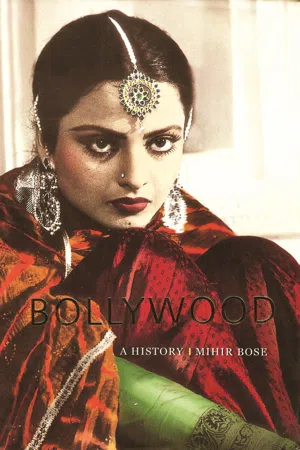
Hollywood may define our idea of movies, but it is the city of Bombay on the west coast of India that is now the centre of world cinema. Every year, the Indian film industry produces more than 1, 000 feature films; every day, 14 million Indians go to a movie in the country; a billion more people a year buy tickets for Indian movies than for Hollywood ones. The rise of Bombay as the film capital of the world has been both remarkable and amazing. Bollywood movies themselves are a self-contained world with their multiple song and dance routines, intense melodrama, and plots that contain everything from farce to tragedy, but always produce a happy ending. The men and women who created these movies are even more remarkable; and it is this fantastic, rich, diverse story, a veritable Indian fairyland, that Mihir Bose, a native of Bombay, tells with vivid brilliance in the first comprehensive history of this major social and cultural phenomenon.
- 380 pages
- English
- ePUB (mobile friendly)
- Available on iOS & Android
eBook - ePub
Bollywood: A History
About this book
Information
Subtopic
Film History & CriticismPart I

In Step with the World
1
The Creators
Modern India has always been haunted by the thought that it gets Western inventions late, long after the West has moved on to better and more advanced things. E.M. Forster’s novel, A Passage to India, ends with the main English character, Henry Fielding, taunting the main Indian one, Aziz, about India’s desire to be an independent country. Fielding snorts, “India a nation. What an apotheosis. Last comer to the drab nineteenth-century sisterhood. Waddling in at this hour of the world to take her seat. She, whose only peer was the Holy Roman Empire, she shall rank with Guatemala and Belgium perhaps.”
Yet, cinema has been different. It came to India less than seven months after the first film was shown in Paris. Cinema was born on 28 December 1895 and, as luck would have it, India’s name was associated with the birth of film. The venue the Lumière brothers, Auguste and Louis, chose to show their short programme was the Salon Indien, located in the basement of the Grand Café at 14, Boulevard des Capucines in Paris. The organisers had gone to great lengths to make the venue look Indian, with the lavish basement hall decorated with sumptuous Oriental rugs. But there was so little confidence that this new invention would catch on that the owner of Salon Indien, Mr Volpini, refused an offer of 20% of the takings, preferring instead to charge the Lumière brothers thirty francs a day. Despite a man standing outside the building, handing out posters all day, and the cost of the show pegged to a franc, only thirty-three paid customers were attracted. It was a cold day in Paris and that may have put people off, but the fact is, the majority of the hundred who filled the basement seats did not pay for the privilege.
Nor was the beginning particularly encouraging. As the lights dimmed and a photographic projection depicted the doors of the Lumières’ photographic factory at Lyon, a murmur of disappointment went round the room: “Why, it is only the old Magic Lantern.” But then they saw a new magic on the white backdrop: moving pictures. The gates opened, workers rushed out, followed by dogs and, suddenly, a whole new world began to emerge. One scene called ‘Condeliers’ Square’, which showed a moving hansom cab, was so realistic that a woman in the audience jumped to her feet as the picture of the hansom cab moved nearer and she had the impression it would rush at her through the screen. ‘Baby’s Dinner’, showing Auguste and his wife feeding their infant daughter, also made an impression, in particular with the swaying trees in the background, which made the audience feel they could hear the rustling of the leaves. In all, ten different scenes, with each reel seventeen metres in length, were shown. As the show ended, and the lights came on, the audience broke into cheers. Slow as the first day’s taking had been, the shows quickly caught on and soon the brothers were making 2,000 francs a day. Salon Indien had got a hit.
The brothers were keen to advertise their products and quickly sent films and projections far and wide to every continent. The result was that on 7 July, 1896, the same day the new invention was being shown to the Tsar of Russia in St Petersburg, Bombay enjoyed the experiences that had first alarmed, and then so thrilled, the Paris audience.
India had to thank geography for this. Maurice Sestier, the Lumières’s man, was on his way to Australia and had to stop over in Bombay. Nevertheless, it meant that when it came to the cinema, India was part of a global phenomenon right from the beginning and did not come waddling in late, long after it was old news in the West. Contrast this with other nineteenth century inventions: the typewriter and the automobile. Both came to India for the first time the same year as the cinema, but the patent for the typewriter had been granted thirty years earlier, and the car had been in existence for more than a decade in the West before the first one was seen in Bombay.
On that June morning in 1896, The Times of India , then a British-owned paper in Bombay, had carried an advertisement asking Bombay residents to witness “the marvel of the century, the wonder of the world” at Watson’s Hotel. There would, said the paper, be four showings of “cinematographe,” living photographic pictures in lifestyle reproductions at 6,7, 9 and 10 pm.
Watson’s was the ideal place to display this new invention representing, as it did, all that was chic and exclusive in British Bombay. The building itself had been the first iron-framed building in the city, made of cast-iron pillars and tiers of wrought-iron galleries, which had moved Mark Twain, who had stayed there during his visit to the city, to describe it as “something like a huge birdcage… risen like an exhalation from the earth.” The hotel was then the best hotel in Bombay and, like many of the best British clubs and hotels in the Raj, not open to Indians. The story in Bombay was that the hotel had a sign saying Indians and dogs not allowed and Jamshetji Nusserwanji Tata, the founder of the great Tata industrial empire of India, had been turned away from Watson’s because of the colour of his skin. He reacted by building the Taj and putting up a sign saying British and cats not allowed. The story of racial discrimination may have been embellished in the endless retelling, perhaps even apocryphal, although it illustrated how the Indians responded to the undoubted racism and belief in white supremacy that formed such an essential part of the British Raj.
The British in India operated, as the Indian writer Nirad Chaudhuri has said, an apartheid system. Watson’s was located on the Esplanade, that part of Bombay which was European in conception, and where the British had their homes and their businesses, and where Indians were allowed on sufferance. Within walking distance was the Bombay Gymkhana, an English club where the British went to relax and play sports and which did not allow Indians as members. But thirty-eight years after Watson’s showed the first film in India, the Bombay Gymkhana would be the venue for the first ever cricket Test match between India and England, seating Indian spectators in special tents and marquees. It would take the Gymkhana another thirty years, long after Indian independence, to open its club-house to the Indians. The apartheid the British practised in India could never be as total and as monolithic as that imposed by whites in South Africa or in the southern states of America. If it made Indians feel inferior in their own land, it also had cracks through which Western ideas and recreations could seep through. In the 1930s, it meant cricket Tests between India and England, at a time when the blacks in America could not play baseball with their fellow whites. It was fourteen years later, in 1947, the year of Indian independence, that Jackie Robinson became the first black man to play major league baseball and the so-called invisible Negro leagues, which had catered for blacks, slowly disappeared. In 1896, the cracks in British apartheid brought film to India.
That evening at Watson’s, the audience saw six short films, including the one that had so astounded the Paris audience—a train coming into the station: L’Arrivée d’un gare de la Ciotat (The Arrival of a Train at La Ciotat Station). With a camera held near the track, this showed a train gradually increase in size as it pulled into the station until the audience thought it would crash through the screen. It was so realistic that some in that Paris saloon had ducked,while others had vacated their seats in a hurry. The reaction of the Bombay audience matched that of the Paris one.
The Bombay Gazette of July 9 described the evening and the effect the films had on that first night Bombay audience:
The view included the arrival of a crowded train at a railway station with all the animation and bustle that such an event presents, and the demolition of a wall—a work so realistic that the dust is seen to ascend in volumes when the wall finally totters and falls. The Sea Bath is another very good scene: the dashing of waves upon the beach, and the antics of the boy bathers, both being very realistic. But this is beaten by Leaving the Factory, which brings a whole crowd of moving humanity onto the canvas and is, without doubt, the most realistic scene of all. Ladies and Solders on Wheels is a very vivid representation of the cycling craze, as can be seen any day in Hyde Park. No one who takes an interest in the march of science should allow the opportunity to pass that now presents itself to see the cinematograph, an invention which is attracting a great deal of attention at home.
Cinema, as the critic Amita Malik has written, could not have arrived at a better time for India. It was the turn of the century, there were urban masses eager for mass entertainment and the cinema with its direct visual impact, easy accessibility and its relatively straightforward themes seemed “the natural answer.”
The screenings at Watson’s generated enough excitement for more showings and these began a week later, on 14 July, at Novelty Theatre, which had a larger seating capacity. It was meant to be for three days but growing public interest meant the screenings continued for several weeks, with the shows regularly advertised in The Times of India and receiving good reviews. The programme was also increased from twelve to twenty-four films. The façade of the theatre was floodlit and under the direction of the organist at St John’s Church in Colaba, a certain F. Seymour Dove, a “selection of suitable music” was provided.
Novelty sought to attract Indians by catering to both the prevailing social customs, a feature of which was lack of emancipation for women, and their capacity to pay. By the end of July, the cinema advertised “Reserved boxes for the Purdah ladies and their families” and they even had zenna shows where the cinema was open only to women. They also offered a broad scale of prices. The first screening had a single admission price but, by the end of the month, prices ranged from a low of four annas (25 paise, about .02 of a penny) to a high of two rupees (about I5p).
The Indians the British exhibitors hoped to attract in the main were the Parsis. They had fled to India around the eighth century AD, after the fall of the pre-Persian Sassanian Empire to the conquering Muslims, arriving by ship to the Western coast of the Indian sub-continent (now Gujarat) to maintain their Zoroastrian religious tradition. The Parsis tell a charming story of how they got asylum in India, one that has lessons for immigration controllers the world over. According to this old Parsi legend, the Raja of Sanjan, the local Hindu king, had given them a cup full to the rim of milk, symbolically stating that the kingdom was already full of people and could not take any refugees. The asylum seekers sweetened the milk with sugar and gave it back to the king, symbolically stating that they would be of immeasurable service to the kingdom and become exemplary subjects of the Raja. The Raja allowed them to keep their customs and traditions, provided they did not try to proselytise, and this Hindu tolerance proved so successful that, although they had lived in India for centuries, they never really lost their identity, or became submerged into the majority Hindu community. Their custom of fire worship was even adopted by Akbar, the greatest of India’s Mughal Emperors. When the European traders started arriving in the sixteenth century, they found the Parsis willing collaborators; by the time the British became masters of India in the eighteenth century, the Parsis were the ideal middle men, both in commerce and the social field. Despite having lived in India for 1200 years they portrayed themselves as interlopers and sought common cause with the latest interlopers, the British. Even today, the Indians talk about the Parsi love for the British and a popular joke is about the Parsi matron referring to “our Queen” but “your President”
It was the Parsis who were to pioneer both industrial development and cricket in India, but a month into the showing of the Lumière films, on 5 August 1896, The Times of India felt sufficiently concerned about lack of Parsi zeal for film shows to write an editorial rebuking “our Parsi friends” for not taking greater interest in this new medium. It appears that despite the four anna tickets and the attention to purdah ladies, it was mainly the British in Bombay who turned up for the screenings.
The Times of India was being hasty in its judgment. The Parsis would take to films and were some of the early pioneers of the industry but, initially, it was a member of the majority Hindu community who showed the greatest enthusiasm for this new medium. He was a Maharashtrian called Harischandra Sakharam Bhatvadekar, also known as Save Dada. Dada means older brother and is a term of respect. Photographs of him, taken when he was well into his old age, show a man sporting a circular turban denoting his high Brahmanical caste, a large tilak mark on his forehead and his gaunt, skinny, hollow-cheeked face lit up with wonderful luminous eyes which shone through his horn-rimmed glasses. These eyes had been dazzled by the screenings of the Lumière brothers at Novelty and the shrewd businessman in him quickly saw the potential. He was already a professional still-photographer and was so taken by this new invention that he ordered a motion picture camera from London at a price of twenty-one guineas. This was, probably, the first such imported equipment to arrive in the country.
His first use of this camera was to photograph a fight between two famous wrestlers, Pundalik Dada and Krishna Nahvi, at Bombay’s Hanging Gardens, which he then sent to London for processing. Meanwhile, he had also brought a projector and become an open air exhibitor of imported films, showing them in a tent cinema he owned. From the beginning, Bhatvadekar realised that only Indian films would not attract audiences, so he exhibited his wrestler’s film, along with some imported ones. He kept to this formula for many shows, mixing imported shorts with a film that focused on the training of circus monkeys and another on the fire temples of the Parsis.
In 1901, he filmed the arrival back in India of Sir Mancherjee Bhownaggree, the second Indian to be elected to the House of Commons, and the first from the Conservative party. Bhownaggree had just been re-elected to the House, having first won election in the 1895 election. That election had also seen the defeat of the first Indian ever to be elected to the House—...
Table of contents
- Cover
- Bollywood
- Other Lotus Titles:
- Title
- Dedicate
- Copyright
- Contents
- Mihir Bose Biography
- Acknowledgements
- Prologue
- Part I: In Step with the World
- Part II: When Bollywood was like Hollywood: The Studio Era
- Part III: Minting Film Gold in Bombay
- Part IV: A Laugh, a Song and a Tear
- Part V: Anger and After
- Bibliography
- List of Illustrations
- Index
Trusted by 375,005 students
Access to over 1.5 million titles for a fair monthly price.
Study more efficiently using our study tools.
Frequently asked questions
Yes, you can cancel anytime from the Subscription tab in your account settings on the Perlego website. Your subscription will stay active until the end of your current billing period. Learn how to cancel your subscription
No, books cannot be downloaded as external files, such as PDFs, for use outside of Perlego. However, you can download books within the Perlego app for offline reading on mobile or tablet. Learn how to download books offline
Perlego offers two plans: Essential and Complete
- Essential is ideal for learners and professionals who enjoy exploring a wide range of subjects. Access the Essential Library with 800,000+ trusted titles and best-sellers across business, personal growth, and the humanities. Includes unlimited reading time and Standard Read Aloud voice.
- Complete: Perfect for advanced learners and researchers needing full, unrestricted access. Unlock 1.5M+ books across hundreds of subjects, including academic and specialized titles. The Complete Plan also includes advanced features like Premium Read Aloud and Research Assistant.
We are an online textbook subscription service, where you can get access to an entire online library for less than the price of a single book per month. With over 1.5 million books across 990+ topics, we’ve got you covered! Learn about our mission
Look out for the read-aloud symbol on your next book to see if you can listen to it. The read-aloud tool reads text aloud for you, highlighting the text as it is being read. You can pause it, speed it up and slow it down. Learn more about Read Aloud
Yes! You can use the Perlego app on both iOS and Android devices to read anytime, anywhere — even offline. Perfect for commutes or when you’re on the go.
Please note we cannot support devices running on iOS 13 and Android 7 or earlier. Learn more about using the app
Please note we cannot support devices running on iOS 13 and Android 7 or earlier. Learn more about using the app
Yes, you can access Bollywood: A History by Mihir Bose in PDF and/or ePUB format, as well as other popular books in Media & Performing Arts & Film History & Criticism. We have over 1.5 million books available in our catalogue for you to explore.