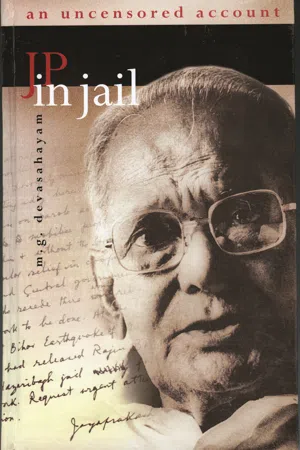
When Indira Gandhi declared a state of Emergency in 1975, the people of India were deprived of their freedom and fundamental rights. The event remains a dark chapter in the history of the sub-continent. Jayaprakash Narayan, branded 'Enemy No.1' of the state, was arrested under Maintenance of Internal Security Act (MISA) and dispatched to Chandigarh's 'Emergency Jail'. Faced with the state's brute force, individuals and institutions surrendered and the world's largest democracy was drifting towards dictatorship. JP, who had tirelessly toiled for the triumph of freedom, dared the might of Emergency dictatorship and fought to restore democracy in India. During JP's six-month confinement, India's 'Second Mahatma' transformed defeat into triumph; the 'Delhi Durbar' indulged in a series of intrigues to isolate and incapacitate him, and reconciliation between Indira Gandhi and JP was sabotaged by a 'coterie' wielding 'veto power'. A riveting first-person, authentic and uncensored account by M.G. Devasahayam, who as district magistrate and inspector-general, prisons, at the time, was in effect JP's custodian, and closely associated with him throughout his confinement.
- 316 pages
- English
- ePUB (mobile friendly)
- Available on iOS & Android
eBook - ePub
JP in Jail: An Uncensored Account
About this book
Trusted by 375,005 students
Access to over 1.5 million titles for a fair monthly price.
Study more efficiently using our study tools.
Information
1
From Democracy to Autocracy -
India under Emergency
India under Emergency
At the dawn of 26 June 1975, Union Territory of Chandigarh was so normal that I had gone for my usual morning tennis work out and was back home around 8 a.m. My wife Aspil informed me that M.L. Bhanot, Senior Superintendent of Police had called and had said it was urgent. As was my wont, I switched on the radio to listen to the morning news. But instead of news, I heard a tight and tense voice of Mrs Indira Gandhi addressing the nation and saying something about ‘grave threat to the country and the need for drastic steps’. I felt that something was amiss and called up Bhanot to find out what was happening. What he told me shook me a bit.
Like in the rest of the nation, the night of 25-26 June has been one of high drama at Chandigarh though on a mini-scale. It reflected the deep depravity into which the governance of the country had been pushed in the name of ‘national security’. On verbal directions from the Delhi Durbar, Giani Zail Singh, Chief Minister of Punjab had called up Mr N.P. Mathur, Chief Commissioner of Chandigarh past midnight to say that Emergency had been declared and press had to be severely disciplined. He was specific that The Tribune should be sealed and should not be allowed to come out that morning. Zail Singh even wanted the arrest of Mr Madhavan Nair, infirm but fiercely independent editor of The Tribune, a household name in the Northwestern states of Punjab, Haryana, Himachal Pradesh, Jammu & Kashmir and the Union Territory of Chandigarh.
Deeply rattled, Mathur called Union home secretary Mr S.L. Khurana, who had no clue as to what was happening. The same was the response from Mr Srinivasa Varadan, Additional Home Secretary. Mathur’s attempts to contact the Union home minister Brahmananda Reddy and minister of state Om Mehta did not bear fruit. As chief commissioner, Mathur was head of the Chandigarh Union Territory and should get orders or instruction from Government of India and not chief minister of Punjab. Mathur would have been in the right if he had ignored the instructions and carried on as usual. At best he could have called me and passed on the buck since as district magistrate, I was responsible for law and order and issuance of orders if any regarding the sealing of The Tribune or arresting its editor.
In his despair, Mathur obviously forgot these minor procedures and instead called Bhanot and passed on the instructions of Zail Singh. Bhanot was certainly not willing to carry out the wishes of the Punjab chief minister blindly. Nevertheless he went through the motion of going to The Tribune premises and advised those on duty not to print any news unpalatable to the ‘powers-that-be.’He also posted a small posse of policemen to keep a watch on the press.
Obviously this did not have much impact on The Tribune and the morning paper came out as usual. This infuriated another chief minister residing in Chandigarh – Chaudhry Bansi Lal of Haryana. In his inimitable style he threatened that if Chandigarh administration was not willing to raid The Tribune, seal its premises and arrest its editor, he will get it done through the Haryana Police. For this purpose he would not even hesitate to ‘takeover’ The Tribune premises and buildings if need be! Indeed, the heady brew of the Emergency had commenced its task of intoxicating!
I as the district magistrate had been kept in the dark about the happenings during the hours of darkness. I made a mental note that this was not going to happen again lest governance got messed up in the name of Emergency. Information was trickling in about the nocturnal signature of the President declaring Emergency without Union Cabinet’s endorsement and the preventive detention of top leaders like Jayaprakash Narayan, Morarji Desai, Atal Behari Vajpayee and others even before the declaration was signed. Though news censorship had been clamped, The Tribune was displaying in their spot news the arrest of JP and Morarji Desai. As we in the Chandigarh administration – chief commissioner N.P. Mathur, home secretary G.V. Gupta, legal remembrancer A.P. Chaudhury, senior superintendent of police M.L. Bhanot and self, district magistrate M.G. Devasahayam – got together for the first Crisis Group meeting, we were clueless as to what was happening and what we need to do.
With rumors spreading like wild fire there was the danger of law and order situation in the city going out of control. Prompted by the Delhi Durbar, both chief ministers were breathing down our neck and could virtually take over the administration and also seal The Tribune if they decided to gang up. To ward off these eventualities I decided to take charge despite absence of any official communication from the Central Government regarding imposition of the Emergency or any other instruction. I swiftly obtained a copy of the Emergency notification from deputy director, Intelligence Bureau, Chandigarh:
To be Published in the Gazette of India Extraordinary
Part II - Section 3 - Sub-section (I)
No. II/16013/1/75-S&P (D.II)
Government of India / Bharat Sarkar
Ministry of Home Affairs / Grih Mantralaya
New Delhi 110001, dated 26 June 1975.
Notification
Part II - Section 3 - Sub-section (I)
No. II/16013/1/75-S&P (D.II)
Government of India / Bharat Sarkar
Ministry of Home Affairs / Grih Mantralaya
New Delhi 110001, dated 26 June 1975.
Notification
G.S.R. 353(E). The following Proclamation of Emergency by the President of India, dated 25 June 1975, is published for general information:
Proclamation of Emergency
In exercise of the powers conferred by clause (1) of Article 352 of the Constitution, I, Fakhruddin Ali Ahmed, President of India, by this Proclamation declare that a grave emergency exists whereby the security of India is threatened by internal disturbances.
Sd/- F.A. Ahmed
President
New Delhi, 25 June 1975.
Sd/-
(S.L. Khurana)
Secretary
New Delhi, 26 June 1975.
Moving fast I imposed prohibitory orders under Section 144 of the Criminal Procedure Code throughout the Union Territory. On my recommendation Mr S.K. Tuteja, Director, Public Relations, Chandigarh administration was appointed as censor officer, invoking the provisions of Defense of India rules. A Joint Planning Committee was constituted under the Internal Security Scheme for continuous monitoring of events.
By evening things were getting clearer and some instructions on Emergency and censorship had come. S.V. Bedi, Senior Correspondent of The Tribune along with Lt. Gen. P.S. Gyani, Trustee called on Mathur and promised to adhere to the censorship rules. This and the other steps initiated by us helped in warding off the onslaughts from Zail Singh and Bansi Lal, both vying for the privilege of being close to the Delhi Durbar.
Initial defiance to the Emergency came in different shapes. The sense of stupor on the face of the people, the choice epithets against the Emergency masters and the ‘sound of silence’ by the press. The Tribune was published with bland censored news. Hindi and Urdu newspapers from Jullundur came out with blank pages with the words ‘censor ka bendh’ (gift of the censor) printed in all pages. Hindustan Times from New Delhi left the entire editorial column blank, reminiscent of pre-independence days of struggle against alien rule. Veer Pratap, a Hindi daily from Jullundur was more poignant. On the 26 June issue the editorial page was blank with an Urdu couplet rubber stamped all over. Translated it meant: ‘I can neither anguish nor petition; it is my fate to choke and die.’
As news of ‘Emergency in action’ started coming in, one was left with the feeling that the country’s hard earned freedom from foreign hegemony was being extinguished and a parliamentary democracy was being turned into personal autocracy. As the Constitution of India, particularly the fundamental rights stood suspended, citizens had no personal liberty. Citizens did not even have the ‘right to live’ as later ruled by the honorable Supreme Court! Maintenance of Internal Security Act (MISA), enacted in the wake of Indo-Pak War 1971 was amended to vest district magistrates with awesome powers to arrest and detain any one without showing cause. All that needed to be done was to compile a reasonable dossier of activities injurious to law & order or ‘security of the state.’
We, the bunch of bureaucrats running the Chandigarh administration had nothing to prove and no laurels to seek from the political masters. So we decided to be very objective and cautious in exercizing the Emergency powers particularly that of preventive detention under MISA. The decision was not to arrest any one under MISA unless there was indisputable and convincing evidence of threat to law and order or security of the state. In the initial days Chandigarh Police confined themselves only to routine rounding up of anti-social elements under Section 107/151 of Cr.P.C.
Though we went through the Internal Security drill with special instructions to college principals and Punjab University authorities to remain vigilant, the quiet and the silence was jarring. Emergency was nowhere in evidence and everything was calm and quiet. Only that one could discern an undercurrent of fear and anxiety in the minds of the people as they went about their routine chores.
The Emergency was bad in itself. But the worst thing is that it ripped apart the delicately crafted and carefully nurtured democratic fabric of a poor nation, wherein lived one-sixth of the human race. Basic violations of the democratic spirit and the crude attempts to legitimize a new type of regime and new criteria of allocation of rights and obligations were more central to what the Emergency was about than arrest and torture of a few thousand individuals. It was the abrogation of any sense of boundary or restraint in the exercise of power, and the striking growth of arbitrariness and arrogance with which citizens were turned into subjects that was at issue.
Far more pertinent than this act of imposition of an Emergency regime is the manner in which the nation almost capitulated, to a man, with so few exceptions in such a vast land. There were no doubt protests and acts of both courage and imagination. All these were individual ‘heroics’, which is all that these individuals could do. But they hardly had any great impact on the course of things. But there was one individual called Jayaprakash Narayan and the action of this individual did have great impact not only on India’s polity but on the country’s history as well.
2
JP in Chandigarh –
‘A prisoner in despair’
‘A prisoner in despair’
On the morning of 1 July 1975, Tuteja dropped in my office and said that something was brewing in Delhi and the ‘most important leader in custody’ would be my honored guest at PGI. I did not take it seriously, but nevertheless called Dr P.N. Chuttani, Director PGI for confirmation. He was down with flu and had no clue. He wished the news was not true since it would spoil his ‘golf holiday’ to Gulmarg scheduled for the next week! I left it at that.
Suddenly there was flurry of activities and telephone calls back and forth leading to our Crisis Group meeting at 6 p.m. What Tuteja mentioned about ‘floating news’ in the morning now became official instruction. Jayaprakash Narayan, ‘Enemy No. 1’ of the state and the most prominent leader in detention was being shifted to Chandigarh and he would be brought in a special aircraft that evening itself. Mathur was excited and a bit surcharged. Obviously, because Mathur had worked with JP during the Bihar famine and they belonged to the same kayastha caste. Instructions from the Union home ministry were that JP was to be received at the Chandigarh airport and put up at the PGI.
We – Gupta, Bhanot and me – swung into action and within minutes landed at the PGI guest house where JP would be lodged pending regular arrangement. Dr Y.N. Mehra, ENT Specialist and Superintendent of the Nehru Hospital attached to the PGI was already there along with his team. We had a quick conclave and instructions were given to spruce up the main bedroom on the ground floor, repair the air conditioner and vacate the adjacent room and the building opposite all in a jiffy. Within minutes work started in full swing.
We quickly firmed up the security and policing arrangements. It was decided to notify the guest house as temporary jail under Section 417 Cr.P.C. and post jail officials at the inner perimeter. Police was to man the outer perimeter and provide the necessary security. As a matter of abundant caution it was decided to disconnect the telephone line.
The ETA of the flight bringing JP was 9.30 p.m. at the Air Force technical bay. Therefore we had enough time to listen to Mrs Gandhi’s address to the nation unveiling her famous ‘20-point Economic Programme’ meant to transform India’s economy and banish poverty from its soil. It was a typical case of packing ‘old wine in new bottle’ and a wish list of clichés. This rehashed programme was to serve as the ‘economic balm’ for the political body blow delivered in the form of the Emergency. This document became the ‘Bible of sycophants’ and a convenient cover to justify the ravaging of India’s democracy under the slogan ‘bread is more important than freedom.’
After listening to the PM’s discourse, Bhanot and myself reached the Air Force station at 9.15 p.m. Station commander, air commodore Bhasin and his colleague wing commander Nanda were already there. We briefed them about the mission and who was coming since they had no information. They told us about the delay in the flight and the revised ETA of 10.30 p.m. The wait was long and we spent the time strolling on the runaway.
At 10.35 p.m. the aircraft landed and we were on the tarmac near the ladder. First the superintendent of police from Delhi accompanying JP came down to hand over the relevant papers to his counter part in Chandigarh. Then I saw the frail old man coming down the steps clad in immaculate white. I shook hands with JP introducing others and myself in the reception team. I felt that the old man was perplexed and my introductions had not registered with him.
My staff car pulled in near the ladder and I asked JP to sit inside as I attended to the paper work like the transfer warrant (D – 1) at the lounge. When I returned after five minutes JP was still standing outside, leaning on the door of the car. He was concerned about the safety of his luggage consisting of two brief cases. The SP from Delhi showed both the bags to JP and put them in the luggage boot. We proceeded to the PGI guest house accompanied by Dr M.L. Bhatia who had come from All India Institute of Medical Sciences (AIIMS) and reached at about 11 p.m.
The guest house was ready in all respects. Dr Mehra and his team along with the jail doctor conducted a quick medical check up on JP and found everything OK. They also had discussion with Dr Bhatia. Since JP said that he had his meal we took leave of him after assigning the guest house caretaker and one of my orderlies (Manohar Lal) to attend to the old man. JP asked me whether I was going back to Delhi. I clarified that I was the district commissioner of Chandigarh and Bhanot was the Senior Superintendent of police. Now JP understood and profusely apologized for the mix up.
I had a brief meeting with executive magistrate Mohinder Singh, who was also the superintendent of Chandigarh sub-jail, R.D. Sharma, Assistant Superintendent of jail, the deputy superintendent of police (headquarters) and law officials and formally signed the orders declaring the PGI guest house as sub-jail enabling jail officials to take charge of the inner perimeter.
During our meetings in the evening Gupta had conveyed the directive from Delhi Durbar that on ‘depositing’ JP at the PGI guest house, I should report to Mr Bansi Lal, the then Chief Minister of Haryana and a key member of the ruling Emergency coterie. As I returned home my wife told me that Bansi Lal had called and left message that I should talk to him urgently. When I called him up, his attitude was haughty and his instructions were terse, ‘ye salah apne aapko hero samajtha hai. Vus ko wahin pade rehne do. Kisi se milne ya telephone karne nahin dena. Aap hi kadam ho jayaga’ (This damn fellow thinks he is a hero. Let him lie there. Don’t allow him to meet anybody or telephone any one. He will be finished this way). The same night Gupta conveyed to me another message from Bansi Lal that JP should not be allowed to take a walk in the open between sunrise and sunset. Though this callous attitude and crude language of Bansi Lal as well as his direct interference put me off, I did not give it much importance. But later events were to reveal as to how ominous these remarks and these instructions turned out to be!
I was at the PGI guest house early next morning. JP was sitting in his room in spotless white kurta. He received me with a warm handshake though he did not recognize as to who I was. I had to introduce myself all over again. On my query about his health, JP replied that he was feeling all right except for some fatigue, since he did not sleep well being a...
Table of contents
- Cover
- About the book
- About the author
- Title
- Copyright
- Book Name
- Contents
- Foreword
- Acknowlegements
- Author’s Preface
- 1 From Democracy to Autocracy – India under Emergency
- 2 JP in Chandigarh – A Prisoner in Despair
- 3 Death Drill for JP and Exile for Chandrashekhar
- 4 Why Emergency – Indira Gandhi Vs Jayaprakash Narayan
- 5 Coming to Terms with Confinement
- 6 JP dares PM – ‘I am content to die a prisoner’
- 7 JP Introspects
- 8 Introspection Leads to Ailment
- 9 Emergency’s Fascist Face
- 10 JP Concedes Defeat, Declares Fast Unto Death, Retracts
- 11 An Emergency Master and His Mindset
- 12 As Bihar Reels Under Flood, JP Petitions PM for Parole
- 13 Bihar Drowns, for Indira it is Politics!
- 14 Opening a Door for Reconciliation
- 15 Can JP Stop Sanjay Gandhi Becoming Prime Minister?
- 16 JP holds Out Olive Branch
- 17 First Step Towards Reconciliation – JP Writes to Sheikh ‘Mohammed’ Abdullah
- 18 The Mountain Moves – Special Emissary Arrives to Test the Waters
- 19 Kamaraj Passes Away
- 20 Hope in Reconciliation, JP Unveils his Political Framework
- 21 Time to Take Stock
- 22 Indira Atones for Emergency
- 23 Reconciliation Efforts Sabotaged? Is JP’s Life in Danger?
- 24 The Unresolved Mystery
- 25 Pursuing Reconciliation and JP’s release
- 26 The Tale of Two Orders – Release, and Parole
- 27 JP – A Free Citizen, Yet in Fetters
- 28 From Defeat to Defiance – JP Departs Chandigarh
- 29 JP Returns India to Freedom
- Epilogue: ‘Lest We Forget’
- Annexure: Letters
- Back Cover
Frequently asked questions
Yes, you can cancel anytime from the Subscription tab in your account settings on the Perlego website. Your subscription will stay active until the end of your current billing period. Learn how to cancel your subscription
No, books cannot be downloaded as external files, such as PDFs, for use outside of Perlego. However, you can download books within the Perlego app for offline reading on mobile or tablet. Learn how to download books offline
Perlego offers two plans: Essential and Complete
- Essential is ideal for learners and professionals who enjoy exploring a wide range of subjects. Access the Essential Library with 800,000+ trusted titles and best-sellers across business, personal growth, and the humanities. Includes unlimited reading time and Standard Read Aloud voice.
- Complete: Perfect for advanced learners and researchers needing full, unrestricted access. Unlock 1.5M+ books across hundreds of subjects, including academic and specialized titles. The Complete Plan also includes advanced features like Premium Read Aloud and Research Assistant.
We are an online textbook subscription service, where you can get access to an entire online library for less than the price of a single book per month. With over 1.5 million books across 990+ topics, we’ve got you covered! Learn about our mission
Look out for the read-aloud symbol on your next book to see if you can listen to it. The read-aloud tool reads text aloud for you, highlighting the text as it is being read. You can pause it, speed it up and slow it down. Learn more about Read Aloud
Yes! You can use the Perlego app on both iOS and Android devices to read anytime, anywhere — even offline. Perfect for commutes or when you’re on the go.
Please note we cannot support devices running on iOS 13 and Android 7 or earlier. Learn more about using the app
Please note we cannot support devices running on iOS 13 and Android 7 or earlier. Learn more about using the app
Yes, you can access JP in Jail: An Uncensored Account by M.G. Devasahayam in PDF and/or ePUB format, as well as other popular books in History & 20th Century History. We have over 1.5 million books available in our catalogue for you to explore.