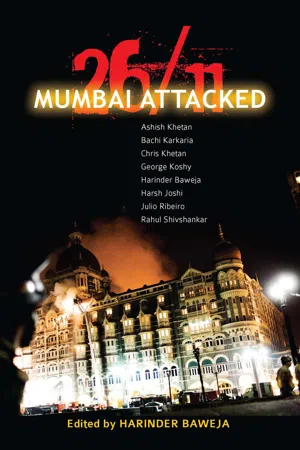
Bringing together the careful research and analyses of renowned journalists and police officials, 26/11 Mumbai Attacked explicates the reality behind the brazen attack on India's sovereignty in November 2008 when ten heavily armed terrorists held an entire city to ransom by the sheer force of their zealotry. The scene-by-scene accounts, incisive analyses, and an exclusiveinterview with a LeT representative along with a description of its training camp in Muridke, Pakistan, reveal how the failure of Indian intelligence agencies landed Mumbai in the quagmire of terrorism. Paying homage to the brave security officers who lost their lives fighting the terrorists, 26/11 Mumbai Attacked reiterates the chilling reality that India is under grave threat and the clock is ticking before the next big attack.
eBook - ePub
26/11 Mumbai Attacked
- 224 pages
- English
- ePUB (mobile friendly)
- Available on iOS & Android
eBook - ePub
26/11 Mumbai Attacked
About this book
Information
‘Inflict maximum damage and don’t be taken alive.’
Karachi to Mumbai: Terror, Step by Step
ASHISH KHETAN
The First Interrogation
Additional Commissioner Tanaji Ghadge is fifty-one and more than half his age has gone into policing. A smile always lingers on his cherubic face but tonight it is sombre, almost mournful. Dyed black hair parted neatly down the side and hands held across the chest, he is staring into the camera, waiting for the cue. Above his right shoulder, the word ‘Police’ is painted on the wall in Marathi, in bold black letters. He is seated at a police desk outside the emergency ward of the Nair Hospital, a corner assigned to the police for fulfilling legal formalities and paperwork for cases involving accidents, shootout injuries, anything that falls under medico-legal cases. The time is 1 a.m., the date 27 November 2008.
On cue, Ghadge begins: ‘I am the additional commissioner of Girgaum division. There were incidents of indiscriminate firing at the Taj Mahal hotel, the Oberoi hotel and the VT station last night which appear to be a well-coordinated terror attack. In an encounter with the police at Girgaum Chowpatty one terrorist has been killed while another has suffered injuries and has been brought to the hospital. It is important to interrogate him and therefore I am proceeding to question him.’
Next frame. A youth, seemingly in his early twenties, lies prone on a green plastic, the sheet being a protection from bloodstains for the white sheet that covers a mattress. A fine brown blanket has been pulled close to the chest of the young man who lies naked underneath. His thick mop of hair, greasy and dishevelled, is pressed against the bed’s headrest. Wheatish in complexion, the youth is well built – round arms, pumped-up biceps, and thick neck. His clean-shaven oval face bears a high forehead. There is a fresh injury on the chin smeared with an ointment, and a sledge-shaped bandage covers the right side of his neck. Apart from both the arms, which are bandaged from wrist to biceps, the torso bears no injury. He shows no signs of physical pain, only his forehead is creased and eyes are tightly shut, the stiffness of his face making clear that he is not asleep.
‘Maine bahut galat kiya (I have committed a big mistake),’ move the parched lips, catching a glimpse of the policeman walking into the room before shutting his eyes again. No question was posed, but Ghadge’s walking in inspired the unsolicited admission.
‘On whose instance?’
‘Chacha ke kehne pe. (At the behest of Uncle.)’ Eyes still closed; the voice betraying an effort to exhibit pain and earn empathy, more beseeching than replying.
‘Who is this uncle?’ Ghadge is staring down with bewilderment, still standing by the right side of the bed, near the young man’s shoulder.
‘The one from Lashkar.’
‘Lashkar what? Which village he is from?’
‘I don’t know about his village. But he has an office … he keeps visiting the office,’ the voice relaxes for a second.
‘Who sent you here?’
‘My father said we were very poor … our condition would improve … we will have food to eat … clothes to wear,’ an emotional explanation, an excuse embedded in the reply.
‘Was he your real father?’ an incredulous Ghadge enquires.
‘Real father … real father,’ the man seemed determined to condemn his father.
‘What’s your name?’ asked Ghadge, a fountain pen ready to scribble on a writing pad.
‘Ajmal.’
‘What’s your age?’
‘Twenty-one.’
‘Where is your gaon (village)?’
‘Faridkot in tehsil Depalpur (administrative division), district Okara.’
‘Who all are there in your family?’
‘Mother … sisters.’
‘Mother’s name,’ asks Ghadge, hardly looking at him, concentrating hard on the writing pad.
‘Noor Illahi.’
‘Her age?’
‘Wahi koi chaalis ke aas paas. (Must be around forty years.)’
‘What’s your father’s name?’ Ghadge continues.
‘Amir,’ eyes still closed, head at ninety degrees to the pillow, body, hands and legs stiff like dead.
‘What’s his father’s name?’
‘Shahban.’ His eyelids open for a split of a second before closing again.
‘What’s the surname?’
‘Kya? (What?)’
‘What’s the surname? Khandaan ka naam kya hai?’ Ghadge makes his question simpler.
‘Kasab.’
‘Are you a butcher?’
‘No. We are not in this business … just the name has stuck.’
‘So, Amir Shahban Kasab, that’s your father’s name.’
‘Yes.’
‘What’s his age?’
‘Somewhere around forty-five years,’ head jerks a trifle, before stiffening again.
‘What does your father do?’
‘He sells dahi-wade. Sometimes in the village … . sometimes he goes to Lahore city … . It’s difficult to run the family,’ Kasab now opens his eyelids, catching a glimpse of his interrogator from the corner of his eyes.
‘How many brothers are you?’ Ghadge determined to know every bit about his family.
‘Hum teen bhai hai. (We are three brothers.)’
‘What are the names of your brothers?’
‘Afzal and Munir.’
Questions and answers continue like this in one-liners.
‘What are their ages?’
‘Afzal is around four years elder to me. Munir is around four years younger to me.’ The recording and remembrance of age he seems to do only in relative terms.
‘Which means Afzal is twenty-five and Munir is eighteen?’ Ghadge gets his math wrong with the younger brother’s age.
‘Haan sahab. (Yes, sir.) You can deduce that,’ Kasab not the least interested to correct him.
‘What do your brothers do?’
‘Afzal works as a farm labourer in the village itself,’ Kasab replies with a groan, remembering he is injured and in pain.
‘Is Afzal married?’
‘Yes. He is married to Safia. He has two children: one son and one daughter. Son’s name is Ali. He must be around seven to eight years. Daughter’s name I don’t know. She is just one-year-old. She was born when I was away from home for training. I don’t know what they have named her,’ Kasab, for the first time makes a departure from one-line replies.
‘Where is Safia’s paternal home?’
‘She is my maternal uncle’s daughter. They are from Lahore.’
‘What’s the name of the village?’
‘There is no village. They stay in Lahore city. At Safawala Chowk, near Nizam Adda in Lahore. Her father’s name is Manzoor. She now stays with her parents. They had a fight, my brother and his wife. After that she stays with her parents,’ Kasab, on his own, provides the unsolicited information about the break-up between his brother and his wife.
‘Why was there a fight?’ Ghadge asks, showing interest.
‘Don’t know exactly. Paise ke kharche ko lekar jhagda hua hoga. (Must have been over how money was being spent.)’ Kasab puts it down to the money, or the lack of it.
‘Where did you say her father’s home is?’
‘At Safawala Chowk, near Nizam Adda in Lahore. I have been there many times. After getting off at Nizam Adda it’s quite close by. It’s near a bank.’
‘What’s the name of the bank?’
‘Don’t know; it is a big bank. Anybody will tell you.’
‘What does Munir, your second brother, do?’
‘Woh sakool-wakool jata hai. (He goes to some school.)’ Kasab doesn’t attach much importance to his younger brother’s occupation.
‘Sakool means?’ Ghadge fails to get Kasab’s pronunciation.
‘Sakool … sakool,’ Kasab tries his best, surprised the cop is not getting it.
‘Sakool … school, you mean?’
‘Yes.’
‘What about your sisters?’
‘I have two sisters – Rukaiya and Suraiya.’
‘Where are they?’
‘Rukaiya is married. She is around one and a half years elder to me. She lives with her husband in Pathankot.’
‘Where in Pathankot?’
‘It’s a small village, adjacent to Havelilakha. You ask anybody about my taye (elder uncle). His name is Nisaq. Anybody will tell you. It’s a small place.’
‘You said she is married?’
‘She is married to my taye’s son. Her husband’s name is Hussain.’
Ghadge, as if he has had enough of his family, skips enquiries about Kasab’s younger sister Suraiya and switches back to Kasab’s own life, at the time the centre of Ghadge’s curiosity and in days to come of an entire nation.
‘How much have you studied?’
‘Till fourth standard. In 2000 I quit sakool.’
‘Which school was it?’
A primary village sakool. In my village.’
‘And after that?’
‘I first worked as a labourer in my village. After some time I moved to Lahore and started working there.’
‘What labour job?’
‘Mazdoori. Cement, etc. Bricks, etc. Working with a mistri. Construction work. For five years I stayed in a mohalla called Tohidabad, gali number chauranja, makaan number baraah.’
‘Chauranja? One and four?’ Ghadge fails to get Kasab’s alien dialect.
‘No, chauranja: five and four,’ says Kasab correcting Ghadge, seeing that his wretched past is recorded correctly. ‘There was a subzi mandi close to that house. I stayed there till 2005, along with other labourers. We stayed there on rent. Now I have heard they have razed the quarters and constructed a building in its place.’
‘You came back to your village in 2005, after five years?’
‘In between also I made a few trips. But in 2005 I returned to my village.’
‘Then?’
‘Sometime in 2007 my father took me to Zaki chacha and asked me to work with him.’ Kasab, cutting straight to 2007 from 2005, skipped details of the two years in between.
‘Who is Zaki chacha?’
‘He is the big man of Lashkar.’
‘Where was his office?’
‘In my village. In Depalpur.’
Then Kasab, in an accusatory tone, added, ‘Zaki chacha would say: Work with me. You will bring a good name to your family. You will get money. It is Allah’s work.’ Kasab implies he never believed in what Zaki told him – either an honest admission or a clever ploy to blame it on Zaki, having been misled by him. ‘My father said: You will live the way they live. You will eat well. Clothe well. Live a life of comfort. Your brothers and sister will get married,’ says Kasab, implicating his father too.
‘You went along with Zaki.’
‘No, I worked at Lashkar’s office in the village … ‘...
Table of contents
- Cover
- About the Author
- Bookname
- Title
- Copyright
- memoriam
- Map
- contents
- Editor’s Note
- ‘They kept the soldier’s promise ...’
- ‘His pants were starched with coagulated blood ...’
- ‘Men, women and children ... Kasab’s AK-47 did not discriminate’
- ‘Assemble bed-sheets, carpets, mattresses, set them on fire.’
- ‘At the Tiffin restaurant there was blood, blown-out bits of flesh ... splattered on the floor.’
- ‘I went up assuming that my husband would follow me but he didn’t make it out of the door.’
- ‘Inflict maximum damage and don’t be taken alive.’
- ‘The Lashkar was obviously not using money to buy flowers for the Indian Army.’
- ‘Like that only and proud, no?’
- ‘The need is operational independence without political intervention.’
- ‘Shivraj Patil delayed the NSG flight by 45 minutes.’
- About book
- Insert
- Backcover
Trusted by 375,005 students
Access to over 1.5 million titles for a fair monthly price.
Study more efficiently using our study tools.
Frequently asked questions
Yes, you can cancel anytime from the Subscription tab in your account settings on the Perlego website. Your subscription will stay active until the end of your current billing period. Learn how to cancel your subscription
No, books cannot be downloaded as external files, such as PDFs, for use outside of Perlego. However, you can download books within the Perlego app for offline reading on mobile or tablet. Learn how to download books offline
We are an online textbook subscription service, where you can get access to an entire online library for less than the price of a single book per month. With over 1.5 million books across 990+ topics, we’ve got you covered! Learn about our mission
Look out for the read-aloud symbol on your next book to see if you can listen to it. The read-aloud tool reads text aloud for you, highlighting the text as it is being read. You can pause it, speed it up and slow it down. Learn more about Read Aloud
Yes! You can use the Perlego app on both iOS and Android devices to read anytime, anywhere — even offline. Perfect for commutes or when you’re on the go.
Please note we cannot support devices running on iOS 13 and Android 7 or earlier. Learn more about using the app
Please note we cannot support devices running on iOS 13 and Android 7 or earlier. Learn more about using the app
Yes, you can access 26/11 Mumbai Attacked by Ashish Khetan,Bachi Karkaria,Chris Khetan,George Koshy,Harsh Joshi,Julio Riberio,Rahul Shivshankar in PDF and/or ePUB format, as well as other popular books in Politics & International Relations & Terrorism. We have over 1.5 million books available in our catalogue for you to explore.