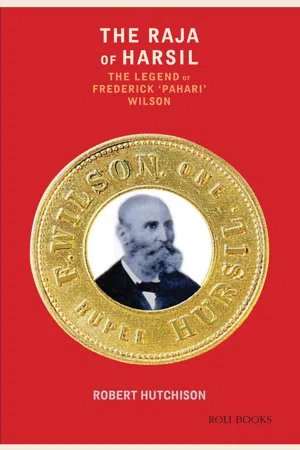
A young British officer deserted during the First Afghan War (1839-42) and went to ground in the wilds of Tehri-Garhwal. Frederick 'Pahari'Wilson changed the face of the region forever and became a Himalayan legend. He played a daring role in the Great Game, was witness to the Anglo-Sikh War of 1845 - when the British nearly lost India - and became a pioneering force in the great Indian Railways adventure. Capturing the humour of the petty world of officers'clubs in Meerut, Mussoorie and Shimla, the chill of stiff winds on the high passes into Tibet, and the hardships of life in the remote valleys of Garhwal, The Raja of Harsil is a thrilling account of that tumultuous and exciting period. Driven by personal ambition, Frederick Wilson introduced commercial timbering to the Himalayas and became India's first timber magnate. An avid hunter, ornithologist and botanist, he settled at Harsil, near the source of the Ganges, and shared the lives and destinies of the Garhwali people. He acquired enormous wealth - becoming the richest man in northern India - and famous as the 'raja'of Harsil before falling into disfavour - termed a pariah for plundering Garhwal of its wildlife and natural resources.
- 290 pages
- English
- ePUB (mobile friendly)
- Available on iOS & Android
eBook - ePub
The Raja of Harsil: The Legend of Frederick "Pahari Wilson"
About this book
Information


Robert Hutchison studied at McGill University in Montreal, Canada and interrupted his studies to travel and begin a career in journalism. A native of Quebec, he has lived in Switzerland for many years. He is fluent in English and French.
From 1961 to 1976, Hutchison was a correspondent for the Sunday and Daily Telegraph of London. He has also contributed articles to The Sunday Times (London) and The Smithsonian (Washington). His photos have appeared in leading publications around the world. He is the author of the following works: Vesco, Off The Books, Juggernaut, In the Tracks of the Yeti and Their Kingdom Come.
When not writing or photographing his favourite pastimes are ski-touring in the Alps and trekking in the Himalayas. While researching a feature article on the Garhwali activist Sunderlal Bahuguna in 1987 he fell in love with India’s Garhwal region and has visited the area many times since. ‘Mussoorie,’ he says, ‘is my second home.’
OTHER LOTUS TITLES
| Anil Dharker | Icons: Men & Women who Shaped Today’s India |
| Aitzaz Ahsan | The Indus Saga: The Making of Pakistan |
| Ajay Mansingh | Firaq Gorakhpuri: The Poet of Pain & Ecstasy |
| Alam Srinivas | Women of Vision: Nine Business Leaders in Conversation |
| Amarinder Singh | The Last Sunset: The Rise & Fall of the Lahore Durbar |
| Aruna Roy | The RTI Story: Power to the People |
| Ashis Ray | Laid to Rest: The Controversy of Subhas Chandra Bose’s Death |
| Bertil Falk | Feroze: The Forgotten Gandhi |
| Harinder Baweja (Ed.) | 26/11 Mumbai Attacked |
| Harinder Baweja | A Soldier’s Diary: Kargil – The Inside Story |
| Ian H. Magedera | Indian Videshinis: European Women in India |
| Kunal Purandare | Ramakant Achrekar: A Biography |
| M.J. Akbar | Blood Brothers: A Family Saga |
| Maj. Gen. Ian Cardozo | Param Vir: Our Heroes in Battle |
| Maj. Gen. Ian Cardozo | The Sinking of INS Khukri: What Happened in 1971 |
| Madhu Trehan | Tehelka as Metaphor |
| Manish Pachouly | The Sheena Bora Case |
| Moin Mir | Surat: Fall of a Port, Rise of a Prince, Defeat of the East India Company in the House Of Commons |
| Monisha Rajesh | Around India in 80 Trains |
| Noorul Hasan | Meena Kumari: The Poet |
| Prateep K. Lahiri | A Tide in the Affairs of Men: A Public Servant Remembers |
| Rajika Bhandari | The Raj on the Move: Story of the Dak Bungalow |
| Ralph Russell | The Famous Ghalib: The Sound of my Moving Pen |
| Rahul Bedi | The Last Word: Obituaries of 100 Indian who Led Unusual Lives |
| R.V. Smith | Delhi: Unknown Tales of a City |
| Salman Akthar | The Book of Emotions |
| Sharmishta Gooptu | Bengali Cinema: An Other Nation |
| Shrabani Basu | Spy Princess: The Life of Noor Inayat Khan |
| Shahrayar Khan | Bhopal Connections: Vignettes of Royal Rule |
| Shantanu Guha Ray | Mahi: The Story of India’s Most Successful Captain |
| S. Hussain Zaidi | Dongri to Dubai |
| Thomas Weber | Going Native: Gandhi’s Relationship with Western Women |
| Thomas Weber | Gandhi at First Sight |
| Vaibhav Purandare | Sachin Tendulkar: A Definitive Biography |
| Vappala Balachandran | A Life in Shadow: The Secret Story of ACN Nambiar – A Forgotten Anti-Colonial Warrior |
| Vir Sanghvi | Men of Steel: India’s Business Leaders in Candid Conversation |
FORTHCOMING TITLES
| Jenny Housego | A Woven Life |
ROLI BOOKS
This digital edition published in 2020
First published in 2020 by
The Lotus Collection
An Imprint of Roli Books Pvt. Ltd
M-75, Greater Kailash- II Market
New Delhi 110 048
Phone: ++91 (011) 40682000
Email: [email protected]
Website: www.rolibooks.com
Copyright © Robert Hutchison, 2020
All rights reserved.
No part of this publication may be reproduced, transmitted, or stored in a retrieval system, in any form or by any means, whether electronic, mechanical, print reproduction, recording or otherwise, without the prior permission of Roli Books. Any unauthorized distribution of this e-book may be considered a direct infringement of copyright and those responsible may be liable in law accordingly.
eISBN: 978-81-945973-4-6
All rights reserved.
This e-book is sold subject to the condition that it shall not, by way of trade or otherwise, be lent, resold, hired out, or otherwise circulated, without the publisher’s prior consent, in any form or cover other than that in which it is published.
For Lucia and Tamara
Contents
Author’s Note
Christmas Eve, 1841
Camel’s Back Road
Lamkot Mountain
The Degchi Brigade
Umar the Terrible
Captain Apsley’s Report
Up the Country
Nasty Business at Jhala
The Ghostmen
The Pradhan and the Pundit
Mungetu Chand
Murder at Chitkul
Mungetu’s Daughter
The Raja’s Golden Bird
A Visit with Cautley
Medical Deception
Mingdoling Monastery
Simla Safe House
Done for Adultery
Tin Wizard
Shaitan’s Folly
Clean Slate
Brass Rupees
The Beau Colonel’s Story
Dance of Illusions
The Red Lion
Monkshood and Mischief
Seeds of War
Talwandi Junction
India’s Waterloo
Himalaya Club
Wilson’s Bundobust
Markham’s ‘Invaluable Companion’
A Visit to Firozpur
The Monkey Takes Leave
Timber Concession Renewed
Pursuing the Ibex
The Vansittart Investigations
Princess Khaneti
Everything will become Red
Wretchedly Worried
Difficult Contract to Make
Rogue’s March
Upholding the Right
Delhi Falls to the Rebels
Organized Thuggery
Devils in the Doon
Profit Transfer
Prosperity Reigns
Selku Mela at Mukhba
Someshwar’s Curse
The Rape
A Hidden Hand
Torrid Nights at the Charleville
The Sink Asks a Favour
The Kalwa Disconnects
Death at Darkot
Ruffled Feathers
Mountaineer’s Farewell
Ungrateful Son
Epilogue
Glossary
Acknowledgements
Author’s Note
Frederick ‘Pahari’ Wilson is a historical figure. He did exist, although his origins are strangely obscure. He passed through the British hill station of Mussoorie for the first time in the early 1840s, but nobody is quite sure precisely when or why. One thing, however, is certain: within his lifetime he became a legend throughout the North-West Provinces of British India. In Garhwal that legend lives to this day, even if Wilson has been forgotten by historians and is totally unknown in his home country.
He claimed to be from a middle-class Yorkshire family and grew up around Wakefield, near Leeds. At various times he described himself as merchant, cragsman, forester or contractor. Others called him a ‘Ranger of the Himalayas’. His life was adventuresome to say the least. Early in his career he was a deserter on the run. He settled at Harsil, a remote village in the Bhagirathi valley near the source of the Ganges. He became a spy who trained other spies to infiltrate the lands to the north. In this context he knew George Hayward, the headstrong young Englishman who in 1870 was murdered in Dardistan while trying to reach the source of the Oxus.
One of the problems in attempting to discover Wilson is that if you speak to any six persons in Tehri-Garhwal today you are likely to get six different versions of his life, all with some concordant facts but all essentially different. We know that he had two wives, both from Harsil’s neighbouring village of Mukhba. The prettier one was Raimatta, who proved unable to bear children. The more enduring one was her aunt, Sungrami, whose nickname was Gulabi. She was two years younger than her niece and bore Wilson three sons: Nathanial, Charles and Henry. The people of Harsil and Mukhba still tell tales about them, using their local names of Natthu, Charli Sahib and Indri.
A few years after settling in Harsil, Wilson petitioned the raja of Tehri-Garhwal, Sudarshan Shah, for an exclusive concession to hunt musk deer in the Garhwal Himalayas. The raja rejected his plea but recognized Wilson as a future source of revenue for the royal coffers. He asked whether the Englishman might desire something else. Wilson requested a timber concession instead. This was granted against an annual payment of Rs 150, later increased to Rs 400 a year. Wilson introduced commercial timbering to the Himalayas and it made him immensely rich, perhaps the richest man in northern India. With timbering he brought progress to a region that had never known a cash economy until he minted his own coin, the Wilson rupee. The local people called him Hulseyn Sahib, Hulseyn being their transliteration for Wilson.
I believe, and my research tends to confirm, that Rudyard Kipling based his short story ‘The Man Who Would Be King’ on Wilson. Kipling supposedly said of the pioneering timber magnate: ‘He lived a life that would have been the envy of kings.’ Indeed, Wilson became known as the ‘Raja of Harsil’. In the villages of Upper Tangnore – the name then used for the Garhwali hill district where Harsil is located – folk ballads are still sung about the infamous exploits of Wilson’s eldest son, Nathanial.
The Kipling connection remains misty. The writer Ben Macintyre claimed that an American adventurer, Josiah Harlan, was Kipling’s inspiration for the would-be king, Daniel Dravot.1 In Kipling’s short story, Dravot took over a scruffy village in the Afghan mountains, transforming it and the surrounding valleys into an independent hill state. However, when his subjects discovered that the despotic Dravot was not the god they imagined they cast him to his death from a rickety footbridge into the deep gorge below.
It is true that in 1839 Josiah Harlan, a deserter from the East India Company army, led a ragtag rebel force north from Kabul to the region of Ghor, where he concluded a treaty with the local tribesmen conferring upon him the title of Prince of Ghor. But Harlan’s situation soon became untenable and he was forced to flee. Reaching India in 1842, twenty-four years before Kipling was born, Harlan recounted his tale to the authorities. Soon after, he returned to the United States. He died in San Francisco in 1871, when Kipling was five.
In November 1887, the twenty-two-year-old Kipling joined the staff of the Pioneer in Allahabad, the same newspaper that four years earlier had published a front-page obituary eulogizing Frederick Wilson. In May and June of 1888, Kipling joined his friends, Professor and Mrs S.A. Hill, for a vacation at Mussoorie. They stayed at the Charleville Hotel, in which Wilson was said to have held an interest and had hoped that his middle son, Charles, would take over the management. But when Kipling and the Hills stayed there, Wilson was already five years dead, and Charles had taken up other pursuits.
Nevertheless, the young journalist would have heard tales of Wilson’s many exploits. He would have heard that Wilson played a role in the Great Game, that at first the people of Upper Tangnore respected him, and that he became known as the Raja of Harsil, ruling over the district like a feudal lord. But the views of the local inhabitants changed: the criminal behaviour of Wilson’s deranged son, Nathanial, and a conflict with the high priest of Mukhba made him persona non grata. The people of Upper Tangnore in a sense rebelled against the Raja of Harsil, as the people of Kipling’s Kafiristan rebelled against Daniel Dravot.
According to Kipling’s friend, Mrs Edmonia Hill, the idea for ‘The Man Who Would Be King’ started ‘germinating in R.K.’s mind while lunching with us’ in Allahabad, shortly...
Table of contents
- The Raja of Harsil: The Legend of Frederick ‘Pahari’ Wilson
Trusted by 375,005 students
Access to over 1.5 million titles for a fair monthly price.
Study more efficiently using our study tools.
Frequently asked questions
Yes, you can cancel anytime from the Subscription tab in your account settings on the Perlego website. Your subscription will stay active until the end of your current billing period. Learn how to cancel your subscription
No, books cannot be downloaded as external files, such as PDFs, for use outside of Perlego. However, you can download books within the Perlego app for offline reading on mobile or tablet. Learn how to download books offline
Perlego offers two plans: Essential and Complete
- Essential is ideal for learners and professionals who enjoy exploring a wide range of subjects. Access the Essential Library with 800,000+ trusted titles and best-sellers across business, personal growth, and the humanities. Includes unlimited reading time and Standard Read Aloud voice.
- Complete: Perfect for advanced learners and researchers needing full, unrestricted access. Unlock 1.5M+ books across hundreds of subjects, including academic and specialized titles. The Complete Plan also includes advanced features like Premium Read Aloud and Research Assistant.
We are an online textbook subscription service, where you can get access to an entire online library for less than the price of a single book per month. With over 1.5 million books across 990+ topics, we’ve got you covered! Learn about our mission
Look out for the read-aloud symbol on your next book to see if you can listen to it. The read-aloud tool reads text aloud for you, highlighting the text as it is being read. You can pause it, speed it up and slow it down. Learn more about Read Aloud
Yes! You can use the Perlego app on both iOS and Android devices to read anytime, anywhere — even offline. Perfect for commutes or when you’re on the go.
Please note we cannot support devices running on iOS 13 and Android 7 or earlier. Learn more about using the app
Please note we cannot support devices running on iOS 13 and Android 7 or earlier. Learn more about using the app
Yes, you can access The Raja of Harsil: The Legend of Frederick "Pahari Wilson" by Robert Hutchison in PDF and/or ePUB format, as well as other popular books in History & Indian & South Asian History. We have over 1.5 million books available in our catalogue for you to explore.