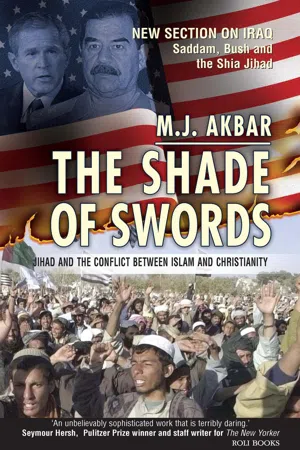
The Shade of Swords: M.J. Akbar writes the first cohesive history of jihad. From the Prophet Muhammed to the presence of British and American troops in Afghanistan, and more recently in Iraq, Akbar shows how jihad's origins lie in the earliest consciousness of Muslims, how it thrives on complex notions of persecution, victory and sacrifice. Jihad pervades the mind and soul of Islam. This book reveals its strength and significance, and this jihad has come to Iraq in a new Shia dimension.
- 404 pages
- English
- ePUB (mobile friendly)
- Available on iOS & Android
eBook - ePub
The Shade of Swords: Jihad and the Conflict between Islam and Christianity
About this book
Trusted by 375,005 students
Access to over 1.5 million titles for a fair monthly price.
Study more efficiently using our study tools.
Information
1
Chapter and Verse
Narrated Abdullah bin Abi Aufa: Allah’s Messenger (May Peace Be Upon Him) said, ‘Know that Paradise is under the shade of swords’.
[From the Book of Jihad in Sahih al Bukhari]
[From the Book of Jihad in Sahih al Bukhari]
In the beginning was a miracle and the miracle was a word: iqra. Read. Read, said the angel of God, Gabriel, and the illiterate Muhammad began to read the word of God out to the world in an enchanting prose that was later compiled and called the Holy Quran.
Islam was twice-born. The Christian calendar begins with the birth of Jesus, but the Muslim calendar begins its journey not from the birth of the Prophet, or the day of the revelation, but from the moment of survival, the Hejira, or the migration of the Prophet from Mecca to Medina along with his devoted companion Abu Bakr, a friend who also became a father-in-law when the Prophet married Aisha.
The Quraysh, his tribe, persecuted the Prophet when he announced his revelation; and when he sought refuge in Yathrib, soon to become famous as Medina, they wanted the life of this kinsman who promised to destroy idol worship in the Kaaba and thereby hurt the lucrative benefits of the pilgrimage. The Quraysh sent an army, between 900 and a thousand strong, led by their best nobles, to, in the words of the most formidable Muslim-baiter, Abu Jahl (nicknamed by Muslims as the Father of Folly), ‘destroy . . . him that more than any of us hath cut the ties of kinship and wrought that which is not approved’. The Muslims, some 300 strong, took position at the well of Badr, blocking the water from the advancing Quraysh. Battle was joined on the 17th day of Ramadan, and some indication of the apostle’s anxiety is evident in this story. As he prayed to Allah, the Prophet cried out: ‘Oh Allah, if this band of Muslims perish today Thou will not be worshipped any more’. Muhammad then slumbered, and when he awoke he was reassured for he had seen Gabriel holding ‘the rein of a horse and leading it. The dust is upon his front teeth’ (the quotations here are from The Life of Muhammad, A Translation of Ishaq’s Sirat Rasul Allah, ed. by A. Guillaume, Oxford, 1955). After victory, Muslim soldiers insisted that angels, in white turbans, had come to their aid in a battle in which they were heavily outnumbered; believers to this day are convinced they will receive Allah’s help in the midst of battle. Stories of Badr are part of the Islamic inspiration.
The spirit of jihad entered Islam at Badr. It is a spirit that inspires among believers a heroism beyond the bounds of reason; equally, it inspires dread among those outside the fold of Allah. Its root lies in the Arabic jahd, meaning exertion or striving. Its resonance comes from the nature of this strife: jihad is the holy war, the war of righteousness, the struggle against tyranny. It is a passion indifferent to the fate of battle because the jihadi wins either way: in the long run, the war will be won; and in the short run, death will bring martyrdom and paradise. Simultaneously, the strife is also to cleanse one’s soul, for no martyrdom is possible without that inner purity.
The greater of the two kinds of jihad, the Jihad al Akbar, is the war against the enemy within; against one’s own weakness and wandering. It is the Jihad al Asghar, or the lesser jihad, that is fought on the battlefield.
Islam, as the word itself implies, does not seek violence. Equally, Islam does not permit meek surrender either. There are circumstances in which all Muslims are commanded to fight to defend their faith. In such times war becomes a duty, and those who shirk it are condemned by the Quran. It may only be a lesser jihad, but for some twelve hundred years only a comparative handful of infidel armies emerged from the lesser jihad either with their pride or their power intact.
The success of Muslim arms has been phenomenal. The beginning was astounding. Within just two years of the Prophet’s death, during which insurrections of the apostates had also to be met, the armies of Islam had challenged and defeated the drilled, disciplined, and superbly armed forces of the two great powers of the age, the Persians to the east and the Byzantines to the north and west. Within two generations, armies chanting jihad had marched from Medina to Jerusalem, Damascus, Antioch, Alleppo, and further north into the body of the Byzantine empire; in the east to Qadisiyya and Madain, which stored the wealth of the Sassanids, and from there to Nehawand, Hamadan, and up to the Caspian. A detour took them to Basra and Isfahan, whence to Nishapur and the Amu Darya (Oxus) in Central Asia, a flank turning towards Afghanistan and another march taking them to Sind and the Indus valley on the Indian subcontinent. To the south they reached Fustat and Alexandria in Egypt, opening the door to the Maghreb through which they raced across to reach the shores of the Atlantic at Ceuta where, searching for fresh worlds to conquer, they eventually crossed to Jabel Tariq (Gibraltar) and then on to Cordoba, Toledo, and Sargossa to establish a glittering empire that would merge east and west for seven hundred memorable years.
The sheer excitement of this achievement, however, has tended to eclipse a basic impulse of the Muslim mindset. Jihad is not a sanction to empire-building, though empires did emerge in its wake. The most powerful manifestation of jihad is not when all is won, but when all seems lost: that is the spirit of Badr.
The political consciousness of Muslims is heavily influenced by the inheritance of a powerful history. A community spread across so much geography and through so many cultures is not going to display monotonous uniformity in its responses, but there is a point at which the community unites more readily than any other. This might be called the Medina Syndrome. It is the belief that Islam and Muslims are under threat from powerful enemies, and that the only answer is unity, faith, and war.
Once it was the Quraysh. Now it is the Christian West, a conclusion that has formed over a millennium, from the days of the ‘Franj’ in Palestine. The argument that ‘Christian’ as an adjective is misplaced generally falls on stone. A remark such as the one made by President George Bush in the aftermath of the attack on the World Trade Centre and the Pentagon on 11 September 2001, promising a crusade against Osama bin Laden; or a speech by the Italian Prime Minister Silvio Berlusconi describing Christianity as a more civilized religion than Islam is sufficient to persuade the unconvinced. The frustration of loss and the memory of green standards that once commanded the heights of political power plays its part.
All empires rise and fall, but the Muslim believes in a three-phase cycle: rise, fall, and renewal. Since an empire is the achievement of man, corruption is inevitable. The Prophet foresaw this when he said that the best Muslims were those of his generation, and that each successive generation would see progressive decline. He understood the ability of power to corrupt, hence his notable dictum: the closer you are to government, the further you are from God.
The lean warrior who conquered a kingdom was bound to change into the obese ruler. The fifth caliph, who seized power after Islam’s first civil war, and must not be seen on the same page as the venerable first four (Hazrats Abu Bakr, Omar, Usman, and Ali), became so fat that by the time he died in 680 he was unable to climb to the pulpit during prayers.
The answer was not capitulation before an infidel, but a continuing moral renaissance from which would emerge the next stage of political success. The Prophet promised in the Sunna the appearance of a true imam (the al-Mahdi) – according to one tradition, he would appear every hundred years – who would restore the glory of power through the purity of faith and a return to those first principles that had made Islam into a world presence within a single lifetime. To understand Islam today, we need to understand that beginning.
Treat it if you like as only a poetic truth, but Muslim historians record that on the night that Muhammad was born, the palace of Khusrau, king of the Persians, shook, fourteen of its turrets collapsed, the fire of the Zoroastrians died out, and the lake Sawah sank. Reality would make this prophetic. Persia would become Muslim and the Zoroastrians survive in exile, largely in India. That however was still many travails into the future.
The tradition of divine blessing is strong. Inevitably, there were variations, but one will serve the immediate purpose. Abdullah, Muhammad’s father, was walking by the house of the scholar Waraqah ibn Nawfal, along with his father, Abd al-Muttalib ibn Hisham, when Waraqah’s sister, Quotila, called out to him to marry her. Waraqah was a hanif, a person who accepted monotheism but was neither a Christian nor a Jew. She offered him a hundred camels, but Abdullah would not disobey his father and went with him to the house of Wahb ibn Abdi Manaf, where he was married to Manaf’s daughter Amina. He spent three days with his new bride, during which time Muhammad was conceived. On his way back Abdullah met Quotila again, and asked if her proposition still stood. Her reply was crisp: No. There had been a light on his face three days ago and someone had taken it away. She had wanted to be the mother of this child who would be the future Prophet.
Muhammad was not destined to enjoy the love of his parents for very long. His father died two months before he was born, on a journey to a city, Yathrib, that would also become his refuge, and his mother when he was about six. His grandfather Abd al Muttalib doted on him, but could not, obviously, substitute for a mother. Although the family belonged to the Quraysh nobility, they were not very well off. But Muhammad’s natural talents soon began to draw attention.
His intelligence and integrity won early recognition. At a relatively young age, for instance, he was selected to arbitrate on a dispute that could have sparked off yet another round of bloodshed between the traditionally fractious tribes. The Kaaba is the great symbol of Islam. Believers everywhere turn to this cube-shaped structure at the centre of the mosque in Mecca to pray five or more times a day. Tradition has it that Adam (the Quran calls both Adam and David khalifahs or caliphs of God) built it at the exact spot on earth directly below the perfect Kaaba in Heaven. Destroyed in the Noah flood, it was rebuilt by Abraham with the help of his son Ishmael from the stones of five mountains, Sinai, al Judi, Hira, Olivet, and Lebanon. Searching for a stone to mark one corner, Ishmael met the angel Gabriel who gave him the famous black stone inside the Kaaba. According to a tradition, the Prophet said that when the stone came from paradise it was whiter than milk, but it had now become black from the sins of those who had touched it.
The Kaaba had fallen into the hands of those who had rejected the Lord God of Abraham.
The man who introduced idolatry into the Kaaba is said to be Amr ibn Luhaiy, who brought the image of Hubal from Mesopotamia and placed it there. The Quraysh now controlled the Kaaba and its revenues; Muhammad’s own grandfather was custodian of the Sacred House when it was decided to raise the structure. When the black stone was to be restored to its original place, each tribe was ready to shed blood for the honour of doing so. Muhammad called for a cloak, placed it beneath the stone, and gave a part of the hem to all the tribes. There was peace. They named him al Amin, the one who could be trusted. He was about 35.
His reputation had already brought him to the notice of a rich, twice-married widow of noble ancestry, Khadija bin Khuwaylid. She employed him to oversee her caravans to Syria. He was 25 and she 40 when she sent an emissary, Nafisa bin Munya, to sound out Muhammad on marriage. He agreed, but her father proved a more difficult proposition. Her will prevailed. Muhammad loved Khadija deeply, called her the best of women, and promised that she would live with him in paradise in a house of reeds amidst peace and tranquility. Muhammad of course married again, but only after Khadija passed away. He had three sons, Qasim, Abdullah, and Tahir, but they all died in infancy. His four daughters, Zaynab, Ruqayya, Fatima, and Umm Kulthum lived to normal age. Aisha, the love of the Prophet’s later life, was often envious of Khadija, causing Muhammad to rebuke her. He cherished Khadija, he said, because of her loyalty and love: when others did not believe in him, she had faith in him; when others were afraid to whisper support, she stood like a rock. She was his best companion and the mother of his children. He could not forget the decade of trial when the message of Allah lay in his heart, and the faith of a few was mocked and persecuted by a jeering world.
That message came in a cave about three miles out of Mecca called Hira, to which the Prophet would often retire, sustaining himself with only kaak, which was flour cooked in oil. One night in the month of Ramadan in 611, the angel Gabriel appeared to him in a dream, held out a long silk strip with written letters and said: ‘Read!’ (the word in Arabic is iqra from which ‘Quran’ is derived).
The Prophet replied that he did not know how to read. Gabriel grasped the Prophet so tightly to his breast that he thought he would die. Thrice Gabriel commanded: Read! Finally Muhammad answered, ‘What am I to read?’ Then were revealed the first verses of the Holy Quran, Surah 96, 1–5: ‘Proclaim! (or Read!) In the name of thy Lord and Cherisher who created man out of a [mere] clot of congealed blood. Proclaim! And thy Lord is Most Bountiful. He who taught [the use of] the pen taught man that which he knew not.’ As Maxime Rodinson (Mohammed, Penguin, 1971) puts it: ‘The Voice said three words in Arabic which were to shake the world: “You are the messenger of God”.’
As he turned towards home, the Prophet began to shiver. He sank his face into his wife’s lap and narrated his experience. She realized that the moment had arrived. She comforted her husband and then called on the scholar Waraqah, whose sister had once wooed the Prophet’s father Abdullah because she had seen a special light on his brow. Blind with too much reading, old and infirm, Waraqah asked to be led to the Prophet’s presence. He said, perhaps with a sense of foreboding: ‘I should like to be in the land of the living when your fellow men send you into exile!’
That exile, and worse, including a plot to assassinate him, would come within a decade. A revelation of peace had launched Islam; the hard steel of war would be necessary to protect it.
Allah did not send His message and then leave the Prophet to his own devices; it was an active and interventionist Allah who gave continuing guidance on matters both strategic and personal, spiritual and temporal. That first decade was the darkest in the history of Islam, and sustenance for the small community came from the verses of the Quran, as in Surah 93: ‘Thy Guardian-Lord hath not forsaken thee nor is He displeased.’ That period has a particular significance today, for crisis and the urge to despair is once again the lot of Muslims. (Quotations from the Quran are from the translation by Abdullah Yusuf Ali, published by Amana Corporation, 1989.)
A wife, a cousin, a companion, and a freed slave were the first four converts to Islam. Khadija was the first. The second was a ten-year-old boy, Ali, who would grow up to become the foremost warrior of the faith, the Lion of God. The third was Abu Bakr, who would deny the succession to Ali, who was praised by the Prophet for his purity and known as Siddiq, and who would be the Prophet’s only companion during the emigration. The fourth was a freed man, Zayd. This however was obviously family, or close to it. The first arc of expansion brought in the idealistic young or those who were discriminated against and searching for social justice. Among the most famous was Bilal, an African slave, who was bought and freed by Abu Bakr and who became a cult figure. It was however only a trickle, and the Quraysh restricted their anger to ridicule. Abu Talib, the Prophet’s uncle, loved him deeply, and gave him valuable protection, but did not become a Muslim. Another uncle, Abdul Uzza, nicknamed Abu Lahb or father of the flame, was the opposite: he hated the Prophet and the faith.
Matters reached a crisis point when Abu Lahb persuaded enough of the leaders of the Quraysh that they must physically eliminate Muhammad. A scheme was devised to clear the principal hurdle to assassination, the fear that his clan would extract reparation. One member of every clan in the conspiracy would plunge a dagger, making it difficult for Muhammad’s people to confront everyone. The Prophet had prepared for the worst. He had made enquiries about a possible move to Taif, but there too encountered hostility. He decided finally on Yathrib, some 200 miles from Mecca, called Medina, or the city. Three tribes of Jews lived in it, the Qurayza, the Nadir, and the Qayqune. The two dominant Arab tribes were the Aws and the Khazraj. When negotiations were successful the Prophet asked Muslims to precede him to Medina and await his arrival.
His own emigration was full of drama. Abu Jahl was at the door, waiting to ambush Muhammad as he came out, but he fell asleep. The Prophet left Ali on his own bed, the latter’s face covered, to buy some time. Furious, the Quraysh offered a hundred she camels to anyone who could overtake Muhammad and Abu Bakr. They had not, in fact, gone very far: they had a rendezvous with a guide at a deserted cave in Jabal Saur. Abu Jahl was part of the group that followed the tracks up to this cave, but they found a shrub had risen, a pair of wild pigeons had built a nest, and a spider had spun a web across the mouth of the cave. They turned away. The Prophet took a route towards the Red Sea coast and then north, cutting across the main road to Medina.
It was a Jew who sighted him at noon near Medina on the twelfth day of Rabiul Awwal, a Monday, at the foot of a solitary palm tree near an oasis called Quba. On Friday the Prophet entered the city to a tumultuous welcome; and the first mosque was built in Medina where his camel halted of her own will.
It was at Medina that the believers began to organize themselves as a community. It was here that the practices that still symbolize the faith were laid down. The Muslims were commanded to turn to prayer towards the Kaaba rather than Jerusalem. The Prophet used to fast three days a month: Ramadan was declared a full month of fasting: ‘And eat and drink until the white thread of dawn appear to you distinct from its black thread; and then complete your fast till the night appears.’
‘To th...
Table of contents
- Cover
- About the Book
- Book Name
- Title
- Copyright
- Contents
- Dedication
- Acknowledgements
- Preface
- Introduction
- 1 Chapter and Verse
- 2 The Joys of Death: A Bargain with Allah
- 3 Rebellions in the Dark of the Night
- 4 A Map of Islam
- 5 Circle of Hell
- 6 Allah! Muhammad! Saladin!
- 7 The Doors of Europe
- 8 Jihad in the East: A Crescent Over Delhi
- 9 The Holy Sea: Pepper and Power
- 10 The Bargain Goes Sour
- 11 The Wedge and the Gate
- 12 History as Anger, Jihad as Non-violence
- 13 Islam in Danger Zone
- 14 Jinnah Redux and the Age of Osama
- Glossary
- A Suggested Reading List
- Thumbnail Sketches
- A Relevant Calendar
- Backcover
Frequently asked questions
Yes, you can cancel anytime from the Subscription tab in your account settings on the Perlego website. Your subscription will stay active until the end of your current billing period. Learn how to cancel your subscription
No, books cannot be downloaded as external files, such as PDFs, for use outside of Perlego. However, you can download books within the Perlego app for offline reading on mobile or tablet. Learn how to download books offline
Perlego offers two plans: Essential and Complete
- Essential is ideal for learners and professionals who enjoy exploring a wide range of subjects. Access the Essential Library with 800,000+ trusted titles and best-sellers across business, personal growth, and the humanities. Includes unlimited reading time and Standard Read Aloud voice.
- Complete: Perfect for advanced learners and researchers needing full, unrestricted access. Unlock 1.5M+ books across hundreds of subjects, including academic and specialized titles. The Complete Plan also includes advanced features like Premium Read Aloud and Research Assistant.
We are an online textbook subscription service, where you can get access to an entire online library for less than the price of a single book per month. With over 1.5 million books across 990+ topics, we’ve got you covered! Learn about our mission
Look out for the read-aloud symbol on your next book to see if you can listen to it. The read-aloud tool reads text aloud for you, highlighting the text as it is being read. You can pause it, speed it up and slow it down. Learn more about Read Aloud
Yes! You can use the Perlego app on both iOS and Android devices to read anytime, anywhere — even offline. Perfect for commutes or when you’re on the go.
Please note we cannot support devices running on iOS 13 and Android 7 or earlier. Learn more about using the app
Please note we cannot support devices running on iOS 13 and Android 7 or earlier. Learn more about using the app
Yes, you can access The Shade of Swords: Jihad and the Conflict between Islam and Christianity by M.J. Akbar in PDF and/or ePUB format, as well as other popular books in Politics & International Relations & Terrorism. We have over 1.5 million books available in our catalogue for you to explore.