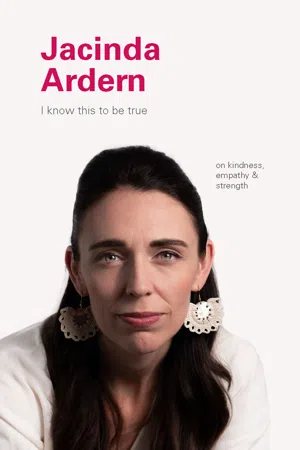
I Know This to Be True: Jacinda Ardern is an interview with politician, feminist, and champion for social equality Jacinda Ardern.
As the fortieth prime minister of New Zealand, Ardern epitomizes the modern leader.
This landmark interview series offers encouragement and guidance to graduates, future leaders, and anyone hoping to make a positive impact on the world.
• Part of the landmark book series that brims with messages of leadership, courage, compassion, and hope
• Created in collaboration with the Nelson Mandela Foundation
Inspired by Nelson Mandela's legacy, I Know This to Be True is a global series of books created to spark a new generation of leaders.
The series is a collection of extraordinary figures from diverse backgrounds answering the same questions, as well as sharing their compelling stories, guiding ideals, and insightful wisdom.
• A lovely ebook with vivid photographic portraits throughout
• Royalties from sales of the series support the free distribution of material from the series to the world's developing economy countries
• You'll love this book if you love books like Make Your Bed: Little Things That Can Change Your Life . . . And Maybe the World by Admiral William H. McRaven; In the Company of Women: Inspiration and Advice from over 100 Makers, Artists, and Entrepreneurs by Grace Bonney; and Great Thinkers: Simple Tools From Sixty Great Thinkers To Improve Your Life Today by The School Of Life.
- 84 pages
- English
- ePUB (mobile friendly)
- Available on iOS & Android
eBook - ePub
I Know This to Be True: Jacinda Ardern
About this book
Information
Topic
Personal DevelopmentSubtopic
Social Science BiographiesThe Interview
Tell us a little about yourself.
My name is Jacinda Ardern and I’m the prime minister of New Zealand. And I’m the third female prime minister, the second youngest, and the youngest female prime minister.
What really matters to you, particularly in your role as a leader?
People drive everything that I do, everything that I’ve ever been motivated to do and I think that even when you’ve got some of the most challenging, difficult problems or you’re looking to take on the most challenging or difficult roles, if it’s all centred around the thing that motivates you the most in the world, then you’ll be surprised what you can do and what you can overcome. So, for me, the fact that I do a job that is so centred on people, that’s what keeps me going.
What were the seeds of that? Did you have a particular ambition or aspiration as a young person? Where did this idea about caring about other people come from?
I just can always remember being a pretty angsty child. I worried about people around me; I noticed if children around me didn’t have what I had; I’ve very clear memories of living in a very small town in New Zealand that went through a pretty tough period, and my dad was the local policeman there. So we moved to this little town of 3,000 people and I vividly remember when kids didn’t have food to eat at school. I remember walking home one day and seeing a little boy in the middle of winter who just didn’t have any shoes. And things like that really raised so many questions for me, so I think in large part it was just part of who I was, but otherwise I also learned a huge amount from my parents. To this day people ask me who my role models are and of all of the world leaders that I could possibly choose, I still choose my mother and my father. My mother was just, for me, the epitome of kindness; if she saw anyone in need around us she’d be the first person to bake a casserole or whip up a cake. That was just the kind of person she was. So, in part, I probably got that angstiness from her.
Has there been a special individual or individuals that have particularly inspired you by their example or wisdom?
Yes, yes, yes! I’ve always been fascinated by people who endure, you know? Who, instead of choosing an easier road with their lives, choose to take on these enormous challenges, and it’s why I think people like Nelson Mandela, but also people like Ernest Shackleton, who just choose to take that path less travelled, and even though it comes with such adversity, keep going and bring people with them. That for me is incredible.
You were seventeen when you joined the Labour Party?
Yes, I joined a political party when I was a teenager and for me it wasn’t because I thought a life in politics was for me. Absolutely no! In fact, if anything, I thought it looked like a very hard life. It was because I was one of those young people that thought I’d like to change the world, even if it was in the smallest of ways, it just felt like I was doing something that would make a difference. So, in amongst my job of working at a supermarket as a check-out girl, I wanted something that felt a bit more meaningful, and even if that was just delivering flyers, or knocking on doors, that was enough for me to make me feel like I was doing something useful. So I probably could have joined a political party a lot earlier than that! But, you know, it set me on a path I didn’t expect.
At seventeen did you imagine ever that you would become prime minister?
Until the day before I became prime minister I couldn’t have imagined becoming prime minister! And in part that’s because I’m a New Zealander and we are naturally quite a self-deprecating people, and part, if I’m honest, it’s probably because I’m also a women who looks more quickly at my deficits; the things that I’m not good at, rather than what I am. But either way, I never would have imagined as a child that I would end up doing a role like this, because I grew up in a very small town, and there are one hundred and twenty MPs (members of Parliament) in New Zealand. How could I possibly imagine being one of them?
You’ve become an internationally famous person, a role model for many around the world, but it was just over three years ago that the then-leader of the Labour Party called you into his office and said, ‘I don’t think I can get there,’ and said that he wanted to place his trust in you. I remember that first press conference . . .
So do I!
. . . the impact you made, and the authority and confidence you brought to that moment. I think many people around New Zealand felt that perhaps you didn’t have enough experience, or that you were too young. What gave you the confidence to suddenly step forward?
You’re absolutely right. It was my birthday when the leader of the political party that I was then deputy leader of, said to me, ‘I don’t think I can get the numbers up in order for us to win the election.’v It was seven weeks away and I remember being absolutely adamant [saying], ‘You have to stay.’ I thought we needed to be consistent and that people wouldn’t appreciate us losing a leader so close to an election, but he’d made his mind up. And at that point I thought, ‘Well, he’s decided, now I just need to get on with it.’ There wasn’t a question in my mind that now I had a job to do and that I could do it. You know it’s one thing to not be able to necessarily imagine yourself in that position, but when you’re there you’re just actually thinking, ‘Right, there’s no time for me to second-guess myself now, people don’t need to hear me question anything right now, they just need to know, and hear me say, “I can.”’ And so, in that moment, I absolutely knew I could and so it was just a matter of going out there an...
Table of contents
- Cover
- Title
- Dedication
- Copyright
- Introduction
- Prologue
- The Interview
- Epilogue
- About Jacinda Ardern
- About the Project
- The People Behind the Project
- About Nelson Mandela
- About the Nelson Mandela Foundation
- Notes, Sources and Permissions
- Chronicle Ebooks
Trusted by 375,005 students
Access to over 1.5 million titles for a fair monthly price.
Study more efficiently using our study tools.
Frequently asked questions
Yes, you can cancel anytime from the Subscription tab in your account settings on the Perlego website. Your subscription will stay active until the end of your current billing period. Learn how to cancel your subscription
No, books cannot be downloaded as external files, such as PDFs, for use outside of Perlego. However, you can download books within the Perlego app for offline reading on mobile or tablet. Learn how to download books offline
Perlego offers two plans: Essential and Complete
- Essential is ideal for learners and professionals who enjoy exploring a wide range of subjects. Access the Essential Library with 800,000+ trusted titles and best-sellers across business, personal growth, and the humanities. Includes unlimited reading time and Standard Read Aloud voice.
- Complete: Perfect for advanced learners and researchers needing full, unrestricted access. Unlock 1.5M+ books across hundreds of subjects, including academic and specialized titles. The Complete Plan also includes advanced features like Premium Read Aloud and Research Assistant.
We are an online textbook subscription service, where you can get access to an entire online library for less than the price of a single book per month. With over 1.5 million books across 990+ topics, we’ve got you covered! Learn about our mission
Look out for the read-aloud symbol on your next book to see if you can listen to it. The read-aloud tool reads text aloud for you, highlighting the text as it is being read. You can pause it, speed it up and slow it down. Learn more about Read Aloud
Yes! You can use the Perlego app on both iOS and Android devices to read anytime, anywhere — even offline. Perfect for commutes or when you’re on the go.
Please note we cannot support devices running on iOS 13 and Android 7 or earlier. Learn more about using the app
Please note we cannot support devices running on iOS 13 and Android 7 or earlier. Learn more about using the app
Yes, you can access I Know This to Be True: Jacinda Ardern by Geoff Blackwell,Ruth Hobday in PDF and/or ePUB format, as well as other popular books in Personal Development & Social Science Biographies. We have over 1.5 million books available in our catalogue for you to explore.