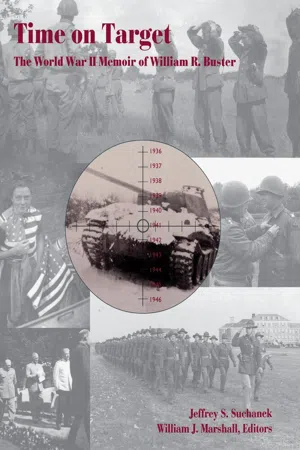
- 176 pages
- English
- ePUB (mobile friendly)
- Available on iOS & Android
eBook - ePub
Trusted by 375,005 students
Access to over 1.5 million titles for a fair monthly price.
Study more efficiently using our study tools.
Information
CHAPTER ONE: A MILITARY CAREER
William Robaras Buster was born in Mercer County, Kentucky, in 1916 during World War I, “the war to end all wars.” In the same year, the first tanks were employed by the British Army during the Battle of the Somme. This new technology did little to alter the “meat-grinder” nature of the war as French, British, and German casualties amounted to over one million in just this one battle. The Treaty of Versailles, which officially ended the tragic conflict in 1919, coupled with economic depression and the shame of defeat, sowed the seeds for a second conflict and eventually led to the rise of a new Reich led by a megalomaniac named Adolf Hitler.
These events had little effect in small towns or in rural areas like Mercer County, Kentucky. Influenced by an uncle, a veteran of “The Great War,” who raised him, William Buster prepared himself for a military career from an early age. While in high school he attempted to join a newly formed National Guard unit, but was refused because of his age. Following a year at Centre College, he attended a school which prepared young men for service-academy entrance examinations. In 1935, after failing to pass the Naval Academy physical, Buster accepted an appointment to the United States Military Academy at West Point, New York.
I trace my roots to Harrodsburg, one of Kentucky’s most historic towns. In October 1916, my father and mother, John Buster and Martha Lillard Nooe Buster, moved their family into Harrodsburg, the oldest town west of the Alleghenies, from their farm near Burgin, Kentucky. Since a disastrous flu epidemic had struck Mercer County the year before, my father took the advice of his brother-in-law and family doctor, Dr. John Robards, and moved his pregnant wife and three sons to a comfortable brick house on Hillcrest Avenue adjacent to Clay Hill, the birthplace of Beriah Magoffin, one of Kentucky’s Civil War governors. They found living more convenient and the doctor closer in Harrodsburg.
The Buster family first came to Kentucky from Virginia, where in 1720 they had been among the early settlers of Goochland County, now Albemarle, near Charlottesville. Several generations later part of the family migrated down the Cumberland River to Wayne County, Kentucky, arriving about 1800. One of them was a surveyor and helped General Joshua Jones lay out the town of Monticello, Kentucky. My paternal grandparents, Nimrod and Sally Buster, moved to Boyle County in 1873. He owned a considerable amount of land about three miles north of Danville. My father owned part of that land until his death, and then my older brother Jack bought it.
The Lillards on my mother’s side of the family trace their ancestry back to France in the 1600s. Captain John Lillard married Susanna Ball, a cousin of Martha Washington, and fought with the Virginia Militia under the command of George Washington during the American Revolution. Following the war, Captain Lillard moved from Culpeper County, Virginia, to the Kentucky Territory and settled in the vicinity of Harrodsburg.
His great-great-granddaughter, my mother, Martha Lillard Nooe, grew up known as “Mattie” by family and friends. Her father was John Augustus Nooe, a prominent farmer in Mercer County. He was a graduate of the old Kentucky University, a forerunner of Transylvania University, and one of the founders of the school system in Burgin. The Nooes came to Kentucky sometime in the early 1800s and lived in Jessamine County. The old Nooe homestead was located on the Lexington-Harrodsburg road. The house is still there and the Nooe family cemetery is behind it. My mother died of edema, or “dropsy” as it was called then, when I was eighteen months old, and I did not have much contact with her side of the family thereafter.
It was into this lineage that I was born on 10 October 1916, the youngest of four boys. My oldest brother was Nimrod Shelby Buster, the next was John “Jack” Ingram Buster, and the third was Granville Robards Buster. I was christened William Lillard Buster, and after my mother’s death I lived with my aunt and uncle, Dr. John B. and Emma Robards. They had no children of their own, and since my father already had three sons to raise, they agreed to take me in upon the death of my mother. Growing up as I did practically as their son, I became so closely associated with them from an early age that, more often than not, many people called me by their name. Eventually I adopted their name as my middle name and had it changed legally.
My father’s farm was located on the Buster Pike between Burgin and Danville. I adored my father. He was a great man and really one of the fairest and finest people I’ve ever known. He was a tobacco and livestock farmer. Even though I lived with my aunt and uncle, I saw him all the time because his farm was just four miles outside of Harrodsburg. My father served as sheriff of Mercer County and worked in the sheriff’s office for a total of sixteen years. Back in those days and up until just recently, the sheriff couldn’t serve consecutive terms of office, so my father was the High Sheriff for four years and then one of his deputies would take the office for the next four and my father would be his deputy. They maintained the line of succession to the sheriff’s office in this way, which was very effective, but in reality my father ran the office the whole time.
My aunt and uncle built a brick house on College Street in Harrodsburg. We moved into that when I was four or five years old and lived there until 1927. While the new house was being completed we lived at historic “Diamond Point,” a lovely old house that guarded the northern approach to Harrodsburg and is located where the road divides to become North Main and College Streets. I lived with my aunt and uncle on College Street until I went to West Point. My uncle, a country doctor and a good one, had a wide practice. I spent many hours going on calls with him, and later when I was old enough to drive, fourteen or fifteen years old, sometimes he would root me out of bed in the middle of the night to drive him to his emergency calls. If it was an obstetric case, sometimes that meant waiting for hours in the car while he was attending to the patient inside the home. Much of his medical practice consisted of home visits. The local hospital was used only for very serious cases. Many of his cases were old patients with minor illnesses. Of course, some were hypochondriacs, and they would call when there wasn’t anything wrong with them. They just wanted him to come out and visit, and most of the time he would go.
With my uncle being a doctor we lived comfortably, but we felt the Depression like everyone else. Many of his patients would pay him in vegetables and produce, and many others just couldn’t pay at all. When he died in 1938, the amount that people owed him totaled thousands of dollars. Although Harrodsburg was fairly insulated from extreme want, I also remember the severe drought of 1930. I don’t think agricultural communities suffered nearly as much during the Depression as the urban areas. It didn’t change lives a great deal in Mercer County, but I do remember one instance that was rather horrifying. After the stock market crash in 1929, when the banks closed, Bush W. Allen, the president of the Mercer County National Bank and one of the community’s leaders, committed suicide. That was our family’s bank and he was a family friend, so that was a blow to everyone. But even though we felt the stress and strain of the Depression, we lived comfortably compared to other people. Everyone felt that the hard times were just something you had to live through and that economic conditions would eventually improve. If the tobacco farmers had a good crop, although prices were low, that movement of money, which was very unusual then, was encouraging.
Both my father and my uncle were leaders in the Democratic Party in Mercer County. That was back in the days when the feeling between Democrats and Republicans ran pretty strong. Mercer County was a Democratic community. I think people exercise their judgment a lot more now than they did in those days. Party affiliation was much more important at that time than it is now. My uncle ran for the state legislature and served a term in the state senate. He was a great political opponent of John Young Brown Sr., although they were friends otherwise. He was a great favorite among the legislators and had a fair amount of influence. I can remember helping him during his campaigns. I would go house to house and knock on doors and introduce myself and hand out cards and tell people, “Please vote for Dr. Robards.” Since many people owed my uncle money for services rendered, I don’t think it was too difficult a job for me! While I don’t know whether I helped him or not, I disliked doing it. Campaigning was always very distasteful to me.
I spent the year 1925 in Florida. That was during the real estate boom, and Dr. Robards decided that he was going to get involved in the real estate business. We were there until the boom became a bust and my uncle decided to return to Kentucky. I didn’t enjoy Florida. The place we initially rented while we were building a house was rather cramped. Once we got into our own house conditions improved. But I remember that everything in Florida was crowded. The school system was vastly overloaded. They had to have double classroom sessions. I would go to school from eight o’clock to twelve, and then there would be another group of students who would arrive and would stay until four o’clock. I didn’t make any close friends there. It was another interesting experience for me, though, and I did enjoy the visits we made to Clearwater Beach and Tarpon Springs.
Back home in Kentucky I attended the Harrodsburg public schools, which were excellent. I felt like I received a good education. The teachers were excellent and although I was not always a good student, I received good grades. I didn’t work as hard as I should have, yet I ranked near the top of my class. I guess I absorbed information quickly, but I certainly didn’t tax myself. In high school my favorite subject was geometry. I also liked history and the sciences. I did not like foreign languages. I had no problems with English, but it was not a favorite subject.
After graduating from high school, I entered Centre College in the fall of 1934. I had determined to try for one of the service academies, and in those days a year of satisfactory college work precluded the need to take an entrance exam. Also a year of college was good preparation. In addition to the college work, I also felt I needed some extra preparation for what I thought would be an appointment to the Naval Academy at Annapolis, Maryland. I took additional instruction at the Kavanaugh Academy in Lawrenceburg, which offered a night course to instruct those students who thought that they might like to attend one of the military schools.
Rhoda Kavanaugh, the principal, was a real character. Kavanaugh was the name of the school established by her family, which had been chosen to be a county high school. But she also had some special students who came to her for preparation for Annapolis or West Point. These students lived at the school and were called “house boys.” They were instructed in the evenings as well as in the daytime. She had a study hall in the evening that she supervised. She would sit there in her long black dress, rocking back and forth in a chair by an old potbellied stove. If anybody lifted their head from their book, she would crack down on them either verbally or with the cane she always carried. She was tough, but I also remember that she had a wonderful sense of humor.
I went there to sharpen my ability in algebra and to learn what to expect at the academy. She would give us assignments and if we had questions she was there to help. We would go over the military academies’ previous year’s entrance exams and work the problems so that we became familiar with the system. The entrance exams were printed and distributed by the Government Printing Office and were available by request. Kavanaugh had been requesting the entrance exams for years and had prepared a number of students who went on to become admirals. Admiral Edmund Tyler Wooldridge (Class of 1920), Vice Admiral Charles K. Duncan (Class of 1933), and Rear Admirals John Huston Brady (Class of 1923), Rhodam Yarrott McElroy (Class of 1935), Andrew Irwin McKee (Class of 1917), Logan McKee (Class of 1921), and Elliott West Shanklin (Class of 1924) all had attended the Kavanaugh Academy to help prepare them for Annapolis. Two other attendees of the Kavanaugh Academy went on to West Point and later became generals: William Breckinridge, who later was one of my instructors at the Military Academy, and me. Most of the “house boys” who attended the Kavanaugh Academy were trying to get into the Naval Academy, although the entrance requirements were the same as those for West Point.
My uncle had served in World War I in the Medical Corps and was very interested in the Army and a military career for me. It was his influence more than anything else that put the idea of a military career in my mind, and I worked toward that goal. While I was still in high school the Harrodsburg National Guard unit (the one that later endured the Bataan Death March during World War II) was organized. I tried to join but I was too young. I also tried to take some Civilian Military Training Corps courses but, again, I was told I was too young.
My father and my uncle had the right connections to get me an appointment to the Naval Academy. They were great friends of Virgil Chapman, who was the U.S. congressman representing Mercer County. My father handled all of the political patronage in the county for the Democrats, so it was not difficult to get an appointment from Congressman Chapman. Back in those days, anyone who attended either one of the service academies was held in high esteem by his peers and by the people in the community. It was considered quite an achievement to get an appointment. But it took a lot of preparation in order to qualify and stay once you got there. There are many stories of boys from Kentucky who received an appointment only to fail the entrance examination or, once accepted, were dismissed for academic failings later.
I actually had a choice of attending the Naval Academy or West Point, and my first choice, after much deliberation, was the Naval Academy. A great friend of mine, Ralph Kercheval, one of my heroes and a football player for the University of Kentucky, outlined for me on several occasions the advantages of a naval career over that of the Army. He told me that in the Navy I would be able to see the world and wouldn’t have to get dirty. So I chose an appointment to the Naval Academy and reported there on 1 July 1935. I took the physical examination and passed all of it except the color perception test. My color perception was borderline. The doctors were a little unsure whether I was actually color blind, so they gave me four sets of tests, three more than they normally gave. The last test, which involved pinpoints of light at twenty feet with variations in shades of red and green, got me. I flunked that one. So although I qualified academically, I failed the physical.
My uncle had accompanied me to Annapolis for my physical examination. On our way back to Kentucky through Washington we called Congressman Chapman and told him that I had failed the physical at the Naval Academy and that he could give the appointment to someone else. I went home prepared to enjoy the summer before reentering Centre College in the fall. I was home about two weeks when I received a telegram from Congressman Chapman which ordered me to report to the United States Military Academy at West Point on 1 August. It seems Congress had passed an act that expanded the enrollment of the service academies and many of the new slots were still unfilled. Needless to say, I was delighted to have received a second chance, but apprehensive about having to pass another physical examination. When I arrived at the Military Academy, I was greatly relieved to learn that the color perception test was not nearly as stringent as it had been at Annapolis. Besides, I had learned a few tricks from my previous experience, which I will not divulge. So I passed the physical with flying colors and became a cadet.
In all honesty I had not been devastated when I failed the physical at the Naval Academy because the atmosphere there was not what I had expected. I wasn’t expecting brass bands or anything like that, but for me the attitude there was too low key and casual. When you entered the grounds of the Military Academy at West Point, you knew immediately that you were in a military installation and that discipline and orderliness were the orders of the day. That’s what I expected and wanted to be a part of, and I have never been sorry.

Cadet William R. Buster, 1939. “When you entered the grounds of the Military Academy at West Point, you knew immediately that you were in a military installation and that discipline and orderliness were the order of the day. That’s what I expected and wanted to be a part of, and I have never been sorry.”
CHAPTER TWO: THE UNITED STATES MILITARY ACADEMY
The years from 1935 to 1939 were eventful and ominous internationally. In 1935, Italy’s fascist dictator, Benito Mussolini, led that country into war with Ethiopia. In 1936, Germany’s own Nazi dictator, Adolf Hitler, reoccupied the Rhineland and began supplying men and material to the fascist side during the Spanish Civil War. In 1937, Japan and China officially declared war against one another, an event that had been brewing since the Japanese takeover of Manchuria six years earlier. In 1938, Hitler forcibly annexed Austria as a province of Germany and also bullied Czechoslovakia into handing over the Sudetenland.
The political and military developments in Europe prompted the United States Congress to initiate a small buildup of the nation’s armed forces, including the Corps of Cadets at the United States Military Academy at West Point. The Military Academy, not unlike the nation itself, was undergoing great change during the four years (1935-39) that William Buster attended. New academic buildings and cadet living quarters were constructed, and a widely expanded curriculum was initiated to meet changing military technology and tactics. Buster attended West Point during the brief period when upper (first) classmen were allowed to tour military facilities during the summer recess to witness maneuvers and the firing of weapons firsthand. The summer tours, which left hazing of the plebes to underclassmen (yearlings) at Beast Barracks and summer camp, were discontinued in 1939.
Classes that graduated during the late 1930s and early 1940s provided the Army with the junior officers who served during World War II and Korea. Others, like Creighton W. Abrams, Andrew Goodpaster, Bruce Palmer Jr., and William C. Westmoreland, later rose to prominence during the Vietnam War.
Beast Barracks
Henry Riggs Sullivan, a classmate from Centre College, had also received a late appointment to the Military Academy. The two of us rode the train together to West Point and entered the Academy at the same time. We even roomed together for the first year. Riggs had an excellent mind and was a good student and a natural-born leader. I think he had attended summer training in the Marine Corps one summer prior to his Academy appointment, so he was more familiar with the military lexicon and system than I was. He eventually went into the Army Air Corps and, like most people who went into the Air Corps early, advanced up the chain of command very rapidly. After the war he was with the Strategic Air Command for many years. He was one of Curtis LeMay’s fair-haired boys. I think he also became the first Commandant of Cadets at the Air Force Academy when the Air Force split from the Army and became its own service branch.
Riggs and I took the “George Washington” from Lexington, Kentucky, to Grand Central Station. We had to go across the Hudson River on the Weehawken Ferry to get to the West Shore Railroad Station. I recall that the train to West Point rode the tracks along the shore of the Hudson R...
Table of contents
- Cover
- Title Page
- Copyright
- Table of Contents
- Foreword
- Editors’ Preface
- Chapter One: A Military Career
- Chapter Two: The United States Military Academy
- Chapter Three: The Prewar Army
- Chapter Four: North Africa
- Chapter Five: Invasion
- Chapter Six: Operation Cobra—The St. Lo Breakout
- Chapter Seven: The Drive Across France
- Chapter Eight: Battling to Germany
- Chapter Nine: The Ardennes Counteroffensive
- Chapter Ten: Crossing the Roer
- Chapter Eleven: Berlin and Home
- Afterword
- A Final Tribute
- Index
Frequently asked questions
Yes, you can cancel anytime from the Subscription tab in your account settings on the Perlego website. Your subscription will stay active until the end of your current billing period. Learn how to cancel your subscription
No, books cannot be downloaded as external files, such as PDFs, for use outside of Perlego. However, you can download books within the Perlego app for offline reading on mobile or tablet. Learn how to download books offline
Perlego offers two plans: Essential and Complete
- Essential is ideal for learners and professionals who enjoy exploring a wide range of subjects. Access the Essential Library with 800,000+ trusted titles and best-sellers across business, personal growth, and the humanities. Includes unlimited reading time and Standard Read Aloud voice.
- Complete: Perfect for advanced learners and researchers needing full, unrestricted access. Unlock 1.5M+ books across hundreds of subjects, including academic and specialized titles. The Complete Plan also includes advanced features like Premium Read Aloud and Research Assistant.
We are an online textbook subscription service, where you can get access to an entire online library for less than the price of a single book per month. With over 1.5 million books across 990+ topics, we’ve got you covered! Learn about our mission
Look out for the read-aloud symbol on your next book to see if you can listen to it. The read-aloud tool reads text aloud for you, highlighting the text as it is being read. You can pause it, speed it up and slow it down. Learn more about Read Aloud
Yes! You can use the Perlego app on both iOS and Android devices to read anytime, anywhere — even offline. Perfect for commutes or when you’re on the go.
Please note we cannot support devices running on iOS 13 and Android 7 or earlier. Learn more about using the app
Please note we cannot support devices running on iOS 13 and Android 7 or earlier. Learn more about using the app
Yes, you can access Time on Target by William R. Buster in PDF and/or ePUB format, as well as other popular books in History & Historical Biographies. We have over 1.5 million books available in our catalogue for you to explore.