- 365 pages
- English
- PDF
- Available on iOS & Android
About this book
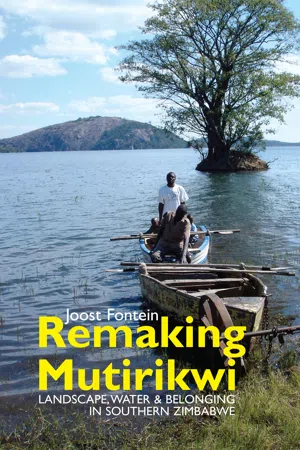
The Mutirikwi river was dammed in the early 1960s to make Zimbabwe's second largest lake. This was a key moment in the Europeanisation of Mutirikwi's landscapes, which had begun with colonial land appropriations in the 1890s. ButAfrican landscapes were not obliterated by the dam. They remained active and affective. At independence in 1980, local clans reasserted ancestral land claims in a wave of squatting around Lake Mutirikwi. They were soon evicted asthe new government asserted control over the remaking of Mutirikwi's landscapes. Amid fast-track land reform in the 2000s, the same people returned again to reclaim the land. Many returned to the graves and ruins of past lives forged in the very substance of the soil, and even incoming war veterans and new farmers appealed to autochthonous knowledge to make safe their resettlements.
This book explores those reoccupations and the complex contests overlandscape, water and belonging they provoked. The 2000s may have heralded a long-delayed re-Africanisation of Lake Mutirikwi, but just as African presence had survived the dam, so white presence remains active and affective through Rhodesian-era discourses, place-names and the materialities of ruined farms, contour ridging and old irrigation schemes.
Through lenses focused on the political materialities of water and land, this book reveals how the remaking of Mutirikwi's landscapes has always been deeply entangled with changing strategies of colonial and postcolonial statecraft. It highlights how the traces of different pasts intertwine in contemporary politics through the active, enduring yet emergent, forms and substances of landscape. Joost Fontein is Director of the British Institute in Eastern Africa and Lecturer in Social Anthropology at the University of Edinburgh. Published in association with the British Institute in Eastern Africa.
Frequently asked questions
- Essential is ideal for learners and professionals who enjoy exploring a wide range of subjects. Access the Essential Library with 800,000+ trusted titles and best-sellers across business, personal growth, and the humanities. Includes unlimited reading time and Standard Read Aloud voice.
- Complete: Perfect for advanced learners and researchers needing full, unrestricted access. Unlock 1.4M+ books across hundreds of subjects, including academic and specialized titles. The Complete Plan also includes advanced features like Premium Read Aloud and Research Assistant.
Please note we cannot support devices running on iOS 13 and Android 7 or earlier. Learn more about using the app.
Information
Table of contents
- Frontcover
- Contents
- Illustrations
- Acknowledgements
- Note on fieldwork, notes & sources
- Glossary
- Acronyms & Abbreviations
- Chronology
- Remaking Mutirikwi: An Introduction
- PART ONE : Remaking Mutirikwi in the 2000s
- PART TWO: Damming Mutirikwi 1940s–1990s
- Epilogue: Remaking Mutirikwi in the late 2000s & early 2010s
- Bibliography
- Index