This book is designed to provide simple, practical and effective answers to the main questions concerning the creation of a well-drafted SEO plan and its working mechanisms. The aim is to offer a simple and practical path, aimed at mastering the subject at work even for those who are not directly involved in the web. Among the topics covered within it, you can find out - how the SEO activity is born and what its mechanisms are;
- how search engines work;
- how to properly organise your website with a view to SEO;
- what are the key points to leverage to get a good indexing;
- what points and structures of the website you need to work on to achieve your goals;
- how to exploit the influence of external sites to improve your site's ranking;
- how to understand when SEO is preferable and when it is better to use pay per click;
- and finally, what mistakes you need to avoid when positioning your site. Within this guide you will find all the information you need to understand how SEO works, what work is normally done by a web positioning expert and how long it takes to get the desired results. At the end of the guide, the reader is offered a small challenge in the form of a self-assessment test, together with some web reference resources to help him or her get started in this area.
eBook - ePub
A simple approach to SEO
How to understand the basics of search engine optimisation in a simple and practical way through a non-specialist discovery path for everyone
- English
- ePUB (mobile friendly)
- Available on iOS & Android
eBook - ePub
A simple approach to SEO
How to understand the basics of search engine optimisation in a simple and practical way through a non-specialist discovery path for everyone
About this book
Information
Topic
BetriebswirtschaftSubtopic
Business allgemein1. What is SEO and how does it come about?
Seo is an acronym for three words: search engine optimisation . The concept can be translated as search engine optimisation.
In a way, we could say that SEO was born when the invention of programmes designed to scan the web for other sites took shape, in order to collect information and organise it in order of importance.
This simple premise can already tell you a lot about the processes involved in SEO and the strategies used by those who build and optimise a site to make it one of the most visited.
In fact, search engines were not the first tools used by Internet users to easily find sites in line with their interests or specific information needs.
In the early days of the web, there were no algorithms capable of acting automatically on the network. For this reason, the selection activity was manual and the main orientation resources were directories, i.e. pages that collected the web addresses present on the network in an orderly and sectorial manner.
In practice, the first directories were the web's yellow pages, in which the sites considered to be the most reliable or the best made on a specific subject were catalogued by hand (and therefore according to simple criteria belonging to personal taste).
In the nineties of the previous century, the first optimisation activities consisted of submitting one's own website to as many directories as possible, hoping that their managers would list it more prominently than that of its competitors.
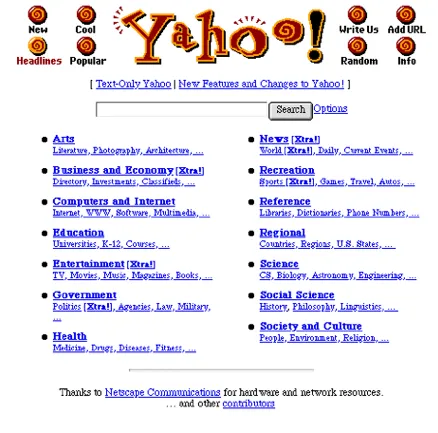
Among the first directories to gain some visibility was Yahoo, a portal founded as a hobby in 1994 by two students from Stanford University. Today Yahoo is one of the many competitors in the search engine market, but during its early years of fame it was considered the real reference for web search.
Yahoo organised the collection and cataloguing of links in a sectoral way, asking the site owners to give a short description and to add some keywords associated with the topics dealt with in the web pages. In 1995, Yahoo's main search page looked like this:
This premise on the history of search engines will come in very handy in the following pages, when we will describe the logical mechanisms according to which these software are commonly programmed.
After a few years, Yahoo began to refine the parameters for the insertion of sites in its directories, guaranteeing their presence within 72 hours of their notification. At the same time, the first 'crawlers' (also called 'spiders' or 'robots') were developed, i.e. software that, on the basis of specific algorithms, was able to automatically scan the web.
Crawlers collect information on the composition of the network, detect the presence of new sites and changes made to already indexed sites, but at least initially they are not very successful. This is both because people a...
Table of contents
- Cover
- A SIMPLE APPROACH TO SEO
- Table of contents
- How this book works
- Introduction
- 1. What is SEO and how does it come about?
- 2. How to organise an SEO activity?
- 3. What are the key elements in SEO?
- 4. How do you create and edit a site for SEO?
- 5. What influence do the links have?
- 6. Better SEO or pay per click?
- 7. What should be avoided in SEO?
- Conclusion
- Self-Assessment Test
- Solutions
- Additional bonus resources
Trusted by 375,005 students
Access to over 1.5 million titles for a fair monthly price.
Study more efficiently using our study tools.
Frequently asked questions
Yes, you can cancel anytime from the Subscription tab in your account settings on the Perlego website. Your subscription will stay active until the end of your current billing period. Learn how to cancel your subscription
No, books cannot be downloaded as external files, such as PDFs, for use outside of Perlego. However, you can download books within the Perlego app for offline reading on mobile or tablet. Learn how to download books offline
Perlego offers two plans: Essential and Complete
- Essential is ideal for learners and professionals who enjoy exploring a wide range of subjects. Access the Essential Library with 800,000+ trusted titles and best-sellers across business, personal growth, and the humanities. Includes unlimited reading time and Standard Read Aloud voice.
- Complete: Perfect for advanced learners and researchers needing full, unrestricted access. Unlock 1.5M+ books across hundreds of subjects, including academic and specialized titles. The Complete Plan also includes advanced features like Premium Read Aloud and Research Assistant.
We are an online textbook subscription service, where you can get access to an entire online library for less than the price of a single book per month. With over 1.5 million books across 990+ topics, we’ve got you covered! Learn about our mission
Look out for the read-aloud symbol on your next book to see if you can listen to it. The read-aloud tool reads text aloud for you, highlighting the text as it is being read. You can pause it, speed it up and slow it down. Learn more about Read Aloud
Yes! You can use the Perlego app on both iOS and Android devices to read anytime, anywhere — even offline. Perfect for commutes or when you’re on the go.
Please note we cannot support devices running on iOS 13 and Android 7 or earlier. Learn more about using the app
Please note we cannot support devices running on iOS 13 and Android 7 or earlier. Learn more about using the app
Yes, you can access A simple approach to SEO by Stefano Calicchio in PDF and/or ePUB format, as well as other popular books in Betriebswirtschaft & Business allgemein. We have over 1.5 million books available in our catalogue for you to explore.